
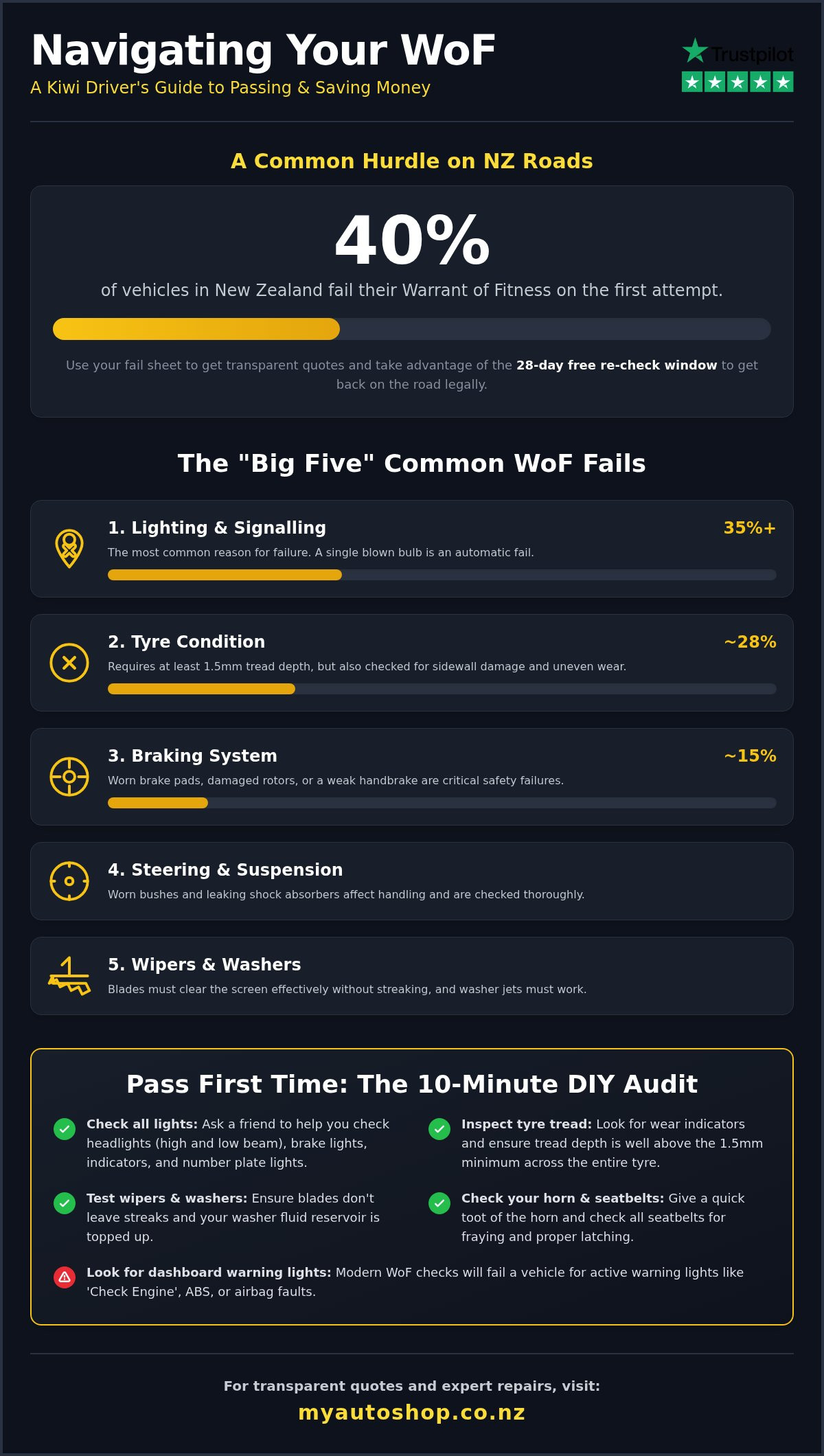
Did you know that roughly 40% of vehicles in New Zealand fail their Warrant of Fitness on the first attempt? It’s a sinking feeling when the inspector hands you a fail sheet, especially when you’re already worried about the wof repair cost nz and how you’ll get around while your car is stuck in the shop. We know that unexpected repair bills and confusing Waka Kotahi safety standards are the last things you need in your busy week.
This guide simplifies the process so you can get that legal sticker as quickly and cheaply as possible. You’ll learn the most common reasons for failures, including lighting and tyre issues, and how to handle them without the stress. We’ll walk you through the 28-day re-check window and help you understand which repairs are actually required for safety. From mobile mechanic fixes for blown bulbs to transparent quotes for brake repairs, we’ve got you covered. Let’s get your car sorted and back on the road with total confidence.
Key Takeaways
- Roughly 40% of Kiwi cars fail their first inspection; learn how to manage the wof repair cost nz by using your fail sheet for transparent quotes.
- Spot the “Big Five” common failure points like tyres and lights early to prevent a simple $5 bulb from turning into a major headache.
- Stay ahead of modern safety standards by understanding how ADAS sensors and dashboard warning lights can trigger an automatic fail.
- Use the 28-day re-check window effectively to secure a free re-inspection and keep your vehicle legally on the road during repairs.
- Save time and money with a simple 10-minute DIY audit to identify easy fixes before you head to the testing station.
Understanding WoF Repair Costs in New Zealand
Understand the difference between a WoF inspection and the total wof repair cost nz before you book. The inspection fee is a fixed entry price, but the repair bill is where the real variance happens. In 2026, approximately 1 in 3 Kiwi cars fail their first inspection. This high failure rate often stems from an aging vehicle fleet and owners delaying routine maintenance until the annual check forces their hand. When your car fails, the inspector provides a “fail sheet.” Treat this document as your roadmap. It lists every item that requires attention before a legal sticker can be issued.
Calculating the final cost involves three main components: parts, labour, and GST. Parts prices vary based on your vehicle’s make and model, while labour is charged at the workshop’s hourly rate. When budgeting for your wof repair cost nz, remember that quotes should always include GST to avoid surprises at the counter. Use your fail sheet to shop around for competitive quotes rather than accepting the first price you hear from the testing station.
Inspection Fee vs. Repair Bill
Don’t be fooled by a “cheap” WoF inspection price. Some workshops offer low inspection fees to get cars through the door, hoping to make up the margin on repair recommendations. Independent testing stations focus solely on the inspection and don’t perform repairs themselves. This creates a transparent environment where the inspector has no financial incentive to find faults. If you fail at an independent station, you have 28 days to get the repairs done elsewhere. You are never obligated to use the repair services of the business that performed the initial check. Take your fail sheet to a trusted mechanic to ensure you only pay for what is strictly necessary.
The Legal Requirement for Roadworthiness
The Warrant of Fitness (WoF) is a mandatory safety check that ensures your vehicle meets Waka Kotahi (NZTA) standards. These standards evolve as vehicle technology advances, meaning a car that passed easily last year might face new requirements today. Ignoring a failure is not just about avoiding a fine; it is a significant safety risk for you and other road users. Maintaining a schedule of comprehensive servicing is the best way to prevent surprise repair costs. Regular checks identify wear in components like brake pads or tyres before they become critical failures, allowing you to manage your car’s maintenance budget on your own terms rather than under the pressure of a 28-day deadline.
The “Big Five” WoF Fails and What They Cost to Fix
Most vehicle failures in New Zealand fall into five predictable categories. Understanding these helps you manage the wof repair cost nz by identifying issues before you even reach the testing station. According to the official WoF inspection checklist, inspectors must verify that every safety system is functional. Surprisingly, lighting and signaling faults are the most common reason for failure, accounting for over 35% of all rejections. A single blown $5 bulb is a quick fix, but it will still earn you a fail if you don’t check it beforehand.
Wipers and washers are another frequent stumbling block. If your blades leave streaks or your washer fluid is bone dry, you won’t pass. Steering and suspension issues also rank highly. Worn bushes or leaking shock absorbers often go unnoticed during daily driving but are critical for emergency handling. Addressing these mechanical faults early keeps your repair bills manageable and your car safe on the road.
Tyre Condition and Alignment
Tyre issues contribute to about 28% of all WoF failures. While the legal minimum tread depth is 1.5mm, inspectors also check for sidewall damage and mismatched tyre sizes on the same axle. If you notice uneven tread wear, you likely need a wheel alignment. This is a common hidden cost that can arise during tyre replacement. While budget tyres are an affordable entry point, premium tyres often offer better long-term value by resisting wear and improving wet-weather performance.
Braking System Repairs
Brake-related faults account for roughly 15% of failures. Before you book your test, listen for squealing noises or feel for vibrations when stopping. Replacing worn brake pads is a standard maintenance task, but waiting too long can lead to damaged rotors, which significantly increases the price of the job. The handbrake is another common fail point; it must be strong enough to hold the vehicle on a steep incline without slipping. If your car fails on brakes, consider using a mobile mechanic to perform the repairs in your own driveway for maximum convenience.
Modern Challenges: ADAS, Sensors, and Structural Rust
Modern vehicles are more complex than ever. This evolution brings new safety benefits but also adds layers to your wof repair cost nz. In 2026, inspectors pay close attention to Advanced Driver-Assistance Systems (ADAS). If your lane departure warning or blind-spot sensors are misaligned, your car won’t pass. Often, these systems require precise calibration after even minor repairs or windscreen replacements. A simple stone chip in the “C-Zone” might be repairable, but damage in the critical viewing area usually demands a full replacement. Because these cameras are often mounted to the glass, a new windscreen now involves specialized software alignment to ensure the safety tech actually works.
Safety isn’t just about what you can see under the hood. According to NZTA WoF requirements, all electronic safety systems must function perfectly. This means any lit warning light on your dashboard is an immediate deal-breaker. Whether it’s the ABS, SRS (airbag), or Electronic Stability Control (ESC), these lights indicate a system fault that must be diagnosed and cleared before a sticker is issued.
Electronics and Safety Systems
Any lit safety warning light like SRS, ABS, or ESC ensures an automatic WoF failure. Modern cars often require diagnostic scans to identify the root cause of these lights. While some codes are non-essential, others require significant parts replacement. For instance, replacing a modern LED headlight unit is far more expensive than swapping a traditional bulb. These sealed units are high-tech components, making them a significant factor in modern wof repair cost nz. Diagnostic fees vary by workshop, but they are a necessary step to ensure your safety systems are communicating correctly.
Structural and Underbody Issues
Structural integrity remains a top priority for inspectors. They look for “rust in the wrong place,” specifically near seatbelt or suspension mounts. What looks like surface rust to an untrained eye can be a structural failure if it has compromised the metal’s strength. Exhaust systems are also under scrutiny; leaks impact both noise levels and emissions, which are strictly monitored in 2026. A small hole in your muffler isn’t just loud; it can allow carbon monoxide to enter the cabin. Don’t overlook small components like CV joint boots. Catching a small tear in a rubber boot early prevents dirt from entering the joint. This simple fix saves you from a much more expensive CV joint replacement later.
Managing the 28-Day Re-Check Window
Failing your Warrant of Fitness doesn’t mean your car is grounded forever. It simply means you’ve entered the 28-day re-check window. This period is your most valuable tool for controlling the wof repair cost nz. The clock starts the moment your vehicle is rejected, giving you exactly 28 days to rectify the faults and return to the same testing station for a free re-inspection. If you miss this deadline, you’ll have to pay for a full new inspection fee, so stay organized and act quickly.
Many drivers worry about the legality of driving a vehicle that has failed. Under New Zealand law, you are permitted to drive the car only for the purposes of obtaining repairs or a new WoF. Don’t use it for your daily commute or grocery runs until it’s compliant. Use this time to take your fail sheet and get competitive quotes. A mobile mechanic can often handle common fails like bulbs, wipers, or battery replacements right in your driveway. This saves you the hassle of coordinating drop-offs and pick-ups at a traditional workshop.
The Re-Inspection Process
Follow these three steps to clear your fail sheet efficiently. First, review the codes on your report; “R” stands for Repair and “X” for Reject. These provide the specific reasons your vehicle didn’t meet the grade. Next, book your work with an MTA-assured mechanic to ensure the repairs meet official safety standards. Finally, return to the original inspector within the 28-day limit. Present your repair invoices if requested, and the inspector will verify the work. Once they are satisfied, they’ll issue your new sticker and update the national database.
Saving Money on WoF Repairs
Transparency is key to managing your automotive budget. Digital platforms allow you to upload your fail sheet and receive fixed-price quotes from multiple workshops. This prevents “over-servicing” where a garage might suggest extra work that isn’t strictly required for a WoF pass. Consider booking a basic service alongside your repairs. Combining these tasks often reduces total labour costs and ensures your car stays in peak condition for the next 12 months. Shop around and stay organized to keep your costs down. Ready to get back on the road? Get a transparent repair quote now to manage your costs without the stress.
How to Pass First Time: The 10-Minute DIY Audit
Passing your WoF on the first go is the most effective way to keep your wof repair cost nz at zero. Many failures are caused by minor issues that you can spot and fix in your own driveway. A quick 10-minute audit identifies the simple faults that catch out thousands of Kiwi drivers every month. Grab your keys and follow this checklist before you book your appointment at the testing station.
Start with your tyres using the 20c coin test. Insert the coin into the tread; if the base of the “20” is hidden, you likely have enough depth. Next, check every exterior light. Turn on your indicators, park lights, and high-beams. Don’t forget the number plate light at the back, as this is a common and frustrating reason for a fail. Finally, ensure your washer fluid is topped up and your wipers clear the screen without leaving streaks. If you find a blown bulb or a torn wiper blade, a mobile mechanic can often swap these out quickly before your test.
The Quick Exterior Walk-Around
Test your brake lights by reversing toward a garage door or a large window. Look for the red reflection in your mirrors as you press the pedal. Inspect your windscreen for any chips or cracks. If a chip is larger than a $2 coin or sits directly in the driver’s line of sight, it will likely require professional attention. Open the bonnet and ensure your battery is secure; a loose battery is an automatic failure. Look under the car for any fresh puddles of oil or coolant. Identifying a leak now allows you to manage the wof repair cost nz on your own terms rather than under a 28-day deadline.
Interior and Safety System Check
Inside the cabin, every safety feature must be fully functional. Pull every seatbelt out to its full length and check for any fraying or cuts in the fabric. Let them go and ensure they retract quickly and smoothly. Test your horn to make sure it’s loud and clear. Your speedometer must also be functional and easy to read. Finally, turn the key and watch the dashboard. All warning lights should disappear once the engine is running. If your ABS or Airbag lights stay on, your car is not compliant. Addressing these small details ensures you walk away with a fresh sticker rather than a fail sheet.
Get Your Car Back on the Road with Confidence
Managing your wof repair cost nz doesn’t have to be a guessing game. By running a quick DIY audit and understanding common failure points like tyres and lighting, you’ve already taken the biggest step toward a stress-free inspection. If you do receive a fail sheet, remember that the 28-day window is your opportunity to find the best value for necessary repairs rather than settling for the first quote you receive. You now have the tools to navigate safety standards without the usual anxiety.
Whether you need a mobile mechanic for a quick bulb replacement or an MTA-assured workshop for more complex brake work, we simplify the process. Our national network provides transparent, upfront pricing so you know exactly what to expect before the work begins. Don’t let a failed inspection slow you down or stretch your budget. Get a fixed-price quote for your WoF repairs with My Auto Shop and experience a modern, efficient way to keep your vehicle safe. You’re ready to get that sticker and get back to your busy life with total peace of mind.
Frequently Asked Questions
Can I drive my car if it fails its WoF in NZ?
You are only permitted to drive a vehicle that has failed its inspection to a place of repair or back to a testing station for a re-check. It is illegal to use the car for general commuting, school runs, or personal trips until it is compliant. Driving without a valid Warrant of Fitness can result in a $200 fine. Prioritize getting your repairs sorted immediately to stay legal and ensure your insurance remains valid.
How much does a WoF re-check cost?
A WoF re-check is free of charge if you return to the original testing station within 28 days of the initial failure. This window helps you manage the total wof repair cost nz by avoiding double-up inspection fees. If you exceed this 28-day limit, you must pay for a full new inspection at the standard rate. Keep your fail sheet safe, as you must present it to the inspector during the re-check.
Does a “Check Engine” light fail a WoF?
A “Check Engine” light is typically not an automatic fail unless it is accompanied by safety-related warning lights like ABS, SRS (Airbags), or ESC. However, if the fault affects the vehicle’s emissions or causes noticeable engine performance issues, the inspector may still reject it. It is always safer to have fault codes scanned and cleared before your appointment. This prevents unexpected delays and ensures your vehicle meets all environmental and safety standards.
What is the minimum tyre tread depth for a NZ WoF?
The legal minimum tyre tread depth for a Warrant of Fitness in New Zealand is 1.5mm. This depth must be present across at least three-quarters of the tyre width and around the entire circumference. Inspectors also check for sidewall damage, bulges, and uneven wear patterns that suggest alignment issues. Checking your tread with a 20c coin before your test is a simple way to avoid one of the most common failure points.
Can a mobile mechanic fix my WoF fails?
Yes, a mobile mechanic is an excellent choice for fixing many common failures right in your driveway. They can efficiently handle tasks like replacing brake pads, swapping car batteries, or fixing blown bulbs and wipers. This service offers maximum convenience, allowing you to manage your wof repair cost nz without the hassle of workshop drop-offs. Once the work is completed, you can drive straight back to the testing station for your free re-check.
How long do I have to fix WoF repairs?
You have exactly 28 days from the date of the initial failure to complete your repairs and return for a free re-inspection. This timeframe is strict; the clock starts the moment the inspector issues your fail sheet. If you miss this deadline, you will need to pay for a completely new inspection. Organizing your repairs early in this window ensures you have enough time to source parts and schedule a mechanic before the limit expires.
Is a cracked windscreen an automatic fail?
A cracked windscreen is not always an automatic fail, but it depends on the size and location of the damage. Any chip or crack larger than a $2 coin or located in the “C-Zone” (directly in the driver’s line of vision) will result in a rejection. Small chips outside this area can often be repaired rather than requiring a full replacement. Check your glass carefully during your 10-minute DIY audit to identify these issues early.
Why did my car fail on “structure” when I cannot see any rust?
Structural failures often involve rust or damage in areas you cannot see from the outside, such as chassis rails, suspension mounts, or seatbelt anchorages. Inspectors use specialized tools to check the integrity of the vehicle’s frame and underbody. Even if your car looks perfect on the surface, internal corrosion can compromise its safety in a crash. These repairs require certified structural work to meet Waka Kotahi safety standards and ensure your vehicle is roadworthy.
Disclaimer
This article provides general information only and should not be relied on as professional mechanical, safety or legal advice. Vehicle requirements and circumstances vary. If you are unsure about your vehicle, have it inspected by a qualified automotive professional.