
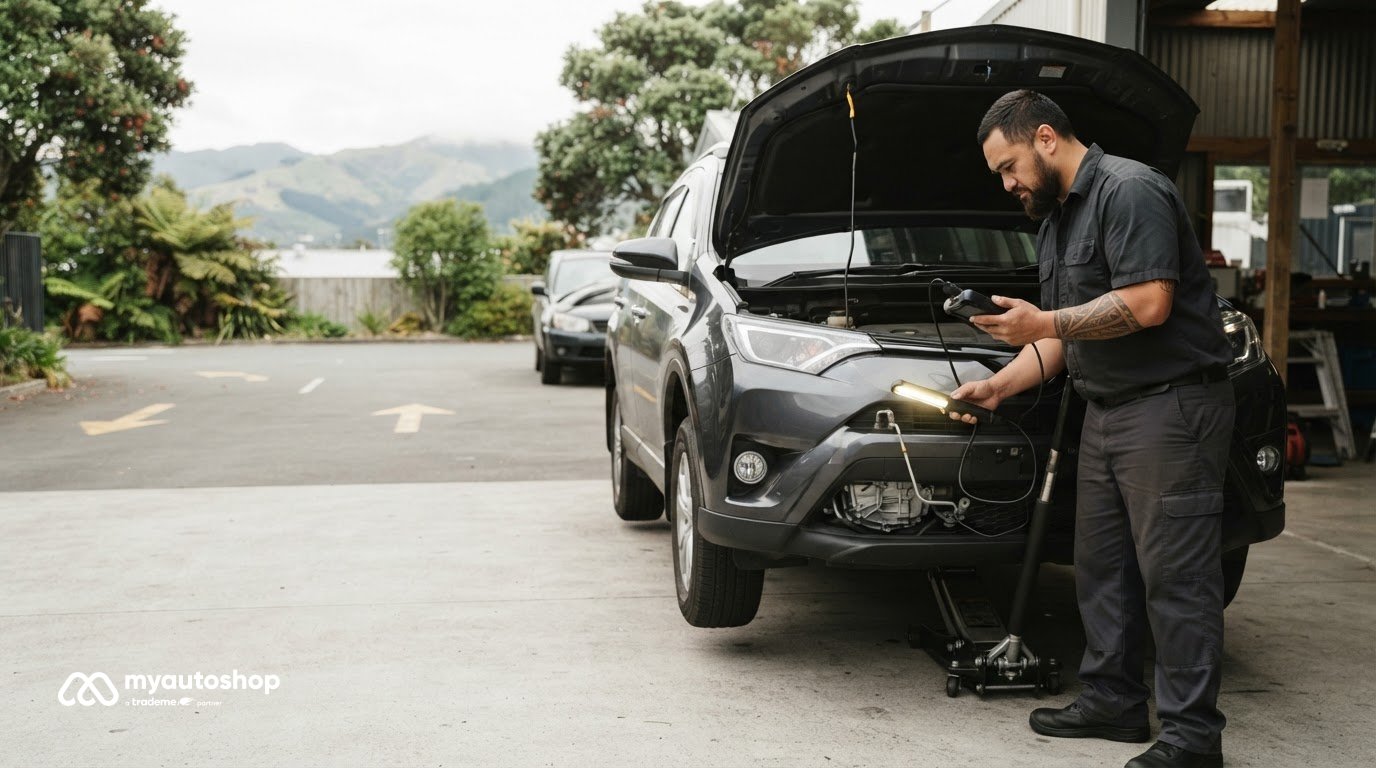
Can you trust a used Mitsubishi Outlander with a CVT, or could a smooth test drive be hiding an expensive problem? Mitsubishi Outlander CVT reliability isn’t a simple yes-or-no verdict. It depends on the specific vehicle, its maintenance history, how it’s been driven and whether it shows signs of transmission trouble.
It’s understandable to feel cautious. Owner stories can point in opposite directions, and without model-year context they may not tell you much about the Outlander you’re considering. A CVT issue can also be difficult to spot during a brief drive. A current Warrant of Fitness (WoF) is not a full mechanical assessment of the gearbox.
This guide explains what can affect CVT condition, which records and driving behaviours deserve a closer look, and what symptoms should prompt caution. You’ll also learn how to assess an Outlander during a test drive and how an independent pre-purchase inspection from My Auto Shop can help you make a more informed decision about that specific vehicle. No inspection can promise how it will perform in the future.
Key Takeaways
- Mitsubishi Outlander CVT reliability depends on the condition and maintenance history of the specific vehicle, not its badge alone.
- Documented CVT servicing matters. Don’t rely on a one-size-fits-all fluid type or service interval.
- Notice dashboard warnings, unusual noises and changes in how the Outlander accelerates. Record when they occur.
- Follow a clear buying sequence: identify the vehicle, review its records, test drive it and arrange an assessment.
- My Auto Shop’s independent pre-purchase inspection can help assess the Outlander’s current condition, but cannot guarantee its future reliability.
Is the Mitsubishi Outlander CVT reliable? The balanced answer
A Mitsubishi Outlander with a CVT can be a dependable used vehicle, but the model name alone can’t tell you whether a particular one is in good condition. A better assessment starts with the exact vehicle’s specification, service records, past use and current behaviour. That’s more useful than treating one owner’s experience as a verdict on every Outlander.
CVT reliability is how consistently a specific transmission performs over time, assessed against verified vehicle details, maintenance history and present condition. Keep that in mind when comparing online accounts. A report about an Outlander may be relevant, but it’s most useful when you know whether that vehicle is comparable to the one you’re considering.
Why Outlander CVT experiences can differ
Two vehicles with the same model name can have very different histories. One may have documented servicing and careful use; another may have incomplete records or a harder-working life. Age, kilometres travelled and how a vehicle has been used all provide context, but none proves on its own that the transmission is healthy or faulty.
Before applying advice from another owner, gather the exact vehicle details and review its maintenance documents. Note missing or unclear entries rather than assuming what work was done. If you spot a concern, a vehicle symptoms guide can help you describe what you’ve noticed without jumping to a diagnosis.
Do all Mitsubishi Outlanders use the same CVT?
Don’t assume every Outlander has the same transmission. Specifications can differ by model year, engine, drivetrain and version. A plug-in hybrid also has a different drivetrain setup from a conventional petrol vehicle, so advice about one should not automatically be applied to the other.
Identify the vehicle by comparing its registration or VIN details with its documentation, such as the owner’s manual and service records. If the information conflicts, resolve the exact specification before relying on advice about transmission maintenance or known issues. This helps keep general guidance in its proper context.
A CVT, or Continuously Variable Transmission, differs from a conventional stepped automatic in how it varies the drive ratio. The Continuously Variable Transmission (CVT) overview explains the general principle, but it doesn’t establish which unit is fitted to a particular Outlander or how that vehicle has been maintained.
Treat the model’s reputation as background, not a buying decision. Confirm the exact variant, review the records and assess the vehicle in front of you. That gives you a more grounded view of Mitsubishi Outlander CVT reliability than a broad claim that every example is dependable or troublesome.
What affects Mitsubishi Outlander CVT reliability over time?
Mitsubishi Outlander CVT reliability depends partly on how the transmission has been maintained and used. A CVT changes the ratio between the engine and wheels continuously, rather than moving through a fixed set of gears like a conventional automatic. That can make the engine’s response feel different, but a different feel alone doesn’t prove there’s a fault.
Maintenance matters because transmission fluid helps the system operate as designed. The required fluid and servicing schedule can vary by vehicle specification, so don’t rely on a generic online recommendation or assume advice for another Outlander applies.
How a CVT behaves differently from a conventional automatic
A stepped automatic changes between set gear ratios. A CVT varies its ratio instead, so engine revs may rise and hold while the vehicle gathers speed, rather than climbing and dropping in familiar steps. The precise feel depends on the vehicle. Compare it with the correct documentation, and note behaviour that feels inconsistent or repeats, particularly if it comes with noise or vibration. Don’t diagnose a fault from one sensation alone.
Why service records matter when assessing a used Outlander
Ask to see dated service records that identify the vehicle and describe the work completed. Compare the entries with the maintenance guidance for the exact Outlander, including its model year and transmission specification. A missing entry creates uncertainty about what was done, but doesn’t prove the CVT has failed. Look for a clear, consistent history rather than relying on a verbal assurance.
Transmission maintenance requirements should match the exact vehicle’s manufacturer documentation, not a generic schedule or advice for a different version. If the handbook or service records are missing, treat that as a gap to resolve before purchase. Don’t guess the fluid type or interval. If a record says fluid was changed, check that it identifies the work and vehicle clearly enough to be useful.
Use, as well as servicing, can shape the transmission’s workload. Frequent heavy loads or towing may place different demands on a vehicle than ordinary commuting. Ask how the Outlander was used and consider whether the answer fits its condition and paperwork. This provides context, not a diagnosis.
On a test drive, observe how the vehicle responds as you accelerate and slow down. A smooth but unfamiliar response may be normal for that CVT, while repeated hesitation, shuddering or unusual noise deserves closer assessment. Note when it happens and under what driving conditions. A single short drive can’t confirm what maintenance was done or establish the transmission’s full condition.
If you’re buying and the records leave unanswered questions, an independent pre-purchase vehicle inspection can help assess the specific Outlander. It provides a clearer picture of its current condition, not a guarantee of future reliability.
Which CVT warning signs should Outlander buyers take seriously?
Pay attention to changes in how the Outlander sounds, responds and displays warnings. A symptom can have more than one possible cause, so don’t treat one unusual moment as proof that the CVT has failed. Look for behaviour that repeats, note the conditions in which it appears, and arrange an assessment rather than guessing at a repair.
Warning signs warrant assessment, but diagnosis requires vehicle-specific testing. When buying a used vehicle, your observations help describe a concern. An assessment is needed to establish what may be behind it.
What to notice during a test drive
Drive normally and safely on a suitable route. Notice whether acceleration feels delayed or inconsistent, whether the vehicle shudders or jerks at low speeds, and whether engine revs rise without the Outlander gaining speed as expected. Listen for whining or other unusual noises, and note whether they change with road speed or acceleration.
Don’t provoke a symptom or attempt hard acceleration on public roads. Instead, observe the vehicle during ordinary driving, such as pulling away smoothly or slowing for a stop. If a behaviour appears, record what was happening, how the vehicle responded and whether it happened again. A single sensation doesn’t identify a specific transmission fault.
How to interpret warning lights, noises, or fluid concerns
A dashboard warning or message deserves attention, especially if it appears alongside a change in how the vehicle drives. Note the wording and when it appeared. If safe, take a clear photo while parked. A warning light by itself doesn’t confirm a CVT problem. The cause needs to be checked against the vehicle’s systems and specification.
Listen for new whining or high-pitched sounds, and note whether they occur while moving, accelerating or slowing down. Check for visible fluid beneath the vehicle when it’s parked, but don’t try to identify the fluid by colour or assume a leak comes from the transmission. An unusual burning smell is also a reason to seek assessment, not a diagnosis.
- Dashboard: Record warning lights, messages and the circumstances in which they appeared.
- Noise or smell: Note what you noticed and whether it changes with vehicle speed or driving conditions.
- Driving behaviour: Describe hesitation, shuddering, jerking or unexpected changes in response.
Keep your notes factual. For example, write “hesitated pulling away after stopping” rather than naming a failed component. If you’re unsure how to describe a broader vehicle symptom, this guide to vehicle symptoms can help you organise what you observed.
For a used Outlander, repeated symptoms, warning messages, unusual noises, visible leaks or unexplained smells are reasons to pause and arrange an assessment. That doesn’t mean every concern rules out the vehicle. It means you’ll have better information before deciding whether its condition and asking price make sense.
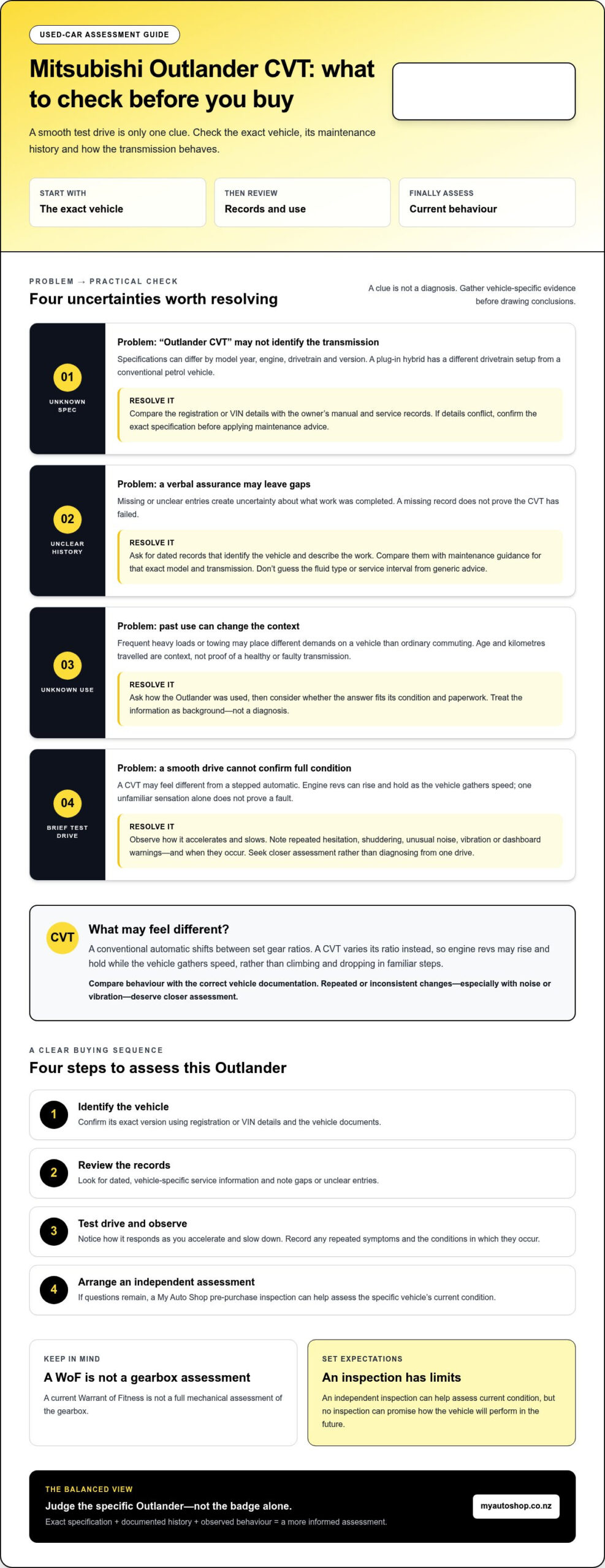
How to assess a used Mitsubishi Outlander CVT before buying
Use a clear sequence: identify the vehicle, review its records, test drive it safely, then arrange an independent assessment if questions remain. This gives you evidence to weigh up the specific Outlander rather than relying on its general reputation. A clear dashboard and a short drive are useful observations, but neither establishes the transmission’s full condition or reveals every issue that may develop later.
Review the vehicle identity and transmission history
Start by matching the year and version in the vehicle documents with the details on the vehicle itself. Use that information when checking maintenance guidance. If the documents don’t clearly identify the transmission specification, don’t apply advice based on another version.
Next, review the service records. Look for dated entries that identify the vehicle and describe the work completed. Compare those records with the manufacturer information for that exact vehicle. Missing paperwork doesn’t prove the CVT has failed, but it leaves a question unanswered. Note gaps, unclear descriptions or inconsistencies so you can consider them alongside the test drive and inspection.
Use the test drive as evidence, not a diagnosis
Drive under ordinary, safe conditions and pay attention to how the vehicle responds when pulling away, accelerating and slowing down. Note any repeatable hesitation, shuddering, unusual noise or inconsistent response. Don’t try to force a symptom to appear or carry out risky tests on public roads.
Compare what you observe with the seller’s description and the available records. For example, if the seller says the vehicle drives smoothly but you notice repeated hesitation, record when it happens and raise it for assessment. One observation doesn’t identify the cause, and a brief drive can’t replace a closer look.
Keep your notes practical and factual. Record the conditions, such as whether the vehicle was accelerating or slowing, and whether the behaviour happened more than once. Avoid assigning a fault yourself. Use your observations to focus questions and help an assessor understand what you noticed.
A pre-purchase inspection checklist can help you consider the Outlander beyond its transmission, including the vehicle’s broader condition. For wider buying context, use a New Zealand pre-purchase assessment guide alongside the records and your own observations.
If you’re still uncertain, an independent assessment can help evaluate the specific vehicle before you decide. My Auto Shop provides pre-purchase inspections to help buyers make better-informed decisions. The inspection can inform your decision about the Outlander’s current condition, but it can’t guarantee future reliability. Arrange an inspection before committing to the purchase.
When an independent Outlander pre-purchase inspection makes sense
An independent inspection is useful when you want more than the seller’s description, service paperwork and your own test drive can tell you. It assesses the particular Outlander at the time of inspection, helping you make a decision with clearer information. It can’t guarantee future reliability or rule out every fault, so treat the findings as evidence, not a promise about what will happen next.
What an independent inspection adds to your own checks
Some concerns are difficult for a buyer to assess confidently, especially if they appear intermittently or need more than a brief drive to understand. An independent assessment adds another perspective alongside your observations and the vehicle’s records. My Auto Shop provides independent pre-purchase inspections to help buyers make better-informed decisions. The inspection can help identify concerns with the specific vehicle, but it can’t predict every future problem.
This can be particularly helpful if the records are incomplete, the seller’s account doesn’t match what you observed, or you’re unsure how to interpret a finding. An inspection also helps put a CVT concern into the context of the vehicle’s overall condition. The aim isn’t to label every Outlander as reliable or unreliable; it’s to make a more informed decision about the one you’re considering.
How to act on inspection findings
Read the findings alongside the maintenance history and your test-drive notes. Separate issues identified during the assessment from areas where information remains uncertain. Consider the whole vehicle rather than treating one isolated comment as the complete picture. If a finding isn’t clear, make sure you understand what was observed and what it means for your decision before committing.
A clear result is useful, but it describes the vehicle’s condition at the time of assessment. It doesn’t remove the uncertainty that comes with buying any used vehicle, and it isn’t a guarantee of Mitsubishi Outlander CVT reliability over the years ahead. Equally, a concern doesn’t automatically mean the vehicle is a poor buy. Its significance depends on the details, the rest of the vehicle’s condition and your willingness to accept any remaining uncertainty.
Use the information to decide whether to proceed, reconsider or take more time to understand the findings. That’s a more grounded approach than relying on a broad reputation or a short drive alone.
If you’re weighing up a used Outlander, My Auto Shop’s independent pre-purchase inspection can help you assess the vehicle before you commit. Book an inspection for an independent view to support your decision.
Make your next step a confident one
A used-car decision doesn’t need to rest on forum stories or guesswork. Weigh what you’ve observed against the vehicle’s records and current condition. If important questions remain, pause before committing. More clarity can help you decide whether this Outlander fits your needs and your comfort with uncertainty.
Mitsubishi Outlander CVT reliability comes down to the individual vehicle, not a blanket promise attached to its name. An independent inspection can add useful evidence to your decision, while leaving the final choice with you. My Auto Shop provides independent pre-purchase inspections to help buyers make better-informed decisions.
If you’re considering a used Outlander, arrange a My Auto Shop pre-purchase inspection before you commit. Take the time to make an informed decision that feels right for you.
Frequently Asked Questions
Is the Mitsubishi Outlander CVT reliable?
It can be, but there isn’t one verdict that applies to every Outlander. For a buying decision, focus on whether the evidence for the particular vehicle gives you enough confidence to proceed. Set out what you know, what remains unclear and what would change your mind. That puts forum opinions in perspective and gives you a practical basis for comparing vehicles.
What are the signs of CVT problems in a Mitsubishi Outlander?
Symptoms can raise concern, but they can’t tell you the cause on their own. If a seller mentions a past transmission issue, ask what was checked, what work was completed and whether there’s paperwork to support the account. Treat the seller’s explanation as context, not a diagnosis. Supporting documents offer more useful detail than a label such as “fixed” or “runs fine”.
Do all Mitsubishi Outlander models have the same CVT?
No. Outlander versions shouldn’t be treated as mechanically identical. Advice about one version may not help you assess another, even if both are called Outlanders. Check that information you rely on applies to the vehicle you’re considering. Be especially cautious about carrying advice across different drivetrain types without vehicle-specific evidence.
How often should Mitsubishi Outlander CVT fluid be changed?
There isn’t one interval that can safely be applied to every Outlander. Follow the schedule in the documentation for the specific vehicle, and use service records to see whether scheduled work was recorded as completed. If you’re comparing vehicles, note any difference in the clarity of their maintenance histories. An invoice that simply says “service” isn’t proof of a particular transmission-fluid change.
Can I test a Mitsubishi Outlander CVT during a test drive?
A test drive can help you judge whether the vehicle feels suitable for your needs, but it’s only one part of a buying decision. Choose a route that reflects the kind of driving you expect to do, while following normal road rules. Afterwards, write down anything that felt unexpected while it’s fresh in your mind. Use those notes to guide further questions, not to name a fault.
Is a Mitsubishi Outlander CVT problem expensive to repair?
Costs depend on what a proper diagnosis finds and what work is needed, so a symptom alone can’t provide a reliable estimate. If a concern affects your decision, get a written diagnosis and quote before agreeing to repairs or making a purchase. Check that the proposed work addresses the confirmed issue, then consider it alongside the vehicle’s overall condition before deciding whether the expense makes sense.
Should I get a pre-purchase inspection for a used Mitsubishi Outlander?
An inspection can be a sensible step if you want an independent view before deciding. To make the assessment more useful, share the questions you want answered and relevant documents, such as service paperwork or written details of past work. Read the findings before you commit, then weigh them against your budget and intended use. This gives you a clearer basis for deciding whether to proceed.
Disclaimer
This article provides general information only and should not be relied on as professional mechanical, safety or legal advice. Vehicle requirements and circumstances vary. If you are unsure about your vehicle, have it inspected by a qualified automotive professional.