
You are sitting at a busy Auckland intersection when the light turns green. You shift into first, release the pedal, and your engine revs, but the car barely moves. That sinking feeling in your stomach is usually followed by a smell like burnt toast and the realization that your clutch has finally given up. It’s a stressful, inconvenient moment that leaves most Kiwi drivers fearing a massive, hidden repair bill.
We know the frustration of being stranded and the confusion that comes with technical terms like flywheels or slave cylinders. This clutch replacement cost guide nz is designed to strip away that anxiety. We’ll give you a transparent look at 2026 pricing and help you understand if your vehicle is still safe to drive right now.
You don’t need to be a mechanic to get a fair deal. Read on to learn how to spot failure before it leaves you stuck, what factors actually drive the price up, and how you can book a reliable repair for a fixed price. Let’s get your car back on the road with total financial clarity and zero guesswork.
Key Takeaways
- Spot early warning signs like gear slipping and burning smells to avoid a total breakdown on the road.
- Use this clutch replacement cost guide nz to understand how your car’s drive type and labor hours impact your final bill.
- Compare 2026 price estimates for common Kiwi vehicles to budget accurately for your repair.
- Learn why a failing clutch or hydraulic leak can trigger a WOF failure even if the gearbox isn’t directly inspected.
- Find out how to get a fixed-price quote and use a mobile mechanic for a stress-free diagnostic check at home.
Is Your Clutch Failing? Signs You Can’t Ignore
A failing clutch doesn’t usually happen without warning. It typically gives you several clear signals before it finally packs up and leaves you stuck. Recognizing these symptoms early is the best way to avoid an expensive tow truck call-out or a dangerous loss of power while driving. This clutch replacement cost guide nz helps you stay ahead of the curve by identifying exactly what your car is trying to tell you before the damage gets worse.
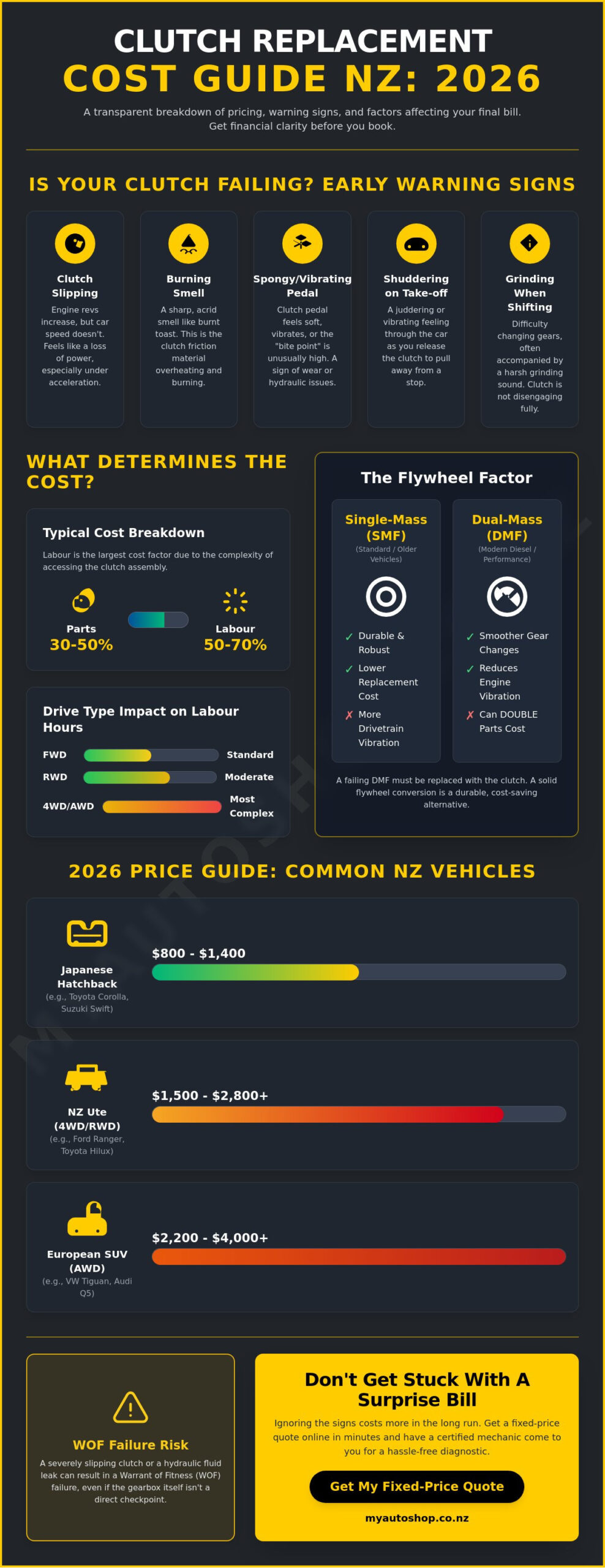
The most common sign is a slipping sensation. You’ll notice your engine revs climbing quickly when you accelerate, but your actual road speed lags behind. It feels like the car is struggling to find its footing. This happens because the friction material has worn down so much that it can no longer grip the engine’s power effectively. To understand the mechanics better, you can read about how a car clutch works and how it transfers energy through your transmission system.
You might also notice a sharp, acrid smell similar to burnt toast or scorched rubber. This is the distinct scent of the friction plate overheating. If you’re smelling this after a hill start or while reversing a trailer, your clutch is under serious stress. Pay attention to your pedal too. If it feels spongy, vibrates, or the “bite point” has moved much higher than usual, your system is reaching its limit. These changes don’t just feel bad; they directly impact your fuel economy since the engine has to work harder to maintain your speed.
The Physical Warning Signs
Watch out for a distinct shudder when you pull away from a stop. This juddering feeling through the floorboards usually means the friction surface is uneven or contaminated. If you hear a grinding noise when shifting, the clutch might not be disengaging fully. This is a frequent issue in NZ utes and vans, where a stiff gear stick makes every shift feel like a workout. It’s not just “old car character”; it’s a sign of mechanical fatigue that needs a professional look.
Why Early Detection Saves Money
Ignoring a worn clutch is a gamble that rarely pays off for Kiwi drivers. When the friction material is completely gone, the metal rivets can start scoring the surface of your flywheel. Replacing a flywheel can double your repair costs instantly. Beyond the money, there’s the safety risk of losing drive while merging onto a busy NZ state highway. Clutch slip is the primary indicator that your friction material is depleted and needs immediate attention. Catching it now keeps you in control and keeps your repair bill manageable.
What Determines the Cost of a Clutch Replacement in NZ?
The total price you pay for a new clutch isn’t just about the parts. It’s a combination of the physical clutch kit and the significant number of labor hours required to reach it. This clutch replacement cost guide nz highlights that while parts might make up 30% to 50% of the bill, the complexity of your vehicle’s layout is the real price driver. Accessing the clutch requires separating the transmission from the engine, which is a major mechanical undertaking.
Your car’s drive system dictates the difficulty. Front-wheel drive (FWD) cars are the standard benchmark, but rear-wheel drive (RWD) vehicles often allow for faster access. Four-wheel drive (4WD) and all-wheel drive (AWD) models are the most expensive to service. These vehicles have extra components like transfer cases and additional driveshafts that must be removed first. If you drive a popular NZ ute or a European SUV, expect the labor time to reflect this added complexity.
Vehicle origin also plays a role. Japanese imports generally benefit from a wide availability of affordable aftermarket parts. European models often require specialized tools and more expensive OEM-spec kits. Regardless of what you drive, it’s vital to understand your Consumer rights on car repairs when receiving a quote. Always ask if the price includes “while we are in there” essentials like the release bearing or the rear main seal. Replacing a $40 seal now is much cheaper than paying for the labor all over again in six months.
The Flywheel Factor: Single-Mass vs Dual-Mass
Modern diesel engines and many high-performance petrol cars use a Dual-Mass Flywheel (DMF). This component acts as a shock absorber for your drivetrain, reducing vibration and making gear changes smoother. However, DMFs are wear items. If the internal springs fail, the flywheel must be replaced alongside the clutch, which can double your parts cost. Some owners choose a “solid flywheel conversion” kit to save money and improve long-term durability, though this can slightly increase cabin vibration. If you aren’t sure which system your car uses, you can get a tailored quote to see the specific requirements for your make and model.
Labour: Why It’s a Full-Day Job
Replacing a clutch is rarely a “while you wait” service. It’s a full-day job because the technician must practically perform surgery on the heart of the car. In many modern vehicles, the entire front subframe must be lowered or removed just to create enough space to pull the gearbox back. This adds hours to the clock before the old clutch is even visible. For newer vehicles with “clutch-by-wire” systems, expert calibration is also required after installation to ensure the electronics and hydraulics talk to each other perfectly. Precision takes time, but it’s the only way to ensure your new clutch lasts another 100,000 kilometers.
2026 Price Guide: Average Clutch Replacement Costs in New Zealand
Budgeting for a major repair in 2026 requires a clear understanding of the current market. While older guides might suggest lower figures, inflation and the rising cost of specialized parts have shifted the baseline. When you receive a quote, always check if it includes GST and the cost of new transmission fluid. These “hidden” extras can add hundreds to your final invoice if they aren’t clearly stated upfront. A standard clutch replacement in 2026 typically ranges from $1,200 to $2,800 depending on flywheel requirements.
The price you pay is heavily influenced by the type of driving you do. If you use your vehicle for heavy-duty towing or performance driving, you’ll likely need a reinforced clutch kit. These kits use high-friction materials designed to handle extreme heat, but they come with a price premium. For most Kiwi commuters, a standard kit is sufficient, but skipping the quality check on parts can lead to premature failure and another big bill down the line.
Estimated Costs by Vehicle Type
There is a significant price gap between different vehicle categories in New Zealand. A Toyota Corolla, being a front-wheel-drive hatchback with high parts availability, sits at the lower end of the pricing scale. In contrast, a Ford Ranger or similar 4WD ute requires more intensive labor and often features a Dual-Mass Flywheel, which pushes the cost toward the higher end of our estimate. European brands like VW, BMW, or Audi also carry a “Euro Premium” in NZ. This is due to the specialized sensors and complex bolt patterns that require more time and specific diagnostic tools to reset correctly after the mechanical work is finished.
Aftermarket vs. Genuine Parts
Choosing between aftermarket and genuine parts is a balance of cost and long-term reliability. High-quality aftermarket kits from reputable brands are often identical to the original equipment and offer great value for out-of-warranty vehicles. However, if your car is still under a manufacturer warranty, using genuine parts is usually the safer bet to keep your coverage intact. Parts availability in NZ can also fluctuate. If a genuine part has to be air-freighted from overseas, it will significantly inflate your invoice and keep your car off the road longer. Regardless of the parts you choose, ensuring they meet the Warrant of Fitness requirements for your clutch and general roadworthiness is essential for your safety. Using this clutch replacement cost guide nz helps you weigh these options so you can make an informed decision that fits your budget and your car’s needs.
Clutch Health and Your Warrant of Fitness (WOF)
Many drivers believe that because a clutch isn’t explicitly listed on a Warrant of Fitness checklist, it doesn’t matter for the inspection. That’s a misconception. While an inspector won’t pull apart your transmission to check friction material, the overall driveability of your vehicle is a core safety requirement. If your clutch is so worn that you can’t reliably select gears, your car is a hazard to yourself and others. This clutch replacement cost guide nz emphasizes that a failing clutch often leads to secondary issues that will definitely trigger a WOF “fail” sticker.
Hydraulic leaks are a primary culprit. If your clutch slave cylinder is failing, it often leaks brake fluid. In New Zealand, any visible leak from a hydraulic system is an automatic failure. This fluid is corrosive and can damage other components, making it a priority for any safety check. Additionally, check your clutch pedal. NZ safety standards require a secure, non-slip rubber pad on the pedal. If yours is worn down to the metal or loose, you won’t pass your inspection. It’s a small part, but it’s vital for maintaining control during an emergency stop.
Safety Beyond the Inspection
A WOF is just a snapshot in time. Real-world safety happens on the road. Imagine your clutch starts slipping while you’re overtaking a truck on a narrow, winding rural road. If you lose drive at that critical moment, the results can be catastrophic. A weak clutch also compromises your ability to tow a boat or trailer safely. If you’re heading to the ramp and your clutch can’t handle the load, you risk getting stranded or causing an accident. Don’t try to “limp” a car with a bad clutch through traffic; it’s a risk to every other road user.
Maintenance Tips to Extend Clutch Life
You can avoid early replacement by changing a few driving habits. First, stop “riding the clutch” in heavy Auckland or Wellington traffic. Keeping your foot slightly on the pedal generates heat and wears the friction plate unnecessarily. When you’re stopped at a long traffic light, shift into neutral and release the pedal. This takes the pressure off the release bearing and the pressure plate. Finally, include a clutch fluid flush in your regular maintenance schedule. Fresh hydraulic fluid prevents internal corrosion in the master and slave cylinders, which are often the first parts to fail. If you’re worried about your clutch’s health after reading this clutch replacement cost guide nz, book a diagnostic check with a mobile mechanic to get an expert opinion before your next WOF is due.
Booking Your Clutch Replacement with My Auto Shop
You have identified the slipping gears and checked the 2026 price guide. Now you need a solution that fits your schedule without the stress of hidden mechanical fees. We built My Auto Shop to remove the mystery from car repairs. Instead of calling multiple garages and trying to compare vague estimates, you can access a unified platform that prioritizes your time and your budget. This clutch replacement cost guide nz has shown you what to expect; our booking system ensures those expectations are met with total precision.
If you are worried that your car isn’t safe to drive to a workshop, our mobile mechanic service is the perfect first step. We can send a qualified technician to your home or workplace for an initial diagnostic. This is a game changer for clutch issues. Sometimes what feels like a total transmission failure is actually a simple hydraulic adjustment or a failing slave cylinder. By getting an expert to look at the car in your driveway, you avoid unnecessary towing costs and get an honest assessment before any major work begins.
Once the job is confirmed, you gain access to our vetted national network of professional workshops. We don’t just partner with anyone. Every garage in our network is selected for their expertise and reliability. You can choose a location that is convenient for you and book a time slot 24/7 through our digital platform. It is car maintenance designed for the modern age, moving at the speed of an app while maintaining the steady pulse of a dependable local service.
Transparency You Can Trust
We believe in financial clarity. When you get a quote through My Auto Shop, we break it down into parts and labour clearly. You won’t see “miscellaneous fees” or surprise additions on your final invoice. Every booking is backed by a 6-month or 10,000km workmanship warranty, giving you the peace of mind that the job was done right the first time. If you ever feel overwhelmed by technical terms, our customer support team is ready to translate “mechanic speak” into plain English. We act as your transparent partner throughout the entire repair process.
Ready to Get Back on the Road?
Don’t let a failing clutch leave you stranded or compromise your safety during your next WOF inspection. Our online tool provides a streamlined way to get an estimate tailored to your specific vehicle. Whether you drive a compact city hatch or a heavy-duty 4WD ute, we have the expertise and the network to handle the repair. Take control of your car’s maintenance today and experience a service that values your time as much as your safety. Get a transparent clutch replacement quote today and get back on the road with confidence.
Get Back on the Road with Confidence
Identifying early signs of failure like slipping or burning smells protects your engine from secondary damage and expensive flywheel repairs. This clutch replacement cost guide nz gives you the tools to budget effectively while navigating the 2026 pricing market. Remember that while a clutch isn’t a standalone WOF item, its impact on gear selection and hydraulic safety makes it essential for staying roadworthy on Kiwi roads.
Don’t let mechanical jargon or hidden costs slow you down. My Auto Shop connects you with over 100+ vetted NZ workshops or brings the expertise to your driveway with mobile mechanic options for home or work. We provide fixed-price quotes with no hidden fees, ensuring you stay in control of your car’s maintenance from start to finish. Book your clutch replacement with a transparent, fixed quote today and enjoy a smoother, safer drive today.
Frequently Asked Questions
How long does it take to replace a clutch in NZ?
A clutch replacement typically takes between four and eight hours to complete. It is effectively a full-day job because the mechanic must remove the transmission to access the internal parts. Front-wheel drive cars are usually faster, while 4WD vehicles and European models often sit at the longer end of that scale due to their complex layouts and additional components like transfer cases.
Can I drive my car with a slipping clutch?
You should avoid driving with a slipping clutch because it can fail completely without warning and leave you stranded. Continuing to drive causes excessive heat, which can warp or score your flywheel. This turns a standard repair into a much more expensive job. It also makes overtaking or hill starts dangerous, as you lose the ability to transfer power to the wheels when you need it most.
Do I always need to replace the flywheel with the clutch?
You don’t always have to replace the flywheel, but it depends on the type your car uses. Modern diesel engines often use a Dual-Mass Flywheel that cannot be machined and usually requires replacement alongside the clutch. If you have a traditional single-mass flywheel, a technician can often machine the surface to save you money while ensuring the new clutch grips perfectly for another 100,000 kilometers.
Is a clutch covered under a standard mechanical warranty in NZ?
Most mechanical breakdown insurance policies in New Zealand exclude the clutch because it is classified as a wear and tear item. Similar to brake pads or tires, it is expected to wear out over time. However, if a brand-new clutch fails due to a manufacturing defect rather than driver use, it might be covered under a specific parts warranty or the protections offered by the Consumer Guarantees Act.
Why is my clutch pedal sticking to the floor?
A sticking pedal is almost always caused by a failure in the hydraulic system. This usually points to a leaking master or slave cylinder or air that has entered the lines. Without hydraulic pressure, the pedal cannot return to its original position. It is a serious issue that makes the car unsafe to drive, so you should seek a professional diagnosis from a mechanic immediately to avoid a total loss of control.
How much does a mobile mechanic charge for a clutch diagnosis?
A professional diagnosis of transmission issues in New Zealand typically costs between $100 and $200. This fee covers the mobile mechanic’s travel and the time spent performing a road test and physical inspection. Getting an accurate diagnosis early prevents you from overpaying for a full replacement if the issue is actually a minor hydraulic leak or a simple cable adjustment that can be fixed quickly.
What is the difference between a clutch kit and a full replacement?
A clutch kit refers only to the physical parts, while a full replacement covers the entire service including labor. This clutch replacement cost guide nz explains that a kit usually includes the friction plate, pressure plate, and release bearing. A full replacement service encompasses the removal of the gearbox, the installation of those parts, and the necessary testing to ensure your car is safe for the road.
Does a clutch replacement include a gearbox oil change?
Yes, a gearbox oil change is almost always included as part of the replacement process. The technician has to drain the transmission fluid to remove the gearbox from the engine safely. Refilling the system with fresh, specialized fluid ensures your gears shift smoothly and helps protect the internal components of your transmission for the long term. This is a vital step in maintaining your car’s overall health.
Disclaimer
This article provides general information only and should not be relied on as professional mechanical, safety or legal advice. Vehicle requirements and circumstances vary. If you are unsure about your vehicle, have it inspected by a qualified automotive professional.