

Picture this: it’s a humid Tuesday afternoon on the Southern Motorway, and steam starts pouring from your bonnet. Most Kiwi drivers face this exact moment with a sinking feeling in their gut. You’re likely wondering if you’re looking at a minor radiator repair or replacement that will break the bank. We know that the fear of being stranded is only matched by the anxiety of a surprise $900 mechanical bill. It’s frustrating when you don’t have the time to sit in a dusty waiting room while a mechanic explains things in jargon you don’t understand.
You deserve a clear path forward that respects both your wallet and your schedule. In this guide, we’ll break down the four specific signs that tell you it’s time to swap your unit rather than patch it. We provide transparent NZ cost estimates for 2026, ranging from a $185 coolant flush to a $720 full radiator assembly. You’ll also learn how our signature pick up and drop off service ensures your cooling system gets sorted without you losing a single hour of productivity at your desk.
Key Takeaways
- Spot the critical warning signs of cooling system failure early to prevent a minor leak from turning into a costly engine meltdown.
- Navigate the choice between radiator repair or replacement by understanding how modern aluminium cores and NZ summer heat impact your car’s safety.
- Get transparent insights into New Zealand labor and parts costs to ensure you receive a fair deal at a Kiwi-owned workshop.
- Learn why “just topping it up” with water is a dangerous myth that leads to airlocks and localized engine overheating.
- Discover how to access a seamless fix through a national network of pre-vetted mechanics with the convenience of pick-up and drop-off service.
Warning Signs: Is Your Car’s Radiator Failing?
Your engine creates enough thermal energy to heat a small house. The radiator is the only thing standing between a smooth Kiwi road trip and a melted engine block. It functions as the primary heat exchanger for your vehicle. Understanding how a car’s cooling system works is vital because cooling failures account for nearly 40% of major engine breakdowns in New Zealand. You can’t treat a radiator issue as a minor niggle. It’s a critical system failure waiting to happen. Every minute you drive with a faulty cooling system increases the risk of permanent damage.
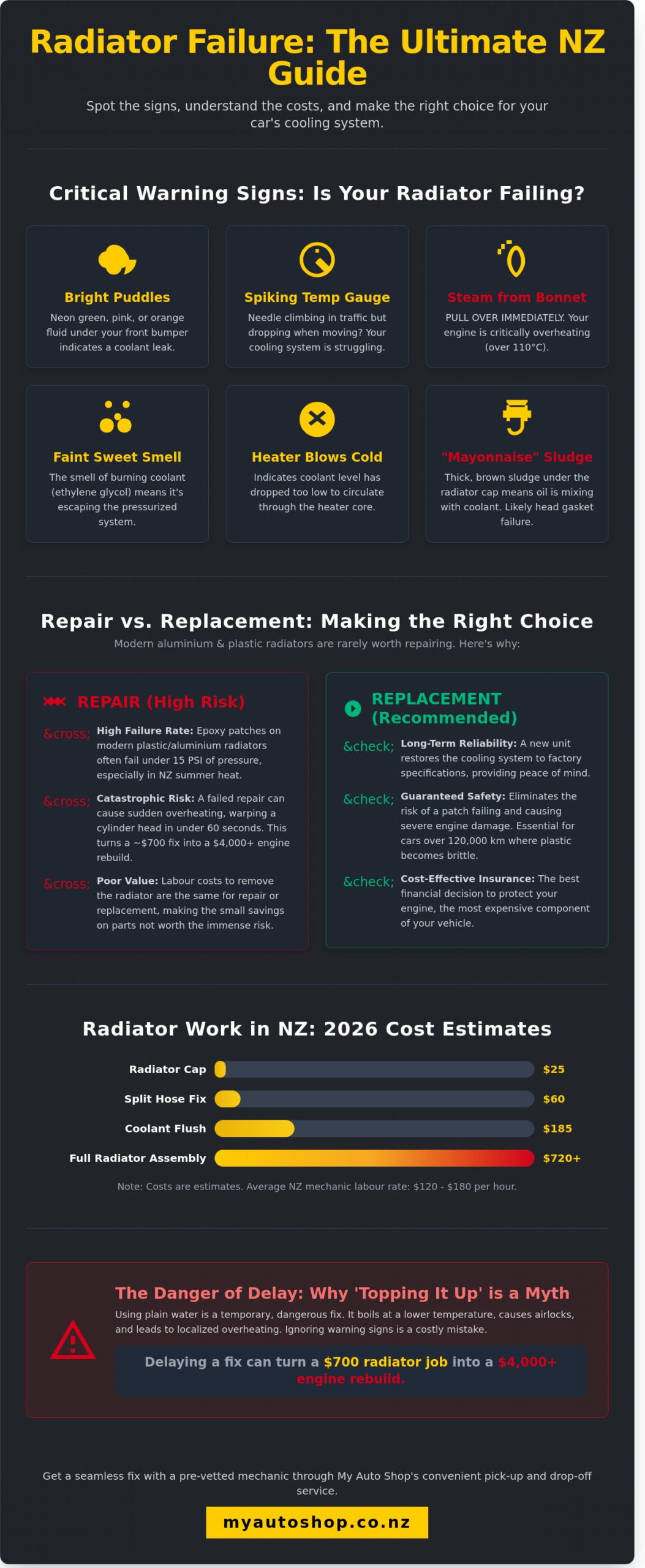
Distinguishing between a simple hose leak and a core failure saves you significant money. A split rubber hose is often a $60 fix. A cracked radiator core is a different story. If you see fluid spraying from a flexible hose, it’s usually a quick repair. If the metal or plastic body of the radiator is weeping, you’re facing a decision on radiator repair or replacement. Don’t ignore that faint, sweet smell in the cabin. It’s ethylene glycol. Breathing it isn’t healthy. It’s the first sign that coolant is escaping your pressurized system and evaporating near your air intakes.
The radiator cap is more than a lid; it’s a high tech pressure valve. It’s designed to hold roughly 15 psi of pressure. If this $25 part fails, your coolant boils at a lower temperature. This causes the entire system to over-pressurize. It can blow out your radiator’s plastic tanks or cause hoses to pop under the strain. Replacing a cap is the cheapest insurance you can buy for your engine.
Visual Red Flags in the Driveway
Step outside and look at your parking spot. Modern coolants are dyed bright green, pink, or orange to make leaks obvious. If you see a puddle of neon fluid under your front bumper, your system is compromised. Look closer at the radiator itself for a “white crust.” This chalky residue is dried coolant. It marks the exact spot where a seam or a pinhole is failing. Check under the radiator cap when the engine is stone cold. If you see a thick, brown “mayonnaise” or sludge, you have oil mixing with your coolant. This usually indicates a failed head gasket, which requires immediate professional intervention before you start looking at radiator repair or replacement options.
Performance Symptoms While Driving
Your dashboard provides the best early warnings. Watch the temperature gauge during Auckland stop-start traffic on the Southern Motorway. If the needle climbs while you’re idling but drops when you move, your radiator or its fans are struggling. Your cabin heater is another diagnostic tool. It relies on hot coolant flowing through a small heater core. If your heater suddenly blows cold air, your coolant level has likely dropped below the intake line. This is a red flag. If you see steam curling from the edges of your bonnet, pull over immediately. At this stage, your engine is likely exceeding 110 degrees Celsius. Continuing to drive for even 60 seconds can warp your cylinder head. This turns a simple cooling fix into a $3,000 engine rebuild.
Radiator Repair vs. Replacement: Making the Right Choice
Deciding between radiator repair or replacement used to be simpler when units were made of heavy copper and brass. Today, 95% of modern vehicles use aluminum cores crimped to plastic end-tanks. This design is lightweight and efficient, but it’s rarely fixable once the main structure fails. If your car has ticked over 120,000 kilometers, the plastic components have likely become brittle from thousands of heat cycles. At this stage, the material loses its structural integrity.
Safety is the priority during a Kiwi summer. When temperatures hit 25°C or higher, your cooling system operates under roughly 15 PSI of pressure. A patched radiator is a ticking time bomb in these conditions. If an epoxy repair fails while you’re climbing a steep grade on the Crown Range, you risk an immediate engine overheat. This can warp a cylinder head in under 60 seconds, turning a $500 radiator job into a $4,000 engine rebuild. The risk rarely outweighs the reward.
Labor is the great equalizer in this debate. Most mechanics in New Zealand charge between $120 and $180 per hour. Since the labor required to remove a radiator for a repair attempt is identical to the labor for a full replacement, the savings often vanish. Following official maintenance and prevention advice helps you spot these issues before they become roadside emergencies. If you’re unsure about your car’s cooling health, you can book a professional inspection to get a clear, transparent assessment of your cooling system.
When a Repair is Possible (and Recommended)
Not every puddle of coolant means the radiator is toast. Small wins are common. If the leak originates from a $10 stainless steel clamp or a perished rubber hose, a simple component swap is all you need. Replacing a $45 thermostat or a faulty radiator cap can also solve overheating issues instantly. A professional flush is another smart move. It removes up to 95% of internal scale and debris, restoring flow without needing new hardware.
When Replacement is the Only Safe Option
Cracked plastic end-tanks are a total deal-breaker. Heat causes plastic to expand and contract at different rates than the aluminum core. Epoxy patches cannot keep up with this movement and will eventually pop off under pressure. Severe fin corrosion is another red flag. If 20% or more of the aluminum fins have crumbled away, the radiator loses its ability to dissipate heat. Finally, watch for internal leaks. If coolant mixes with transmission fluid, it creates a “strawberry milkshake” texture that destroys gearboxes. In these cases, radiator repair or replacement isn’t a choice. Replacement is the only way to protect your transmission.
Calculating the Cost: Radiator Work in New Zealand
Transparency keeps the Kiwi motoring industry honest. You shouldn’t feel like you’re solving a riddle when you open a mechanical invoice. Most Kiwi-owned workshops follow a pricing model that splits the ‘wrench time’ from the ‘shelf price’ of components. When deciding on a radiator repair or replacement, understanding this split helps you spot a fair deal from a mile away. In 2026, labor remains the most variable factor, especially in high-demand hubs like Auckland or Wellington.
Your vehicle’s make and model dictate parts availability across the North and South Islands. Popular models like the Toyota Hilux or Ford Ranger benefit from local stock, keeping prices down. If you drive a European import or a niche luxury vehicle, expect a 25% markup due to shipping lead times and specialized fittings. Choosing the cheapest quote often backfires. A sub-standard fix can lead to a blown head gasket within 6 months, turning a NZ$500 job into a NZ$3,500 engine rebuild. For a broader understanding of how to avoid surprise bills across all vehicle maintenance, our complete guide to stress-free car repair in NZ covers the latest 2026 pricing benchmarks and how to find truly transparent service providers.
Labor and Diagnostic Fees
Precision starts with a pressure test. Expect to pay between NZ$85 and NZ$135 for a professional diagnostic. This fee covers the technician’s time to pressurize your cooling system and locate hairline cracks that aren’t visible to the naked eye. In major centers like Auckland, mechanic hourly rates currently sit between NZ$145 and NZ$195. In Wellington, you’ll find rates closer to NZ$135 to NZ$185. Our ‘Pick up & drop off’ service adds massive value here. It saves you two hours of commuting time without inflating the labor rate, making the logistics of a radiator repair or replacement entirely seamless.
Parts Pricing: OEM vs. Aftermarket
The price gap between genuine manufacturer (OEM) parts and high-quality aftermarket alternatives is usually 15% to 30%. While OEM parts offer a guaranteed fit, modern aftermarket radiators from reputable brands often match or exceed factory cooling specs. You must also account for high-spec OAT or HOAT coolant. This isn’t just colored water; it’s a chemical barrier against internal corrosion that costs roughly NZ$60 to NZ$110 for a full flush and fill.
- Small Hatchback (e.g., Suzuki Swift): NZ$480 to NZ$750 total.
- Family SUV (e.g., Mazda CX-5): NZ$650 to NZ$950 total.
- Performance/Euro (e.g., BMW 3 Series): NZ$900 to NZ$1,400+ total.
These 2026 estimates include parts, labor, and GST. We prioritize clear, upfront quotes so you can make an informed choice. By using a transparent partner, you ensure that every dollar spent contributes to your car’s longevity on New Zealand roads. Don’t settle for guesswork when it comes to your engine’s health.
The Danger of Delay: Why ‘Just Topping It Up’ is a Myth
It’s a common scene on the side of State Highway 1. A driver stands by an open bonnet, pouring a bottle of Mount Franklin into the overflow tank. They think they’re saving money until their next payday. In reality, they’re likely signing a death warrant for their engine. Choosing between radiator repair or replacement early is a financial decision, but delaying it is a gamble with 10 to 1 odds against you.
When you top up a leaking system with water, you introduce two major catalysts for engine failure. First, you create air pockets, often called airlocks. Unlike liquid coolant, air doesn’t transfer heat. These pockets sit against cylinder walls, causing localized overheating that won’t always show up on your dashboard gauge. Second, you’re ruining the chemistry of your cooling system. NZ tap water contains minerals like calcium and magnesium that create scale buildup. Within 30 days of using plain water, corrosion begins eating through your aluminum components from the inside out.
This neglect leads to a cascading failure. A leaking radiator reduces system pressure, which forces the water pump to work harder. This eventually burns out the pump seals. Once the pump fails, the coolant stops moving entirely, and your engine temperature skyrockets in less than 120 seconds.
The NZ$5,000 Head Gasket Nightmare
The math is simple but brutal. A professional radiator repair or replacement typically costs between NZ$450 and NZ$900 depending on your vehicle. If you ignore the leak, you risk a blown head gasket or a warped cylinder head, which carries a repair bill often exceeding NZ$5,000. When an engine overheats, the metal expands beyond its design limits. Thermal expansion is the physical increase in the volume of engine components as they absorb heat during operation. If this expansion is uneven, the head warps, the seal breaks, and oil begins mixing with your coolant, creating a milky sludge that destroys the entire engine block.
Environmental and Roadside Risks
A leaking radiator isn’t just a mechanical issue; it’s an environmental hazard. Most NZ vehicles use ethylene glycol, a sweet-smelling green or red liquid that is highly toxic. It’s incredibly attractive to dogs and cats, but even a small amount can cause fatal kidney failure in pets within 48 hours. Furthermore, NZ’s strict environmental regulations mean that allowing coolant to enter our storm drains and waterways can result in significant fines from local councils.
From a safety perspective, radiator issues are the primary cause of breakdown calls in New Zealand, accounting for roughly 22% of all roadside assistance requests according to 2023 service data. Getting stuck on a narrow section of the Karangahake Gorge or a busy Auckland motorway is a high-stress situation that’s easily avoided. You should also consider your next Warrant of Fitness. While a tiny weep might pass, any significant leak that drips onto the road or poses a fire risk by spraying on hot exhaust components will result in an immediate WOF failure.
Don’t wait for a breakdown to find out your engine is cooked. Get a transparent, upfront price for a radiator inspection or replacement today and keep your car running cool.
Seamless Radiator Solutions with My Auto Shop
Deciding between a radiator repair or replacement shouldn’t feel like a gamble. My Auto Shop removes the mystery from automotive maintenance by providing a clear, digital path to a healthy cooling system. We’ve built a national network of over 2,100 pre-vetted mechanics across New Zealand. Every workshop in our network undergoes a rigorous screening process. This ensures they possess the technical expertise and high-quality equipment needed to handle modern engine cooling demands. You won’t have to spend hours reading reviews or wondering if you’re getting a fair deal. We’ve done the hard work for you.
Our platform is built on the foundation of transparency. We deliver instant quotes that break down the costs of parts and labor upfront. This eliminates the anxiety of the “mystery bill” that often follows a trip to the garage. You’ll know exactly what you’re paying before the mechanic even picks up a wrench. This commitment to openness has made us a trusted partner for thousands of drivers from Auckland to Invercargill. We prioritize your budget and your vehicle’s safety in equal measure.
We understand that your time is your most valuable asset. Most people can’t afford to lose a day sitting in a waiting room. Our signature “Pick up & Drop off” promise is designed to solve this exact problem. For a small fee, a professional driver collects your car from your home or office, takes it to the specialist, and brings it back once the work is finished. In the last 12 months, this service has saved Kiwi car owners over 18,000 hours of unnecessary travel and waiting time. You stay focused on your work or family while we handle the logistics of your radiator repair or replacement.
Booking Your Radiator Service in Seconds
Our intelligent platform uses your registration number to identify your vehicle’s exact specifications. This ensures we match you with a cooling expert who understands your car’s unique requirements, whether it’s a late-model Euro or a reliable Japanese import. Since our inception, over 65,000 Kiwis have trusted us for their car repair NZ needs. Every service is logged in a centralized digital record. This makes it easy to track your maintenance history, which can significantly boost your car’s value when it’s time to sell. You’ll never lose a paper receipt again.
Quality Guaranteed
We never compromise on the components that keep your engine cool. Our partner mechanics use parts that meet or exceed original equipment manufacturer (OEM) standards. This ensures your radiator can handle the pressure of summer road trips and heavy traffic. Every job booked through My Auto Shop comes with a 12-month or 20,000km warranty. This provides total peace of mind that your repair is backed by professional standards. Don’t risk an expensive engine meltdown.
Keep Your Engine Running Cool Across Aotearoa
Ignoring a rising temperature gauge is a gamble that rarely pays off for Kiwi drivers. Most cooling issues start small, but delaying a fix can turn a simple leak into a full engine rebuild costing upwards of NZ$4,000. When you’re deciding on radiator repair or replacement, the choice usually comes down to the age of the unit and the extent of the internal corrosion. Topping up your coolant every few days isn’t a strategy; it’s a warning sign that your car needs professional attention before you’re stranded on the side of the SH1.
My Auto Shop has helped over 20,000 happy Kiwi customers maintain their vehicles with total confidence. We provide transparent, upfront pricing and a vetted network of professional NZ workshops to ensure you never face hidden costs. With our convenient pick up and drop off service, getting your cooling system sorted fits perfectly into your busy schedule. Don’t wait for the steam to start pouring from under the hood. Book your radiator inspection with NZ’s best mechanics today and enjoy the peace of mind that comes with a healthy, reliable engine.
Frequently Asked Questions
How much does a radiator replacement cost in NZ?
Radiator replacement in New Zealand typically costs between NZ$450 and NZ$1,100. This price includes the new unit, fresh coolant, and roughly 2 hours of labor. Smaller Japanese imports usually sit at the lower end of this scale. Larger 4WDs or European models can exceed NZ$1,500 due to part complexity. Use our platform to get a transparent, fixed price for your specific car.
Can I drive my car with a leaking radiator?
Don’t drive your car if the radiator is leaking. Even a small hole can drop coolant levels fast, leading to engine temperatures over 110 degrees Celsius. This heat causes permanent damage to your engine block or head gasket. If you spot a puddle, book a radiator repair or replacement immediately to avoid a bill that could top NZ$3,000 for an engine rebuild.
How long does it take to replace a car radiator?
Most radiator swaps take between 2 and 4 hours to complete. A standard front-wheel-drive car often takes 90 minutes if access is clear. Some modern vehicles require the front bumper or cooling fans to be removed first, which adds another hour to the job. We offer a pick up and drop off service so your day isn’t interrupted while the work happens.
Does a radiator repair come with a warranty?
Most professional mechanics in NZ provide a 12 month or 20,000km warranty on their repairs. If you choose a brand new replacement part, the manufacturer’s warranty often extends to 24 months. We only work with NZ’s best mechanics to ensure your cooling system stays reliable long after you leave the workshop. Always check your digital invoice for the specific terms of your service.
What is the difference between a radiator flush and a repair?
A radiator flush is preventative maintenance, while a repair fixes a mechanical failure. A flush uses specialized chemicals to clear 98% of internal scale and rust from the system. A radiator repair or replacement is necessary when the unit has a physical crack or a blown seal. If your car is over 10 years old, a flush might not be enough to fix a persistent overheating issue.
Why is my car still overheating after a radiator replacement?
Your car might still overheat if there is trapped air in the system or a failed thermostat. Air pockets block coolant flow in 15% of DIY replacements. Other common causes include a worn water pump or a faulty electric cooling fan. If the new radiator doesn’t fix the problem, have a technician pressure test the entire system to find hidden leaks or blockages.
Will a radiator leak fail a WOF (Warrant of Fitness)?
A visible radiator leak will cause your car to fail its WOF. Inspectors look for any fluid dripping onto the ground or active steaming from the engine bay. A leak is considered a safety risk because it leads to engine failure on the road. Fixing the issue before your inspection saves you the NZ$50 recheck fee and ensures your vehicle remains legal and reliable.
Can a mobile mechanic replace a radiator at my home?
Yes, a mobile mechanic can replace your radiator at home or your workplace. They need a flat surface and about 60 minutes of clear access to the front of your vehicle. This is a great option if you’re worried about driving the car and causing more damage to the engine. Our network includes mobile experts who bring the workshop directly to your driveway.
Disclaimer
This article provides general information only and should not be relied on as professional mechanical, safety or legal advice. Vehicle requirements and circumstances vary. If you are unsure about your vehicle, have it inspected by a qualified automotive professional.