

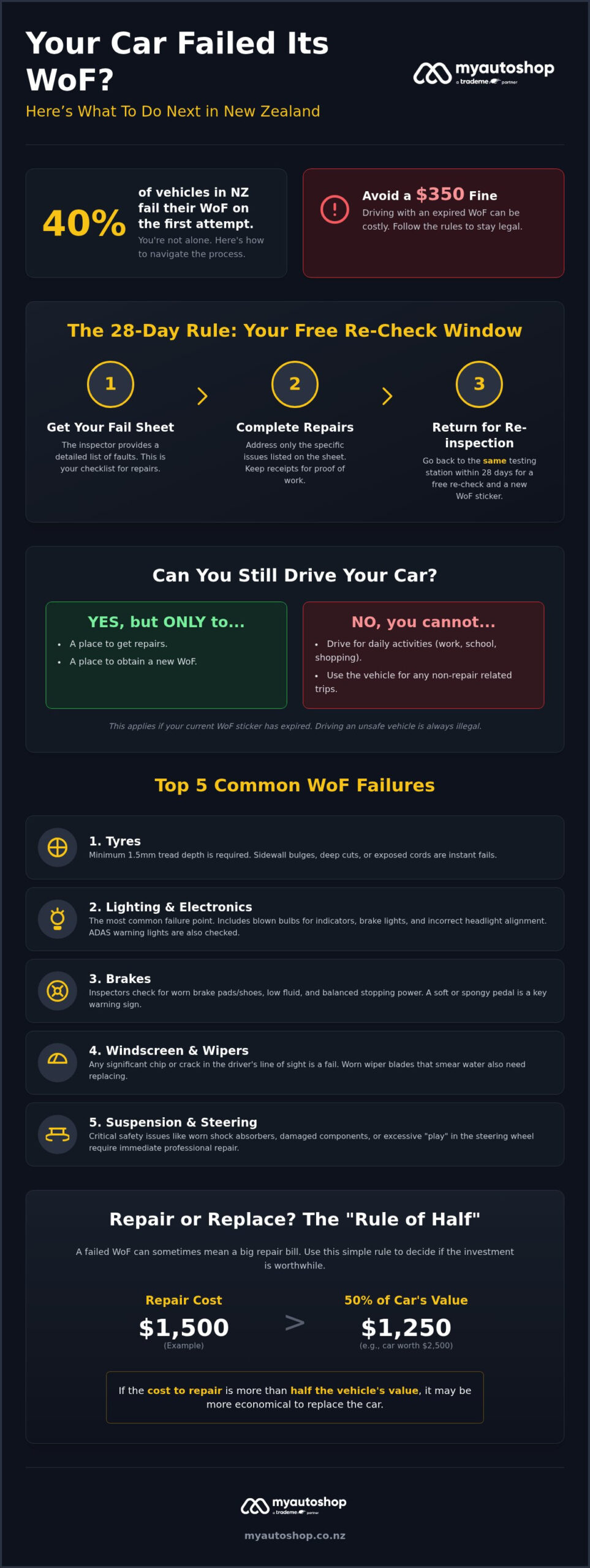
Nearly 40% of New Zealand vehicles fail their Warrant of Fitness on the first try. If you’ve just been handed a list of repairs, you’re likely wondering what to do if your car fails its wof. It’s a common hurdle that often brings unexpected costs and the worry of a $350 fine. We know the stress of staring at an inspection sheet full of jargon while trying to figure out your next move.
This guide simplifies the process so you can move forward with confidence. We’ll explain the 28-day re-inspection rule and the latest 2026 regulation changes that affect your vehicle’s safety requirements. Our goal is to help you find the most cost-effective way to get back on the road without the guesswork or the typical mechanical headaches. We’re here to act as your transparent partner in navigating these rules.
We’ve broken down the legal limits for driving a failed vehicle and provided a clear strategy for handling repairs. You’ll get an expert look at common failure points like brakes, tyres, and ADAS warning lights, helping you decide whether to invest in a fix or consider a sale. Let’s turn that failure into a road-legal success.
Key Takeaways
- Use the 28-day re-inspection window to get a free re-check and keep your total costs down.
- Learn exactly what to do if your car fails its wof to avoid new $350 fines and stay legal on the road.
- Decode technical jargon on your failure sheet to identify which safety-critical repairs need urgent attention.
- Explore how mobile mechanics can fix common failures like brake pads or batteries right in your driveway.
- Apply the “Rule of Half” to determine if your car is an economic write-off or worth the repair investment.
The 28-Day Rule: Understanding Your Timeline After a WoF Failure
Failing a Warrant of Fitness (WoF) can feel like a setback, but New Zealand’s 28-day rule is designed to help you get back on track without double-handling costs. The 28-day rule serves as a financial grace period that allows vehicle owners to have their cars re-inspected at no additional cost after completing required repairs. Essentially, if your car fails, you have exactly 28 days to fix the issues and return to the same inspection station for a free or discounted re-check.
It’s vital to remember this window is a cost-saving measure, not a license to drive a faulty vehicle. Many drivers mistakenly believe they have 28 days of legal driving time after a failure. In reality, if your current sticker has expired, you are only allowed to drive the vehicle for the purposes of getting it repaired or obtaining a new WoF. Knowing what to do if your car fails its wof starts with respecting this distinction between financial grace and road safety. With 2026 fines for an expired WoF reaching $350, ignoring this timeline can become expensive very quickly.
If you exceed the 28-day limit, even by a single day, the inspection station is legally required to perform a brand-new, full inspection. This means you will pay the full fee again, which typically ranges from $50 to $95. Staying within the window keeps your wallet happy and your schedule on track.
How the Re-inspection Process Works
The path from a failed check to a new sticker is straightforward if you follow these steps:
- Receive your fail sheet: The inspector will provide a list of non-compliant items. Put this document in your glovebox immediately; you’ll need it for the re-check.
- Target the listed faults: Only focus on the items noted by the inspector. You don’t need to perform extra maintenance to pass the re-check, though keeping up with general servicing is always a good idea.
- Return to the same station: To qualify for the free re-inspection, you must go back to the original organization that performed the initial check.
Deadlines and Documenting Repairs
Tracking your deadline is your responsibility. Mark the 28th day on your phone calendar as soon as you leave the testing station. If you’re using a professional service, keep your receipts as proof of repair. While the inspector will visually verify the fix, having documentation from a qualified mechanic ensures there is no confusion about the work performed. This clarity helps the inspector sign off your vehicle quickly, moving you one step closer to that new sticker.
Decoding the WoF Failure Sheet: Common Faults and Priorities
Staring at a check-sheet filled with scribbled notes can be overwhelming. Approximately 35-40% of Kiwi vehicles fail their first attempt, so you aren’t alone. Knowing what to do if your car fails its wof begins with categorizing these faults. Some are quick fixes you can handle today, while others require professional expertise to meet safety standards. Following the official NZ Transport Agency guidelines ensures you understand exactly what standards your vehicle must meet to be road-legal.
Structural issues like rust or “under-body” damage are serious because they involve the vehicle’s chassis or load-bearing components. These require certified repairers to fix correctly. In contrast, minor fails like a blown indicator bulb or worn wiper blades are easy DIY tasks you can handle in your driveway before your re-inspection. Distinguishing between these allows you to manage your repair budget effectively.
Top 5 Most Common WoF Fails in New Zealand
Most failures fall into five predictable categories. Understanding these helps you prepare for your next check and avoid the $350 fine for non-compliant equipment:
- Tyres: You need a minimum of 1.5mm tread depth across the entire tyre. Sidewall bulges or deep cuts are instant fails.
- Lighting and Electronics: This is the most common failure point. Inspectors check indicators, brake lights, and headlight alignment. New 2026 rules also include checks for ADAS warning lights like Lane Keep Assist.
- Brakes: Inspectors check for worn pads and balanced stopping power. If your brake fluid is low or pads are under the safety threshold, you’ll need a replacement.
- Windscreen: Any chip or crack in the driver’s line of sight will result in a fail. Worn wipers that smear the glass also count.
- Suspension and Steering: Worn shock absorbers or excessive play in the steering are critical safety issues that require immediate professional attention.
Prioritising Your Repairs
Look closely at your sheet for “monitor” notes. These aren’t failures yet, but they are warnings about parts that will likely fail before your next inspection. Focus your budget on the “immediate fix” items first to regain your road-legal status. To avoid hidden costs and financial anxiety, compare fixed-price repair quotes through a transparent platform. This allows you to see the cost for things like brake pad replacements or battery swaps before you commit to a shop. By prioritizing safety-critical repairs like steering and brakes, you ensure your vehicle remains safe for your family while staying within your budget.
Can You Still Drive? The Legal Realities of a Failed Warrant
Many drivers assume that if their old WoF sticker hasn’t reached its expiry date yet, they can keep driving even after a failed inspection. This is a dangerous misconception. According to the NZ Transport Agency (Waka Kotahi), your vehicle must be up to WoF standard at all times it is on the road. A failed WoF technically renders the vehicle unroadworthy immediately. This means your current sticker becomes effectively void because a professional inspector has officially documented that the car is unsafe or non-compliant.
If you are caught driving a vehicle with a failed or expired warrant, the financial consequences are steep. As of 2026, the fine for a WoF that has been expired for more than two months has increased to $350. Police can also issue fines for specific defects, such as $350 for non-compliant tyres. While a standard failure allows some leeway for repairs, a ‘Pink Sticker’ is far more serious. This is issued for safety-critical faults that make the car a clear danger to other road users, and it must be towed rather than driven. Knowing what to do if your car fails its wof starts with recognizing that your legal right to use the car for daily errands has ended.
Insurance Implications of a WoF Failure
Driving with a failed warrant is a massive financial gamble that extends beyond police fines. Most New Zealand car insurance policies include a ‘reasonable care’ clause. This requires you to keep your vehicle in a roadworthy condition. If you have an accident and the insurer discovers you were driving on a failed WoF, they may argue you failed to take reasonable care. This could lead to a declined claim, leaving you responsible for thousands of dollars in damages. It’s a high-stakes risk that simply isn’t worth the convenience of a quick trip to the shops.
Driving to the Workshop
You are legally permitted to drive your vehicle under two specific conditions: when going directly to a place of repair or returning for a re-inspection. You cannot use the car for school runs, grocery trips, or commuting. If you are stopped, be honest with the officer and show them your inspection report as proof of your intentions. To avoid the risk entirely, you can book a mobile mechanic to perform repairs like brake pad replacements or battery swaps at your home. This approach removes the need to drive an unroadworthy car and keeps you on the right side of the law while you figure out what to do if your car fails its wof.
Managing Repairs: DIY vs. Professional Mechanics
Knowing what to do if your car fails its wof involves making a smart choice between your own toolbox and a professional’s hoist. It’s about balancing your budget with the need for a guaranteed pass. Some repairs are simple weekend projects, but others carry a high safety risk if done incorrectly. Our goal is to help you identify which path gets you back on the road fastest without compromising on safety or your bank balance.
Stick to the basics for DIY work. Swapping a battery or topping up fluids is a great way to save on labor costs. Replacing a cracked tail-light lens or fitting new wiper blades is also manageable for most vehicle owners. However, when the fail sheet mentions “excessive play” in the steering or “pitted” brake rotors, it’s time to call in the experts. Professional mechanics have the specialized diagnostic tools and experience to ensure the repair meets strict NZTA standards the first time, preventing a second failure at the re-inspection.
The Mobile Mechanic Advantage
Logistical convenience is the ultimate stress-reliever when your car is technically unroadworthy. Booking a mobile mechanic for your WoF repairs means your vehicle stays safely parked in your driveway while the work gets done. This is the most efficient way to handle common failures like worn brake pads, faulty CV joints, or battery replacements. You save hours of travel time, avoid the hassle of organizing a loan car, and eliminate the fear of being stopped by police on the way to a traditional garage. My Auto Shop connects you with vetted mobile professionals who specialize in these on-site fixes, ensuring your car is ready for its sticker without you ever leaving home.
Getting a Fair Quote
Don’t settle for “ballpark” figures or vague estimates. Demand financial clarity. A fixed-price quote for a radiator repair or shock absorber replacement protects your bank account from hidden fees and the dreaded “over-servicing” where shops fix items not listed on the failure sheet. When you know exactly what to do if your car fails its wof, you can use a transparent platform to compare costs across a nationwide network. This logic ensures you pay a fair price for high-quality work. If your car needs more extensive work, like a clutch replacement or cambelt change, having a fixed quote allows you to plan your finances with confidence. You can book a mobile mechanic through our platform to get the job done right, at a price that makes sense for your budget.
Repair vs. Replace: When a WoF Failure Means It’s Time to Move On
Sometimes, the repair list you receive is simply too long or too expensive to justify. When you are deciding what to do if your car fails its wof, you need a clear financial framework to avoid throwing good money after bad. We recommend using the “Rule of Half” as your guide. If the total cost of the required repairs exceeds 50% of the vehicle’s current market value, the car is likely an economic write-off. At this point, the investment rarely pays off in the long term.
Major structural rust, a failing transmission, or head gasket issues are typical deal-breakers. These problems often require specialized labor that costs more than the car’s resale value. A failed warrant also has a direct impact on how much you can get for the vehicle. Generally, a car without a current sticker will sell for 20% to 30% less than its market value, as buyers factor in the risk and the logistical nightmare of getting it road-legal themselves.
Evaluating High-Cost Repairs
A cambelt replacement or a full suspension overhaul can easily run into the thousands. While these repairs might secure you a new sticker, they don’t necessarily fix the underlying age of the vehicle. Consider your car’s overall reliability. If you fix the brakes today, will the clutch fail next month? Using a professional inspection can provide a neutral second opinion. It helps you see the big picture, allowing you to decide if the car is a dependable asset or a mounting financial burden. Sometimes, the most efficient move is to stop the spending and start looking for a replacement.
Selling a Car That Failed Its WoF
Selling a vehicle without a current WoF is perfectly legal in New Zealand, provided you are transparent with the buyer. If you choose to sell, list the car “as is, where is” on platforms like TradeMe. Always provide the failure sheet to potential buyers. This honesty protects you from future disputes and helps the buyer understand exactly what they are taking on. For cars that are truly beyond repair, local wreckers offer a fast, no-fuss way to clear your driveway and get a bit of cash in hand. Once you’ve moved the old car on, be sure to get a pre-purchase inspection for your next car to ensure your next vehicle doesn’t come with its own hidden fail sheet. This step gives you the confidence to buy a car that will pass its next check with ease.
Get Back on the Road with Confidence
A failed inspection doesn’t have to be a logistical nightmare. By understanding the 28-day re-check window and the legal limits of driving an unroadworthy car, you’ve already taken the first step toward a solution. You now know exactly what to do if your car fails its wof. Whether you’re tackling simple bulb replacements yourself or using the “Rule of Half” to decide if it’s time to sell, staying organized is key. Focus on safety-critical repairs first and keep your fail sheet handy for that free re-inspection.
We’re here to help you bridge the gap between a failed check and a new sticker. You can book your WoF repairs with a trusted local mechanic through My Auto Shop to enjoy fixed-price repair quotes and the convenience of mobile service options. Our nationwide network of expert mechanics ensures high-quality work without the jargon or hidden costs. Take control of your car’s maintenance today and enjoy the peace of mind that comes with a road-legal vehicle. Safe driving, you’ve got this.
Frequently Asked Questions
Can I drive my car after it fails a WoF in NZ?
You can only drive the vehicle for the specific purpose of getting it repaired or returning for a re-inspection. A failed WoF means the car is technically unroadworthy immediately. Driving for daily errands or commuting is illegal and risks a $350 fine. If you are worried about the legality of the trip, a mobile mechanic can perform repairs in your driveway to remove the risk entirely.
How much does a WoF re-check cost if I fix it within 28 days?
A re-check is typically free if you return to the same inspection station within 28 days of the initial failure. This rule is a financial grace period designed to help you get road-legal without paying for two separate inspections. If you miss this 28-day window, you will have to pay the full inspection fee again, which usually ranges from $50 to $95 depending on the provider.
Do I have to go back to the same place for my WoF re-inspection?
Yes, you must return to the original testing station to qualify for a free or discounted re-inspection. If you choose to go to a different garage, they are legally required to perform a brand-new inspection and charge you their full standard rate. Keeping your original fail sheet in the glovebox ensures the inspector can quickly verify the specific repairs you’ve completed.
What is the most common reason for a WoF failure?
Blown bulbs and malfunctioning indicators are the leading causes of failure for Kiwi motorists. Approximately 35-40% of vehicles fail on their first attempt, often due to these simple lighting issues or worn tyre tread. Checking your lights and tyres before your appointment is a smart part of what to do if your car fails its wof to avoid an unnecessary second visit.
Is there a grace period for an expired WoF?
There is no legal grace period for an expired WoF in New Zealand. You can be fined the moment your sticker expires if the vehicle is on a public road. In 2026, the fine for a warrant that has been expired for more than two months is $350. The only legal exception is driving directly to a workshop for repairs or to a testing station for an appointment.
Can I sell my car if it doesn’t have a current WoF?
You can legally sell a car without a WoF, but you must inform the buyer in writing that the warrant is not current. Most sellers list these vehicles “as is, where is” and provide the failure sheet for full transparency. Expect the sale price to be significantly lower, as the buyer factors in the cost and the logistical effort of making the car roadworthy.
Will my insurance pay out if I have an accident with a failed WoF?
Your insurance claim will likely be declined if the accident was caused by a defect listed on your fail sheet. Most NZ policies require you to maintain your vehicle in a roadworthy condition at all times. Driving on a failed warrant is seen as a breach of the “reasonable care” clause, which could leave you personally liable for all repair costs and damages.
What happens if I can’t afford the repairs within 28 days?
If you miss the 28-day window, you lose the benefit of the free re-check. You can still get the car fixed later, but you will need to pay for a full new inspection to get your sticker. When managing what to do if your car fails its wof on a budget, focus on the most critical safety items first and use fixed-price quotes to avoid financial surprises.
Disclaimer
This article provides general information only and should not be relied on as professional mechanical, safety or legal advice. Vehicle requirements and circumstances vary. If you are unsure about your vehicle, have it inspected by a qualified automotive professional.