
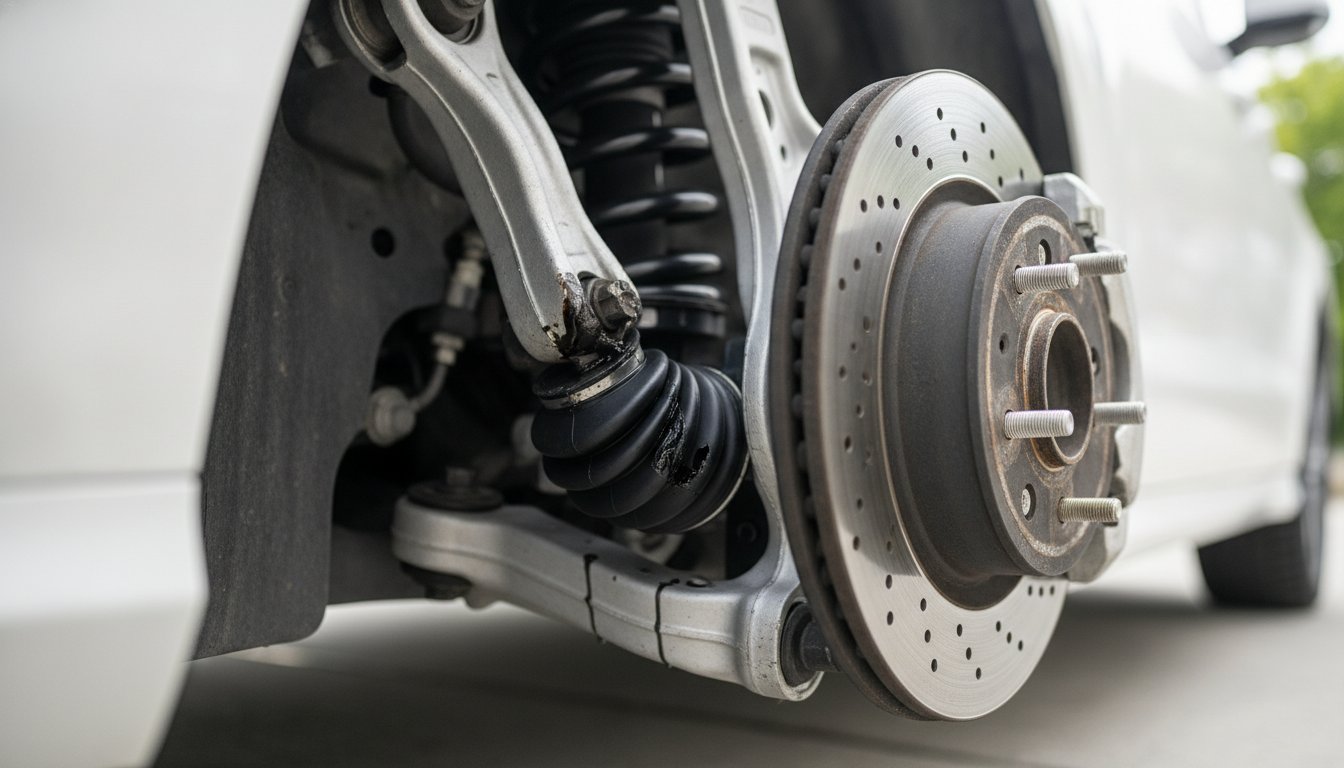
You’re pulling into a tight parking space when it happens: a rhythmic, metallic clicking sound echoing off the pavement. It’s loud, it’s consistent, and it feels like your car is trying to tell you something expensive is about to happen. Identifying the signs of a bad cv joint early is the best way to stop a simple maintenance task from spiralling into a full axle replacement or an unexpected breakdown on the motorway.
We know how stressful it is when your vehicle starts making strange noises, especially when you have a WOF inspection looming. It’s easy to feel overwhelmed by mechanical jargon, but understanding your car’s health shouldn’t be a mystery. We believe in being a transparent partner for your car’s maintenance, helping you drive with confidence instead of crossing your fingers every time you turn the steering wheel.
In this 2026 guide, we will walk you through the five red flags that indicate your CV joints are failing and explain why a torn boot is an automatic WOF failure in New Zealand. You will learn how to diagnose the issue from your driver’s seat and understand exactly when it’s time to call in a professional to keep your vehicle roadworthy and your repair costs down.
Key Takeaways
- Spot the most common signs of a bad cv joint, like rhythmic clicking or grease leaks, to avoid getting stranded on the road.
- Learn why a split CV boot is an automatic WOF failure in New Zealand and how early intervention prevents expensive axle damage.
- Use our DIY parking lot test to quickly diagnose if that strange noise is a safety risk or a simple fix.
- Distinguish between inner and outer joint failures so you can describe the problem clearly to your mechanic.
- Find out how to secure a transparent, professional repair through a mobile service that fits your busy schedule.
What is a CV Joint and Why Does it Fail?
Your car’s drive axle is a hardworking component that bridges the gap between the transmission and the wheels. At the heart of this system is the Constant-velocity joint, or CV joint. These joints are engineered to transmit power at a constant speed even as your wheels bounce over speed bumps or turn through tight corners. Without them, your steering would be jerky and your suspension would be rigid. Recognising the early signs of a bad cv joint is crucial because these parts are under constant physical stress while you drive.
Every CV joint is wrapped in a thick rubber or plastic sleeve called a CV boot. This component has two vital jobs: it keeps the high-pressure lubricating grease inside the joint and prevents New Zealand road grit, water, and mud from getting in. Most mechanical failures start right here. When the rubber perishes or tears, the grease escapes and contaminants enter the metal bearings. This creates friction that quickly destroys the joint’s internal surfaces, leading to total failure if ignored.
The Anatomy of Your Drive Axle
A standard drive axle features two distinct joints. The outer joint sits near the wheel and handles the heavy lifting of steering, making it the most common failure point. The inner joint connects to the gearbox and moves vertically to follow the road’s surface. In front-wheel drive cars, CV joints manage both power and steering, while in all-wheel drive vehicles, they distribute power to all four corners to maintain traction. These components work in tandem to ensure your ride stays smooth regardless of the terrain.
Common Causes of CV Joint Wear in NZ
Our local driving conditions put extra strain on these components. Winding regional roads require frequent, sharp steering adjustments that stretch the outer CV boots to their limits. If you live near the coast, salt air can cause the rubber to become brittle and crack prematurely. Similarly, frequent travel on gravel roads acts like sandpaper against the boots, accelerating wear and tear. For older passenger vehicles, simple high-mileage fatigue eventually causes the internal bearings to lose their precision, leading to the telltale signs of a bad cv joint.
Catching a problem early is the difference between a quick maintenance task and a major repair. If you spot a split boot before the joint starts clicking, you can often just replace the rubber sleeve and pack it with fresh grease. Once the metal starts grinding, however, the entire axle usually needs to be replaced. Being proactive saves money and ensures you won’t be left waiting for a tow truck on the side of the road.
5 Symptoms of a Bad CV Joint You Shouldn’t Ignore
Identifying the signs of a bad cv joint before they lead to a complete breakdown is essential for your safety and your wallet. Your car usually gives you fair warning before a joint fails completely. Pay attention to how your vehicle feels and sounds during your daily commute. If you catch these symptoms early, you might save yourself from a much larger repair bill later on.
The ‘Clicking’ Sound: The Classic Warning
This is the most common indicator of a worn outer joint. You’ll likely hear a rhythmic clicking or popping noise, but only when the wheels are turned at a sharp angle. This happens because the worn internal bearings are forced into the corners of their housing. As you accelerate through the turn, the clicking will speed up to match your wheel rotation. If the noise happens while turning left, your left-side joint is almost certainly the culprit.
Visible Grease: The Telltale Mess
Think of this as the smoking gun of a failed component. CV joints are packed with thick, dark grease that’s held in by a rubber boot. If that boot perishes or tears, centrifugal force flings the grease out as the axle spins. You’ll find this dark mess splattered on the inside of your wheel rim or across the wheel arch. To a non-mechanic, a torn boot looks like a cracked or split accordion-style rubber sleeve. Don’t ignore this; if grease leaks onto your brake rotors, it can seriously compromise your stopping power.
Vibrations are another red flag you can’t afford to overlook. If your car feels like it’s shivering, and that sensation gets more intense as you speed up, you likely have an issue with an inner CV joint. Unlike the clicking sound, these vibrations often occur while driving in a straight line. It’s a sign that the joint is no longer balanced or has developed excessive play, which can quickly lead to further drivetrain damage.
Listen for a heavy clunking sound when you shift from Drive to Reverse or when you suddenly accelerate. This noise suggests the joint has too much slack. The internal components are hitting each other rather than transferring power smoothly. Similarly, if you notice a distinct shuddering sensation specifically when the vehicle is under load, such as when you’re climbing a steep hill, the joint is struggling to handle the engine’s torque.
Don’t ignore these signs of a bad cv joint, as a total failure could leave you stranded without drive to your wheels. If your car is acting up, the smartest move is to get a professional diagnosis. You can easily book a CV Joint & Boot Repair to have an expert technician ensure your vehicle remains roadworthy and safe for your next trip.
Inner vs. Outer CV Joint: How to Tell the Difference
Your car’s drive axle isn’t just a single solid rod. It relies on two distinct types of joints to keep you moving. While they both serve the same ultimate purpose, their location on the axle determines how they fail and what you’ll feel from the driver’s seat. Knowing the difference helps you understand the urgency of the repair and prevents you from being misled by vague mechanical jargon.
Outer joints are the most common failure point. They sit right at the end of the axle, tucked into the wheel hub. Because they have to manage the extreme angles of steering while the suspension moves up and down, they undergo much more physical stress than their inner counterparts. This constant pivoting makes them highly susceptible to wear, especially on New Zealand’s winding roads. When you start searching for the signs of a bad cv joint, the outer joint is usually the first place a mechanic will look.
Identifying Outer CV Joint Failure
The outer joint’s primary job is to transmit power while you steer. Because of its proximity to the road, it’s frequently hit by stones, grit, and debris. If the protective boot is punctured, the joint fails quickly. You’ll notice steering-related symptoms first. Listen for a sharp, rhythmic clicking when cornering or making U-turns. This happens because the joint’s internal bearings are struggling to rotate smoothly at a sharp angle. If the noise disappears when you’re driving straight but returns the moment you turn the wheel, your outer joint is the culprit.
Identifying Inner CV Joint Failure
Inner joints are located at the opposite end of the axle, where it connects to the transmission or gearbox. These joints fail less frequently because they don’t have to pivot for steering. However, when they do wear out, they cause a distinct “body shudder” during heavy acceleration. This side-to-side vibration can be quite severe and is often mistaken for an unbalanced tyre or a failing engine mount. You might also hear a loud clunk when shifting from Reverse to Drive. Because the inner joint is directly linked to your drivetrain, ignoring these signs of a bad cv joint can eventually cause expensive damage to your transmission seals and internal gears.
Understanding these differences allows you to catch problems before they escalate. While an outer joint issue might start as a nuisance noise, an inner joint problem can compromise your entire gearbox health. Both require a professional eye to ensure your vehicle remains safe and roadworthy for the long haul.
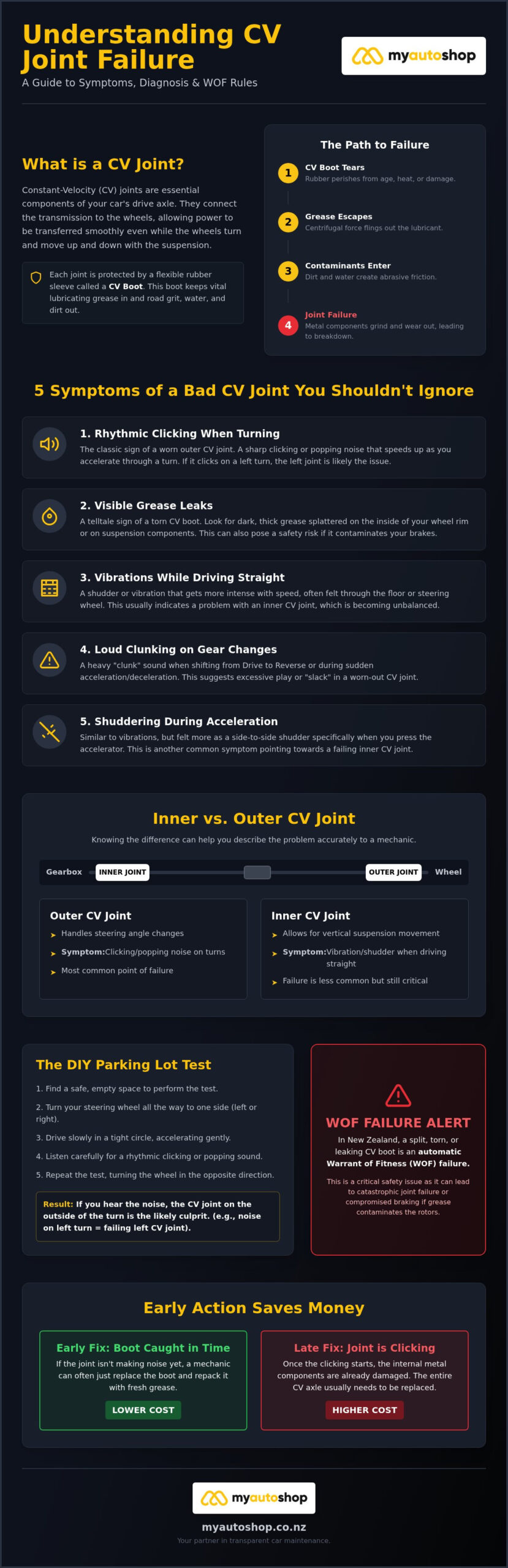
The DIY Parking Lot Test: A Step-by-Step Diagnostic
You don’t need a hoist or a degree in mechanical engineering to spot the signs of a bad cv joint. A simple, controlled driving test can give you a clear answer in minutes. This method is the best way to confirm if that intermittent noise is actually a failing axle or something else entirely. We believe in empowering you with the right information so you can make informed decisions about your vehicle’s safety.
First, find a flat, open space with plenty of room to manoeuvre, such as an empty supermarket parking lot after hours. This ensures you have the freedom to move without the stress of traffic or obstacles. Follow these steps to perform the diagnostic:
- Start the engine and shift your car into reverse.
- Turn the steering wheel fully to one side until it reaches the end of its travel.
- Slowly accelerate in a circle and listen closely for a rhythmic ‘click-click-click’ sound.
- Straighten up and repeat the process by turning the wheel in the opposite direction.
- While the wheels are still turned, use a torch to safely inspect the inner wheel arch for any dark, thick grease splattered on the suspension components or the back of the tyre.
What Your Results Mean
The direction of your turn often reveals which side is failing. Generally, hearing a noise while turning left points to a worn right-side joint, as the weight of the vehicle shifts to the outside of the turn, though a mechanic will confirm the exact side during a physical inspection. A faint click suggests early wear where the joint is losing lubrication, while a heavy clunking sound indicates significant metal-on-metal damage. If the noise is loud enough to be heard over your radio or the car feels like it’s jumping, stop testing immediately and call a professional.
Safety Precautions During Testing
Always prioritise safety. Ensure you have clear visibility in all directions and confirm no pedestrians are nearby before you start circling. When turning the wheel, avoid holding it at ‘full lock’, the very end of its turning range, for more than a few seconds. This prevents unnecessary pressure on your power steering pump. If the steering starts to ‘bind’ or feel like it’s getting stuck, it’s a sign that the joint is close to seizing. Don’t push the car further if you feel this instability.
Once you’ve confirmed the signs of a bad cv joint, don’t wait for the part to fail completely. You can book a professional CV Joint & Boot Repair online to have a mobile mechanic or local workshop fix the issue before it leaves you stranded.
Repair Options and WOF Implications in New Zealand
In New Zealand, the Warrant of Fitness (WOF) manual is very clear about drivetrain safety. A split, torn, or missing CV boot is an automatic failure. This is because a damaged boot allows essential grease to escape while letting road grit and moisture in. Once you notice the signs of a bad cv joint, your vehicle is already on a countdown to a more expensive fix. Catching a tear early often means you can simply replace the rubber boot, but waiting until the clicking starts usually necessitates a full axle replacement.
Will My Car Pass its WOF with a Noisy CV Joint?
The short answer is usually no. While a faint noise might not be the primary reason for a fail, the underlying cause almost always is. WOF inspectors look for “excessive play” in the joint or evidence of a boot failure. If there is grease splattered on the suspension or the boot is perished, you won’t get that sticker. Fixing the issue before your inspection saves you the stress of a “failed” result and the logistical headache of a re-check. It’s about more than just a piece of paper; it’s about ensuring your car won’t lose drive while you’re navigating a busy intersection.
Booking Your Repair with Confidence
Choosing between a boot repair and a full axle replacement depends on how early you catch the signs of a bad cv joint. If the joint is still quiet and the only issue is a small tear, a simple boot replacement is a cost-effective way to protect the metal components inside. However, if you’ve been hearing a loud clicking sound for weeks, the internal bearings are likely damaged beyond saving. In this case, a full CV Joint & Boot Repair involving a new axle is the only safe path forward. We help you understand exactly what your car needs without the confusing mechanical double-talk.
My Auto Shop removes the guesswork from this process. We provide access to a nationwide network of pre-vetted mechanics who value transparency as much as you do. If you’re stuck at home or the office, our mobile mechanic options can come to you for a professional inspection. This service is designed for busy lives, bringing the workshop to your driveway so you don’t have to disrupt your day. You get the convenience of a modern digital platform paired with the reliability of a local expert who treats your car like their own.
Book a professional CV joint inspection with My Auto Shop today to ensure your car stays roadworthy and safe. Our commitment to openness means you’ll know exactly what’s happening with your repair every step of the way.
Keep Your Drive Smooth and Safe
Ignoring the signs of a bad cv joint doesn’t just lead to annoying noises; it’s a direct path to an expensive breakdown or a failed WOF. By spotting grease leaks or clicking sounds early, you can often fix a simple boot tear before it destroys the entire axle. Your car’s safety depends on these hardworking components transferring power smoothly to your wheels, especially on winding regional roads.
Identifying the problem is the first step, but getting it fixed shouldn’t be a source of anxiety. We’ve built a platform that removes the mystery from car repairs by connecting you with a vetted network of professional NZ mechanics. Whether you prefer a local workshop or need a mobile mechanic to visit your home or office, we ensure you receive transparent pricing with no hidden surprises. Our goal is to act as your reliable partner, stripping away the jargon and focusing on your safety.
Don’t wait for your steering to bind or for a failed inspection sticker to appear on your windscreen. Get a transparent quote for CV joint repair from a local expert today and enjoy the peace of mind that comes with a roadworthy vehicle. We’re here to help you get back on the road with total confidence.
Frequently Asked Questions
Can I drive with a bad CV joint for a long time?
Driving with a worn CV joint is not recommended for more than a few days. While the car might feel okay initially, the joint can seize or snap without warning. This results in a complete loss of power to the wheels, leaving you stranded. It’s much safer and more cost-effective to address the issue as soon as you notice the signs of a bad cv joint rather than risking a breakdown.
How much does it cost to fix a CV joint in NZ?
Repair costs vary significantly based on your vehicle’s make, model, and the extent of the damage. A simple boot replacement is generally the most affordable option if caught early. However, if the joint itself has failed, the cost increases because a full axle replacement is usually required. We provide transparent, upfront quotes through our platform so you can understand the investment required without any hidden surprises, guesswork, or confusing mechanical jargon.
What happens if a CV joint breaks while driving?
If a CV joint fails completely while you’re moving, the axle will stop transmitting power to the wheel. You’ll lose the ability to accelerate, and the engine will simply rev without moving the car. In some cases, the loose axle can flail around, causing secondary damage to your suspension, brake lines, or transmission. This is a major safety risk that requires an immediate tow to a professional workshop for repair.
Is a clicking sound always a CV joint?
While a rhythmic clicking during turns is a classic indicator, other issues can cause similar noises. A loose wheel nut, a failing wheel bearing, or even a pebble caught in your brake assembly might produce clicking or grinding sounds. However, if the noise specifically speeds up as you accelerate through a corner, it’s highly likely to be one of the signs of a bad cv joint. A professional inspection is the only way to be certain.
How long do CV joints usually last in passenger cars?
Most CV joints are designed to last between 150,000 and 250,000 kilometres under normal driving conditions. However, their lifespan depends heavily on the integrity of the protective rubber boot. If the boot tears and allows grit to enter the joint, it can fail in as little as a few thousand kilometres. Regular checks during your routine servicing help ensure they reach their maximum potential mileage without incident or an unexpected failure on the road.
Does a torn CV boot always mean the joint is bad?
A torn boot doesn’t automatically mean the joint is ruined, but it’s a critical warning. If you catch the tear before the grease has leaked out and dirt has entered, you can often just replace the boot. This is a proactive fix that saves the expensive internal metal components. Once you start hearing clicking or feel vibrations, the joint has likely suffered internal wear and will need a full replacement to remain roadworthy.
Can a bad CV joint cause a car to shake at high speeds?
Yes, a failing inner CV joint often causes the vehicle to shudder or vibrate, especially during heavy acceleration or at motorway speeds. Unlike the clicking of an outer joint, this vibration feels like it’s coming from the centre of the car. It can sometimes be mistaken for unbalanced tyres. If the shaking stops when you take your foot off the accelerator, it’s a strong sign the inner joint is the primary culprit.
Will a CV joint failure damage my transmission?
It can. If an inner CV joint fails, it can put excessive stress on the transmission’s output shaft and seals. This often leads to transmission fluid leaks or internal gear damage. Additionally, if the axle snaps while driving, the loose end can strike the transmission casing, causing cracks or other catastrophic failures. Addressing joint issues early protects your entire drivetrain from these avoidable and much more expensive repairs later on.
Disclaimer
This article provides general information only and should not be relied on as professional mechanical, safety or legal advice. Vehicle requirements and circumstances vary. If you are unsure about your vehicle, have it inspected by a qualified automotive professional.