
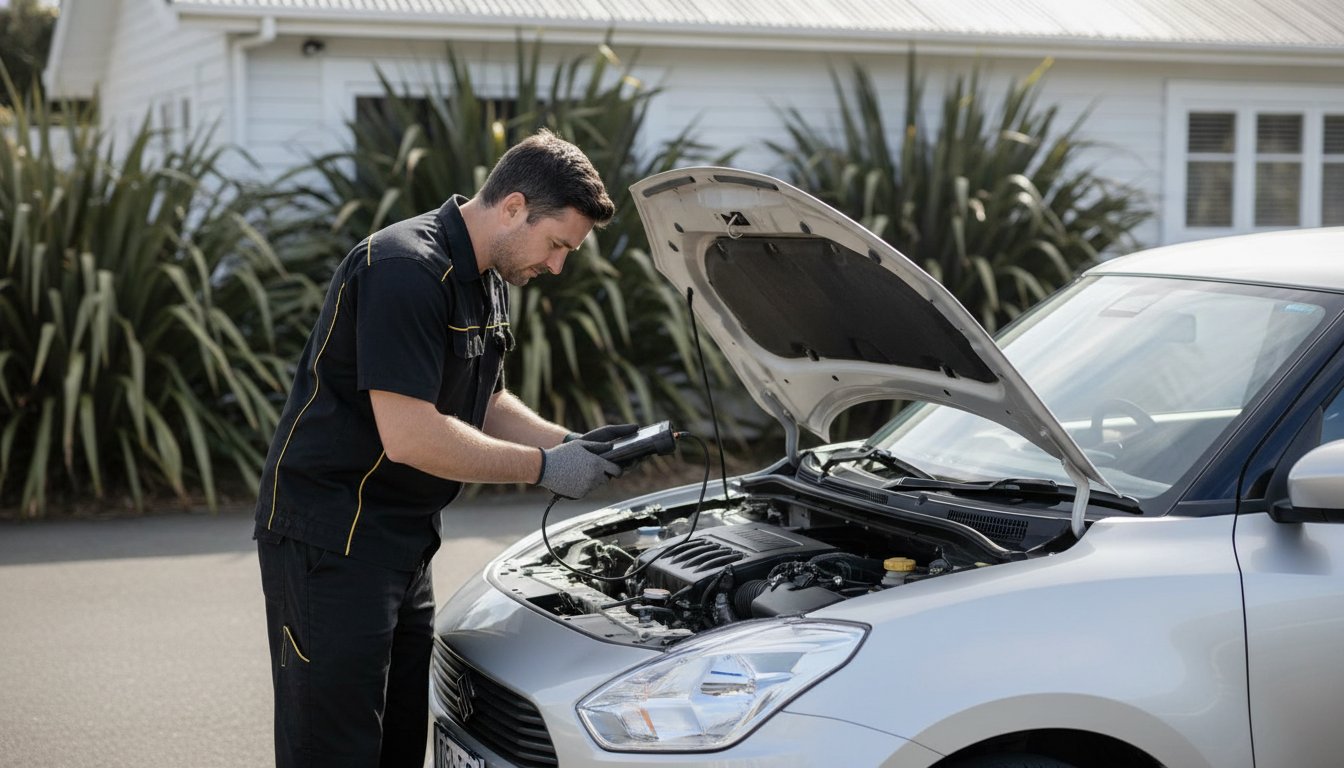
You’re pulling out of a busy intersection when your car shudders, the revs climb, but you aren’t actually moving any faster. It’s a sinking feeling that every owner dreads; however, you aren’t alone in facing Suzuki Swift transmission issues nz. Whether you’re driving a zippy JDM import or an NZ-new GLX, your gearbox is the heart of your drive. We know that hearing a weird whine or feeling a “slip” can immediately trigger fears of a massive, unpayable repair bill. Most Swift owners love these cars for their efficiency, but a sudden transmission fault can turn a fun commute into a stressful nightmare.
At My Auto Shop, we believe you deserve clear answers instead of confusing technical jargon. This 2026 guide helps you identify exactly what’s wrong with your gearbox and whether your car is still safe to drive on Kiwi roads. We’ll explore the costs of remanufactured units, which can range from NZ$2,525 to over NZ$3,725 depending on your model year, and explain how the Consumer Guarantees Act protects your rights. From identifying bearing wear to understanding CVT fluid maintenance, we provide the steps you need to keep your Swift running smoothly without the financial guesswork.
Key Takeaways
- Spot early warning signs like low-speed shuddering or high-pitched whining to prevent a total gearbox failure.
- Identify the specific Suzuki Swift transmission issues nz affecting 2005-2017 models, including common manual bearing wear and CVT challenges.
- Learn why CVT fluid is never a “lifetime” product in New Zealand and how regular servicing protects your car from the strain of local hills.
- Get clear on the typical costs for remanufactured transmissions and how the Consumer Guarantees Act protects your rights as a vehicle owner.
- Discover why a professional diagnostic scan or a pre-purchase inspection is your best defense against buying a vehicle with hidden mechanical faults.
Understanding Suzuki Swift Transmissions in the New Zealand Market
Suzuki Swifts are a staple on New Zealand roads. From students in Dunedin to city commuters in Auckland, these hatchbacks are everywhere. They’re fuel-efficient and easy to park, but their popularity means there’s a huge range of used stock on the market. Maintaining the resale value of your car depends heavily on the gearbox. If you ignore potential Suzuki Swift transmission issues nz, you’ll likely find that buyers disappear as soon as they notice a shudder during a test drive. A healthy transmission is the difference between a quick sale and a car that sits on Trade Me for months.
CVT vs. Manual: Which Gearbox is in Your Swift?
Most Swifts in NZ use a Continuously Variable Transmission (CVT). Unlike a traditional automatic with fixed gears, a CVT uses a belt and pulley system to provide infinite gear ratios. It feels smooth and gearless, though some drivers find the “rubber band” acceleration a bit unusual at first. This happens when the engine revs stay high while the car catches up in speed. Manual gearboxes remain popular in the “Sport” models, offering a more tactile driving experience. While manuals are generally tough, the CVT is the most common source of Suzuki Swift transmission issues nz in the local market. Understanding the Suzuki Swift model history helps clarify why certain years moved toward CVT technology to meet stricter fuel economy targets. If you aren’t sure which one you have, look at your gear shifter; a CVT won’t have the traditional 1-2-3-4-5 layout.
Why Japanese Imports Require Extra Transmission Vigilance
New Zealand’s car parks are full of Japanese Domestic Market (JDM) imports. These cars often look mint on the outside, but they arrive at our wharves with “hidden” service histories. A car that spent five years idling in heavy Tokyo traffic has a very different wear profile than an NZ-new model. Our hilly terrain and open-road speeds put much higher thermal stress on the transmission than Japanese city driving. Steep climbs in places like Wellington or the Kaimai Range require the gearbox to work much harder. Before you buy, check the auction grade and ask for any import paperwork. It’s also wise to book a pre-purchase inspection to ensure the gearbox fluid hasn’t been burnt out by the stop-start life it led overseas. This transparency helps you avoid expensive repairs down the road.
Common Symptoms of Suzuki Swift Transmission Failure
Identifying Suzuki Swift transmission issues nz starts with your senses. You don’t need to be a qualified mechanic to notice when your car isn’t behaving. Early detection is your best defense against a total gearbox failure, which can cost thousands of dollars to resolve. In New Zealand, our varied driving conditions, from steep Wellington hills to stop-start Auckland traffic, often make these symptoms appear sooner than you might expect. If your car feels different during your morning commute, it’s time to pay attention.
The Infamous CVT Shudder and Hesitation
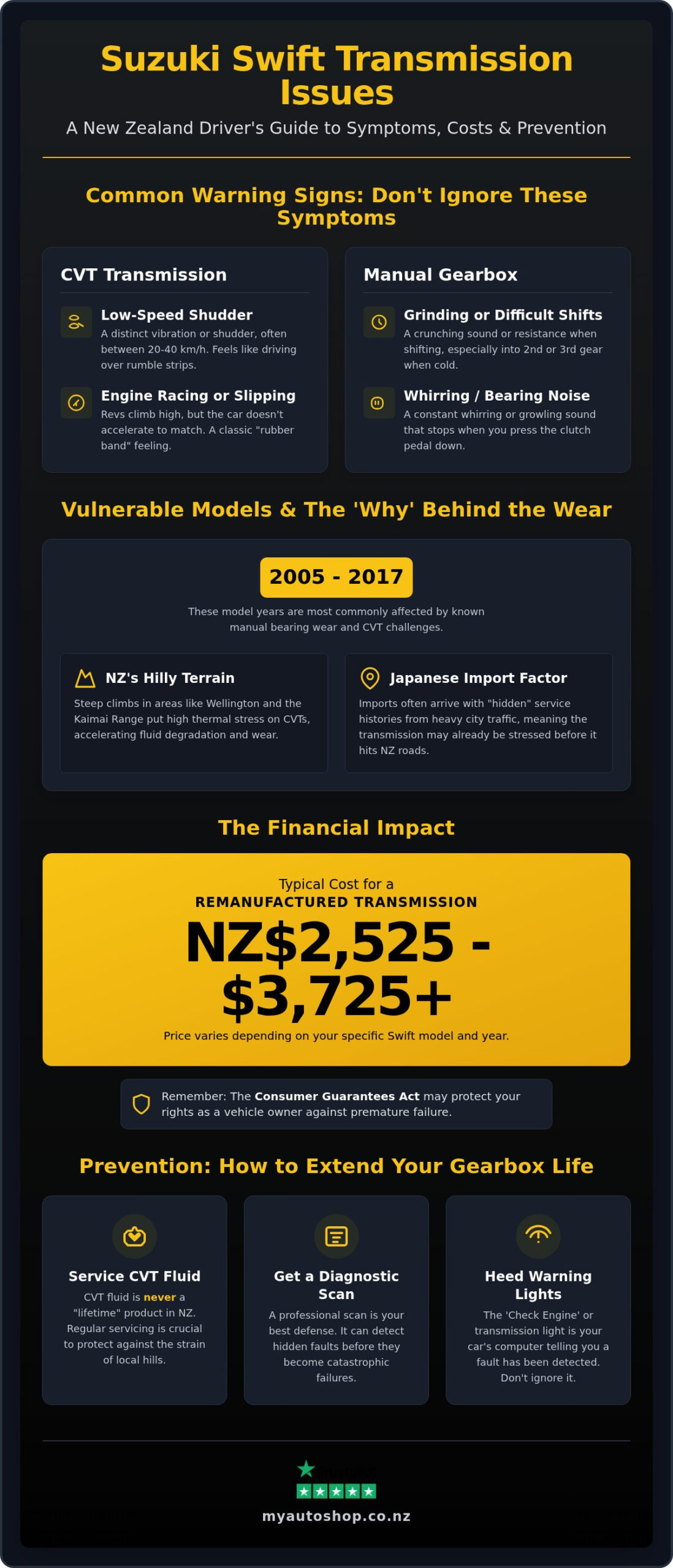
The most reported symptom in CVT-equipped Swifts is a distinct shudder or vibration. This usually happens at low speeds, typically between 20km/h and 40km/h, as you accelerate away from a traffic light. It feels similar to driving over a small patch of rumble strips. You might also notice the engine “racing.” This occurs when the revs climb significantly, but the car doesn’t actually gain speed at the same rate. CVT slipping is a mismatch between engine RPM and wheel speed. If you’re feeling a strange vibration or lag, a mobile mechanic can perform a diagnostic check at your home or office to see if a fluid flush or a more serious repair is needed.
Manual Gearbox Red Flags: Grinding and Bearing Noise
Manual Swifts have their own set of warning signs. One of the most common is difficulty shifting into second or third gear, especially when the car is cold. If you hear a crunching or grinding sound during these shifts, the synchronizers inside the gearbox may be wearing out. Another specific red flag is the “input shaft bearing” noise. This sounds like a constant whirring or growling while the car is idling or moving. Crucially, this noise usually stops the moment you press the clutch pedal down. You should also check the weight of your clutch pedal. A heavy or stiff pedal often indicates an aging pressure plate that’s nearing the end of its life.
Don’t ignore the dashboard. If the “Check Engine” light or a specific transmission warning light illuminates, your car’s computer has detected a fault in the sensors or hydraulic pressure. Understanding your rights for car repairs is crucial if you’ve recently purchased a vehicle with these symptoms. Under the Consumer Guarantees Act, repairs must be completed with reasonable care and skill, ensuring your Swift remains fit for purpose on Kiwi roads.
The Most Vulnerable Suzuki Swift Generations and Models
Not every Swift is a ticking time bomb. Knowing which generation you’re driving helps narrow down potential Suzuki Swift transmission issues nz. The New Zealand used car market is flooded with various versions, ranging from high-spec NZ-new models to JDM imports with high mileage. Each era has its own mechanical quirks that you should be aware of before signing a purchase agreement.
The CVT Struggle: 2011-2017 Model Years
The ZC72S era is easily the most reported for CVT trouble. Early software in these models often failed to manage hydraulic pressure correctly, which led to premature wear on the internal steel belt. This specific generation is a common source of Suzuki Swift transmission issues nz due to its early belt design and sensitivity to fluid quality. If you’re looking at a car from these years, check the service book for a CVT fluid flush. Ideally, this should happen every 40,000km to 60,000km under local driving conditions. If you’ve already purchased a car with these faults from a dealer, you should understand your rights under consumer law. The Consumer Guarantees Act ensures that the vehicle must be of acceptable quality, which includes a functioning transmission.
Early Generation Manual Bearing Failures
The 2005-2010 models (ZC21S/ZC31S) are legendary for a different reason: manual gearbox “whine.” This high-pitched sound usually starts in 1st and 2nd gear and gets louder as you accelerate. It’s almost always the input shaft bearing failing. Ignoring this noise is a massive gamble. If that bearing eventually disintegrates, it can punch a hole directly through the gearbox casing. At that point, a simple bearing replacement becomes a total gearbox swap. For these older models, the cost of a full rebuild often rivals the car’s market value, making early detection the only way to save the vehicle.
Thankfully, the 2017+ (ZC33S) models, including the Smart Hybrid and Turbo variants, have shown significant reliability improvements. Suzuki updated the CVT logic and strengthened internal components to handle the extra torque from the turbo engines. However, mileage remains the great equaliser. A high-mileage import with 120,000km on the clock will always carry more risk than a low-mileage local car. Booking a pre-purchase inspection is the best way to ensure you aren’t buying someone else’s expensive problem.
Prevention and Maintenance: Extending Your Gearbox Life
Many owners are told their transmission fluid is “filled for life.” In the context of Suzuki Swift transmission issues nz, this is a dangerous misconception. New Zealand’s unique landscape, characterized by short urban trips and steep inclines, places immense thermal stress on the gearbox. Heat is the primary enemy of any transmission, and once the fluid breaks down, internal wear accelerates rapidly. Proactive maintenance is the only way to avoid the NZ$3,000 plus bill that comes with a full replacement.
The Importance of Regular Transmission Fluid Changes
CVT fluid is a sophisticated hydraulic liquid that manages both lubrication and pulley pressure. In NZ, fluctuating temperatures and high-load hill driving cause this fluid to oxidize and lose its protective properties faster than in flatter, more temperate climates. Avoid using generic “multi-vehicle” fluids. These often lack the specific friction modifiers required for Suzuki pulleys, which can lead to belt slippage. CVT fluid should ideally be replaced every 40,000km to 60,000km in NZ. If you’re only doing a “drain and fill,” you’re only replacing about half the old fluid. For a car with higher mileage, a full transmission flush is often a better investment to ensure the entire system is clean.
Driving Habits That Protect Your Transmission
Your right foot has a direct impact on your gearbox’s lifespan. Stop doing “jack-rabbit” starts where you floor the accelerator the moment the light turns green. This sudden torque spike puts massive strain on the CVT belt and can lead to premature stretching. Another common Kiwi habit to break is “holding” the car on a hill using the accelerator instead of the brake. This generates massive internal heat and can glaze the transmission’s friction components. When you’re tackling mountain passes or steep descents, use the ‘L’ (Low) or ‘Sport’ mode. This engages engine braking, which protects your transmission from overheating while also saving your brake pads from excessive wear.
Sometimes, what feels like a mechanical failure is actually a software glitch. Modern Swifts rely on an Electronic Control Unit (ECU) to manage shifting logic. If your car is jerky or “hunts” for the right ratio, a simple software reflash can often resolve the issue without opening the gearbox. If your gearbox is already showing signs of wear or you’ve missed a service interval, book a comprehensive service to have your fluid quality checked by a professional before a small problem becomes a major failure.
Repairing or Replacing Your Swift Transmission in New Zealand
Once you’ve identified a potential fault, the next step is a clear diagnosis. Jumping straight to a full replacement is a costly mistake; many Suzuki Swift transmission issues nz are actually caused by faulty sensors or minor electrical gremlins. A professional mechanic uses a high-end scan tool to read the car’s internal data. This tells them if the problem is a simple solenoid failure or a terminal mechanical breakdown within the pulleys. Getting this right early prevents you from paying for a new gearbox when you only needed a sensor.
If the damage is mechanical, you have a choice: repair the internals or install a reconditioned unit. Reconditioned gearboxes are often the smarter play for JDM imports. They come with a warranty and have been rebuilt to address the original factory weaknesses. Avoid buying a “box” from a car wrecker unless you have no other choice. You have no way of knowing if that second-hand unit has been serviced or if it’s just weeks away from the same failure you’re currently facing. It’s a gamble that often results in paying for labour twice.
When to See a Mechanic: Diagnostic Costs vs. Repair Costs
A proper transmission road test involves more than just a quick lap around the block. A specialist looks for specific shift patterns and listens for bearing frequencies that indicate internal wear. They can distinguish between a slipping clutch and a software-induced lag. This level of detail saves you from the “parts cannon” approach where mechanics replace components until the problem disappears. If your car is acting up, book a diagnostic check-up with a local My Auto Shop expert to get a transparent breakdown of what’s really going on under the bonnet.
The Ultimate Protection: Booking a Pre-Purchase Inspection
Never assume a fresh Warrant of Fitness (WOF) means a car is mechanically sound. A WOF only checks safety items like tyres, lights, and brakes; it doesn’t look at the health of a CVT belt or manual bearings. A dedicated Pre-Purchase Inspection (PPI) is the only way to catch a failing transmission before you own it. My Auto Shop inspectors specifically test for the infamous CVT shudder and clutch slip under load. Since a remanufactured CVT for a post-2011 Swift can cost NZ$3,725 plus installation, a PPI is a tiny investment by comparison.
If the report shows early signs of wear, you can either walk away or use that information to negotiate the price of the used Swift. It’s the best insurance you can buy in the NZ used car market. Avoid a lemon – book your NZ-wide Pre-Purchase Inspection here and ensure your new car doesn’t come with an immediate repair bill.
Take Control of Your Swift’s Future
Identifying Suzuki Swift transmission issues nz early is the best way to keep your car on the road and your bank account intact. By staying alert to low-speed shudders and committing to regular fluid changes every 40,000km to 60,000km, you can prevent minor wear from turning into a total gearbox failure. Whether you’re navigating the hills of Wellington or the motorways of Auckland, proactive care ensures your hatchback remains the reliable daily driver you need.
Ready for expert help? Our network of professional mechanics nationwide is here to provide clarity. We offer fixed-price pre-purchase inspections to help you avoid a “lemon”; additionally, our mobile mechanics can come directly to your home or work for diagnostic checks. Get a transparent quote for your Suzuki Swift repair or inspection today. You don’t have to navigate mechanical jargon alone; we are here to make your car maintenance simple and stress-free.
Frequently Asked Questions
Is the Suzuki Swift CVT transmission reliable?
Later models from 2017 onwards are generally very reliable, but earlier CVT units from 2011 to 2017 are more sensitive to wear. These gearboxes require strict adherence to fluid change intervals to avoid premature failure. While they provide excellent fuel economy, their long-term health on New Zealand roads is directly linked to how often they’ve been serviced. Neglecting maintenance in these specific years often leads to expensive mechanical faults.
How much does it cost to fix a Suzuki Swift transmission in NZ?
Minor transmission repairs like sensor replacements generally cost between $300 and $800 in the New Zealand market. Major internal work typically falls in the $1,500 to $3,500 range. For a full replacement, remanufactured CVT units for post-2011 models are priced around NZ$3,725 plus installation. These figures highlight why identifying Suzuki Swift transmission issues nz early is the best way to protect your finances from a massive bill.
Can I drive my Swift with a transmission shudder?
You should avoid driving your Swift if you feel a persistent shudder or vibration during acceleration. This sensation usually indicates that the CVT belt is slipping or that the hydraulic pressure is inconsistent. Continuing to drive will cause further internal damage and may lead to a sudden breakdown on a busy road. It is much safer and cheaper to have the vehicle inspected immediately by a professional mechanic.
What is the difference between NZ-new and JDM Swift transmissions?
Mechanically, the transmissions are often identical, but their histories and wear profiles differ significantly. NZ-new models usually have verifiable service records from local dealers and are used to our hilly terrain. Japanese Domestic Market (JDM) imports often arrive with unknown maintenance histories and may have faced higher wear from Tokyo’s heavy traffic. This makes a pre-purchase inspection essential for any import to ensure the gearbox fluid hasn’t been burnt out overseas.
How often should I change the transmission fluid in my Suzuki Swift?
You should replace your transmission fluid every 40,000km to 60,000km to ensure long-term reliability. New Zealand’s steep hills and short city trips put extra stress on the oil, causing it to break down faster than a “lifetime” suggestion might imply. Regular changes are the most effective way to prevent Suzuki Swift transmission issues nz and extend the life of the pulleys and belts. Always use the correct Suzuki-spec fluid for the best results.
Does a Warrant of Fitness (WOF) check the transmission?
A Warrant of Fitness does not cover the mechanical health or performance of your transmission. The WOF inspection focuses strictly on safety items like tyres, lights, seatbelts, and structural integrity. It will not detect a slipping CVT belt, worn manual bearings, or degraded gearbox fluid. To check the transmission, you need a specific mechanical inspection or a comprehensive service that includes a diagnostic scan of the car’s computer system.
Why is my Suzuki Swift making a whining noise when I accelerate?
A high-pitched whining noise is usually a sign of bearing wear or hydraulic pump issues. In manual models, this often points to the input shaft bearing, which can fail if left unaddressed for too long. In CVT models, a whine can indicate that the internal pump is struggling or that the fluid is no longer providing adequate lubrication. If the noise gets louder as your vehicle speed increases, you should book a diagnostic check immediately.
Is it worth replacing the transmission on an older 2007 Suzuki Swift?
This depends on the overall condition and current market value of your specific vehicle. A full transmission replacement can cost between $2,000 and $4,000, which might approach the total resale value of a 2007 model. If the rest of the car is in excellent shape, a reconditioned gearbox might be a sound investment. However, if other major repairs are looming, it may be more economical to trade the vehicle in its current state.
Disclaimer
This article provides general information only and should not be relied on as professional mechanical, safety or legal advice. Vehicle requirements and circumstances vary. If you are unsure about your vehicle, have it inspected by a qualified automotive professional.