

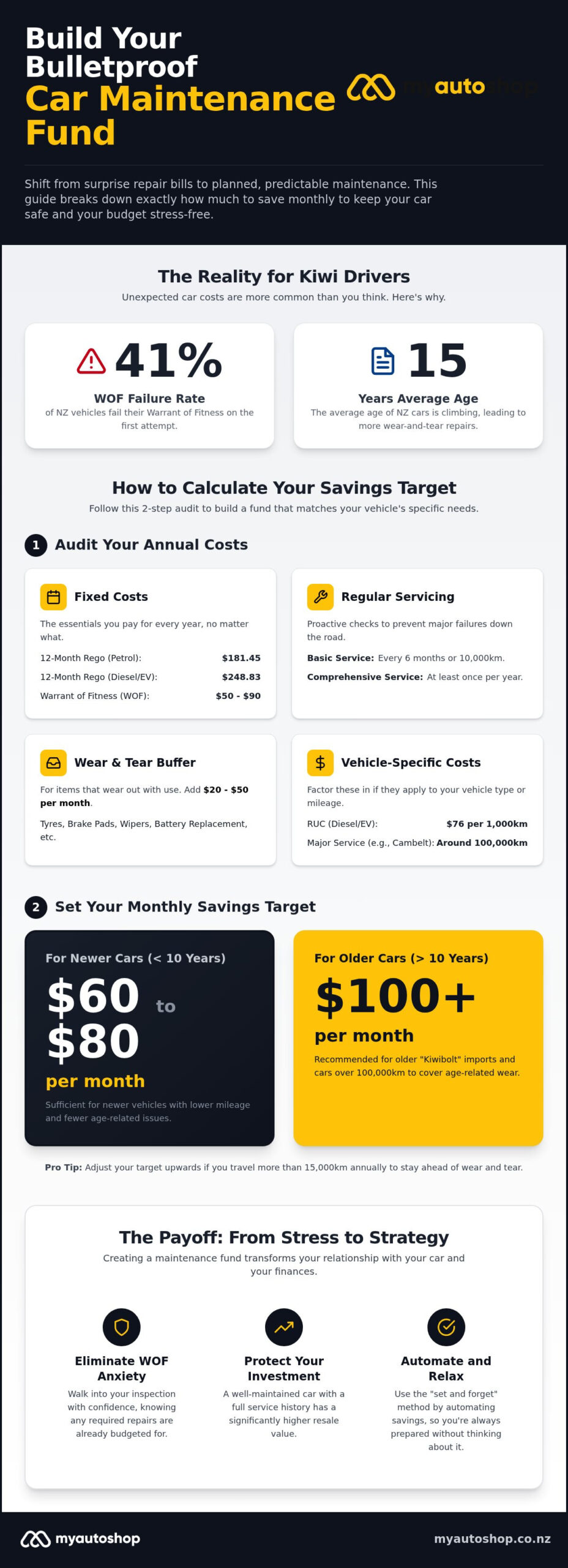
Did you know that over 41% of Kiwi vehicles now fail their Warrant of Fitness on the first try? With the average age of cars in New Zealand climbing toward 15 years in 2026, those unexpected mechanical surprises are becoming the new normal for many drivers. It’s a genuine stress when a routine check-up turns into a massive bill for a new clutch or a cambelt replacement you didn’t see coming.
We understand that car repairs shouldn’t feel like a gamble with your monthly budget. By creating a car maintenance fund, you can transform these high-pressure moments into simple, planned expenses that don’t disrupt your life. Learn how to build a bulletproof savings plan that protects your wallet and keeps your vehicle road-ready.
This guide breaks down specific monthly savings targets for 2026. We’ll explain how to account for the latest registration and RUC increases while providing a clear roadmap for total peace of mind before your next service.
Key Takeaways
- Shift your mindset from “emergency repairs” to “predictable maintenance” to eliminate the stress of your next annual WOF check.
- Learn the two-step audit process for creating a car maintenance fund that accounts for your vehicle’s specific age, mileage, and fixed NZ costs.
- Discover why spending a few hundred dollars on proactive maintenance like brake pads today saves you thousands on major engine or suspension failures tomorrow.
- Master the “set and forget” method by automating your savings into dedicated accounts so you are never caught short at the mechanic.
- Use transparent, upfront pricing tools to get a clear picture of your upcoming costs and make your maintenance fund go further.
Why Every Kiwi Driver Needs a Dedicated Car Maintenance Fund
Car repairs often feel like a sudden strike of bad luck. You’re driving to work, a light pops up on the dash, and suddenly your week is ruined. This reactive cycle is exhausting and expensive. By creating a car maintenance fund, you stop treating your vehicle like a ticking time bomb and start treating it like the asset it is. While a standard emergency fund handles truly unpredictable disasters, car maintenance is actually very predictable. You know your tyres will wear out. You know your oil needs changing. It’s an operational cost, not a surprise.
The “WOF Anxiety” Cycle and How to Break It
Most Kiwis dread the Warrant of Fitness. It feels like a test you’re destined to fail, especially with current failure rates sitting around 41%. When you don’t have a dedicated budget, a failed WOF isn’t just a mechanical issue; it’s a financial crisis. A maintenance fund breaks this cycle. It allows you to address small issues, like a thinning tyre or a flickering bulb, the moment they appear. Instead of crossing your fingers at the testing station, you walk in knowing your car is safe and the bill is already covered. The psychological relief of having that money ready is huge.
Maintenance as an Investment, Not an Expense
Think of regular servicing as insurance for your car’s future value. A vehicle with a documented service history is worth significantly more on the New Zealand used car market. Prospective buyers look for proof that you didn’t skimp on a Basic Service or ignore a critical Cambelt / Timing Belt Replacement. Proactive care prevents “big ticket” disasters. For example, catching a worn CV joint early is a simple fix. Ignoring it can lead to a total axle failure while you’re driving, which costs much more to repair.
Effective vehicle management means you stop reacting to problems and start preventing them. This approach keeps your car reliable and keeps your family safe. Creating a car maintenance fund ensures your bank account stays level when the next service reminder pops up.
Calculating Your Fund: How Much Should You Save for Car Repairs?
Start by auditing your vehicle’s specific needs based on its current age and mileage. A car approaching the 100,000km mark likely requires a Cambelt / Timing Belt Replacement, which is a significant milestone to budget for well in advance. You also need to factor in the fixed costs of running a car in New Zealand. As of 2026, the 12-month registration for a petrol vehicle is $181.45, while diesel or electric passenger vehicles cost $248.83. Standard WOF fees across the country typically range from $50 to $90, so it’s best to allocate the higher end of that scale to stay safe.
Next, estimate your annual servicing requirements to keep your engine healthy. Plan for a Basic Service every six months or 10,000km and a Comprehensive Service once a year. These regular check-ups prevent major mechanical failures and ensure your vehicle remains efficient on the road. Finally, apply the “Buffer Rule” by adding $20 to $50 per month for wear-and-tear items like tyres, wipers, or a Car Battery Replacement. Creating a car maintenance fund isn’t about guesswork; it’s about using these concrete figures to build a financial shield for your vehicle.
The “NZ Car Math” Framework
Different vehicles require different financial strategies. A standard hatchback is generally cheaper to maintain than a heavy SUV, which wears through tyres and brake pads much faster. If you drive an older “Kiwibolt” Japanese import, your monthly buffer should be slightly higher to account for age-related wear on suspension and cooling systems. Don’t forget to include Road User Charges (RUC) if you drive a diesel or electric vehicle. At $76 per 1,000km, these costs add up quickly. For someone doing 20,000km a year, that’s an extra $1,520 you need to account for in your annual budget plan.
Setting Your Monthly Savings Target
Aim to save $100 per month for vehicles over ten years old, while $60 to $80 is usually sufficient for newer cars. You can get a precise figure for your next service by using My Auto Shop to compare upfront pricing from local workshops. Creating a car maintenance fund based on real-time quotes is the best way to avoid financial stress. Adjust your target upwards if you travel more than 15,000km annually to stay ahead of the curve and keep your vehicle reliable. This proactive approach ensures you’re never caught off guard when the next service light appears.
The High Price of Procrastination: Maintenance vs. Emergency Repairs
Procrastination is the most expensive way to own a car in New Zealand. When you delay a small fix, you aren’t just saving money today; you’re essentially taking out a high-interest loan that you’ll pay back in massive repair bills later. By creating a car maintenance fund, you give yourself the financial leverage to act before a minor noise becomes a total breakdown. Maintenance is predictable and controlled. Emergency repairs are chaotic and often double or triple the original cost.
The “Cambelt Caution” is the perfect example of this math. A scheduled Cambelt / Timing Belt Replacement is a standard job that keeps your engine’s internal components in sync. If you spend the money now, your car stays reliable. If you wait until it snaps, the valves and pistons collide, often resulting in a wrecked engine. You move from a manageable maintenance cost to a bill that can easily exceed $5,000. When calculating car ownership costs, the price of doing nothing is always the highest figure on the page.
Regular oil changes are another simple way to protect your wallet. Fresh oil prevents sludge buildup and protects expensive parts like turbochargers. Skipping a Basic Service might save a few dollars this month, but the long-term damage to your engine’s internals can lead to total failure. Using your fund to tackle “Stage 1” problems, like a small fluid leak or a worn belt, prevents them from reaching “Stage 3,” where the car is no longer safe to drive.
Brake Pads and Safety Components
Brake systems are designed to give you plenty of warning. If you hear a high-pitched squeal or feel a pulse through the pedal, you likely need a Brake Pad Replacement. Catching this early is affordable. If you ignore it, the metal backing of the pad will grind into the rotor, requiring a much more expensive repair involving new rotors and potentially calipers. Your fund should also cover suspension issues. Ignoring a knock can lead to uneven tyre wear or the need for a Shock Absorber Replacement, which impacts your WOF and your safety on the road.
Cooling Systems and Batteries
Your cooling system is your engine’s life support. A small Radiator Repair & Replacement is a simple fix that prevents the engine from overheating. If the engine gets too hot, you risk a warped head gasket, which is one of the most expensive repairs a mechanic can perform. Similarly, predicting your Car Battery Replacement cycle is vital. Most batteries last three to five years in NZ conditions. A Comprehensive Service is the best tool for spotting these aging components before they leave you stranded in a supermarket car park on a rainy Tuesday.
How to Build and Manage Your Car Fund Without Stress
Managing your money should be as streamlined as your car’s digital dashboard. When creating a car maintenance fund, you need a system that works in the background. Don’t rely on your memory or willpower. Instead, choose a savings vehicle that keeps the money separate from your daily spending. Whether you use a dedicated high-interest account or a “bucket” within your main banking app, the goal is visibility without temptation. Keeping these funds in your primary transactional account often leads to “accidental” spending on groceries or weekend trips.
Automation: The Secret to Consistency
Align your savings transfer with your payday. If you get paid weekly, set up a small automatic transfer of $20 or $30 immediately. These micro-contributions are much easier to manage than a sudden $400 hit for a Comprehensive Service. Most NZ banking apps allow you to label these sub-accounts. Give it a clear name like “The Car Cloud” or “WOF Shield.” This “Set and Forget” method ensures your fund grows steadily, turning car care into a fixed subscription rather than a variable stressor.
Prioritising Your Repairs
If your fund is still in its early stages when a problem arises, you must triage. Safety items always come first. A WOF failure for thin tyres or a Brake Pad Replacement must take priority over cosmetic issues or minor oil leaks. If you’re unsure which repairs are urgent, you can book a Mobile Mechanic to give your vehicle a professional once-over. They provide an honest priority list, helping you decide what needs immediate attention and what can wait until your next payday.
Defining a “maintenance emergency” is vital for long-term success. A dead battery or a broken CV joint qualifies because they keep you off the road. A new set of floor mats or an audio upgrade does not. Once you dip into the fund for a major job like a Cambelt / Timing Belt Replacement, your next priority is replenishment. Treat the “loan” from your fund like a bill. Temporarily increase your weekly transfer until the balance returns to its target level. This discipline ensures you’re always prepared for the next service milestone. Creating a car maintenance fund is a marathon, not a sprint; consistency is what keeps your vehicle reliable for the long haul.
Using Your Fund Wisely with My Auto Shop’s Professional Network
You’ve done the hard work of creating a car maintenance fund. Now you need to ensure every dollar is spent efficiently. The traditional mechanic experience often involves dropping your car off and waiting for a phone call with a price you didn’t expect. This “sticker shock” is exactly what a maintenance fund is designed to avoid. By using a platform that prioritises transparency, you maintain control over your budget from start to finish. You stop being a passive bystander in your car’s care and become an informed partner.
Efficiency is at the heart of modern car care. Our network allows you to compare quotes from local professionals instantly. This means you can match the cost of a Comprehensive Service or a Brake Pad Replacement against your current fund balance before you even book. It removes the guesswork. It ensures you’re getting a fair price for quality work without the need to call five different garages for a quote. Your fund goes further when you have the tools to choose the best value for your specific needs.
Transparency in Car Care
Knowing the cost upfront is essential for financial clarity. When you book through us, you receive pre-approved repair costs. There are no hidden fees or mysterious “extra” parts added without your consent. We vet every mechanic in our national network for quality and reliability. You know your vehicle is in good hands. This level of openness is the ultimate signature of a modern service; it allows you to plan your withdrawals from your car fund with total precision. You know exactly what’s leaving your account before the work even begins.
Convenience That Fits Your Lifestyle
Busy Kiwi families don’t always have time to sit in a workshop waiting room. Mobile Mechanics are a game-changer for maintaining your vehicle without taking time off work. They come to your home or office. They perform everything from a Basic Service to a Car Battery Replacement on-site. This saves you the logistical headache of arranging drop-offs and pick-ups. If you’re planning to use your fund to upgrade your vehicle, booking a Pre-purchase Inspection ensures you aren’t buying someone else’s mechanical headaches. It’s the smartest way to protect your investment.
Take the next step in your vehicle management journey. Book your service or repair today and experience car care designed for the digital age. Whether it’s a routine check or a critical Cambelt / Timing Belt Replacement, we help you manage your vehicle with confidence. Creating a car maintenance fund was the first step; using it with a trusted partner is how you stay on the road safely.
Drive with Confidence: Your Road Map to Stress-Free Car Care
Taking control of your vehicle’s future doesn’t have to be a source of stress. By creating a car maintenance fund, you’ve moved from reactive panic to proactive planning. You now have the framework to calculate your monthly targets, automate your savings, and address “Stage 1” issues before they become “Stage 3” disasters. This simple financial shift ensures that your next WOF or major service is just another tick on your to-do list rather than a hit to your lifestyle.
Ready to put your plan into action? Our national network of top-rated NZ mechanics is here to help. You can enjoy total financial clarity with upfront, transparent pricing and the ultimate convenience of mobile mechanic options that come to you. Don’t let your car care wait for an emergency. We make it easy to maintain your vehicle’s value while respecting your busy schedule.
Get an instant quote and book your next service with My Auto Shop today. It’s the smartest way to keep your vehicle reliable and your bank account balanced for the long haul.
Frequently Asked Questions
How much should I save for car maintenance every month in NZ?
Aim to save between $60 and $100 per month depending on your vehicle’s age and mileage. For cars over ten years old, $100 is a safer target to cover both routine servicing and unexpected repairs. This amount ensures you’re ready for annual costs like rego and WOF fees while building a buffer for bigger items like tyres or a new battery.
Does a car maintenance fund cover my WOF and registration?
Yes, your fund should definitely cover these fixed annual expenses. Including the $181.45 petrol car registration and the $89 WOF fee in your calculations prevents these predictable bills from feeling like emergencies. By creating a car maintenance fund that accounts for these legal requirements, you ensure your vehicle stays road-legal without dipping into your daily spending money.
Where is the best place to keep my car maintenance savings?
The best place is a separate, high-interest savings account or a dedicated “bucket” within your banking app. Keeping these funds away from your primary transactional account prevents accidental spending. Label the account clearly as “Car Fund” to maintain focus. This separation makes it easier to track your progress toward your annual maintenance goals without the temptation to use the money for other things.
Is it better to save for repairs or just use a credit card?
Saving is significantly better because it avoids high-interest debt and financial stress. While a credit card provides immediate relief, the interest charges make the repair more expensive in the long run. Creating a car maintenance fund allows you to pay for services and repairs upfront. This proactive approach keeps your car reliable without adding to your monthly debt obligations or creating a cycle of interest payments.
How much does a cambelt replacement usually cost in NZ?
A cambelt replacement is a major mechanical job that varies significantly based on your vehicle’s make and model. It involves complex labour to access the engine’s timing components. Because this is a critical preventative task, it’s often one of the most expensive routine repairs you’ll face. Check your vehicle’s manual for the recommended replacement interval, usually every 100,000km, to avoid total engine failure.
Should I use my maintenance fund for a Pre-purchase Inspection?
Yes, using your fund for a Pre-purchase Inspection is a wise investment when buying a new vehicle. It prevents you from inheriting expensive mechanical problems from a previous owner. By spending a small amount from your fund now, you can save thousands in future repairs. This ensures the next car you add to your fleet is reliable and doesn’t immediately drain your savings.
What is the difference between a Basic and Comprehensive service?
A Basic Service typically includes an oil and filter change along with a safety check of essential components like brakes and tyres. A Comprehensive Service is more thorough, involving deeper inspections of the cooling system, spark plugs, and drive belts. Alternating between these services ensures minor issues are caught early while maintaining the long-term health and resale value of your vehicle.
Can I use my fund for a mobile mechanic?
Absolutely. Using your fund for a Mobile Mechanic is a great way to handle repairs and servicing with maximum convenience. They can perform most maintenance tasks, such as a Car Battery Replacement or Brake Pad Replacement, at your home or workplace. This saves you the time and hassle of travelling to a workshop, allowing you to maintain your car without disrupting your daily routine.
Disclaimer
This article provides general information only and should not be relied on as professional mechanical, safety or legal advice. Vehicle requirements and circumstances vary. If you are unsure about your vehicle, have it inspected by a qualified automotive professional.