

You don’t have to be a mechanical expert to win an argument with a garage. You just need to know your rights under the Consumer Guarantees Act. It’s incredibly stressful to drop your car off for a basic service and walk away with a bill that’s double what you expected. If you’re wondering how to dispute a garage bill in nz, you aren’t alone. Feeling taken advantage of is bad enough, but the fear that the mechanic might keep your keys until you pay makes the situation even more overwhelming.
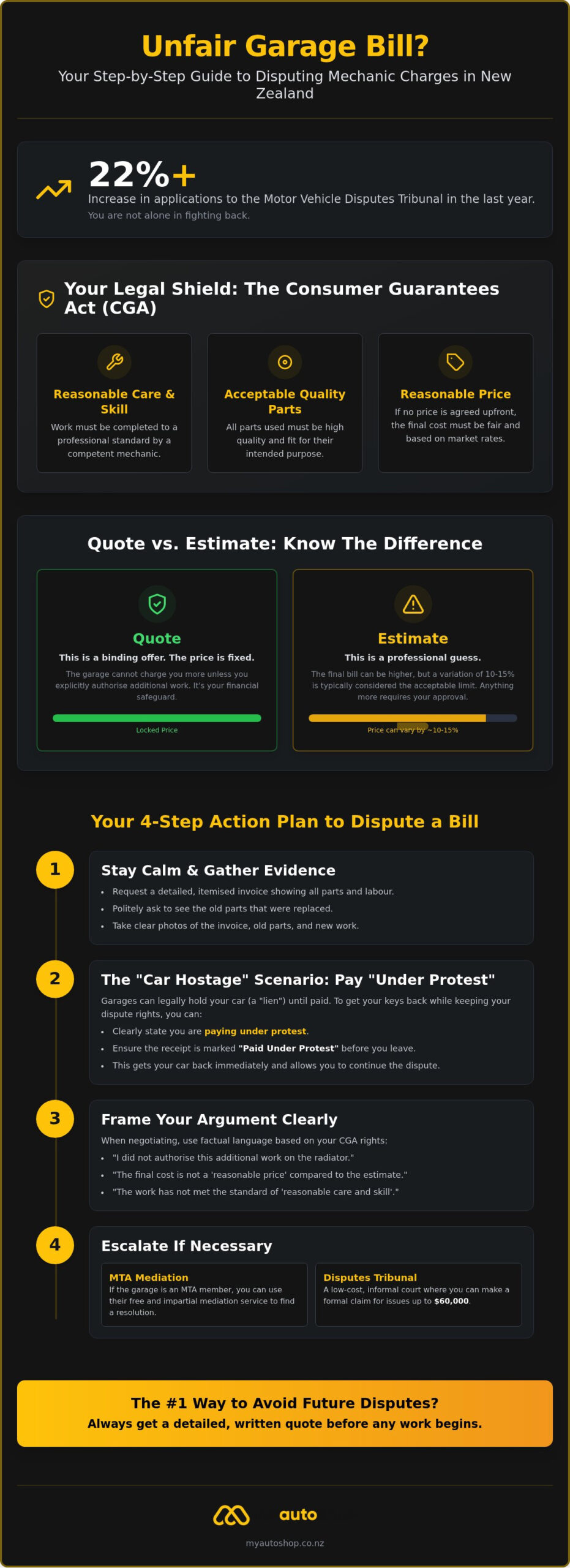
Applications to the Motor Vehicle Disputes Tribunal jumped over 22% in the last year, proving that more Kiwis are standing their ground. We’ll show you how to use the law as a professional lever to get a fair price and get your car back without paying for unauthorised work. This guide covers everything from MTA mediation to the new $60,000 Disputes Tribunal limit, giving you a clear roadmap to resolve the standoff and regain your peace of mind.
Key Takeaways
- Understand your legal protections under the Consumer Guarantees Act, which requires all vehicle repairs to be completed with reasonable care and skill.
- Learn how to dispute a garage bill in nz by requesting an itemised invoice and identifying work that was never authorised or performed.
- Discover the critical difference between a binding written quote and a verbal estimate to protect your wallet from future “bill shock.”
- Follow a clear escalation path from calm negotiation to free MTA mediation or a formal claim through the Disputes Tribunal.
Know Your Legal Rights Under the Consumer Guarantees Act (CGA)
You aren’t at the mercy of a mechanic just because they have your keys. In New Zealand, the Consumer Guarantees Act (CGA) is your strongest tool when learning how to dispute a garage bill in nz. This law covers every nut and bolt of automotive repair. Whether you went in for a basic service or a complex clutch replacement, the garage must follow specific legal standards. If they don’t, you don’t have to just accept the bill and walk away.
The CGA sets three non-negotiable rules for every mechanic. First, services must be performed with “reasonable care and skill.” This means the work should be up to the standard of a competent professional. Second, any parts used, like brake pads or car batteries, must be of acceptable quality and fit for their intended purpose. Finally, if you didn’t agree on a price upfront, the final cost must be “reasonable.”
The ‘Reasonable Price’ Rule Explained
Many disputes start because of a surprise total at the bottom of an invoice. If you didn’t get a fixed price before the work began, the garage can’t just pick a number out of thin air. A “reasonable price” is determined by current market rates and the actual time a skilled mechanic would take to finish the job. Understanding the difference between a quote and an estimate is vital for your financial safety.
- A Quote: This is a binding offer. Once you accept it, the price is set. The garage cannot charge more unless you specifically authorise extra work.
- An Estimate: This is a professional guess. While it allows for some flexibility, it isn’t a blank cheque. Traditionally, a variation of 10-15% is considered acceptable in the industry. Anything beyond that usually requires a fresh conversation and your explicit “yes.”
When Work Fails the “Care and Skill” Test
Poor workmanship isn’t just frustrating; it’s a breach of your rights. If your car comes back with the same rattle or a new leak after a radiator repair, the service failed the care and skill test. You have the right to demand the garage fixes the issue at no extra cost to you. This is a standard protection for all Kiwi consumers.
If the failure is substantial, meaning the car is unsafe or the job was done so poorly it can’t be easily fixed, you may be entitled to a full refund. This is why keeping records of your initial request is so important when you need to know how to dispute a garage bill in nz. You need to prove what you asked for versus what was actually delivered. At My Auto Shop, we believe in stripping away this guesswork by offering fixed-price servicing, so you never have to lean on these legal fallbacks.
Step 1: The Initial Conversation and Gathering Evidence
You’ve seen the total, and your stomach has dropped. Before you reach for your wallet, take a breath. Staying calm is your best negotiation tool. A professional, level-headed approach is far more likely to yield a discount or a correction than an emotional outburst. Mechanics are people too; they’re more likely to listen if you treat the situation as a business discrepancy rather than a personal attack. Start by asking for a detailed, itemised invoice before you even discuss payment. You need to see exactly what you’re being charged for, from specific parts like brake pads to the exact labour hours logged.
The “Car Hostage” Situation: Understanding Liens
In New Zealand, garages have a legal right called a “particular possessory lien.” This allows them to keep your vehicle until the bill is paid in full. It can feel like your car is being held hostage, but you have a way out. If you need your car back to get to work or manage family life, you can pay the bill “under protest.” This is a vital step when you’re figuring out how to dispute a garage bill in nz. Tell the mechanic clearly that you disagree with the charges and ensure they write “Paid Under Protest” on your receipt. This keeps your right to a refund alive while getting your keys back immediately.
Documenting the situation is just as important as the conversation itself. If possible, ask the mechanic to show you the old parts they replaced. Take photos of these parts and the new ones installed. Following the official steps to making a complaint requires a solid foundation of evidence. Compare the final invoice against any written or verbal estimates you received earlier. If there’s a gap, you’re ready to make your case.
How to Frame Your Argument
When you sit down to talk, stick to facts and use specific language. Don’t be vague. Use phrases like, “I did not authorise this additional work on the radiator repair.” If the price has jumped significantly from the initial talk, state, “This price does not seem reasonable for the market rate of this service.” Refer directly to your rights by saying, “Under the CGA, I expected a price closer to the estimate provided.”
Always follow up your conversation with a quick email. Summarise what was discussed, the points you disagreed on, and any partial resolution you reached. This creates a paper trail that is essential if the dispute escalates. To avoid these stressful standoffs in the future, you might prefer a fixed-price basic service where the costs are transparent from the very start. This eliminates the “bill shock” that leads to these disputes in the first place.
Common Dispute Scenarios: Unauthorised Work vs. Poor Quality
Most conflicts at the workshop fall into a few specific categories. Identifying which scenario you’re facing is the first step in learning how to dispute a garage bill in nz effectively. You need to match your complaint to the specific legal protection that was breached. Whether it’s a financial surprise or a technical failure, your leverage depends on the facts of the case.
- Scenario A: The mechanic performed “extra” fixes, like a radiator repair, that you never authorised while the car was in for a basic service.
- Scenario B: The final bill for your brake pad replacement is double the initial estimate you were given over the phone.
- Scenario C: You drive away and the car has the exact same fault, or a brand new one, within minutes of leaving the garage.
- Scenario D: You specifically requested budget-friendly parts for a car battery replacement, but the invoice shows premium, high-performance components instead.
Handling Unauthorised Repairs
You aren’t a bank for a mechanic’s assumptions. If a garage completes work you didn’t agree to, you aren’t legally required to pay for it. The contract you made was for specific tasks. When they go beyond that without calling you, they take a financial risk. If you find yourself in this spot, stay firm. The mechanic might offer to “undo” the work, but they cannot leave your car in a damaged or unsafe state to do so. A common compromise is offering to pay for the “parts only” at cost price, while refusing to pay the extra labour charges for the unauthorised time.
Disputing “Ghost” Repairs or Poor Workmanship
Technical jargon often makes customers feel like they can’t argue. If you suspect you’ve been charged for “ghost” repairs that didn’t happen, or if the workmanship is clearly sub-par, you need a second opinion. Take your car to another qualified professional to verify the work. If you recently bought the vehicle, a Pre-purchase Inspection report serves as an excellent baseline to prove the car’s previous condition.
Always demand to keep the old parts if a mechanic claims they were faulty. These are your property and serve as vital evidence if you need to escalate to the Disputes Tribunal. If two mechanics give you conflicting stories, a neutral referee at the Tribunal can help decide who is telling the truth. Remember, the goal of knowing how to dispute a garage bill in nz is to ensure you only pay for quality work that you actually asked for. Our network of vetted mechanics at My Auto Shop helps you avoid these scenarios entirely by providing clear, upfront evidence of every repair needed.
Escalating the Dispute: MTA and the Disputes Tribunal
If your initial conversation and follow-up emails haven’t led to a fair resolution, it is time to escalate. You don’t have to accept an unfair bill just because the mechanic is being stubborn. Knowing how to dispute a garage bill in nz means understanding the formal channels available to every Kiwi motorist. These services exist to level the playing field, ensuring you aren’t bullied into paying for poor workmanship or unauthorised repairs.
The MTA Complaint Process
First, look for the blue Motor Trade Association (MTA) badge on the garage wall or website. MTA members must follow a strict Code of Ethics that prioritises honesty and professional standards. If the garage is a member, you can access the MTA’s free mediation and grievance service. This is a massive advantage. An independent mediator will listen to both sides and try to find a middle ground without the need for a court hearing.
If the garage is not an MTA member, you can skip this step and head straight to the legal route. While mediation is ideal, it is voluntary for non-members. You shouldn’t waste time pleading with a shop that isn’t interested in a fair outcome. Instead, move your focus to gathering the evidence you’ve already collected, like your photos of replaced parts and your “Paid Under Protest” receipt.
Preparing for the Disputes Tribunal
The Disputes Tribunal is the final stop for most automotive conflicts. It isn’t a traditional court; it’s a place where common sense prevails. Lawyers are not permitted to represent either side, which keeps the process low-cost and informal. A trained referee will hear your case and make a legally binding decision. Since January 2024, the maximum claim limit has increased to $60,000, covering almost any standard vehicle repair dispute.
Filing a claim is simple and can be done online. You will need to provide a one-sentence summary of your claim, such as: “The respondent charged for a cambelt replacement that I did not authorise and that was not required.” As of July 2026, filing fees are tiered based on the claim amount:
- Claims up to $1,999.99: $62
- Claims from $2,000 to $4,999.99: $124
- Claims from $5,000 to $30,000: $248
- Claims from $30,001 to $60,000: $496
Winning at the Tribunal requires clear evidence. Bring your itemised invoice, any written quotes, and witness statements if another mechanic has inspected the work. To avoid the stress of these hearings entirely, consider using a platform that does the vetting for you. Book through My Auto Shop to ensure you’re working with professional, transparent mechanics who value financial clarity as much as you do.
How to Avoid Garage Bill Disputes in the Future
Prevention is always better than a legal standoff. While it’s vital to understand how to dispute a garage bill in nz, your ultimate goal should be a transparent experience from the moment you drop off your keys. Most disputes happen because of a breakdown in communication. You can stop these issues before they start by changing how you interact with the workshop. Start by being incredibly specific. Never leave your car with a vague request like “just give it a once-over.” Be precise about what you want done, whether it’s a car battery replacement or a check on your shock absorbers.
- Request a written “Quote” rather than an “Estimate”: A quote is a binding contract for a specific price. An estimate is just a professional guess that can fluctuate as the job progresses.
- Set a “no-work-beyond” limit: Tell the mechanic, “Do not perform any work that pushes the bill over $400 without calling me for approval first.” This simple instruction removes the “I didn’t know” excuse.
- Keep a digital log: Maintain a record of your car’s service history. Knowing exactly when you last had a cambelt replacement prevents a garage from recommending redundant work.
The Power of Fixed-Price Servicing
The traditional way of booking repairs is often opaque. You drop the car off and hope for the best. Fixed-price servicing removes this anxiety entirely. By using a digital platform, you get financial clarity before the tools even touch your vehicle. My Auto Shop acts as a reliable partner in this process. We ensure the price you see is the price you pay for standard jobs like a Comprehensive Service. If a mechanic discovers an urgent issue during the repair, they must provide clear evidence through our platform. You remain in control of the budget at every step.
Proactive Maintenance via Pre-Purchase Inspections
The best way to avoid a dispute is to avoid buying someone else’s mechanical problems. Many “shock bills” come from issues that were present when you bought the car but weren’t visible to the naked eye. A professional inspection identifies these hidden faults early. You can then use the report to negotiate the car’s price or walk away from a bad deal entirely. Learn more about our Pre-Purchase Inspections to protect yourself from future repair headaches. Being proactive is the smartest way to ensure you never have to worry about how to dispute a garage bill in nz in the first place.
Take Control of Your Car Repairs Today
You now have a clear roadmap for handling unfair mechanic charges. Remember that the Consumer Guarantees Act is your strongest shield, ensuring that every service is performed with reasonable care and skill. By keeping a meticulous paper trail and paying under protest when necessary, you protect your right to a fair resolution. Now that you know how to dispute a garage bill in nz, you can stand your ground with the confidence of an expert.
You deserve a mechanical partner that values financial clarity as much as you do. We are 100% NZ owned and operated, focusing on stripping away the anxiety often found in the traditional repair industry. Our professional network of vetted mechanics is committed to high-quality work without the hidden costs or technical jargon that lead to disputes.
Skip the stress and book a transparent car service with My Auto Shop. We offer fixed pricing on all standard services, giving you total certainty before the work even begins. You’ve got the tools to handle a standoff; now choose a service that makes sure you never have one. Drive with confidence knowing your car and your wallet are in safe hands.
Frequently Asked Questions
Can a mechanic keep my car if I refuse to pay the bill in NZ?
Yes, mechanics have a legal right called a possessory lien. This allows them to hold your vehicle as security until the invoice is settled. If you need your car back immediately but still want to fight the charges, pay the bill and ensure the receipt is clearly marked “Paid Under Protest.” This specific wording preserves your legal right to seek a refund through mediation or the Disputes Tribunal later.
What is the difference between a quote and an estimate in New Zealand?
A quote is a binding contract for a set price that cannot change without your explicit permission. An estimate is a professional guess that allows for some flexibility as the mechanic uncovers the full extent of the job. In the Kiwi motor trade, a variation of 10% to 15% is generally considered acceptable for an estimate. If the final cost exceeds this margin, the mechanic should have contacted you for approval.
Do I have to pay for car repairs I didn’t authorise?
No, you are not legally required to pay for work you did not agree to. When learning how to dispute a garage bill in nz, your first step is identifying any unauthorised line items on your invoice. A mechanic cannot simply decide to fix extra parts just because the car is already on the hoist. You are only responsible for the tasks you specifically requested and authorised during the initial drop-off or via follow-up communication.
How much does it cost to take a mechanic to the Disputes Tribunal?
Filing fees are tiered based on the total amount you are claiming in the dispute. As of July 2026, claims up to $1,999.99 cost $62, while claims between $2,000 and $4,999.99 cost $124. For larger disputes between $5,000 and $30,000, the fee is $248. If your claim involves high-value repairs up to the $60,000 limit, the filing fee is $496. These fees are designed to keep justice accessible for every motorist.
What should I do if the mechanic fixed the car but it’s still not working?
Take the vehicle back immediately and ask the garage to remedy the fault under the Consumer Guarantees Act. The law requires all automotive services to be provided with reasonable care and skill. If the initial repair failed to solve the problem you paid for, the workshop must fix it at no extra cost to you. If they cannot or will not fix it after a second attempt, you may be entitled to a full refund.
Does the Consumer Guarantees Act cover second-hand car parts?
Yes, the CGA covers both new and second-hand parts used during a repair or service. While a used part isn’t expected to last as long as a brand-new one, it must still be of acceptable quality and fit for its intended purpose. If a second-hand alternator or starter motor fails shortly after installation, you have the same legal rights to a repair or replacement as you would with a new component.
How do I know if a mechanic’s hourly rate is “reasonable”?
A reasonable rate is determined by the average market price for similar services in your specific region. If you are unsure how to dispute a garage bill in nz based on labour costs, call three other local workshops and ask for their standard hourly rate. If your garage is charging significantly more than the local average without providing specialised equipment or expertise, you have a strong case to negotiate the labour portion of your bill.
Is a verbal agreement for car repairs legally binding in NZ?
Yes, a verbal agreement is a legally binding contract, though it is notoriously difficult to prove if a dispute reaches the Tribunal. If you agreed to a price or a specific scope of work over the phone, that agreement is valid. To protect yourself, always ask the mechanic to send a quick text or email confirming the details. Having a written record prevents “he said, she said” arguments and provides clear evidence for your case.
Disclaimer
This article provides general information only and should not be relied on as professional mechanical, safety or legal advice. Vehicle requirements and circumstances vary. If you are unsure about your vehicle, have it inspected by a qualified automotive professional.