
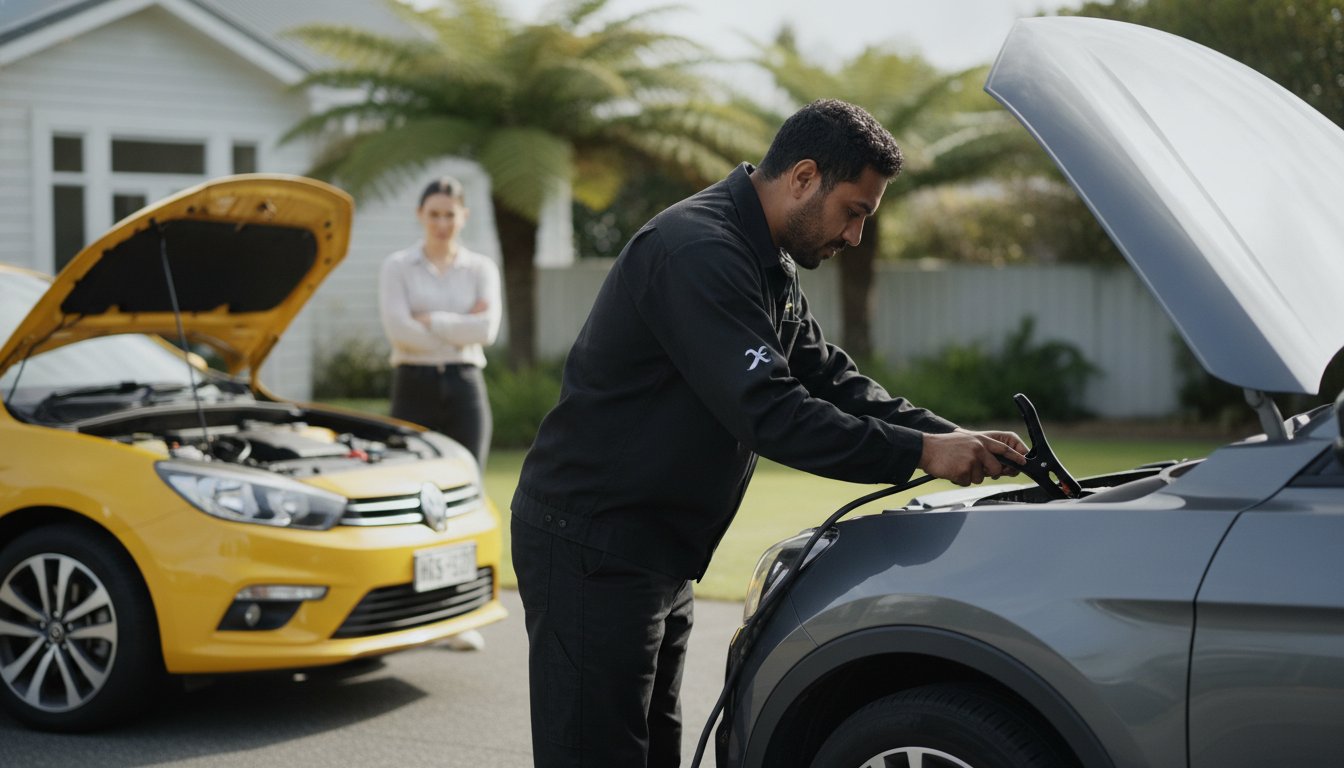
You’re already running late for a shift in Auckland, and that heavy silence when you turn the key confirms your worst fear. Your battery is flat. While your first instinct is to grab the nearest set of jumper cables, modern Kiwi cars are packed with sensitive electronics that don’t handle mistakes well. Knowing how to jump start a car safely is the difference between a quick fix and an expensive trip to the mechanic to repair a fried engine control unit.
It’s completely normal to feel a bit of anxiety when you’re staring at a tangle of red and black wires. Nobody wants to deal with unexpected sparks or the fear of an electrical shock while stranded on the side of the road. This guide masters the exact sequence you need to get your engine turning again without any drama. We will walk you through the precise connection order, essential safety precautions, and how to determine if you need a simple boost or a professional car battery replacement to keep you moving.
Key Takeaways
- Identify the signs of a flat battery, such as dim headlights or a clicking sound, before you even reach for the cables.
- Learn the exact four-step sequence for how to jump start a car safely to avoid dangerous sparks or electrical surges.
- Protect your vehicle’s expensive Engine Control Unit (ECU) by following specific connection rules designed for modern, computer-driven cars.
- Use the “30-Minute Rule” to determine if your battery just needs a charge or if it’s time for a professional replacement.
- Troubleshoot common non-starting issues, like a faulty starter motor or fuel pump, when a jump start doesn’t solve the problem.
Preparing for a Safe Jump Start: The Essential Checklist
Jump starting is essentially a mechanical rescue mission. It involves using a donor battery from another vehicle to provide enough “cranking amps” to turn over your dead engine. While the process of jump-starting a motor vehicle is common, doing it wrong can lead to sparks or damaged sensors. Learning how to jump start a car safely begins with a thorough inspection before you even touch a cable. Whether you are stuck in a driveway in Christchurch or a car park in Auckland, these steps ensure you don’t turn a flat battery into a major repair bill.
First, confirm your battery is actually the culprit. If you turn the key and hear a rapid “clicking” sound, or if your dashboard lights look dim and flickering, your battery likely lacks the juice to start the car. However, if the engine cranks strongly but won’t fire, the problem might be your fuel system or spark plugs instead. Verification saves you time and prevents unnecessary wear on the donor car’s electrical system.
Safety is your top priority. Check the dead battery for any signs of physical failure. If the plastic casing is bulging, cracked, or leaking fluid, stop immediately. Attempting to jump a damaged battery can cause an explosion. Ideally, wear work gloves and avoid leaning directly over either battery during the process. Batteries can emit flammable hydrogen gas, so keeping your face away is a smart move that protects you from potential acid splashes.
Identifying Your Terminals and Tools
Take a moment to locate the Positive (+) and Negative (-) terminals on both batteries. The positive terminal usually has a red plastic cover or a plus sign stamped into the metal. The negative terminal is often bare metal with a minus sign. Check your jumper cables for any exposed copper or frayed insulation. Damaged cables are a fire hazard. Finally, park the donor vehicle close enough for the cables to reach comfortably, but ensure the two cars are not touching. If the metal bodies touch, it can create a ground circuit that causes a dangerous spark when you connect the leads.
Pre-Flight Safety Checks
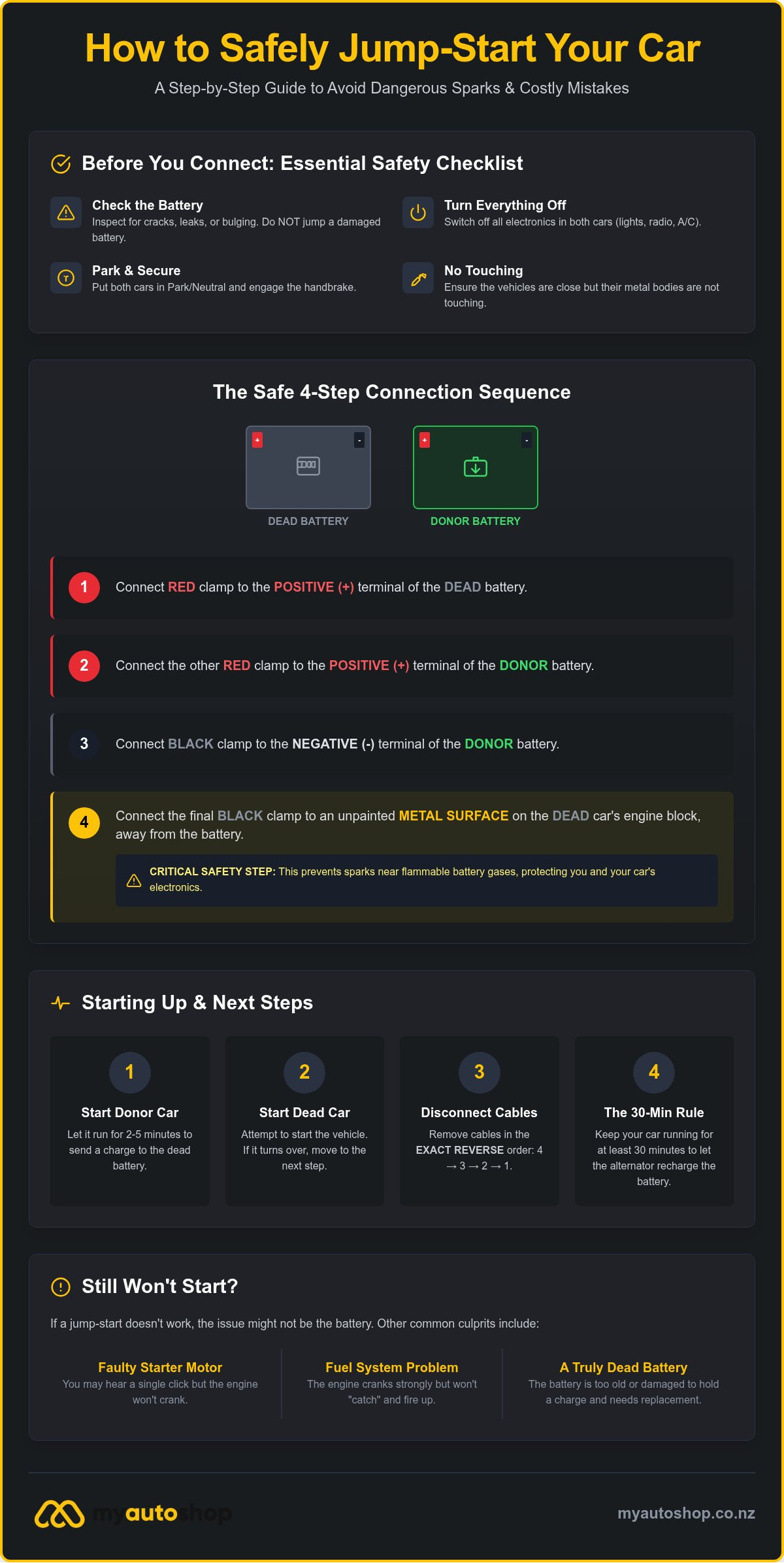
Before connecting anything, turn off every electronic component in both cars. This includes headlights, heaters, and even the radio. Modern cars are sensitive to voltage spikes, and turning off the “accessories” helps protect the onboard computers. Ensure both vehicles are in “Park” or “Neutral” with the handbrake pulled tight. Finally, tuck in any loose clothing and remove metal jewellery like rings or watches. You don’t want anything getting snagged in a spinning fan belt or creating an accidental short circuit between the battery terminals.
The Safe 4-Step Sequence: How to Connect Jumper Cables
Once you have positioned the cars and performed your safety checks, it is time to connect the leads. Learning how to jump start a car safely is about more than just matching colours. You must follow a specific sequence to manage the flow of electricity and prevent accidental damage to your vehicle. Grab your cables and follow these four steps exactly.
- Step 1: Connect the RED (Positive) clamp to the positive terminal of the dead battery. This terminal is usually marked with a plus sign or a red plastic cap.
- Step 2: Connect the other RED (Positive) clamp to the positive terminal of the donor battery. Make sure the clamp has a firm grip on the metal terminal.
- Step 3: Connect the BLACK (Negative) clamp to the negative terminal of the donor battery. This terminal is often bare metal or marked with a minus sign.
- Step 4: Connect the final BLACK (Negative) clamp to a solid, unpainted metal part of the dead car’s engine block. A clean bolt or a metal bracket away from the battery is perfect.
Why the Order Matters
Many Kiwi drivers wonder why the final black clamp doesn’t go onto the dead battery’s negative terminal. This is the most critical safety step. Lead-acid batteries can release flammable hydrogen gas while they discharge. When you complete an electrical circuit, a small spark often occurs at the final connection point. By attaching that last clamp to the engine block instead of the battery, you keep that spark far away from any potential gas fumes. This simple precaution helps prevent serious injury from a battery explosion. Following this “Red to Red, Black to Metal” sequence also minimises the risk of a short circuit that could blow fuses or damage your alternator.
Starting the Engines
With everything connected, start the engine of the donor car. Let it idle for about 2 to 5 minutes. This gives the donor battery and alternator time to send a surface charge into the flat battery. After this wait, try to start the car with the dead battery. If it doesn’t turn over immediately, don’t panic. Switch off the ignition and wait another 5 minutes before trying again. Once the engine fires up, do not turn it off. It needs to run so the alternator can begin the recharging process. If your car repeatedly fails to start even with a donor vehicle, you might need a professional Car Battery Replacement to get back on the road permanently.
Protecting Modern Car Electronics and ECUs
Modern vehicles are essentially high-speed computers wrapped in steel. They are packed with sensitive sensors and Engine Control Units (ECUs) that manage everything from fuel injection to your dashboard display. These components are incredibly sensitive to voltage spikes. If you aren’t careful about how to jump start a car safely, a single surge can fry a circuit board. This often leads to a repair bill that far exceeds the cost of a new battery.
The biggest risk occurs the moment the dead car fires up. As the engine starts, its alternator immediately kicks in to begin recharging the battery. This creates a sudden, massive change in the electrical load across the jumper cables. This “surge” is exactly why car clubs like AAA provide specific instructions on how to safely jumpstart a car. While older vehicles were more robust, modern cars are better served by using a surge-protected portable jumper pack. These handheld devices have built-in safety chips that block high-voltage “noise” from reaching your car’s sensitive computers.
Avoiding the Deadly Loop
Handling the cables requires focus. Never let the metal clamps touch each other while they are connected to a battery. This creates a direct short circuit that can melt wires or explode the battery casing. You should also avoid the old-school habit of “revving” the donor car excessively. While a slight increase in RPM can help, pinning the throttle can send too much current into the dead car’s ECU. Once the car is running, remove the cables in the EXACT reverse order you attached them. Start with the negative clamp on the engine block, then the negative on the donor car, followed by the two positive clamps. This breaks the circuit safely and prevents a final, unwanted spark.
When to Call a Professional
Some situations are too risky for a DIY jump start. If you are driving a hybrid or an electric vehicle (EV), the rules change completely. Many manufacturers explicitly forbid using an EV to jump start another car because the high-voltage system is not designed for that kind of load. You should also stop if you notice a burning smell or see smoke coming from the battery area. These are signs of a serious electrical fault rather than a simple flat battery. If your jump start attempt fails, or if you feel uncomfortable poking around under the bonnet, book a Mobile Mechanic for an on-site diagnosis. It is always cheaper to pay for an expert’s time than to replace a fried computer system.
Post-Jump Care: Is Your Battery Actually Dead?
You’ve successfully navigated how to jump start a car safely, and your engine is finally humming. But don’t switch it off just yet. A common mistake is thinking the job is done once the car starts. In reality, the next thirty minutes are critical for determining whether you’ll be stranded again tomorrow. Getting the car running is only the first step in a two-part recovery process.
Your alternator is designed to maintain a battery’s charge, not necessarily to revive one from the dead. To give your battery a fighting chance, you need to drive at open-road speeds for at least 30 minutes. Stop-start traffic in the city often won’t cut it. Your engine needs higher RPMs to generate enough current to push a meaningful charge back into the lead plates. If you just drive around the block and park, the battery likely won’t have enough power to turn the starter motor again when you next need to leave.
There is a big difference between a “discharged” battery and a “failed” one. If you accidentally left your dome light on overnight, the battery is simply discharged and should recover after a long drive. However, if the battery is over 3 to 5 years old, a jump start is often just a temporary bandage on a terminal problem. A professional load test is the only way to know for sure if those internal cells are healthy or ready to quit.
Recharging vs. Replacing
Batteries that stay flat for too long suffer from sulphation. Sulphation is the chemical process where lead sulphate crystals build up on the battery plates, permanently reducing their ability to hold a charge. While a high-quality external charger can sometimes reverse minor damage, most old batteries never fully recover once this process takes hold. Your alternator acts as a maintainer, so don’t expect it to “deep charge” a battery that has been flat for days. If your car needs a jump start more than once a month, the internal chemistry is likely compromised.
Signs You Need a New Battery
Keep an eye out for warning signs over the next few days. If the engine still struggles to turn over on a cold morning despite your long drive today, the internal cells are failing. You might also notice a white, powdery crust forming around the terminals. This corrosion often returns even after cleaning if the battery case is venting gas excessively due to age or heat. If you’re tired of the morning anxiety, it is time to book a Car Battery Replacement. Getting a new unit installed now is much cheaper than an emergency tow later.
What to Do if Your Car Still Won’t Start
Sometimes, even after following every instruction on how to jump start a car safely, the dashboard lights up but the engine stays silent. Don’t beat yourself up. If the battery was the only issue, the car would be running by now. Knowing how to jump start a car safely also includes knowing when to stop and look for other culprits. A failed jump start is often a diagnostic tool in itself, pointing towards other mechanical components that have reached the end of their life.
Listen closely when you turn the key. If you hear a single, sharp “clack” but the engine doesn’t spin at all, your starter motor is likely jammed or burnt out. This component is responsible for physically turning the engine over. No amount of battery power will fix a mechanical failure inside the starter. If this is what you are hearing, further jump-starting attempts are a waste of time and could potentially damage your donor car’s electrical system.
If the engine cranks normally but won’t actually “catch” or fire up, your battery is doing its job. The problem here is usually a lack of fuel or a lack of spark. This could be a failing fuel pump, a clogged filter, or a faulty ignition coil. Since the battery is providing enough juice to crank the engine, you don’t have a power problem; you have a delivery problem. Continuing to crank the engine will only wear out your starter motor and drain your battery again.
It is also worth checking your fuse box for any broken metal links inside the transparent plastic fuses. A surge during a jump start can occasionally pop a fuse related to the ignition or fuel system. Additionally, look for a flashing security light or key icon on your dash. If the battery was completely dead for a long time, the car’s immobiliser might have lost its connection with your key. In this case, the car’s computer is intentionally blocking the start for safety reasons.
The Professional Solution
Prevention is always better than a roadside emergency. While a Pre-purchase Inspection can identify aging components before you commit to a vehicle, life happens to the cars we already own. If you find yourself stuck in your driveway, remember that you don’t always need an expensive tow truck. A mobile mechanic can perform a diagnostic right where the car is parked, saving you both time and transport fees. We believe in financial clarity, so you’ll always see transparent, upfront pricing before any work begins on your vehicle.
Booking Your Rescue
If the jump didn’t work, it’s almost certainly a mechanical issue rather than a user error. You’ve done the hard work of trying to solve it yourself, so let an expert take over from here. Our platform helps you find a trusted local expert quickly, ensuring your car is back on the road without the guesswork or hidden costs. Book a Mobile Mechanic to diagnose your starting issues today and get your day back on track.
Get Back on the Road with Confidence
You now have the exact sequence and safety checklist needed to handle a flat battery without the stress. By remembering the “Red to Red, Black to Metal” rule and protecting your car’s sensitive electronics from voltage surges, you’ve mastered how to jump start a car safely. While a quick boost can get you moving today, a battery that’s over three years old or constantly failing is a clear sign that you need a permanent solution.
Don’t let the anxiety of a dead battery ruin your schedule. We’ve built a professional network of NZ mechanics across the country to make car maintenance transparent and easy. You can get a fixed-price quote for a Car Battery Replacement right now and benefit from upfront, transparent pricing with no hidden surprises. Whether you prefer a local workshop or need one of our mobile mechanics to visit you at home or work, the help you need is just a few clicks away. Drive safe and stay empowered on the road.
Frequently Asked Questions
Can I jump start a car in the rain?
Yes, you can jump start a car in wet weather, but take extra care to keep the battery terminals as dry as possible. Use a clean cloth to wipe away excess moisture and ensure the cable clamps have a solid, metal-to-metal connection. While a 12-volt system isn’t powerful enough to give you a dangerous shock, water is conductive and can cause minor sparks or interfere with the electrical flow during the process.
Does it matter which car I start first?
Always start the engine of the donor vehicle first. This allows the donor’s alternator to provide a steady flow of electricity to the dead battery before you attempt to crank the engine. Let the donor car idle for at least two to five minutes to build up a surface charge. This makes the process of how to jump start a car safely much more efficient and reduces the strain on the donor car’s electrical system.
Can jump starting damage my car’s computer (ECU)?
Yes, modern Engine Control Units are highly sensitive to the voltage spikes that can occur during a jump start. If the cables are connected or disconnected in the wrong order, a sudden surge can overwhelm the car’s delicate internal circuitry. Following the exact “Red to Red, Black to Metal” sequence is your best defence against an expensive repair bill for a fried onboard computer.
How long should I drive my car after a jump start?
Aim for at least 30 minutes of continuous driving at open-road speeds. Short trips around the block or idling in your driveway won’t provide enough RPMs for the alternator to properly recharge a deeply discharged battery. If you don’t give the battery enough time to recover, you’ll likely find it flat again the next time you try to turn the key.
What if the jumper cables get hot?
Stop the process immediately if you notice the cables or clamps becoming hot to the touch. Heat is a sign of extreme electrical resistance, which happens if the cables are too thin for the engine size or if there is a direct short circuit. Turn off both engines, disconnect the cables carefully, and check for any accidental metal-to-metal contact between the clamps or terminals.
Can I jump start a hybrid or electric car?
You can often jump start the small 12-volt battery that powers a hybrid or EV’s electronics, but you should never use an EV to jump start another petrol vehicle. The high-voltage systems in these cars aren’t designed to handle the massive surge required to crank a traditional internal combustion engine. Always consult your owner’s manual first, as many manufacturers have specific “jump points” located away from the main battery pack.
Why did my car battery go flat in the first place?
Batteries usually fail due to old age, extreme temperatures, or leaving accessories like headlights or interior lights on overnight. In some cases, a “parasitic drain” from a faulty alarm or radio can slowly sap power while the car is parked. If your battery is more than three years old, it may simply be losing its ability to hold a chemical charge and require a professional test to see if it’s reached the end of its life.
What happens if I connect the cables to the wrong terminals?
Reversing the polarity by connecting positive to negative creates a direct short circuit that can cause immediate and severe damage. You’ll likely see large sparks, and you risk melting the jumper cables or blowing expensive main fuses. In the worst-case scenario, this mistake can destroy the alternator or the car’s main computer, turning a simple battery issue into a major mechanical overhaul.
Disclaimer
This article provides general information only and should not be relied on as professional mechanical, safety or legal advice. Vehicle requirements and circumstances vary. If you are unsure about your vehicle, have it inspected by a qualified automotive professional.