

A flashing traction control light can mean the system is responding to wheel slip, not that something has failed. What does a traction control warning light mean? The answer often depends on whether it flashes briefly as your tyres lose grip or stays on after the road clears.
It’s understandable to feel unsure, especially on wet or loose New Zealand roads where traction control can help manage wheelspin. A steady warning may mean the system has been switched off or detected a fault. It may also appear with an ABS or electronic stability control warning. If the ABS and red brake warning lights come on together, stop somewhere safe and seek assistance. If only the traction control light stays on, drive cautiously and arrange an assessment rather than assuming the system is working normally.
This guide explains what flashing and steady warnings can indicate, how traction control differs from ABS and stability control, and what to check next. You’ll also learn when a short, careful drive may be reasonable and when to stop.
Key Takeaways
- What does a traction control warning light mean? Its behaviour and any other dashboard warnings provide context, but the light alone can’t identify the fault.
- Traction control helps manage wheel slip during acceleration; ABS supports control during braking. Some vehicles share components or information between these systems.
- Note when the light appears, check how the car handles, and use the owner’s handbook to confirm whether traction control has been switched off.
- If the system activates on a slippery or loose surface, slow down and use gentle steering and acceleration.
- An assessment can interpret diagnostic information and check relevant systems to establish what needs attention.
What does a traction control warning light mean?
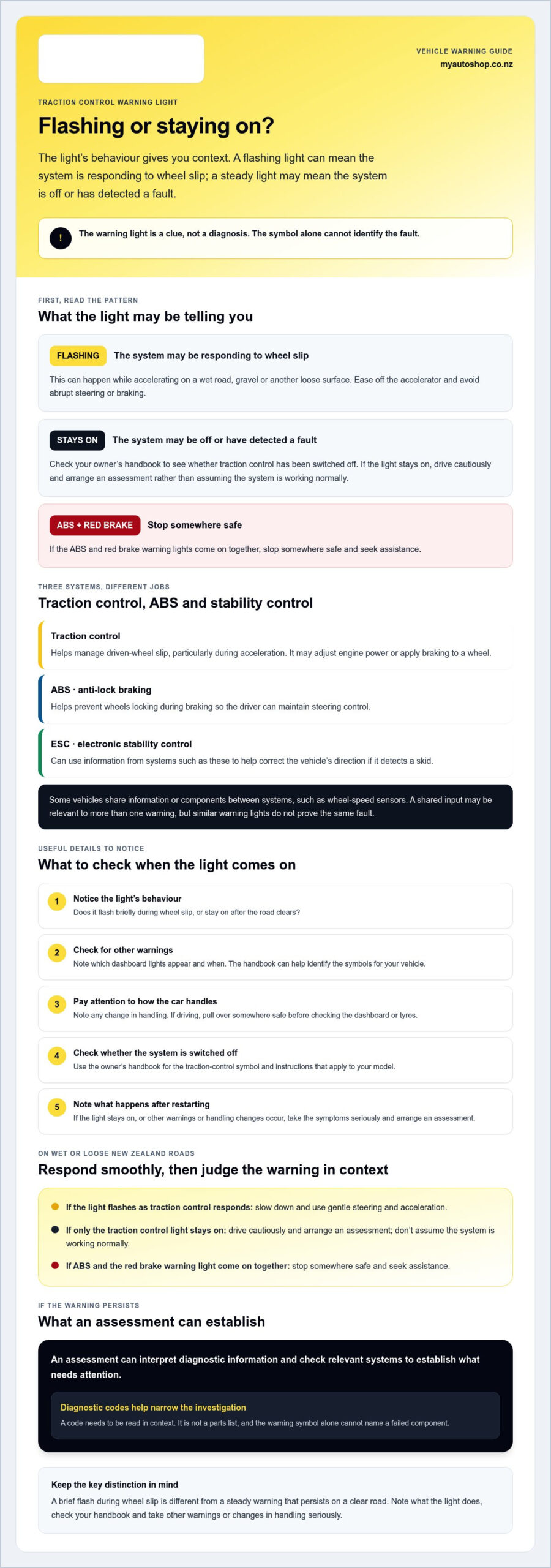
What does a traction control warning light mean? It indicates the status of your vehicle’s traction control system, but it doesn’t identify a fault by itself. The light’s behaviour matters: it may flash while the system responds to wheel slip, stay illuminated because the system is switched off or has detected a fault, or appear alongside other dashboard warnings.
A warning indicator is a clue, not a confirmed diagnosis. The same-looking symbol can have different meanings across vehicles, and some dashboards use a separate light to show when traction control has been switched off. Check your owner’s handbook for the symbol and instructions that apply to your vehicle.
Traction control helps manage driven-wheel slip, often by adjusting engine power or applying braking to a wheel. For a broader technical explanation of the Traction Control System (TCS) and its relationship with other vehicle systems, see the linked overview.
What does a flashing traction control light mean?
On many vehicles, a flashing light means traction control is actively responding to wheel slip. That can happen when accelerating on a wet road, gravel, or another loose surface. It doesn’t automatically mean there’s a fault, but it is a cue to drive smoothly: ease off the accelerator and avoid abrupt steering or braking. If the light flashes unexpectedly or behaves differently from the description in your handbook, check the handbook before assuming what it means.
What does a traction control light that stays on mean?
A light that remains on may indicate that traction control has been switched off or that the vehicle has detected a fault. The symbol alone can’t tell you which applies or name a failed component. Note when the light appears, whether it goes out after restarting, and whether other warning lights or changes in handling occur. If it stays on, arrange an assessment so the cause can be checked rather than guessing at a repair.
Keep the context in mind. A brief flash during wheel slip is different from a steady warning that persists on a clear road. If other warnings appear or the vehicle feels different to drive, consult the handbook and take the symptoms seriously.
How traction control works with ABS and stability control
Traction control, anti-lock braking and electronic stability control (ESC) can work together, but they have different jobs. Traction control helps manage slip at the driven wheels, particularly when accelerating. ABS helps prevent wheels locking during braking so the driver can maintain steering control. ESC can use information from systems such as these to help correct the vehicle’s direction if it detects a skid. The exact setup depends on the vehicle.
This distinction matters when you’re trying to understand what does a traction control warning light mean. A traction control, ABS or ESC warning points to a system that needs attention, but the symbol alone won’t tell you which part is responsible.
How traction control and ABS differ
Traction control responds to wheel slip during acceleration, while ABS manages wheel lock-up under braking. The systems may interact and, in some vehicles, share information or components such as wheel-speed sensors. Their purposes remain different, though, and a warning for one doesn’t automatically mean the other has the same fault. Check your handbook to identify each dashboard symbol and what it means for your model.
Why traction control and stability control warnings may appear together
Some vehicles use linked systems that rely on shared sensor information. A problem affecting one input, such as a wheel-speed sensor, may therefore be relevant to more than one warning. It’s one possible area to investigate, not a diagnosis. System design varies, so don’t assume that two illuminated symbols point to the same failed part.
Similar dashboard warnings don’t prove the same fault. Note which lights appear and when, then check the owner’s handbook. If warnings persist, ask an automotive service provider to interpret the diagnostic codes and assess the systems. A code can help narrow the investigation, but it needs to be read in context rather than treated as a parts list.
What should you check when the traction control light comes on?
Start by observing what the car is telling you, rather than guessing at a repair. If you’re driving, keep your attention on the road and pull over somewhere safe before checking the dashboard or tyres. Use this checklist to capture useful details:
- Watch the light. Note whether it flashes briefly or stays on, and when you first noticed it.
- Check for other warnings. Record whether ABS, brake or stability control lights appeared at the same time.
- Recall the conditions. Was the road wet, gravelly or otherwise loose? Did the light come on while accelerating, braking or turning?
- Notice any change in handling. Record unusual behaviour during braking, steering or acceleration, as well as any unfamiliar noises. Describe what happened; don’t try to diagnose the cause.
These details help explain what does a traction control warning light mean in your particular situation, though they can’t confirm the underlying cause.
Check whether traction control has been switched off
Some vehicles have a control that switches traction control off or changes how it operates. Look for instructions in your owner’s handbook, which can help you locate the control and explain the relevant dashboard symbol. Don’t press unfamiliar controls based on appearance alone. If you’re unsure whether the system is off or there’s a fault, follow the handbook’s guidance.
Restarting the vehicle may change what the dashboard displays, but it doesn’t prove an underlying issue has been resolved. Don’t treat a light going out after a restart, or a warning being cleared, as confirmation that the system is working correctly. Note what happened and seek advice if the warning returns.
Can tyres or road conditions affect traction control?
Wet roads, gravel and other loose surfaces can prompt the system to respond to wheel slip, depending on the vehicle. If the light appears in those conditions, ease off the accelerator and use smooth steering and braking. When safely parked, look over the tyres for obvious damage or a marked difference in condition. Don’t assume tyres caused a warning that stays on; an assessment is needed to establish why it appeared.
If a warning persists or the car’s handling changes, arrange a professional assessment. Use your notes and the owner’s handbook to explain what you’ve seen, and ask for the warning to be checked rather than guessing at a repair.
Is it safe to drive with the traction control warning light on?
It depends on what else the vehicle is doing. A traction control light by itself doesn’t give enough information to judge whether continuing is safe. Consider whether it’s flashing or staying on, whether other warning lights are illuminated, and whether the car’s braking, steering or handling has changed. Check your owner’s handbook for guidance specific to your vehicle.
If the system is responding to wheel slip on a wet or loose surface, slow down and use gentle acceleration, braking and steering. Avoid sudden inputs, and give yourself more room to respond. If the light stays on, remember that traction control may not be available to help manage wheel slip.
When should you stop driving and seek help?
Put the vehicle’s behaviour first. If the brakes feel abnormal, steering becomes difficult, the car feels unstable, or you’re losing control, pull over somewhere safe and seek assistance. Don’t continue just because the traction symbol is the only warning you noticed.
Take multiple warnings seriously. In particular, if the ABS and red brake warning lights are on together, stop somewhere safe and seek assistance rather than continuing your journey. If you’re unsure what a symbol means, consult the handbook. The light alone doesn’t establish a specific fault or determine a WoF outcome.
When should you arrange a diagnostic check?
Arrange an assessment if the warning stays on, returns repeatedly, or appears alongside a change in how the vehicle brakes, steers or accelerates. A technician can use diagnostic equipment to retrieve system information, then interpret it alongside your symptoms and inspect relevant systems. A scan can help guide the investigation, but it isn’t, by itself, a confirmed diagnosis or repair plan.
For related guidance on recognising and describing vehicle symptoms, see the Turners Symptoms Guide. Turners Service & Repairs offers mobile diagnostics in selected regions. Check availability for your area.
If a warning persists or the vehicle’s handling changes, stop driving if it feels unsafe and arrange a professional assessment. My Auto Shop connects motorists with automotive service and repair providers.
What happens during a traction control warning assessment?
A traction control warning light is a starting point for investigation, not a parts diagnosis. A technician may ask about the warning, review how the vehicle behaves, inspect relevant systems and interpret diagnostic information. Those steps help establish what needs attention. The light alone can’t confirm which component has failed or what repair, if any, is required.
That’s why details from your drive are useful. Note whether the light flashes or stays on, when it first appeared, and whether other dashboard warnings came on at the same time. Describe any changes in braking, steering or acceleration, and mention unusual noises. If you know of recent relevant repairs or events, share them as background, but don’t assume they caused the warning.
How diagnostic information helps
A diagnostic scan can retrieve fault information stored by vehicle systems. A technician interprets those results alongside your symptoms and any inspection findings. A code may point towards an area to investigate, but it doesn’t automatically prove a particular part is faulty. The next step depends on the vehicle and what the assessment shows.
If you’re still asking, “”, the answer depends on those findings as well as the light’s behaviour and your vehicle’s handbook. An assessment replaces guesswork with a clearer, evidence-based next step, though the exact outcome can’t be known from the warning symbol alone.
Where can New Zealand drivers find relevant service information?
Before arranging an assessment, gather your notes and check the owner’s handbook for the meaning of the warning symbols on your vehicle. You can also read My Auto Shop’s vehicle symptoms and service information for help describing what you’ve noticed.
Turners Service & Repairs offers mobile diagnostics and mechanical repairs in selected New Zealand regions. Availability depends on location. My Auto Shop is a separate automotive services platform that connects motorists with service and repair providers.
When you’re ready to explore possible service options, visit My Auto Shop. A provider can discuss an assessment based on your vehicle’s symptoms, but the warning light alone can’t guarantee a diagnosis or repair outcome.
Take the next step with confidence
A traction control warning is a signal to check the context, not a diagnosis. A flashing light may show the system responding to wheel slip, while a steady warning can indicate the system is off or has detected a fault. Your owner’s handbook can clarify what the symbol means for your vehicle.
Note whether the light flashes or stays on, which other warnings appear, and whether braking, steering or handling changes. If the car feels unsafe to control, stop somewhere safe and seek assistance. If the warning persists or returns, arrange an assessment rather than guessing at a repair.
My Auto Shop connects motorists with automotive service and repair providers. For mobile servicing and repairs, Turners Service & Repairs operates in selected regions only. Check availability for your area.
Explore automotive service options through My Auto Shop and take a practical next step. With clear observations and an appropriate assessment, you can make a more informed decision about your vehicle.
Frequently Asked Questions
Can I drive with the traction control light on?
It depends on the warning and how the vehicle behaves. A brief flash during wheel slip differs from a light that stays on. Slow down and use gentle inputs, especially on wet or loose roads. Check your owner’s handbook for vehicle-specific advice. If braking, steering or control feels abnormal, stop somewhere safe and seek assistance. Arrange an assessment if the warning persists or returns.
What is the difference between the traction control and ABS warning lights?
Traction control helps manage driven-wheel slip during acceleration. ABS helps manage wheel lock-up during braking, supporting steering control. Some vehicles share sensor information or components between the systems, so warnings can be related, but one light doesn’t confirm a fault in the other system. Check your vehicle handbook to identify the symbols. If braking or handling changes, seek prompt advice rather than relying on the warning light alone.
Why are my traction control and ABS lights on at the same time?
Some vehicles link these systems or use shared components, so a fault affecting one area may trigger more than one warning. A wheel-speed sensor is one possible diagnostic area, but the lights alone can’t confirm it or identify a failed part. Note when the warnings appeared and check your handbook. Arrange an assessment, particularly if braking or vehicle control feels different.
Can bad tyres cause the traction control light to come on?
Tyres and road grip can affect when traction control activates. For example, wheel slip on a wet or loose surface may prompt the system to respond. But don’t assume tyre condition is the cause of a warning that stays on. When safely parked, check for obvious tyre damage or a marked difference in condition. Consult your handbook, and arrange an assessment if the light persists or handling changes.
How do I turn off the traction control warning light?
First, check your owner’s handbook to understand the symbol and whether traction control has been switched off. Use only the control and instructions described for your vehicle. Don’t repeatedly reset or try to hide a persistent warning, as that won’t establish its cause. If the light remains on, returns, or appears alongside another warning, arrange an assessment. The right reset or repair depends on the vehicle and confirmed fault.
Disclaimer
This article provides general information only and should not be relied on as professional mechanical, safety or legal advice. Vehicle requirements and circumstances vary. If you are unsure about your vehicle, have it inspected by a qualified automotive professional.