
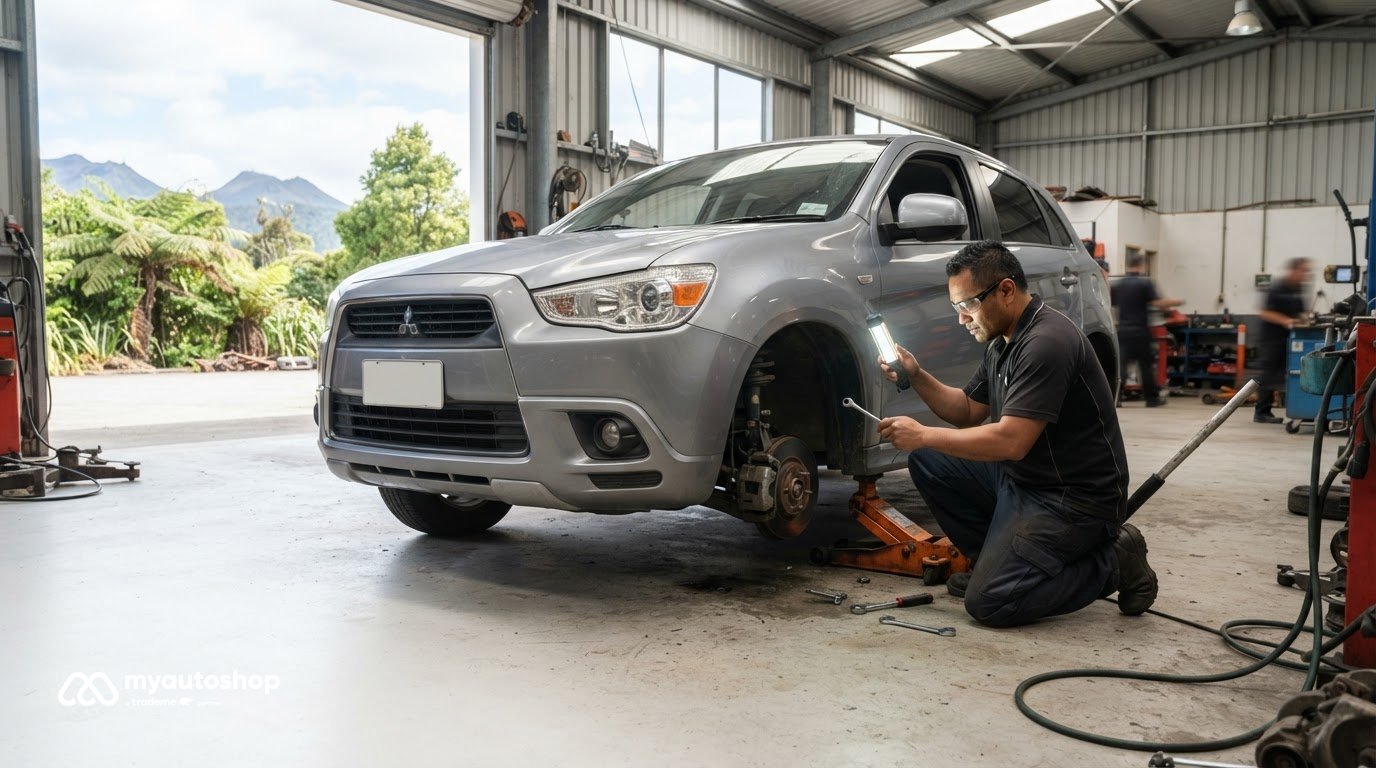
A tidy Mitsubishi ASX with a current WoF can still hide a costly maintenance gap. So, is the Mitsubishi ASX a reliable car? It can be a dependable used SUV, but the badge alone can’t tell you whether a particular car has been cared for.
It’s understandable to want a clear verdict before buying. Reliability information can help you identify what deserves closer attention, but it may relate to a different year, variant or market. The car’s service records and present condition matter just as much.
This guide explains how to weigh general reliability claims against the specific vehicle you’re considering. You’ll learn why the CVT automatic’s maintenance history matters, what to look for in the engine and suspension, and how to use the vehicle’s records and WoF as part of your checks. An independent pre-purchase inspection can add another assessment before you commit. The aim is simple: make a better-informed decision before money changes hands.
Key Takeaways
- So, is the Mitsubishi ASX a reliable car? Its prospects depend on the specific vehicle’s history and condition, not just its reputation.
- Match service records and invoices to the ASX’s age and kilometres. Treat gaps as a reason to investigate, not proof of a fault.
- Compare used SUVs on a like-for-like basis, including their variant, history, condition and inspection findings.
- Use the WoF as a record of a check at a point in time, not a guarantee of future reliability. Review the car and test-drive it too.
- An independent pre-purchase inspection can add another assessment to your own checks before you decide whether to buy.
Is the Mitsubishi ASX a reliable car? Start with a balanced verdict
Is the Mitsubishi ASX a reliable car? It can be a dependable used SUV, but no model reputation can guarantee that an individual vehicle will be trouble-free. The most useful verdict comes from checking the exact ASX’s service history, how it has been used and its current mechanical condition.
Year and variant matter, too. Specifications and equipment can differ, so identify the vehicle accurately before applying general advice. A clean cabin, polished paint or confident seller description may be reassuring, but none proves that the engine, transmission or other components have been maintained well.
This video offers another perspective on the first-generation ASX. Treat it as general background, not a diagnosis of the vehicle you’re considering.
What does reliability mean when buying a used ASX?
For a used car, reliability means more than whether a model has a good reputation. Look for predictable operation, a coherent maintenance and repair history, and no signs that wear, damage or unresolved problems have been overlooked. A model-level pattern can help you decide what to investigate, but it can’t establish what has happened to one particular car.
Start with evidence. Compare service records and invoices with the vehicle’s age and odometer reading. If the history has gaps, that doesn’t automatically mean the ASX has a fault, but it leaves questions to resolve. A pre-purchase assessment can add an independent view alongside your own checks.
Why the exact ASX year and variant matter
Use the vehicle documents to confirm the year, variant, engine and transmission. Don’t rely on a listing description alone if its details don’t match the paperwork. Specifications and equipment can vary, so advice about one configuration may not apply to another. For general background, see Mitsubishi ASX history and specifications, then check details against the car itself.
Avoid broad claims that one year or variant is automatically reliable or troublesome unless they’re backed by sound, model-specific evidence. Instead, use the confirmed details to guide your checks. If you notice a symptom during a viewing or test drive, the vehicle symptoms guide can help you describe what you observed and what may need further assessment.
Which Mitsubishi ASX reliability factors should buyers investigate?
To judge a particular ASX, build a timeline from its documents and your observations. Match service invoices and records to the vehicle’s age and odometer reading, then consider whether the recorded work makes sense for its maintenance history. If it’s an automatic, look for documentation of transmission servicing and compare it with the maintenance guidance for that exact vehicle.
Gaps or mismatched dates and kilometre readings reduce certainty, but they don’t prove the car has been neglected or has a fault. Ask for clarification and look for supporting invoices or other records. The question behind “is the Mitsubishi ASX a reliable car” is ultimately whether this example’s evidence supports confidence.
How to assess ASX service history and ownership
Check the dates and odometer readings across service records and available vehicle documents. Look for a consistent timeline and evidence of regular care, rather than relying on a stamp or a seller’s summary alone. There’s no single service interval to assume for every ASX, so use the maintenance requirements that apply to the specific year and variant.
If records are missing, note what you can’t verify. A gap is uncertainty to investigate, not a diagnosis. You can also check the vehicle’s history and look for any recall information that applies to its make and model. Use relevant New Zealand sources, including Waka Kotahi’s vehicle and safety recall information, and compare any result with the vehicle details.
What a test drive can reveal, and what it cannot
Observe the car before and during a drive. If possible, notice how it starts from cold, whether warning lights remain illuminated, and whether you hear unusual noises. Pay attention to changes during normal driving, such as hesitation or a new sound, without trying to diagnose the cause yourself.
- Record when a noise or symptom occurs, such as at start-up or while turning.
- Note any warning lights and whether they stay on or appear during the drive.
- Look for visible fluid leaks, but don’t assume their source or seriousness from appearance alone.
A smooth drive is useful evidence, but it can’t rule out hidden or intermittent faults. Write down anything that concerns you and have it assessed before making a decision. My Auto Shop’s pre-purchase vehicle inspection can add an independent assessment to your own checks, helping you make a more informed used-car decision.
How does the Mitsubishi ASX compare with another used SUV?
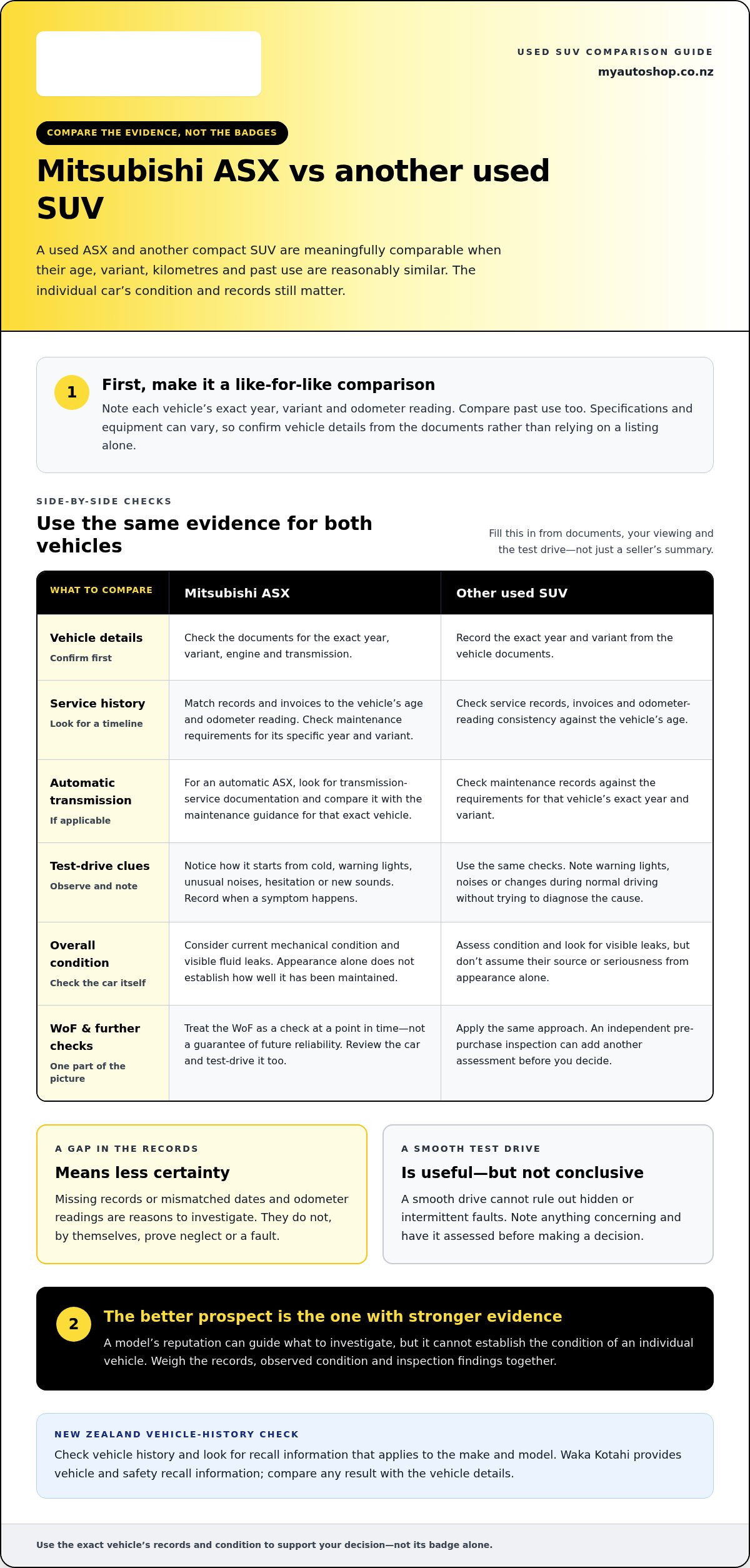
Compare the cars in front of you, not just their badges. A used ASX and another compact SUV are only meaningfully comparable if their age, variant, kilometres and past use are reasonably similar. Even then, condition and documentation can make one example a better prospect than the other.
Use a simple side-by-side check. Fill it in from the records, viewing and test drive rather than relying on a seller’s summary or general model reputation.
| What to compare | Mitsubishi ASX | Other used SUV |
|---|---|---|
| Year and variant | Record the exact details from the vehicle documents. | Record the exact details from the vehicle documents. |
| History and odometer | Check service records and reading consistency. | Check service records and reading consistency. |
| Current condition | Note visible wear, leaks or other concerns. | Note visible wear, leaks or other concerns. |
| Test drive and inspection | Record observations and inspection findings. | Record observations and inspection findings. |
Compare individual vehicles, not just model reputations
Look at both vehicles’ service records, odometer consistency, visible condition and test-drive behaviour. Keep the comparison fair: differences in year, variant, use and maintenance can affect what the evidence tells you. A well-documented ASX may be a stronger prospect than a poorly documented alternative, but records alone can’t establish current mechanical condition.
Use the same checks for each candidate. Write down what’s supported by documents, what you observed and what remains unknown. If an independent assessment would help resolve concerns, My Auto Shop provides pre-purchase vehicle inspections to support a more informed used-car decision.
How to interpret reliability reports and online reviews
Before applying an online claim, check whether it relates to the same year, variant and market as the New Zealand vehicle. Specifications can differ between markets, and a report about one configuration may not describe another. Owner reviews can flag experiences worth investigating, but an individual account isn’t proof of a widespread fault.
Give more weight to clearly sourced information that explains which vehicles it covers and how its findings were reached. Treat overseas reports as context, not a direct prediction for every ASX here. No general report can answer is the Mitsubishi ASX a reliable car as precisely as evidence about the specific vehicle. Finally, weigh suitability against your needs, including the type of driving you do and the car’s condition, not reputation alone.
What should you check before buying a used Mitsubishi ASX in NZ?
Use a clear sequence: confirm which vehicle you’re viewing, check its records, inspect it, take a test drive and resolve any concerns before deciding. This keeps the checks practical and helps you separate what you can verify from what still needs an independent assessment.
A current Warrant of Fitness (WoF) records that the vehicle met the relevant inspection requirements when it was checked. It isn’t a guarantee of future reliability or a substitute for checking the car’s mechanical condition. Check vehicle-history information and any applicable safety recalls using suitable New Zealand sources, such as Waka Kotahi, and make sure the information matches the vehicle’s identifying details.
A practical viewing checklist for an ASX
- Identify the vehicle. Compare its advertised year and variant with the details in the available vehicle documents. Note the registration and vehicle identification details so you can check records against the right car.
- Review the paperwork. Compare service dates and odometer readings across invoices and records. Note missing documents, unexplained gaps or details that don’t line up, then seek clarification.
- Inspect and test-drive it. Look for visible damage or fluid leaks, check the dashboard for warning lights, and listen for unusual sounds. Notice how the car starts and behaves during normal driving.
- Write down concerns. Record what you observed and any questions left unanswered. Don’t treat a symptom as a diagnosis; use it to identify what needs follow-up before you proceed.
For a broader used-car assessment, use this pre-purchase inspection checklist alongside your ASX-specific checks.
When an independent pre-purchase inspection makes sense
Your viewing and test drive give you useful evidence, but they can’t assess every mechanical issue or establish what may happen later. An independent pre-purchase inspection adds another assessment of the vehicle’s current condition. Its findings can help you understand concerns and make a more informed decision, but they can’t guarantee future reliability.
If you’re still asking, “is the Mitsubishi ASX a reliable car?”, let the evidence from the specific vehicle guide your next step. Read the New Zealand pre-purchase car inspection information to learn more about arranging an independent assessment before you buy.
Is a used Mitsubishi ASX right for you? Make the decision with evidence
A used ASX may suit you if it fits your day-to-day needs and the evidence from that specific vehicle gives you confidence. Consistent service records, vehicle details that line up, a reassuring test drive and satisfactory inspection findings are all positive signs. They’re not a promise of fault-free ownership, so weigh them together rather than treating any one as proof.
Signs an ASX may be a stronger used-car prospect
Look for a history that makes sense from one service record to the next, with dates and odometer readings that form a coherent timeline. Check that the vehicle’s documents match the car and that your test-drive observations don’t raise unresolved concerns. An independent inspection can add useful evidence about its current condition.
Then ask whether the ASX suits your needs, including how you’ll use it and what matters most in a used SUV. The best choice isn’t necessarily the car with the strongest online reputation. A well-documented, carefully assessed vehicle may be a better prospect than another example with unanswered questions, regardless of badge.
What to do if the ASX has unanswered questions
Pause before committing if key records are missing, details don’t match or a warning light, noise or inspection finding hasn’t been explained. These issues don’t automatically mean the car is unreliable, but they do leave uncertainty. Seek answers and consider what the findings could mean for your decision before money changes hands.
So, is the Mitsubishi ASX a reliable car? It can be, but confidence comes from the specific car’s history and condition, not a blanket guarantee. Bring together the records, your test-drive notes and any inspection findings. If concerns remain, an independent pre-purchase inspection from My Auto Shop can add another assessment to help you make a better-informed decision.
For practical guidance, read this pre-purchase inspection guide. Ready to take the next step? Book a My Auto Shop pre-purchase inspection before you commit to the ASX.
Make your ASX decision with confidence
So, is the Mitsubishi ASX a reliable car? It can be a dependable choice, but a model’s reputation can’t tell you whether one used example has been maintained well. Check that its records and vehicle details make sense, then weigh your test-drive observations and any inspection findings together.
Compare the ASX with similar used SUVs on their actual condition and history, not broad reliability claims alone. If records are incomplete or a concern remains unexplained, pause and get more information before committing. A current WoF is useful, but it doesn’t promise future reliability.
My Auto Shop provides independent pre-purchase vehicle inspections to help buyers make better-informed used-car decisions. Add an independent assessment to your own checks before you buy. Arrange a My Auto Shop pre-purchase inspection, then take your next step with clearer evidence and greater confidence.
Frequently Asked Questions
Is the Mitsubishi ASX a reliable car in New Zealand?
The ASX can be a dependable used SUV, but the specific vehicle’s history and condition matter more than its badge. To judge whether the ASX you’re considering is reliable, check its service records, confirm its year and variant, and assess how it starts and drives. An inspection can provide further evidence, but no model reputation guarantees trouble-free ownership.
What should I check when buying a used Mitsubishi ASX?
Confirm the vehicle’s details against its documents, then compare service records and odometer readings for consistency. Look for visible damage or fluid leaks, check for warning lights, and listen for unusual noises at start-up and during a test drive. Check vehicle-history and recall information using appropriate New Zealand sources. Record anything unexplained and resolve material concerns before deciding whether to buy.
Are there common problems with the Mitsubishi ASX?
Reports about first-generation ASX models mention possible engine and CVT automatic transmission issues, along with oil consumption, suspension noise and occasional electronic glitches. These reports don’t mean every ASX will develop those problems. For a particular car, check its maintenance history, including documented CVT fluid servicing where applicable, and get concerning symptoms assessed rather than assuming their cause.
Does a current WoF mean a used Mitsubishi ASX is reliable?
No. A current Warrant of Fitness shows the vehicle passed a compliance check at the time it was inspected. It doesn’t guarantee future reliability or confirm that every mechanical component is in good condition. Treat the WoF as one useful piece of information, alongside the vehicle’s history, your viewing and test drive, and any independent inspection findings.
Should I get a pre-purchase inspection for a used ASX?
An independent pre-purchase inspection can add an assessment of the vehicle’s current condition to your own checks. It may help identify issues that aren’t obvious during a viewing or test drive, supporting a better-informed decision. My Auto Shop provides independent pre-purchase vehicle inspections for used-car buyers. An inspection is useful evidence, not a guarantee that the car won’t develop faults later.
How can I check whether a Mitsubishi ASX has a recall?
Check Waka Kotahi’s vehicle safety recall information and match any result to the exact ASX you’re considering. Use the vehicle’s identifying details, not just its model name, as recall information can relate to particular vehicles or versions. If you find a relevant notice, clarify whether it applies to that car and whether the required work has been completed before you buy.
Is an ASX with incomplete service records still worth considering?
Possibly, but missing records mean you have less evidence about how the vehicle was maintained. A gap doesn’t prove neglect or a mechanical fault. Check whether other invoices or documents help fill in the history, compare available odometer readings, and assess the car’s current condition. If important questions remain, consider an independent pre-purchase inspection before making a decision.
Disclaimer
This article provides general information only and should not be relied on as professional mechanical, safety or legal advice. Vehicle requirements and circumstances vary. If you are unsure about your vehicle, have it inspected by a qualified automotive professional.