
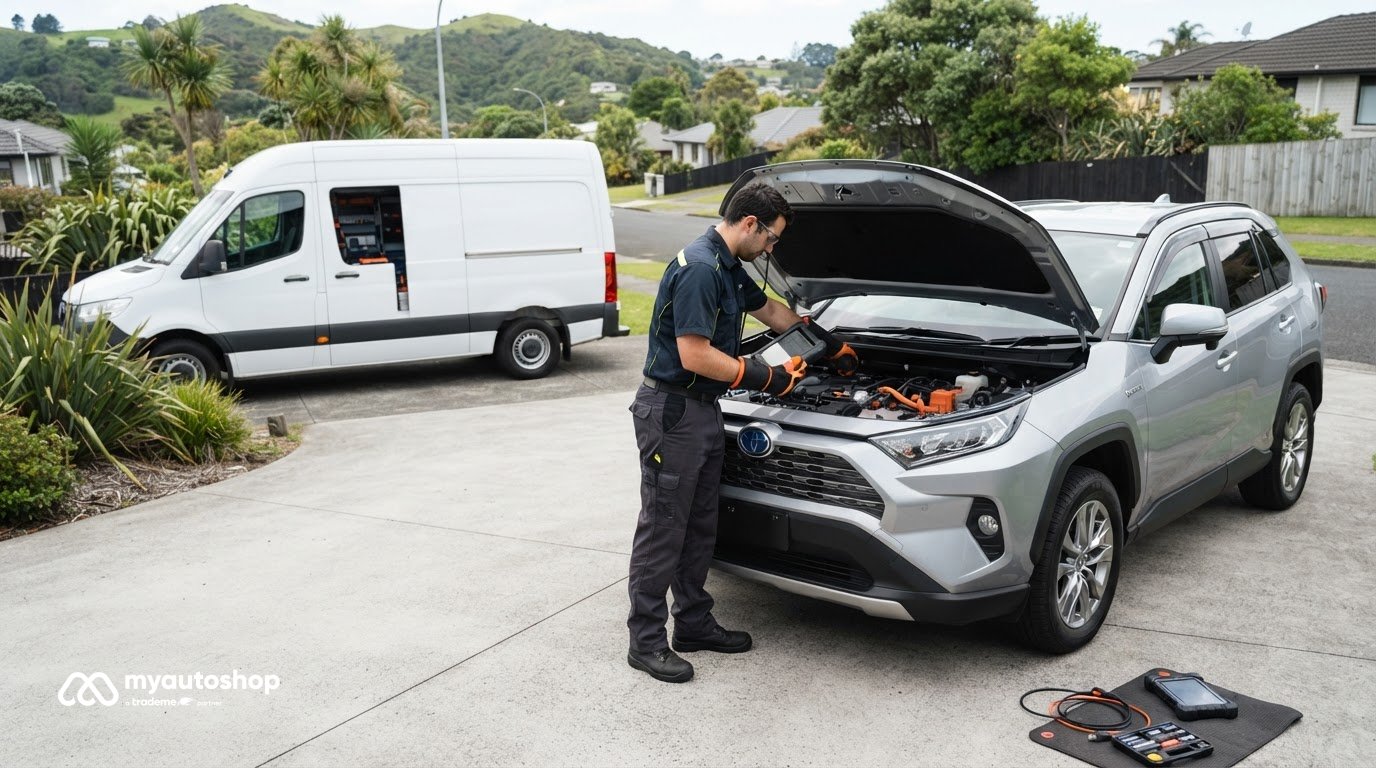
Does a Toyota RAV4 Hybrid need a completely different servicing routine from a petrol RAV4? Not usually. Toyota RAV4 hybrid system maintenance combines scheduled care for the whole vehicle with checks of hybrid-specific components. The right schedule depends on your RAV4’s model year and specification, so use the owner handbook that matches your vehicle.
Servicing should account for both the petrol engine and the hybrid system, including the correct fluids and any relevant cooling components. A hybrid warning or noticeable change in performance is a separate concern from routine maintenance. It may need assessment, but it doesn’t automatically mean the battery has failed.
This guide explains what to check, how to find the maintenance schedule for your RAV4 and what differs from caring for a petrol-only model. It also covers how to respond to a warning or change in the way your vehicle behaves, without jumping to conclusions about the cause.
Key Takeaways
- Toyota RAV4 hybrid system maintenance covers the whole vehicle, including routine petrol-engine care and checks of hybrid components.
- Use the handbook for your RAV4’s model year and specification, rather than relying on a generic service interval.
- A hybrid warning or change in performance needs attention, but it doesn’t automatically mean the battery has failed.
- Record completed servicing and note new symptoms to help distinguish scheduled care from a developing fault.
- Follow the handbook for routine care, and seek suitable assessment for a new warning or unusual behaviour.
What Toyota RAV4 Hybrid system maintenance actually includes
Start with the maintenance schedule for your specific RAV4 Hybrid. There isn’t one special service that applies to every hybrid. Routine care covers the vehicle as a whole, while hybrid components need the checks set out for that model.
Toyota RAV4 hybrid system maintenance means caring for both conventional vehicle systems and the components that support electric drive. The required work and timing depend on your RAV4’s model year and specification. Use its matching Toyota owner handbook instead of applying a generic schedule.
This video demonstrates a maintenance reminder reset on a 2025 RAV4 Hybrid. It can be useful as a visual reference, but resetting a reminder doesn’t replace scheduled servicing or diagnose a fault.
Which parts belong to the RAV4 Hybrid system?
A RAV4 Hybrid combines a petrol engine with electric-drive components. These work together to move the vehicle, with the petrol engine and electric drive operating as parts of one system. The hybrid vehicle overview explains the general principles behind this arrangement.
The high-voltage hybrid battery is one component, not the whole hybrid system or the whole car. Routine vehicle care still includes conventional items such as tyres, brakes and other scheduled checks. Hybrid-specific assessment focuses on components associated with electric drive and how they operate. Leave high-voltage parts closed: don’t attempt to inspect, handle or repair them yourself.
Does a RAV4 Hybrid need a different maintenance schedule?
There isn’t one universal service interval or list of items for every RAV4 Hybrid. Guidance can vary with the vehicle’s year and specification. Find the handbook that matches your car and use its maintenance section to identify the required work and timing. Don’t substitute an overseas dealer schedule or a generic online interval for the guidance specific to your vehicle.
Keep scheduled servicing separate from diagnosis. A service follows planned checks and maintenance instructions; diagnostic work investigates a new warning or a change in how the vehicle behaves. A warning doesn’t automatically prove the hybrid battery has failed. For examples of signs that may need investigation, read this guide to common vehicle symptoms.
For useful records, note the date and odometer reading whenever servicing is completed, and keep the paperwork with the handbook. If you’re unsure which handbook applies, first identify the vehicle’s year and specification. This gives you a reliable starting point for matching the maintenance guidance, without guessing at intervals or treating every hybrid as the same.
How routine RAV4 Hybrid servicing differs from petrol RAV4 care
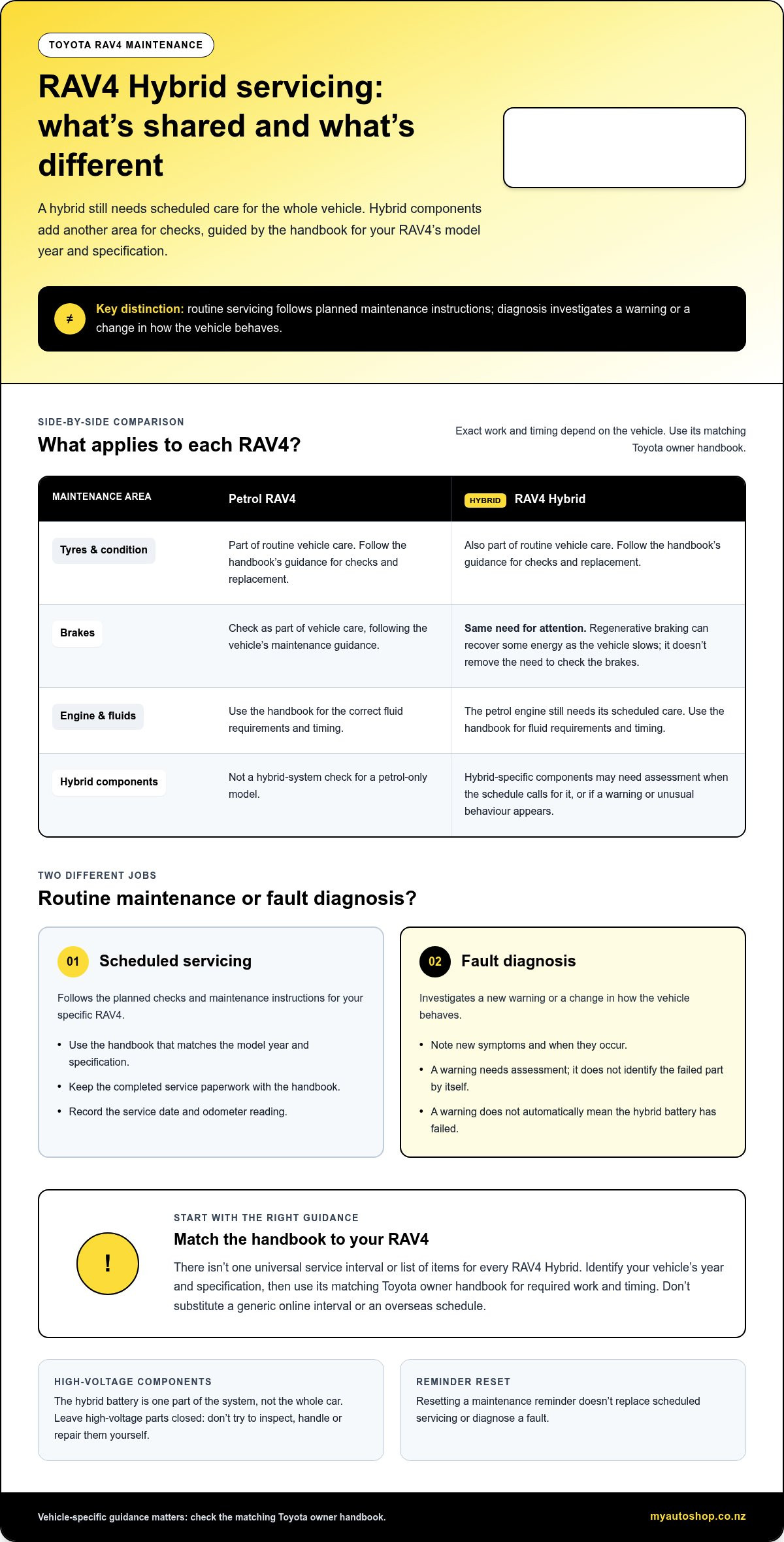
A RAV4 Hybrid still needs scheduled care for the whole vehicle. Its hybrid components add another area for appropriate checks, but they don’t make ordinary maintenance optional. Hybrid technology changes how some systems operate; it doesn’t remove the need for scheduled vehicle care.
The practical difference is that routine servicing covers the vehicle’s condition, while hybrid-specific assessment focuses on components related to electric drive. The exact service items and replacement timing depend on your RAV4’s model year and specification, so check the matching Toyota owner handbook. Avoid applying a single generic schedule to every RAV4 Hybrid.
| Maintenance category | Applies to both versions? | What to keep in mind |
|---|---|---|
| Tyres and general condition | Yes | Follow the handbook’s guidance for checks and replacement. |
| Brakes | Yes | Check as part of vehicle care; regenerative braking is an additional system feature on the hybrid. |
| Engine and vehicle fluids | Yes, where specified | Use the handbook for the correct requirements and timing. |
| Hybrid-system components | Hybrid-specific | Assess when called for by the schedule, a warning or a change in behaviour. |
What routine checks still apply to a hybrid SUV?
Tyres, brakes and the vehicle’s specified fluids remain part of looking after a RAV4 Hybrid, just as they do a petrol RAV4. The handbook tells you which checks apply to your vehicle and when parts or fluids need attention. For everyday checks, a basic car maintenance checklist can help you keep track of general condition between scheduled services.
Regenerative braking allows the system to recover some energy as the vehicle slows. It doesn’t mean you should assume the brakes need less attention or follow a different service interval. Follow the maintenance guidance for your vehicle, and take a new noise or change in braking feel seriously.
What is different about hybrid-system checks?
Hybrid-related components may need assessment when the handbook calls for it, or when a warning or unusual behaviour appears. Routine servicing and diagnosis answer different questions: servicing checks planned maintenance needs, while diagnosis investigates a particular concern. A warning light needs assessment rather than an assumption about which part has failed.
The U.S. Department of Energy’s Hybrid vehicle maintenance and safety overview describes general differences between hybrid and conventional vehicles. Treat it as background information, not a substitute for Toyota guidance for your New Zealand vehicle.
For scheduled servicing or assessment prompted by a symptom, My Auto Shop connects motorists with service and repair providers through its marketplace. Explore the My Auto Shop marketplace to find service and repair options.
Routine maintenance or hybrid fault diagnosis: how to tell the difference
Scheduled servicing and fault diagnosis have different purposes. A service follows the maintenance plan for your vehicle. Diagnosis investigates a new warning, unusual behaviour or change in performance. Keeping the tasks separate helps you respond to a symptom without assuming it means the hybrid battery has failed.
A dashboard message such as “Check Hybrid System”, a noticeable change in fuel economy or sluggish performance may be a reason to investigate. None of these signs proves that a particular component is faulty. Driving conditions, vehicle load and other vehicle systems can affect how a car behaves. Treat a symptom as information to report, not as a diagnosis.
Diagnosis depends on evidence from the individual vehicle, not on one warning or symptom alone. Consider what the car is doing, follow the handbook’s guidance and arrange suitable assessment if the concern persists or the handbook directs you to do so.
When is hybrid battery testing relevant?
Hybrid battery testing may be relevant when there’s a reason to assess battery condition, such as a related warning or a change in vehicle behaviour. It is one possible part of investigating a concern, not proof in advance that the battery is at fault. Whether testing is appropriate depends on the evidence and assessment of your vehicle.
Don’t assume a battery test is needed solely because the vehicle is a hybrid. If a symptom appears, note what you observed and explain it when arranging assessment. The reported concern and the vehicle’s condition can then inform whether battery testing is appropriate. One observation alone cannot establish the battery’s health or predict what repair, if any, may be needed.
What should you do if a hybrid warning appears?
Record the warning’s wording and, if safe, take a photo of the dashboard. Note when it appeared and any changes you noticed, such as reduced response or a difference in fuel economy. Then consult the warning guidance in the owner handbook for your RAV4’s year and specification. Follow its instructions, including any direction to stop driving or arrange prompt assistance.
If the handbook doesn’t direct you to stop, don’t ignore a warning that remains on or returns. Arrange suitable assessment and share the details you recorded. Avoid trying to inspect or repair high-voltage components yourself. A clear account of what happened helps distinguish scheduled maintenance from a new fault investigation.
This is the practical distinction in Toyota RAV4 hybrid system maintenance: follow the handbook for planned care, then assess new evidence on its own merits. A warning may need attention, but it isn’t a verdict on the battery. Avoid guessing from one symptom; use the vehicle-specific guidance and assessment to decide what to do next.
A practical RAV4 Hybrid maintenance routine for New Zealand owners
Keep the process straightforward: identify your RAV4, find the matching handbook, follow its maintenance guidance and keep a clear record. This makes Toyota RAV4 hybrid system maintenance easier to manage without relying on a generic schedule or guessing which checks apply.
- Identify your vehicle. Note its model year and specification using the vehicle documents and information in the car.
- Use the matching handbook. Check the maintenance schedule and any guidance for different operating conditions.
- Record completed work. Save service records and note the odometer reading when work is done.
- Track changes. Write down warning messages or differences in how the vehicle performs, including when they occur.
New Zealand owners may use their RAV4 in a mix of conditions, from short urban trips to longer journeys on rural roads. Don’t assume that one driving pattern automatically changes a service interval. Check how the handbook describes operating conditions and follow its guidance for your vehicle. Apply the same whole-vehicle approach to scheduled maintenance, not just hybrid-related checks.
How to use the correct maintenance schedule
Start with the RAV4’s model year and vehicle specification, then locate the Toyota owner handbook that matches. Use its maintenance section to check service items, intervals and any notes about how the vehicle is used. If you have a digital handbook, match it to your vehicle details rather than selecting one just because it describes a RAV4 Hybrid.
Keep the guidance specific to your car. A schedule published for another market, including a US dealer schedule, may not match your New Zealand-market vehicle. If the handbook’s operating-condition guidance is relevant, compare it with how you drive and follow the instructions it gives. Avoid adding extra service intervals based only on assumptions about local weather or road surfaces.
What information should you keep between services?
Keep invoices or service records together, digitally or in a folder. A simple log can include the date, odometer reading and work completed. If a warning appears or performance changes, note the exact message, what the vehicle was doing and whether the symptom returned. These details give an assessor useful context, but they don’t establish the cause on their own.
If you’re considering a used RAV4 Hybrid, review its maintenance history alongside its overall condition. Missing records don’t prove the vehicle has a fault, but they can leave questions about what work has been completed. A pre-purchase inspection through My Auto Shop can help you assess a vehicle before you buy.
For routine servicing, My Auto Shop connects motorists with service and repair providers through its marketplace. You can explore servicing options through the marketplace.
When to arrange RAV4 Hybrid maintenance or further assessment
Choose the next step based on what’s happening with the vehicle. If scheduled servicing is due, follow the handbook. If a new warning or noticeable change appears, consult the handbook’s instructions and arrange suitable assessment. If you’re unsure which maintenance item applies, check the guidance for your RAV4’s year and specification before relying on a generic schedule.
This keeps routine care separate from fault investigation. A warning message, change in performance or shift in fuel economy may provide useful evidence, but it doesn’t identify the cause by itself. Describe what you noticed and when it happens. Assessment should be based on the individual vehicle, not a guess based on one symptom.
When should an owner seek further assessment?
Don’t dismiss a new warning or a change you can clearly feel or observe. Check the matching owner handbook for the message and follow its instructions. If the warning persists, returns or comes with a change in how the vehicle operates, arrange suitable assessment. If the handbook says to stop driving or take another specific action, follow that guidance rather than continuing as normal.
Keep the details simple and specific: write down the warning’s wording, when it appeared and any related change in behaviour. This history can help guide an assessment, but it can’t confirm a fault or predict what work may be needed. Avoid opening or handling high-voltage components yourself.
For New Zealand roadworthiness or Warrant of Fitness questions, use current Waka Kotahi guidance alongside the vehicle handbook. A routine service and a WoF inspection serve different purposes, so don’t treat one as a replacement for the other. If you’re uncertain about a warning’s implications, seek guidance based on the vehicle and the warning itself.
What can My Auto Shop help you explore next?
Once you’ve identified whether the issue is scheduled maintenance or a new concern, you can explore suitable service or assessment options. My Auto Shop connects motorists with service and repair providers through its marketplace. The providers are connected through the platform and aren’t necessarily My Auto Shop employees. Choose the next step based on the maintenance guidance for your vehicle or the concern you’ve observed.
In practice, Toyota RAV4 hybrid system maintenance means following the vehicle-specific schedule for planned care, then responding to new evidence with suitable assessment. Use the handbook for its instructions, record what you observe and avoid diagnosing a component from a single symptom.
Explore service and repair options through the My Auto Shop marketplace when you’re ready to arrange your next step.
Make your next maintenance step clear
Good ownership doesn’t mean trying to predict every mechanical issue. It means keeping a simple plan and responding calmly when the vehicle gives you new information. Use your handbook and service records to make decisions that fit your RAV4, rather than relying on assumptions about hybrids as a group.
Before arranging work, decide what you need help with: planned maintenance, assessment of a specific symptom or guidance on the correct schedule. Being clear about the concern helps keep the conversation focused and makes it easier to understand the recommended next step. Toyota RAV4 hybrid system maintenance is more manageable when you treat it as part of caring for the whole vehicle, not as a reason to expect a fault.
For your next step, explore My Auto Shop and find service and repair options through the marketplace. Keep your records handy, follow the handbook and take concerns seriously without jumping to conclusions.
Frequently Asked Questions
Does a Toyota RAV4 Hybrid need more maintenance than a petrol RAV4?
Not necessarily. Hybrid technology doesn’t automatically mean more frequent maintenance. Treat servicing as planned care for the whole vehicle, and diagnosis as a separate task if a concern appears. When arranging work, describe whether you need scheduled maintenance or help investigating a particular issue. This helps distinguish routine service tasks from assessment prompted by a symptom.
How often should a Toyota RAV4 Hybrid be serviced in New Zealand?
Use the schedule for your specific RAV4 rather than applying one interval to every model. If the service history is incomplete, review the records and odometer reading to establish what has already been done. Don’t try to make up for a missed service by doubling up on work. First identify what is due for that vehicle, then arrange the relevant maintenance.
Does a RAV4 Hybrid need its hybrid battery serviced regularly?
Don’t assume the high-voltage battery needs a separate regular service just because the car is a hybrid. Battery testing is a distinct assessment that may be relevant if there’s a concern about battery condition. It isn’t the same as routine servicing, and it shouldn’t be treated as a guaranteed fix or a prediction that the battery will need replacement.
Can a Toyota RAV4 Hybrid still need ordinary brake and tyre maintenance?
Yes. Check tyres for visible damage and uneven wear, and pay attention to changes in how the brakes feel or sound. These observations can help you describe a concern, but they don’t confirm its cause. Keep ordinary vehicle checks in your routine, and use the maintenance guidance for your RAV4 to understand when more detailed inspection or replacement is due.
What should I do if the hybrid warning light comes on in my RAV4?
If it’s safe, take a clear photo of the dashboard message and note what was happening just before it appeared. Don’t try to clear or reset a warning to see whether it returns. Follow the handbook’s instructions and share the message and circumstances when arranging assessment. This gives the person investigating the issue a useful starting point.
Can a RAV4 Hybrid be maintained by a regular mechanic?
Routine maintenance can be handled by a mechanic equipped and experienced for the work involved. Jobs involving high-voltage components require relevant hybrid-system knowledge and safe working practices. When arranging work, explain whether it’s a scheduled service or a concern involving the hybrid system so the appropriate assessment can be planned.
Does a hybrid RAV4 need a different WoF in New Zealand?
A RAV4 Hybrid follows New Zealand’s WoF inspection process, but a WoF is not a substitute for scheduled maintenance or a full assessment of hybrid battery health. Passing the inspection doesn’t establish that every vehicle system has been serviced or assessed in depth. For current inspection requirements, check Waka Kotahi guidance, and keep WoF checks and routine servicing as separate parts of vehicle care.
Disclaimer
This article provides general information only and should not be relied on as professional mechanical, safety or legal advice. Vehicle requirements and circumstances vary. If you are unsure about your vehicle, have it inspected by a qualified automotive professional.