

You don’t need to know the name of a faulty part to explain a car problem. The key to how to confidently talk to a mechanic about car problems is to share useful details and ask for clear answers. If a fault comes and goes, or the mechanic can’t reproduce it during an appointment, it’s understandable to worry that you won’t be taken seriously.
You can still help the mechanic investigate. Note when the issue happens, what you notice, and whether anything makes it better or worse. A photo, short video or written note can help explain an intermittent noise or warning light. You don’t need to diagnose the cause yourself.
This guide covers what to tell the mechanic, which questions can clarify a diagnosis, and how to discuss recommended work before agreeing to it. You’ll also learn how to confirm the cost, timing and next steps, so you leave knowing what’s been found, what you’ve approved and what happens next.
Key Takeaways
- Describe what you notice, when it happens and what changes it, without trying to name the faulty part.
- Keep notes about when the problem started and how often it occurs, especially if it comes and goes.
- Use simple, specific examples to explain symptoms, and leave the diagnosis to the mechanic.
- Ask what the mechanic found, how it relates to your concern and what each recommended option would address.
- Finish with a clear summary of the agreed next steps to help you talk confidently with a mechanic about car problems.
Why talking to a mechanic about car problems can feel difficult
Explaining what your car is doing can feel awkward, especially if you’re worried about using the wrong word or sounding as though you’re guessing. You don’t need to know the mechanical cause. Your job is to describe what you experienced; the mechanic can ask follow-up questions and investigate possible causes. A diagnosis may require further checks, so don’t expect an instant answer from a brief description alone.
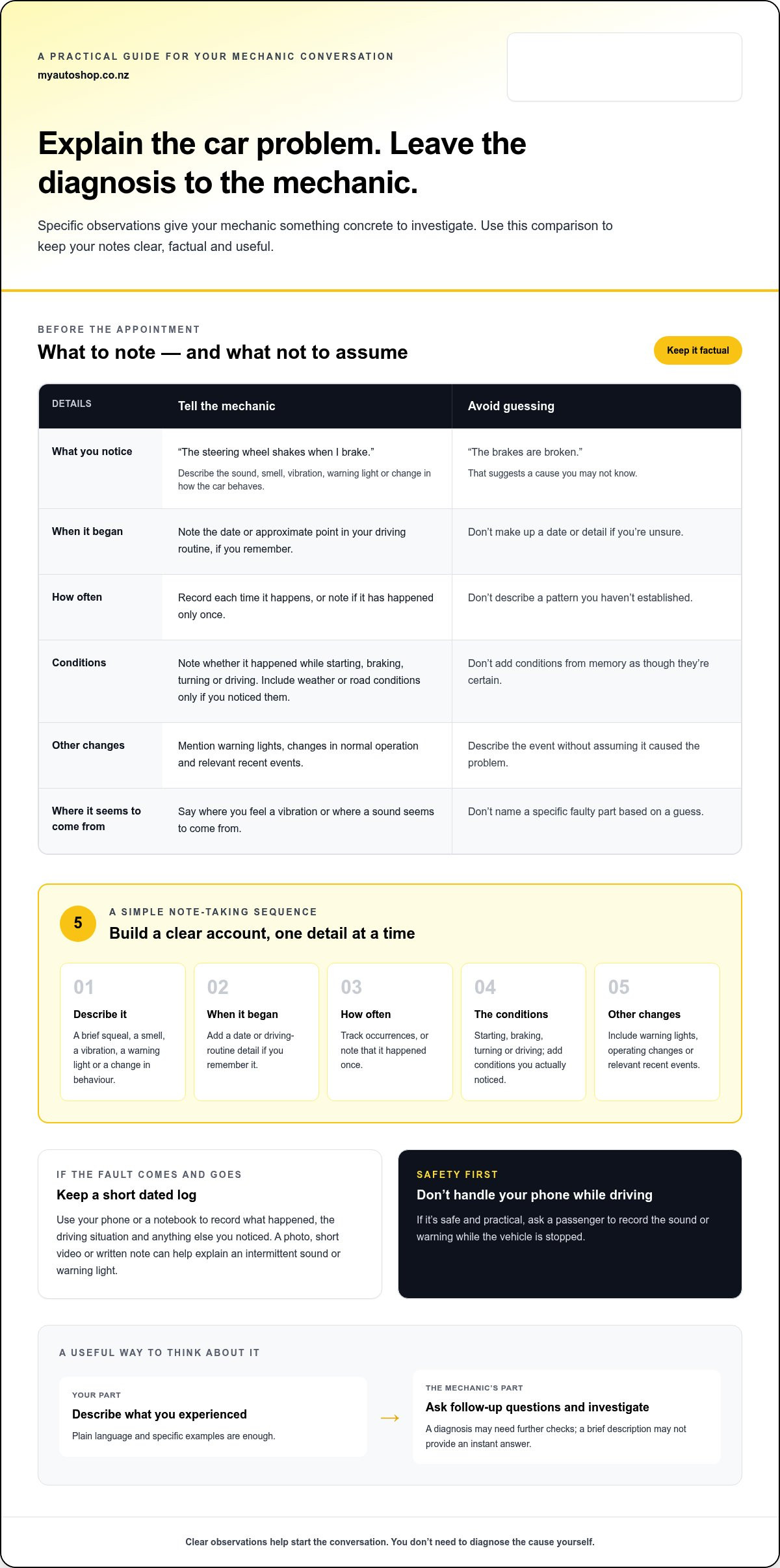
Specific observations are more useful than guessed diagnoses because they give the mechanic something concrete to investigate. “The steering wheel shakes when I brake” describes what you noticed. “The brakes are broken” suggests a cause you may not know.
What makes car problems hard to explain?
Some symptoms are hard to put into words. A noise might be a squeal, knock or low hum; a smell may come and go before you can identify it. You might notice a vibration through the seat, a dashboard warning light or a change in how the car handles. These everyday details help give the concern context.
Intermittent problems can be especially tricky to describe from memory. You may recall that a sound happened on a wet morning or after driving for a while, but not remember exactly where you were or how fast you were travelling. Keep your observation separate from your theory: “I heard a rattle over bumps” is more useful than “the suspension is faulty.”
You do not need to speak like a mechanic
Use plain language and familiar comparisons. Say that a sound is like a ticking clock, that the car feels as if it’s pulling to one side, or that starting takes longer than usual. These descriptions don’t need to be technically exact. They help the mechanic understand what to look for and what to ask next.
It’s also reasonable to ask for an explanation if you don’t understand a term or recommendation. Try, “Could you explain what that means in everyday language?” or “What did you notice that led you to that conclusion?” Understanding the explanation helps you make a considered decision. It isn’t a test of your mechanical knowledge.
A mechanic may ask when the symptom occurs, whether it changes with speed or if you’ve noticed anything else. That’s part of narrowing down the issue, not a sign that you’ve described it badly. A general overview of car repair can provide background, but your own observations are the best place to start the conversation.
If it’s more practical to have the vehicle assessed at home or work, Turners Service & Repairs provides mobile servicing and mechanical repairs in selected New Zealand regions. Find details about the mobile mechanic service through My Auto Shop.
Prepare a clear description of your car problem before the appointment
A few notes made before you speak with the mechanic can help you recall details, particularly if the problem comes and goes. Keep them factual: describe what happened and the conditions you noticed, but leave the cause open. This gives the mechanic a clearer starting point and helps you explain the concern without trying to diagnose it yourself.
Useful symptom notes capture what happened, when it happened, how often it happens and what else you noticed at the time.
Use this sequence to organise your thoughts:
- Describe the symptom. Note the sound, smell, vibration, warning light or change in how the car behaves. Use everyday words, such as “a brief squeal” or “the engine takes longer than usual to start”.
- Record when it began. If you remember, note the date or approximate point in your driving routine when you first noticed it. Don’t guess if you’re unsure.
- Track how often it happens. Record each occurrence, or note if it has happened only once. This helps separate what you’ve observed from a pattern you haven’t established.
- Add the conditions. Write down whether it occurred while starting, braking, turning or driving. Note weather or road conditions only if you noticed them at the time.
- Include recent changes. Mention a dashboard warning light or a change in how the vehicle normally operates. You can also note relevant recent events, such as a change in your usual driving routine, without assuming they caused the problem.
Record what you notice, not what you assume
Keep observation and interpretation separate. For example, write “the steering feels heavier when parking”, rather than “the steering system has failed”. Note whether a warning light stays on or appears briefly, and describe where you feel a vibration. If the sound seems to come from a particular area, say that it seems to, rather than stating that a specific part is at fault.
Make intermittent problems easier to explain
Use a short dated log on your phone or in a notebook. Each entry can include what happened, the driving situation and anything else you noticed. If it’s safe and practical, ask a passenger to record the sound or warning while the vehicle is stopped. Don’t film, take notes or handle your phone while driving. A clear record can help explain an issue that isn’t happening during the appointment.
This preparation makes how to confidently talk to a mechanic about car problems more straightforward: you’ll have details to refer to instead of relying on memory or arriving with a guessed diagnosis. For another perspective on preparing for a conversation with a mechanic, Forbes offers advice in How to Talk to Your Mechanic. If you’re still looking for the right words to describe a symptom, My Auto Shop’s car symptoms guide can help.
How to explain car symptoms without knowing technical terms
Use a simple structure: what happens, when it happens and what changes it. This gives the mechanic a useful account to investigate without asking you to name a faulty part. Describe what you notice, then let the mechanic work out what might be causing it.
A useful distinction is: “A symptom is what you experience; a mechanical cause is an explanation that needs to be investigated.” A noise or warning light can have more than one possible cause, so avoid treating your first guess as a diagnosis.
Use everyday words to describe sounds and sensations
Choose words that help someone picture or hear the symptom. Is the noise faint or loud, repeated or occasional, sudden or gradual? Does the car feel as though it’s pulling, shaking or responding differently from usual? You can compare its current behaviour with what you normally expect from your own car without knowing the technical name for a system or part.
Hypothetical example: “There’s a faint, repeated squeak when I brake slowly. I haven’t noticed it at other times.” That describes a sound and when it occurs. It doesn’t claim that a particular brake component has failed. A warning light works the same way: say which light you saw and whether it stayed on or went away, rather than assuming what needs replacing.
Give the mechanic useful context
Place the symptom in the driving situation: did it happen while starting, turning, braking or travelling over a rough surface? Say whether it seems constant or occurs only occasionally. Mention any recent change you directly observed, such as the car taking longer to start. Keep the details separate. A change may be relevant to the investigation, but it doesn’t prove what caused the symptom.
Hypothetical example: “The steering feels heavier than usual when I’m parking, but it feels normal once I’m moving.” This tells the mechanic what feels different and in which situation, without claiming a steering part is faulty. If you’re unsure how to name a sound, smell or other symptom, the car symptoms guide can help you find words for what you’ve noticed.
At the appointment, give the mechanic your short description first, then add relevant details or show your notes. If you have a recording, explain what was happening when you made it. A clip can provide context, but it won’t identify the cause on its own. Don’t try to reproduce a noise or sensation in a way that could put you or others at risk. Let the mechanic decide what checks are appropriate.
This approach makes how to confidently talk to a mechanic about car problems more straightforward: describe the experience clearly, be open about what you don’t know, and leave diagnosis to the investigation.
Questions to ask when a mechanic explains a diagnosis or repair
You don’t have to accept a diagnosis you don’t understand or decide on recommended work before you’re clear about it. Ask the mechanic to connect their findings to the concern you described. A calm, specific question can help you understand what they observed, what remains uncertain and what choices you have.
Clarify what the mechanic found
Start with the evidence. Ask, “What did you notice that points to this issue?” or “Was there a test or inspection that helped identify it?” You’re not prescribing a diagnosis; you’re asking how the explanation relates to your original concern. If the finding doesn’t seem to match what you reported, explain what feels different and ask the mechanic to clarify the link.
If a term is unfamiliar, say so. Ask for a plain-language explanation of the part or issue and what it does in your car. Then check whether the finding fully explains your symptom or whether further investigation is needed. It’s reasonable to ask what’s known, what’s still a possibility and what the next check would help establish.
Understand recommendations before agreeing
Before approving work, clarify what the mechanic recommends doing now and whether anything can be discussed later. Ask what each job is intended to fix or prevent, and how it relates to the finding. If there are options, ask what each one addresses and what the practical difference is. Take time to make sure you understand before deciding.
Urgency matters too. Ask, “Does this need attention now?” and “What could happen if I wait?” If the mechanic is uncertain, ask what they can confirm at this stage and what remains unclear. Their answer can help you weigh the recommendation without assuming every suggested repair has the same priority.
Questions like these keep the discussion focused on evidence and decisions. You might ask:
- “Could you explain that in everyday language?”
- “How does this finding relate to the symptom I brought the car in for?”
- “What work do you recommend, and what is each part meant to address?”
- “Are there options, and what are the differences?”
- “Is there anything you haven’t been able to confirm yet?”
Before you agree, repeat your understanding in your own words: “So the inspection found this issue, and you recommend this work to address it. Have I understood correctly?” If the proposed work or cost isn’t clear, ask for the details before authorising it. If additional work comes up, clarify what it involves and agree to it before it proceeds. This helps you make an informed decision about how to confidently talk to a mechanic about car problems.
Once you understand the finding and options, My Auto Shop can connect motorists with automotive service and repair providers through its mechanic services marketplace.
Agree on next steps and get help discussing car problems
Before the conversation ends, make sure you both have the same understanding of the concern, what the mechanic found and what happens next. A clear summary helps prevent confusion later, especially if the issue needs more investigation or you want to consider the recommendation before proceeding.
Finish with a shared understanding
Summarise the plan in your own words and invite the mechanic to correct anything you’ve misunderstood. For example: “You’ve found an issue that may explain the noise, and the next step is to investigate it further. Is that right?” If work has been recommended, confirm what you’ve agreed to and what you haven’t. Ask what information you should expect next, and when or how you’ll hear about it if that’s part of the plan.
If the cause is still unclear, ask what further assessment or information would help. Find out whether you should keep an eye on a particular symptom and what change would be useful to report. Don’t assume you need to recreate the problem. If you’re concerned about whether it’s safe to keep driving, raise that directly and ask for clear advice about what to do—and if an issue like tyre damage makes travelling risky, choosing a specialist such as Mobile Tyre Service allows you to get fittings or repairs handled directly at your location.
Keep the details together for future conversations. Save your symptom notes, any recording, the mechanic’s explanation, recommendations and written communications in one place. If you later speak with someone else about the car, these records can help you explain what was observed and what has already been discussed. For broader car repair and maintenance context, use a reliable guide alongside advice specific to your vehicle and its symptoms.
Find a relevant way to arrange support
Knowing the agreed next step makes it easier to decide what support you need, whether that’s further diagnosis, a repair or routine servicing. My Auto Shop connects motorists with automotive service and repair providers through its platform. The providers are not a team of My Auto Shop employees. Turners Service & Repairs is a separate provider of mobile servicing and mechanical repairs in selected New Zealand regions.
Keep your next conversation practical. State the issue you want addressed, share your notes and ask what the proposed appointment or work is intended to cover. For details about mobile mechanical support from Turners Service & Repairs, see the mobile mechanic options on the My Auto Shop website.
Clear communication doesn’t mean knowing the right mechanical terms. It means sharing what you observed, checking that you understand the explanation and leaving with an agreed action. That’s how to confidently talk to a mechanic about car problems while keeping decisions grounded in what you know and what still needs to be checked.
Take your next car conversation one step at a time
You don’t need to have every answer before speaking with a mechanic. Start with what you’ve noticed, ask for anything unclear to be explained and take the time you need to understand the recommendation. You’re part of the decision, and it’s reasonable to leave the conversation knowing what happens next.
That’s the practical heart of how to confidently talk to a mechanic about car problems: share what you know, ask about what you don’t and agree on a next step that makes sense for you. If you need automotive support, My Auto Shop connects motorists with service and repair providers. It also provides independent pre-purchase vehicle inspections to help inform used-car decisions.
Explore automotive service and repair options through the My Auto Shop marketplace and take your next step with more clarity. You can have a straightforward, useful conversation, even without knowing the mechanical jargon.
Frequently Asked Questions
What should I tell a mechanic if I do not know what is wrong with my car?
Start with the vehicle details and the practical effect of the problem. Tell the mechanic the car’s make, model and year, and whether the issue affects starting, driving or using a feature. Mention any work recently done on the vehicle if you know about it. You can also explain how you use the car, such as for a regular commute, to give context to your concern.
Can I show a mechanic a video of a car noise?
Yes. A video can help the mechanic recognise the sound you’re describing. Before showing it, check that the audio is clear and that the clip includes enough of the event to make sense, rather than only the loudest moment. Keep the original file so the sound hasn’t been altered. If the mechanic can’t open it on your phone, describe what the clip captures instead.
What if my car problem does not happen when the mechanic checks it?
Ask what the mechanic can assess without the symptom occurring and whether that assessment can rule out any concerns. If it can’t, agree on what to do if the issue returns, such as arranging another check or providing further information. Make sure you understand any limits to the current assessment. If the car’s behaviour changes or the concern becomes more serious, update the mechanic rather than relying on an earlier assessment.
Should I tell a mechanic what I think is causing the problem?
You can mention your theory, especially if it came from previous work on the car or advice you received elsewhere. Explain where the idea came from, but don’t present it as a confirmed diagnosis. This gives the mechanic relevant context while leaving them to make their own assessment. If you have paperwork from an earlier repair or inspection, bring it along so the mechanic can see what was previously recorded.
What questions should I ask before agreeing to a repair?
Ask for a written breakdown of the proposed work and its cost, and check whether the price is a quote or an estimate. Clarify how the mechanic will seek your approval if extra work is recommended. In New Zealand, the Consumer Guarantees Act provides protections for services supplied by a business, including guarantees about reasonable care and skill. Keep the written details and any invoices with your vehicle records.
How can I feel more confident when speaking to a mechanic?
Set a simple goal for the conversation, such as understanding the finding or deciding what happens next. If you lose track of the discussion, ask the mechanic to go over the main point again before you leave. You can also take someone you trust along if that helps you feel more at ease. Knowing how to confidently talk to a mechanic about car problems comes with practice, not specialist knowledge.
Is a dashboard warning light enough information for a mechanic?
A warning light helps identify what needs discussing, but the symbol alone may not explain the full issue. If you can, note the exact wording shown on the dashboard and check your owner’s manual for the light’s name. Tell the mechanic if you’ve seen the same light before or if the vehicle has had relevant work done. Don’t rely on a guessed interpretation of the symbol.
Disclaimer
This article provides general information only and should not be relied on as professional mechanical, safety or legal advice. Vehicle requirements and circumstances vary. If you are unsure about your vehicle, have it inspected by a qualified automotive professional.