

A battery-health check can make a used EV’s condition clearer before you buy or sell. An Aviloo EV Test assesses the battery’s State of Health, giving both parties useful information to support a more informed decision.
It’s understandable to focus on battery condition: it affects confidence when buying a used EV and can shape price discussions. A test result is one part of the picture, alongside the vehicle’s service history, overall condition and how it drives.
Read on to learn how the test can help with a used EV sale or purchase, what a State of Health result means, and which vehicle models it covers. You’ll also see what the check can and can’t tell you, so you can use the result sensibly rather than treating it as a complete vehicle inspection.
Key Takeaways
- Use a battery health report as one input when weighing a used EV, alongside its history, condition and test drive.
- Understand what a State of Health result says about battery capacity, and why it should be read in context.
- Compare the purpose of PREMIUM and FLASH checks to see which type of assessment suits your decision.
- See which factors can affect the cost of a battery test in New Zealand, without relying on a one-size-fits-all figure.
- Pair battery information with a broader pre-purchase inspection to assess more than the battery alone.
Used EV purchase and sale confidence
A battery assessment can give buyers and sellers a clearer basis for discussing an electric vehicle’s condition. Use the result alongside the vehicle’s history and a test drive, not as a substitute for checking the whole car.
Test Types and Measurement Scope
AVILOO offers PREMIUM and FLASH test options, but their names alone don’t explain what each measures. Compare the stated test process, measurement scope and report before deciding which result suits your purchase or sale. Battery checks can use different methods, so their figures aren’t automatically comparable.
To compare AVILOO with other battery tests or diagnostics, check whether each assesses battery capacity, reads vehicle data or identifies faults. Focus on what the result actually covers rather than treating every battery-health figure as equivalent. For buyers, the key is whether the assessment answers the question behind the purchase.
Test Timing and Preparation
The time required depends on the test option and its process. PREMIUM and FLASH follow different procedures, so allow for the process attached to your choice rather than assuming every test takes the same time.
Before arranging a test, note the vehicle’s make, model, model year and odometer reading. Keep its service history and any battery-related warning messages handy. These details help put the result in context, especially when comparing the report with the seller’s description or the vehicle’s driving range.
If a seller discusses the separate 12-volt battery, this guide to choosing your car battery explains that component; it isn’t the EV’s main traction battery.
Reliability and Purchase Risks
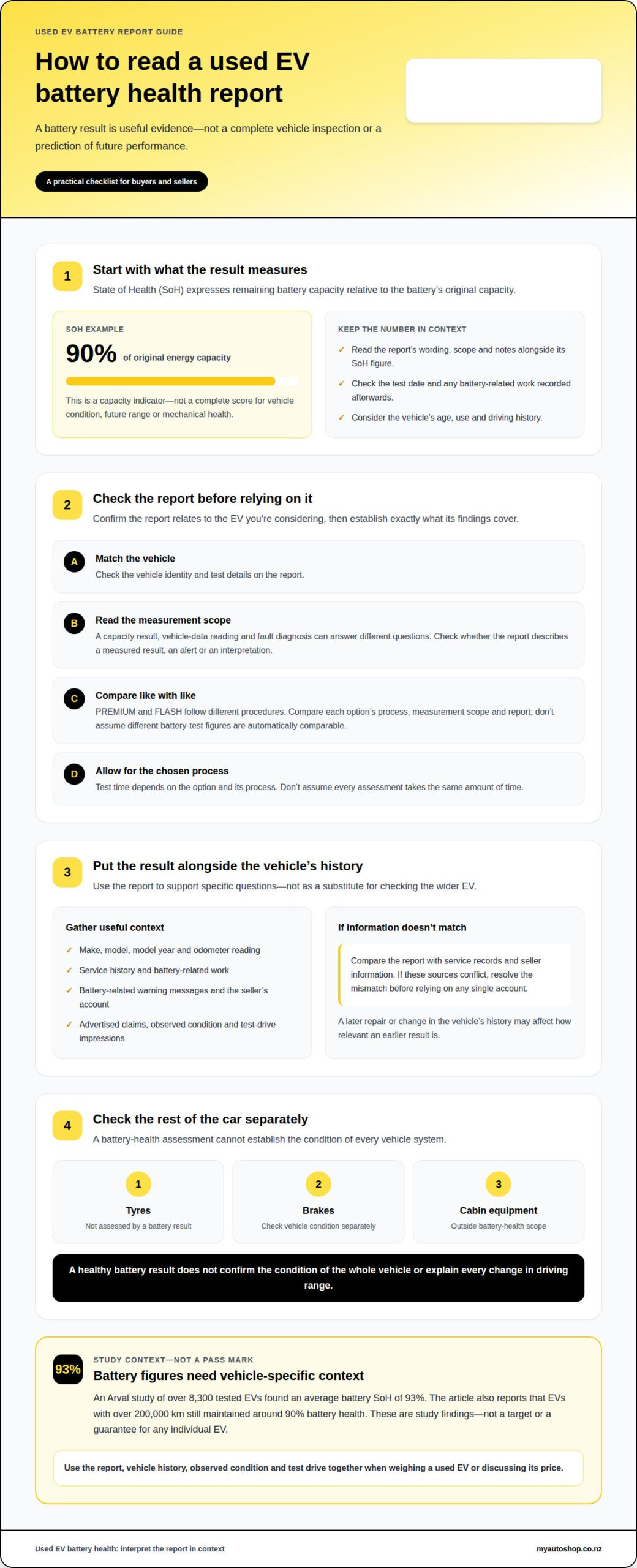
State of Health, or SoH, expresses remaining battery capacity relative to its original capacity. An EV battery with a SoH of 90% can deliver 90% of its original energy capacity. Treat that as a capacity indicator, not a complete score for vehicle condition, future range or mechanical health.
Read the report’s SoH result alongside its stated scope and the car’s history. An Arval study of over 8,300 tested EVs found an average battery SoH of 93%. That is a study finding, not a target that every used EV must meet. A lower or higher result needs context, including the vehicle’s age, use and driving history.
An AVILOO EV Test can support a buying decision, but it cannot establish the condition of every vehicle system. A healthy battery result doesn’t assess items such as tyres, brakes or cabin equipment. Nor will a battery result alone explain every change in driving range. Before agreeing on a price, compare the report with the vehicle’s history, advertised claims and observed condition.
For sellers, a battery report can make discussions about battery condition more specific. Buyers can use it to identify questions about capacity and test scope, then assess the rest of the vehicle separately. This keeps one technical result in proportion to the full purchase decision.
How accurate and reliable are AVILOO battery health and State of Health results?
An AVILOO result is useful when you understand what it reports and how the information was collected. State of Health (SoH) is a defined battery measure, not a prediction of how the vehicle will perform throughout future ownership.
What a State of Health result tells you
Read the report’s SoH figure alongside its wording and any accompanying notes. The percentage is a summary, so the measurement scope and test type matter when interpreting it. For example, a report focused on battery health won’t answer questions about charging equipment, cabin systems or tyre condition.
Keep the result tied to the test date. If the report displays one, compare it with the sale timeline and any battery-related work recorded afterwards. A later repair or change in the vehicle’s history may affect how relevant an earlier result is to the EV you’re viewing.
How to judge reliability
Check that the report identifies the vehicle you’re considering, then read its stated scope before drawing conclusions. When comparing reports from different providers, compare the test methods and the terms used for each result. Two figures may look similar while describing different measurements.
Distinguish a battery-health assessment from a fault diagnosis. A capacity result and a diagnostic finding answer different questions, even when both relate to the EV battery. If you don’t understand a finding, check whether the wording describes a measured result, an alert or an interpretation.
Use the result without over-relying on it
Use the report as one piece of evidence in your decision. Compare it with the EV’s service records, dashboard warnings and the seller’s account of battery-related work. If these sources conflict, resolve the mismatch before relying on any single account.
- Check the vehicle identity and test details on the report.
- Read the stated measurement scope and explanations.
- Compare the findings with service records and seller information.
- Assess vehicle systems outside the battery separately.
A clear report can support a more informed discussion between buyer and seller. It cannot establish the condition of every system or predict future performance. Use its findings to frame specific questions, then make your decision based on the vehicle’s wider history and observed condition.
Long-term results can help put an individual SoH figure in context without replacing the vehicle-specific report. The cited Arval study found that EVs with over 200,000 km (124,000 miles) still maintained around 90% battery health. Many EV batteries retain over 90% health after 100,000 miles. The study “Dynamic Cycling Enhances Battery Lifetime” was published in Nature Energy in December 2024. These findings describe observed battery health, not a guarantee about the condition or future performance of any particular EV.
For day-to-day charging, aim to keep an EV battery between 20-80% charge. Avoid charging the battery to 100% too often, and avoid letting it drop to 0% too often. These practices offer useful context when discussing battery care, but they do not establish an individual vehicle’s current SoH. A test result remains specific to the vehicle and test event, so interpret it alongside its stated scope and the wider history.
AVILOO PREMIUM vs FLASH: Differences and Measurements
AVILOO PREMIUM and FLASH differ mainly in how they assess the EV battery. PREMIUM involves a more detailed test under driving conditions, while FLASH is a quicker diagnostic check that uses vehicle data. PREMIUM is suited to a deeper battery assessment, while FLASH is useful when a faster snapshot is the priority.
What PREMIUM measures
PREMIUM assesses battery performance through a driving test, rather than relying only on information already stored in the vehicle. The process observes how the battery performs as the car is driven, then uses those measurements to assess usable capacity and battery health.
Because the vehicle is driven during the assessment, this option involves more preparation and time than a stationary data check. It may suit buyers who want a fuller picture of battery performance before deciding. The result still relates to the battery, not every mechanical or electrical system in the vehicle.
What FLASH measures
FLASH is a quicker assessment that reads information from the vehicle’s battery management system through its diagnostic connection. The system monitors battery operation and stores relevant data, which FLASH uses to assess battery health without the same driving-test process as PREMIUM.
That difference matters when interpreting the report. FLASH draws on vehicle data, whereas PREMIUM assesses battery performance during a drive. They use distinct test methods, so don’t assume the reports are interchangeable or that matching result labels mean identical measurement processes.
Which test suits your decision?
Choose based on the information you need and the time available for the assessment. For a quick indication based on the vehicle’s stored battery data, FLASH is the more direct option. If you want the battery assessed through a driving test, PREMIUM uses that more involved approach.
- Choose FLASH when a quicker data-based battery check fits your needs.
- Choose PREMIUM when you want a driving-based assessment of battery performance.
- Read the report’s method so you understand how its result was produced.
- Use either result as battery information, not a full vehicle inspection.
For example, a seller preparing an EV for a viewing may prefer the shorter FLASH process. A buyer wanting battery performance assessed during driving may prefer PREMIUM. The right choice depends on the question you need answered, access to the vehicle and the type of report you want to use in your decision.
How much does an AVILOO EV battery test cost in New Zealand?
The cost in New Zealand depends on the case and is provided after a quote request. Key factors include the AVILOO test selected, the vehicle being assessed and the arrangements needed. Request the quote in NZ dollars, and check what it covers before booking.
What can affect the quoted cost?
Start by choosing a test option. PREMIUM and FLASH are separate AVILOO tests, so specify which one you want priced. The test name alone doesn’t show whether it suits your vehicle or purpose. Match the option to the battery information you need, then request a quote for that assessment.
The vehicle matters too. Its make, model and battery configuration help establish whether the chosen test applies. A quote for one model shouldn’t automatically be treated as the price for another. Provide the vehicle details when requesting a quote so the amount relates to the car you plan to buy or sell.
Practical arrangements can also affect the final amount. The booking location and how the test is organised may influence the quote. Make your request specific: name the EV, the test option and where the vehicle can be assessed. This helps clarify what the quoted amount covers.
How to compare quotes fairly
Compare like with like. If you receive different quotes for an AVILOO battery check, confirm that each refers to the same test option and vehicle. Compare what the service includes, such as the test and resulting report. A lower figure may cover a different scope, so headline amounts alone don’t show whether offers are equivalent.
Before accepting a quote, check these details:
- The named test option, PREMIUM or FLASH.
- The exact vehicle make and model covered.
- The assessment location and any stated arrangements.
- Whether the quoted amount includes the battery report.
- The currency, shown as NZ$.
Budget for the decision, not just the test
For buyers, compare the test cost with the information it provides for the purchase decision. A battery assessment focuses on battery-related information; it doesn’t replace an assessment of the vehicle’s wider condition. Sellers can consider whether a report helps answer buyers’ questions about the EV battery.
Keep the quote and report with the vehicle’s records. If you’re comparing two used EVs, request the same test type for each where suitable. This gives you a clearer basis for comparing the service and its findings, without assuming the vehicles or test arrangements are identical.
Most EV batteries are designed to last 8-15 years. That broad design range is context, not a finding about the individual EV being considered, and it does not establish how much capacity a particular battery retains. Use the assessment and its report for vehicle-specific battery information, then weigh that information alongside the purchase or sale decision. Consider the quoted test cost in that context, rather than as a substitute for understanding the battery in the car.
How to Book an AVILOO EV Test in New Zealand
To arrange an AVILOO test, identify the vehicle and choose the test option that fits your purpose. Then follow the booking instructions provided by the organisation arranging it. Before confirming, make sure the details match the EV you want assessed and clarify how to present the vehicle.
Prepare the vehicle details
Have the vehicle’s make, model, model year and registration details ready. Note the odometer reading and where the EV can be accessed. These details help identify the vehicle being assessed and align the booking information with the car you intend to buy or sell.
If you’re buying privately, agree on access with the seller before setting a time. Establish when the EV can be made available and where it will be. If you’re selling, gather relevant service records and details of any battery-related work to provide useful context for the test.
Choose the test and arrange access
Decide whether PREMIUM or FLASH better suits the question you need answered. PREMIUM assesses battery performance during a drive, while FLASH uses vehicle data for a quicker check. State your preferred option in the booking enquiry and read the instructions for that test before arranging access.
Share the vehicle’s location and confirm how it needs to be presented. Don’t assume every test follows the same process: the option you select affects what happens during the assessment. If you’re buying, coordinate arrangements with the seller. If you’re selling, give the person arranging the test the correct vehicle details.
Review the booking and report
Before the test, check that the booking information identifies the right EV and test option. Keep the appointment details with your vehicle records. When you receive the report, compare it with the seller’s description and records, and note any questions to resolve before deciding.
Use this sequence to keep the process organised:
- Record the EV’s identifying details and location.
- Select the test based on the information you need.
- Agree access with the seller or vehicle owner.
- Follow the booking and vehicle-preparation instructions provided.
- Keep the resulting report with the vehicle’s records.
A battery assessment is one part of a used-EV purchase. It doesn’t cover every vehicle feature or mechanical system, so plan separate checks for the rest of the car. You can include a wider used-vehicle assessment alongside the battery report.
When selling, share the report for the correct EV with prospective buyers. When buying, keep it with your notes on the vehicle’s history and condition. This gives you a clear record of what the battery assessment covers and helps organise any remaining questions before you decide.
My Auto Shop: Pre-purchase Inspection
My Auto Shop offers a Pre-purchase Inspection to help assess a used EV beyond its battery report. An AVILOO result focuses on battery health, while an inspection considers the vehicle’s wider condition, including areas such as tyres, brakes and visible mechanical components.
Arrange an inspection when you’re considering a particular EV and want broader information before deciding. Share the battery report and any concerns about the seller’s description so they can inform the assessment. A battery test and vehicle inspection answer different questions, making them useful together when assessing a used-car purchase.
To add a wider check to your buying process, explore the pre-purchase inspection service. Contact My Auto Shop to discuss your inspection needs.
Make your next EV decision with a clear plan
Before committing to a used EV, turn the battery information into practical questions: does the report match the vehicle, and what else needs assessing? An AVILOO EV Test can inform your decision, while your next step depends on whether you’re still buying or already own the car.
For a purchase, My Auto Shop offers a Pre-purchase Inspection to assess the vehicle beyond its battery report. After buying, My Auto Shop also offers Basic Service and Comprehensive Service. Choose the next step that fits your situation, rather than treating one battery result as the whole picture.
Bring your vehicle details and any report or records when you get in touch. Contact My Auto Shop about an EV test and take your next step with a clearer plan.
Frequently Asked Questions
How does this help when buying or selling an EV?
An AVILOO battery report gives buyers and sellers a shared reference for discussing the EV’s battery condition. Buyers can use its findings to ask focused questions before agreeing to a purchase, while sellers can provide evidence when describing the vehicle. For example, if the report differs from the seller’s account, discuss that difference before negotiating. The report makes the conversation more specific, but doesn’t assess the entire vehicle.
Disclaimer
This article provides general information only and should not be relied on as professional mechanical, safety or legal advice. Vehicle requirements and circumstances vary. If you are unsure about your vehicle, have it inspected by a qualified automotive professional.