
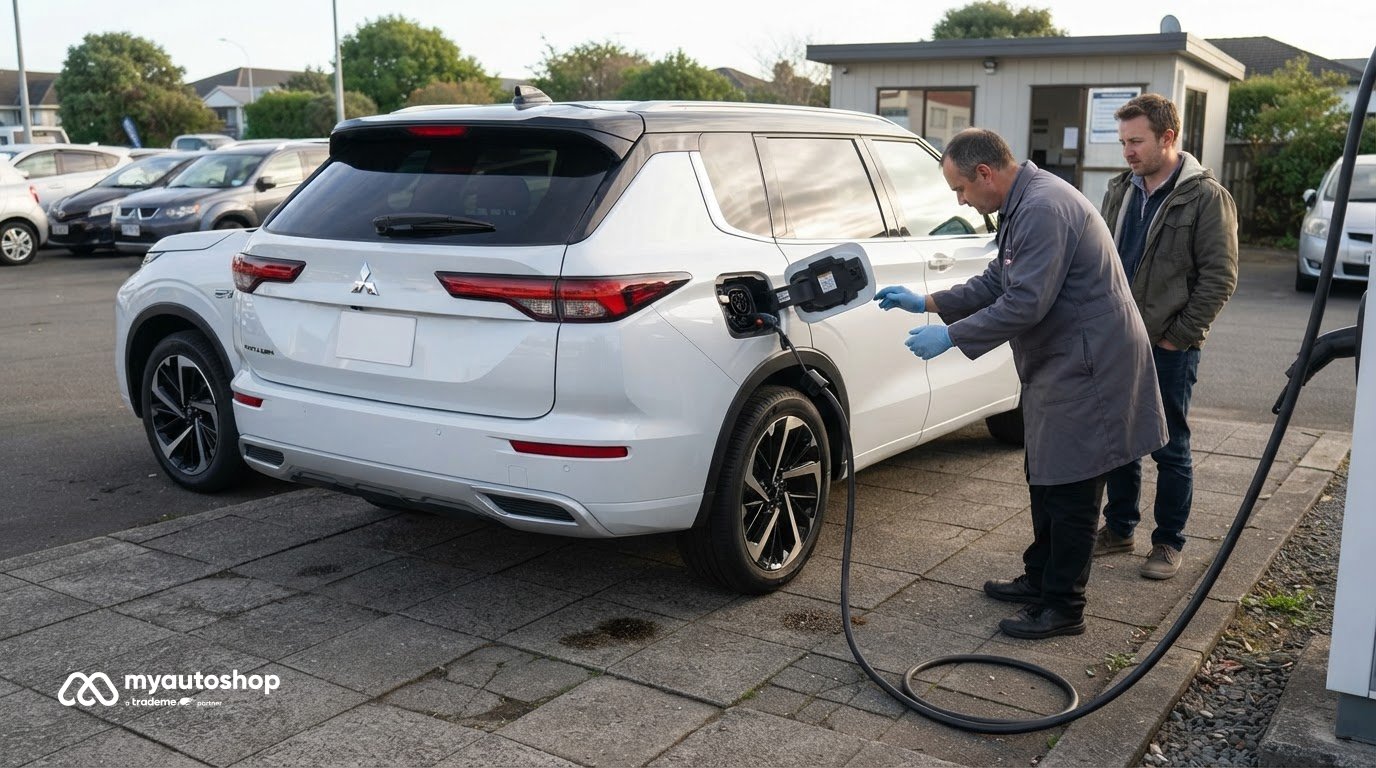
The oldest Outlander PHEV isn’t automatically the one to avoid. The common issues with a used Mitsubishi Outlander PHEV depend more on battery condition, maintenance and how the vehicle has been driven than on its year alone. Early models deserve careful scrutiny, while the 2018 update brought a larger 13.8 kWh battery and a 2.4-litre engine.
Look beyond the advertised electric range. Cooler weather and cabin heating can reduce how far the vehicle travels on a charge, while long trips without regular charging can affect fuel economy. Battery behaviour, reported faults and service history together give you a clearer picture of the vehicle.
This guide explains which model years may warrant extra attention, what to look for in battery performance, and how seasonal driving and real-world fuel use shape ownership. You’ll also find the reported faults worth keeping in mind, so you can assess a used Outlander PHEV with practical expectations rather than relying on the year badge alone.
Key Takeaways
- Assess battery behaviour alongside the displayed range, since charge level and battery condition affect what the vehicle can deliver.
- Weigh a model year against its charging history and condition rather than ruling out a vehicle on age alone.
- Allow for cooler weather and cabin heating to change electric range, especially for regular New Zealand winter trips.
- Know which reported faults to pay attention to, including issues with the 12V battery, parking brake and infotainment system.
- A pre-purchase inspection can help assess the vehicle’s mechanical condition before you decide to buy.
Battery-management system balancing and state of charge
The battery-management system (BMS) monitors the Outlander PHEV’s battery cells and manages their charge. The displayed state of charge is useful, but it doesn’t show the battery’s full remaining capacity. Common issues with a used Mitsubishi Outlander PHEV can include reduced battery capacity or charging problems, so consider the reading alongside the vehicle’s performance.
Battery Degradation and Range Loss
Battery degradation is the gradual loss of the battery’s ability to store and deliver energy. It matters because a full charge may provide less electric range than it once did. One owner reported 55% degradation after five years of daily use, leaving 45% charging capacity. Another owner reported getting 100-105 km per charge in summer, then 85-90 km as the weather cooled and the heater was used about 10% of the time.
Individual examples don’t predict what another vehicle will deliver. Compare range under similar conditions, including route, temperature and heater use. A short stop-start trip and a longer drive aren’t directly comparable.
Cell Failure and Power Loss
A cell failure occurs when one or more battery cells can no longer perform as expected. The BMS monitors cell behaviour, so a fault may affect usable charge or trigger a warning. One owner reported random power loss and stalling after their Outlander PHEV battery failed, including at high speeds and while crossing intersections.
Sudden power loss is different from gradual range reduction and needs serious attention. Record warning messages, unexpected changes in charge or interruptions to power. Assess common issues with a used Mitsubishi Outlander PHEV in context, especially if the same symptom recurs while driving.
Hybrid-System Charging Failures
A hybrid-system charging failure means the vehicle doesn’t replenish its battery as expected during charging or hybrid operation. The symptom alone doesn’t identify the cause: an external charging connection and a fault within the vehicle can produce different problems. Note whether charging starts or stops, and whether the displayed state of charge increases.
If the battery level doesn’t change after a charging session, record the conditions and any dashboard messages. If the petrol engine runs but the displayed charge doesn’t rise, note that pattern too. A charging complaint alone doesn’t prove that a battery cell has failed.
The BMS balances cells to keep their charge levels more consistent. This helps the system assess the battery as a whole, but balancing doesn’t restore capacity lost through degradation. A full-charge reading can therefore coexist with reduced electric range.
When assessing a used Outlander PHEV, compare the displayed state of charge with the distance travelled on a familiar route. Repeat the observation under similar conditions, noting any changes in warnings or power delivery. This gives a clearer picture than relying on one reading or assuming every battery-related symptom has the same cause.
Which Mitsubishi Outlander PHEV years should you avoid?
No single Outlander PHEV year is an automatic avoid. Give earlier 2.0-litre models careful scrutiny, and assess the 2018 update on its individual condition: it introduced a 2.4-litre engine and increased battery capacity from 12 kWh to 13.8 kWh.
That change makes 2018 a useful point of comparison, not a guarantee of better condition. A well-maintained earlier vehicle may suit your needs better than a neglected later one. Check the specific car’s service history, charging behaviour and condition, and have the dealer explain any gaps or recurring charging faults.
Compared with a used Toyota RAV4 Hybrid, the Outlander PHEV’s plug-in battery allows electric driving after external charging, while a conventional hybrid doesn’t plug in. Other plug-in SUVs also depend on charging access, battery condition and the distances you regularly drive, so compare the specific vehicles rather than their badges alone.
There’s no single typical price for a used Outlander PHEV or its repairs in New Zealand. Vehicle value depends on year, kilometres, specification and condition; repair costs depend on the fault and parts required. Battery or charging-system work differs from routine maintenance, so assess the specific car rather than relying on a general figure.
Charging history matters because frequent use of rapid charging and regular home charging describe different patterns of use, but neither alone proves a fault. The Outlander PHEV has two charging sockets: Type 1 for AC charging and CHAdeMO for rapid DC charging. Record which connection is used and whether charging starts and completes.
Compatibility with DC fast chargers can vary by operator firmware. A charger that doesn’t work with one vehicle at one site doesn’t necessarily mean the car’s charging system is faulty. If possible, observe a charging session and note any dashboard message or interruption. A dealer can also explain documented charging repairs.
For a used vehicle, inspect the charging port for visible damage and check that its covers close properly. Confirm the cable connects securely, then see whether the dashboard indicates charging. If charging repeatedly fails or stops mid-session, treat it as a fault to investigate, not just an inconvenience.
Use model year as a starting point, then judge the battery, charging history and service records together. The 2018 engine and capacity update helps distinguish versions, but a documented, well-kept vehicle matters more than choosing a year by reputation alone.
How seasons affect Outlander PHEV electric range
Electric range can change with temperature and the energy needed to keep the cabin comfortable. Compare the vehicle in conditions similar to the trips you expect to make in New Zealand.
Seasonal Range Changes
Seasonal range change is the difference in electric distance available as weather and vehicle use change. Performance on a mild day may not reflect a cold-weather routine. For example, a winter commute with frequent window demisting places different demands on the vehicle than a mild-weather trip with the climate controls turned down.
Where the vehicle is parked can also affect a cold start. A car left outside overnight begins a journey in different conditions from one kept under cover. Consider your usual parking situation when judging whether its electric range will suit your routine.
Conditions vary across New Zealand and between seasons, so one owner’s experience may not match yours. Think about the trips that matter most, such as school runs, errands or regular travel between towns. The balance of short and longer journeys helps show how useful electric driving will be throughout the year.
Electric-Only Range
Electric-only range is how far the Outlander PHEV travels on battery power before petrol assistance is needed. It matters most if you need to complete familiar journeys without the petrol engine starting. Match the vehicle’s performance to your actual routine rather than relying only on the estimate shown after charging.
During an assessment, use the cabin controls as you normally would. For instance, test the demister on a damp morning and see how the vehicle behaves with the climate system set for comfort. This gives a more realistic impression than driving with every accessory switched off.
Consider whether your regular parking place lets you begin trips with a charged battery. A vehicle used for repeated errands without charging between them may behave differently from one charged consistently at home. The pattern of use matters as much as the season.
For a useful comparison, note the route, outside conditions and climate settings during each drive. Where practical, repeat a similar journey in another season. This helps distinguish normal seasonal variation from a change that deserves closer assessment, without treating one dashboard estimate as the whole story.
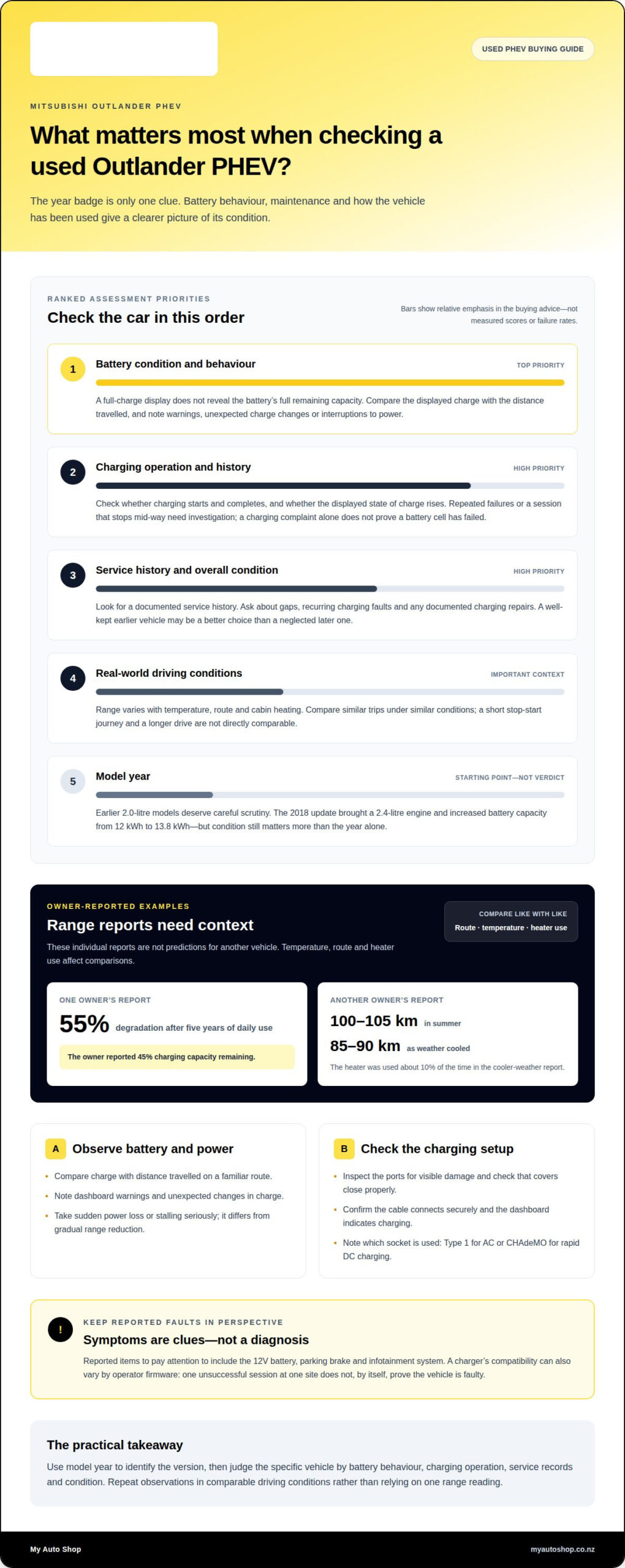
Outlander PHEV reliability and reported faults
Owner experiences range from trouble-free use to electrical and mechanical faults. When assessing a used Outlander PHEV, look for recurring symptoms and records of completed repairs.
Reported Reliability Faults
Reported reliability faults are issues individual owners have experienced, not proof every Outlander PHEV will develop them. They matter because electrical symptoms can affect everyday use. Owners have reported 12V battery drain while parked, an electronic parking brake that sometimes fails to release first time, and infotainment lag on early units.
Other reports describe a fuel-filler flap that triggered a dashboard warning and an infotainment screen that stopped working. These examples help guide an assessment but don’t establish how often each fault occurs. Review service records for repairs, software updates and repeated warning messages, then compare them with the vehicle’s behaviour during a drive.
Recalls, Safety, and WOF Concerns
Recall status depends on the individual vehicle, so its year or registration alone won’t show whether recall work is outstanding in New Zealand. Ask a Mitsubishi dealer to check the vehicle identification number against applicable New Zealand recall records. Overseas recall notices don’t by themselves show that the same campaign applies to a New Zealand vehicle.
A current Warrant of Fitness (WoF) concerns roadworthiness at the time of inspection; it doesn’t assess the full condition of the hybrid battery or infotainment software. Consider WoF status separately from the vehicle’s mechanical and hybrid-system condition.
During a test drive, apply the electronic parking brake more than once and watch for dashboard warnings. Test the touchscreen, reversing display and other infotainment functions. If the 12V battery has gone flat while parked, check the repair history for whether it was replaced and whether the cause was investigated. A replacement alone doesn’t explain why it went flat.
Assess the tyres, brakes, lights and visible suspension condition alongside the vehicle’s electrical functions. These items contribute to roadworthiness, but a WoF doesn’t confirm that every system works as expected. Ask the seller for repair records and written details of recurring faults or completed recall work.
Owner accounts vary: some describe trouble-free use, while others report specific faults. Neither predicts the condition of a particular New Zealand vehicle. Give more weight to its service history, warning messages, test-drive behaviour and the result of a vehicle-specific inspection.
Outlander PHEV fuel economy in real-world driving
The Outlander PHEV’s fuel economy depends heavily on how often it’s charged and how far it travels on petrol. Its official figure exceeds 150 mpg, but that result won’t represent every New Zealand owner’s daily driving. A plug-in hybrid can use little petrol on short trips when regularly charged, yet consume more on longer journeys once the battery’s electric contribution is used.
Owner reports show how widely results can vary. One owner reported overall consumption around 30 mpg, while another reported up to 65 mpg combined. These aren’t controlled comparisons, so treat them as examples, not predictions. Charging frequency, route length, traffic and speed all influence how much work the petrol engine does.
Long motorway journeys can change the picture. The Outlander PHEV can struggle to exceed 30 mpg on long motorway trips or when rarely recharged. That matters if your regular drive involves sustained open-road speeds, rather than short commutes between charging opportunities. The official figure above 150 mpg may be less useful for that pattern of use.
For a buying decision, match the vehicle to your routine. A driver who can charge between short trips may make more use of electric driving. Someone travelling long distances without recharging will rely more on petrol. Ask the seller how the vehicle was typically driven and charged, then compare that pattern with your expected use.
Reported journey totals also vary. One owner described a petrol range of around 200 miles on a full tank, while another reported about 320 miles combined on a dual carriageway using EV and petrol modes. These are individual experiences, not guaranteed distances. Route, driving conditions and starting charge affect the result.
Use a consistent route to understand a particular car’s consumption. Note the starting charge, distance travelled and fuel used, then repeat under similar conditions. One trip may not show the usual pattern, especially if one journey starts with a full charge and another doesn’t. Compare the results with your weekly driving, not just the dashboard estimate.
For a used Outlander PHEV, judge fuel economy alongside charging access and trip length. If you rarely plug in, don’t base running-cost expectations on the official figure. If charging is part of your routine, assess how often your journeys can use battery power. That practical fit matters more than an isolated mpg claim.
Getting a used Outlander PHEV checked before buying
My Auto Shop offers pre-purchase inspections for people assessing a used Outlander PHEV. An inspection is useful if the electric range seems low, charging is inconsistent or service records leave questions about the vehicle’s condition.
Share any concerns you’ve noticed, such as a charging session that stopped early or a warning light during a test drive. Include the vehicle’s service records and any repair details provided by the seller. This gives the inspection a clear focus and helps relate the symptoms to the car’s documented history.
A used plug-in hybrid needs more than a quick look at its exterior. A pre-purchase inspection can assess the vehicle’s general mechanical condition and highlight issues that need attention. For an Outlander PHEV, discuss how the charging system behaved, whether warning messages appeared and whether faults returned after repairs.
- Describe charging problems, including whether charging started and completed.
- Share dashboard warnings or changes in power delivery noticed during a drive.
- Provide service records that show repairs or recurring faults.
- Ask for any seller statements about faults or repairs in writing.
These details help distinguish an isolated inconvenience from a pattern worth investigating. One interrupted charge, for example, tells a different story from repeated failures across charging sessions. Records can also show whether a reported issue was addressed or remains unresolved.
Consider the findings alongside the vehicle’s age, condition and your regular driving needs. A pre-purchase inspection supports an informed decision, and questions about hybrid-battery performance should be raised as part of the assessment. Don’t treat a displayed range or current Warrant of Fitness as a complete picture of the vehicle.
My Auto Shop’s pre-purchase inspection is a practical next step before deciding on a used Outlander PHEV. It helps you assess the vehicle’s condition in light of the concerns that matter to you.
Contact My Auto Shop to discuss a pre-purchase inspection.
Frequently Asked Questions
What are the most common problems with used Mitsubishi Outlander PHEVs?
Common issues with a used Mitsubishi Outlander PHEV vary between vehicles, and owner reports don’t establish how frequently each fault occurs. Use the paperwork to build a timeline: note when a symptom first appeared, what work followed and whether it returned. This can show whether a repair addressed the underlying problem or only cleared a warning temporarily.
Which Mitsubishi Outlander PHEV model years have the most reported faults?
There’s no reliable New Zealand fault ranking identifying one Outlander PHEV year as having the most reported faults. Registration year can also be an imprecise guide to a vehicle’s specification. Compare the vehicle identification number, build details and equipment with the paperwork. Judge the specific car’s condition and maintenance record instead of assuming that vehicles from one year share the same risks.
How long does the Outlander PHEV battery last, and how much does replacement cost in New Zealand?
Battery lifespan and replacement cost depend on the vehicle’s condition and the work required. The diagnosis matters: a battery-related warning doesn’t automatically mean the whole pack needs replacing. A written assessment should identify the fault and explain the proposed repair. For a New Zealand purchase, use this vehicle-specific information to consider ownership costs rather than relying on a figure from another market.
How can I check battery health and electric range on a used Outlander PHEV?
Arrange a hybrid-battery assessment and keep its findings with the vehicle’s service records. A written baseline can help you understand the battery’s condition at purchase and compare it with future assessments. Dashboard estimates can change with recent driving and climate settings, so they aren’t a complete record of battery health. Ask for the findings to be explained in plain language.
What are common faults with the Outlander PHEV petrol engine, transmission, and hybrid system?
Owner reports don’t establish a single recurring petrol-engine or transmission defect across all Outlander PHEVs. Ask for invoices describing any engine, transmission or hybrid-system work, rather than a summary that simply says “repaired”. The repair date, parts or system involved and any follow-up work help clarify the vehicle’s history. If records include diagnostic codes, ask what fault each code related to.
How reliable are the Outlander PHEV brakes, suspension, air conditioning, and electronics?
Reliability depends on the condition and upkeep of the individual vehicle, so a model-wide label can mislead. Consider the vehicle’s kilometres, maintenance records and inspection findings together to distinguish routine wear from a fault. A component needing attention doesn’t by itself establish a broader reliability problem. Clear records make it easier to understand what has been maintained and what may need follow-up.
What should I inspect or test-drive when buying a used Outlander PHEV in New Zealand?
Before arranging a viewing, ask the seller to have the vehicle charged and ready for a proper demonstration. Include your regular driving needs in the assessment, such as whether you rely on home charging or often travel beyond your usual routes. Keep the seller’s written answers and inspection findings with the vehicle paperwork. Together, they provide a clear reference when weighing the purchase decision.
Disclaimer
This article provides general information only and should not be relied on as professional mechanical, safety or legal advice. Vehicle requirements and circumstances vary. If you are unsure about your vehicle, have it inspected by a qualified automotive professional.