
A repair quote is useful only when it clearly explains what the price covers. To get a quote for car repairs online, provide your vehicle details and a specific description of the problem, along with relevant photos or diagnostic information. Ask for the recommended work, parts and labour in writing, and check how the price is calculated before comparing quotes.
A quote based on the information you provide is a starting point, not always a confirmed diagnosis. Similar symptoms can have different causes, and a mechanic may need to inspect the car or run diagnostics before confirming the repair. You’re right to want a clearer idea of costs before giving the go-ahead. This guide explains what to include in an online request, what to look for in a written quote, how to compare costs fairly, and how to judge whether a fault needs prompt attention. It also covers what can affect repair timing, so you can make a practical plan without being left guessing.
Key Takeaways
- Send clear vehicle details and a description of the fault to help a mechanic assess your repair request.
- Look for a written quote that separates the recommended work, parts and labour, making costs easier to compare.
- Understand why an online estimate may change after an inspection or diagnostic check, and what can affect repair timing.
- Use the information in a quote to decide what needs attention and whether a service or mobile mechanic suits your situation.
1. Repair urgency, costs and timeframes
Start by separating a safety concern from a repair that can wait. If the car handles differently, makes a new noise, or shows a warning light, describe that clearly in your online request. Give the mechanic the symptoms and when they occur, such as during braking or when the engine is cold. A clear account helps them assess urgency, but diagnosis may still take several hours.
Treat an estimate as an initial assessment, not a confirmed diagnosis. A mechanic may need to inspect the vehicle or run diagnostics to identify the fault, which can change the recommended work, parts and final cost. Ask for the proposal in writing and check whether it is an estimate or a quote, what work it covers, and whether extra work requires your approval first.
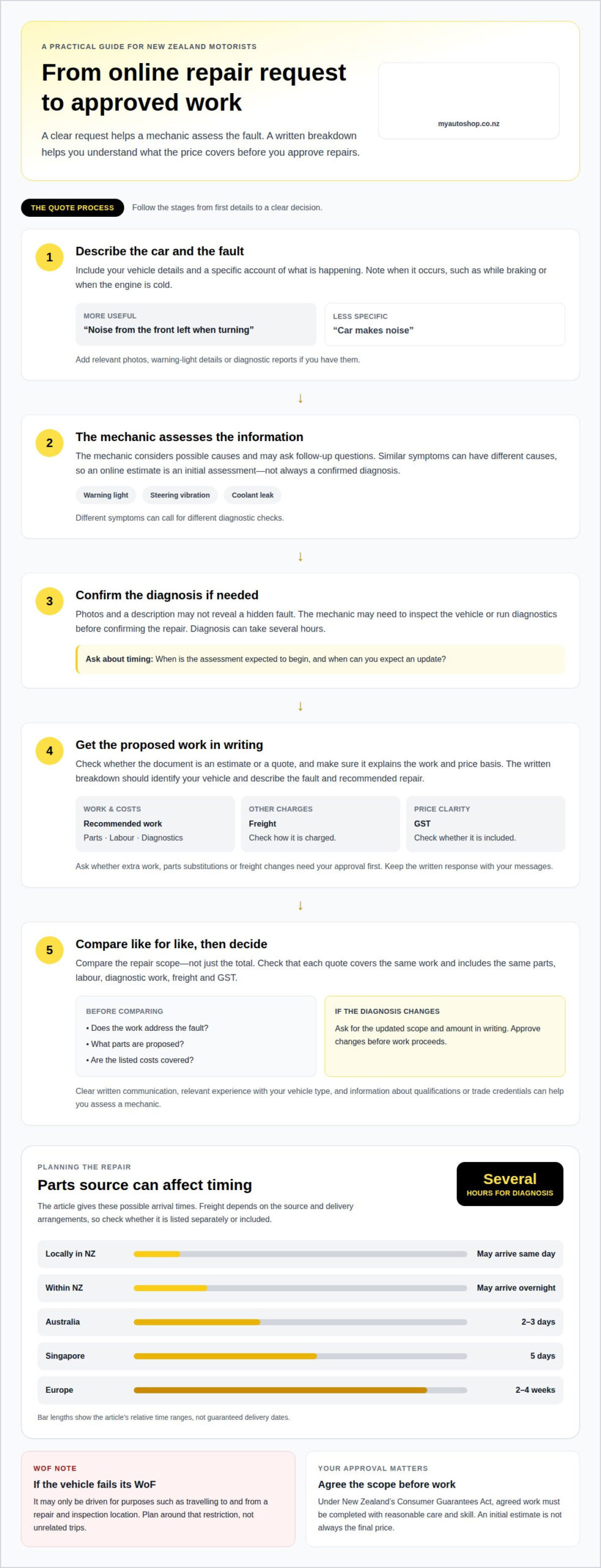
Parts availability can affect both the repair schedule and freight charges. Parts sourced locally in New Zealand may arrive the same day; parts sourced from within New Zealand may arrive overnight. Parts from Australia may take two to three days, while parts from Singapore may take five days. Parts sourced from Europe may take two to four weeks. Freight depends on the part’s source and delivery arrangements, so look for it as a separate line or ask how it is included.
A failed Warrant of Fitness (WoF) affects what you can do next. A vehicle that fails a WoF may only be driven for purposes such as travelling to and from a repair and inspection location. Plan around that restriction rather than using the car for unrelated trips. For other faults, explain any changes in symptoms so the mechanic has useful context.
Work and Income New Zealand states a single person aged 18 or over must have weekly income before tax below NZ$1,010.41 to meet the listed income limit for car repair assistance. A couple, with or without children, must have weekly income before tax below NZ$1,467.61. A sole parent with two or more children must have weekly income before tax below NZ$1,291.75. These are income limits, not a guarantee of assistance.
Work and Income does not usually pay for fuel, WoF, car insurance, car registration or regular servicing. For an online quote, ask directly whether requesting it costs anything. The written quote should state whether GST is included and show whether parts, labour and freight are covered. Read those details before approving work, so the amount and scope are clear.
Diagnosis can take time, so allow for an inspection or diagnostic checks when planning a repair. If timing matters, ask when the assessment is expected to begin and when you can expect an update. Ask the mechanic to explain what the diagnosis has established before you decide on the next step. This gives you a chance to understand the findings and proposed work before authorising it.
Getting a repair estimate or quote in writing from a mechanic
Ask the mechanic to put the proposed repair in writing before you approve work. The document should identify your vehicle, describe the fault, and explain the recommended repair. It should also separate labour, parts, freight, diagnostic work and GST, where applicable. For example, a quote for a radiator issue should say whether it covers repair or replacement. Clear wording helps you understand what the quoted amount includes.
Check whether the document is an estimate or a quote, then read its conditions. An estimate is an expected cost based on available information; an inspection may reveal more work. A written quote should set out the agreed work and price basis. Ask how the mechanic will handle extra repairs, parts substitutions or freight changes. Keep the written response with your messages, so you can refer to the same scope later.
Online quotes can help you compare options, but they may be less precise than an in-person inspection. Photos and a description cannot reveal every hidden fault, so the mechanic may need to inspect the vehicle or run diagnostics. If the inspection changes the diagnosis, ask for an updated breakdown before deciding what work to approve.
Compare quotes by matching the repair scope, not just the total. Check whether each includes the same parts, labour, diagnostic work, freight and GST. Ask what parts are proposed and whether the quoted work addresses the fault you described. To assess a mechanic, look for clear written communication, relevant experience with your vehicle type, and information about qualifications or trade credentials. Avoid assuming two totals cover identical work.
A mechanic may revise an estimate if an inspection reveals a different fault or additional work. Ask for the updated scope and amount in writing, and approve any changes before work proceeds. The Consumer Guarantees Act does not make every initial estimate a final price; it requires agreed work to be completed with reasonable care and skill.
Under New Zealand’s Consumer Guarantees Act, a mechanic must complete agreed work with reasonable care and skill. If you think you’ve been overcharged, ask for a breakdown showing work done, time taken, parts and freight. The Disputes Tribunal can review a claim under the Act to assess whether a mechanic’s requested price is reasonable. For more context on transparent charges, see this guide to fair pricing for repairs.
How a mechanic can provide an online quote for car repairs in New Zealand
To get a quote for car repairs online, start with a clear request. A mechanic needs your vehicle details, a description of the fault and any useful photos or diagnostic reports. For example, “noise from the front left when turning” gives more direction than “car makes noise”. The mechanic may ask follow-up questions before estimating the work.
Next, the mechanic considers possible causes and checks that could identify the fault. A dashboard warning light, steering vibration, or coolant leak each points to different diagnostic steps. A mechanic may use diagnostic equipment to help identify the area of a fault. That scan can help narrow the investigation, but may not identify every repair required.
The mechanic will assess whether the information supports an online estimate or whether an inspection is needed. A visible cracked component may be easier to assess from clear photos than an intermittent noise underneath the vehicle. Ask which details informed the estimate and what checks remain. This helps you understand what the online assessment covers before approving work.
For a written quote, the mechanic records the proposed work and its cost basis. A useful breakdown identifies parts, labour, diagnostic work, freight and GST where applicable. It should describe the repair, rather than relying on a broad label such as “engine work”. If several causes remain possible, the quote can separate the initial diagnostic step from repairs that depend on its findings.
Before preparing a quote, a mechanic may request your registration number, make, model, year, engine type or odometer reading. These details help identify the vehicle and relevant parts. A photo of the registration label or dashboard can clarify vehicle details, while a short video may capture a hard-to-describe sound. Send material that relates directly to the reported fault.
To understand how to get a quote for car repairs online, follow the request through to the written response. The mechanic reviews the information and sends an estimate or quote with the next step, which may be an inspection, diagnostic work or the proposed repair. If an inspection points to another issue, ask for an explanation of the revised work and cost before approving it.
Keep the quote, messages and any diagnostic report together. They record what the mechanic assessed and what you agreed to. If the diagnosis changes, refer to the specific item and ask for the updated scope in writing. A clear record helps both sides follow the request from initial assessment through to the agreed repair, without relying on memory or an informal phone conversation.
What information and photos should you provide for a mechanic to prepare an online repair quote?
Start with the vehicle’s registration, make, model, year and odometer reading. Include the engine type if you know it, especially for hybrid or modified vehicles. These details help identify the vehicle and relevant parts. Mention recent repairs, dashboard warning lights or changes since the last service. For example, say whether a warning appeared after a battery replacement.
Describe the fault in everyday language, then say when it happens. Note whether a sound occurs while turning, braking, accelerating or starting from cold. Explain how often it happens and whether it changes with speed. “A clunk from the front when turning left” gives more useful context than “steering problem”. Include when you first noticed it, even if you only know approximately.
Share the vehicle’s WoF status and any recent inspection findings. If an inspection report identifies worn tyres, a leak or a damaged CV boot, attach the relevant page. The mechanic can use the report to understand what has already been assessed. Distinguish what you observed from a suspected cause or a fault diagnosed by someone else.
Choose photos that show the issue clearly. Take a wide view to locate the affected area, then closer images from different angles. For a visible radiator leak, photograph the wet area and surrounding components. For a damaged exterior panel, include both the whole panel and a close-up of the damage. Keep images in focus and use natural light where possible.
For a sound or intermittent fault, a short video can show when it occurs. Record the noise in a normal, safe situation, such as while the car idles in a driveway. Add a caption explaining the conditions, such as “only after the engine starts”. Describe what you hear and where it seems to come from rather than relying on audio alone. A video provides context, but cannot reveal every hidden fault.
Attach relevant records, such as a recent diagnostic report, service invoice or WoF inspection notes. Tell the mechanic what each file shows. If a scan displays a fault code, send the complete code and description rather than a cropped image. Avoid editing photos in ways that hide surrounding components or alter their appearance.
Before sending, review the request as if you were seeing the car for the first time. Check that the registration and contact details are correct, the symptoms are specific and each attachment relates to the problem. Clear information helps the mechanic assess the request and identify whether an in-person inspection is needed before quoting the repair.
Which New Zealand mechanics offer online car repair estimates, and how do you choose one?
In New Zealand, you can request an online repair estimate through a mechanic’s website form, email or booking platform. The process usually starts with your vehicle details and a description of the fault. Some requests can be assessed from that information, while others need an inspection before the mechanic can price the work. An estimate is a starting point, not proof that the fault has been diagnosed.
Search for the repair you need and compare the scope of the service offered. A mobile mechanic may suit a car that is difficult to take to a workshop, but mobile service is available only in Auckland and Wellington through Turners Service & Repairs. For repairs elsewhere, My Auto Shop connects motorists with automotive service and repair providers through its marketplace.
Compare the written details, not just the total. Put each estimate beside the others and check that they cover the same repair. One might include diagnostic work and replacement parts, while another covers inspection only. Look for labour, parts, freight and GST, and note any exclusions. If the descriptions differ, the totals aren’t directly comparable.
Use the repair scope to assess whether an estimate addresses your symptoms. For example, if you report a coolant leak, check whether the proposal specifies a radiator repair, replacement or diagnostic step. A broad label such as “cooling system” leaves more uncertainty than a specific description. Clear explanations make it easier to understand the proposed work and what remains to be assessed.
Consider how the estimate is delivered. A written response gives you a record of the proposed work, price basis and conditions. Check that it identifies your vehicle and explains whether further inspection could change the recommendation. Keep the estimate and related messages together so you can refer to the same details if the diagnosis changes.
Before choosing, compare the scope, communication and next step. A useful quote explains the repair in plain language, separates included work from possible additions and says whether inspection or diagnostics come first. If an estimate is unclear, ask for clarification through the same online channel. This helps distinguish a complete proposal from an early indication based on limited information.
Use an online request when you can describe the fault clearly and share relevant records. If the issue involves intermittent noises, warning lights or a concern about safe driving, explain those details so the mechanic can assess what checks are appropriate. For a pre-purchase assessment, choose a service intended to inspect a vehicle before buying, rather than treating a repair estimate as a full vehicle assessment. My Auto Shop provides independent pre-purchase inspections to help you make an informed decision.
My Auto Shop
My Auto Shop can help connect your repair question with an appropriate automotive service through its network of mechanics. Share your vehicle details and symptoms to give the request useful context, then review the written scope and clarify what it includes before approving work. For maintenance rather than a fault, a Basic Service or Comprehensive Service may be relevant. If you’re buying a used vehicle, a Pre-purchase Inspection supports that separate decision. Choose the service that fits your need and keep the quote details together. For help with your next step, contact My Auto Shop.
Make your next repair decision with confidence
Use the written quote to decide what you’re ready to approve and what you still need explained. If a recommendation is unclear, ask how the work relates to the fault and what the next step involves. A straightforward conversation can help you move from comparing options to planning the repair.
If you’re learning how to get a quote for car repairs online, focus on understanding the proposed work well enough to make an informed decision. My Auto Shop connects motorists with automotive service and repair providers through its marketplace, and offers independent pre-purchase inspections through VTNZ. Start your online request with clear vehicle details and a description of the issue.
Take your next step with My Auto Shop, and feel more prepared to make the call that suits you and your vehicle.
Disclaimer
This article provides general information only and should not be relied on as professional mechanical, safety or legal advice. Vehicle requirements and circumstances vary. If you are unsure about your vehicle, have it inspected by a qualified automotive professional.