
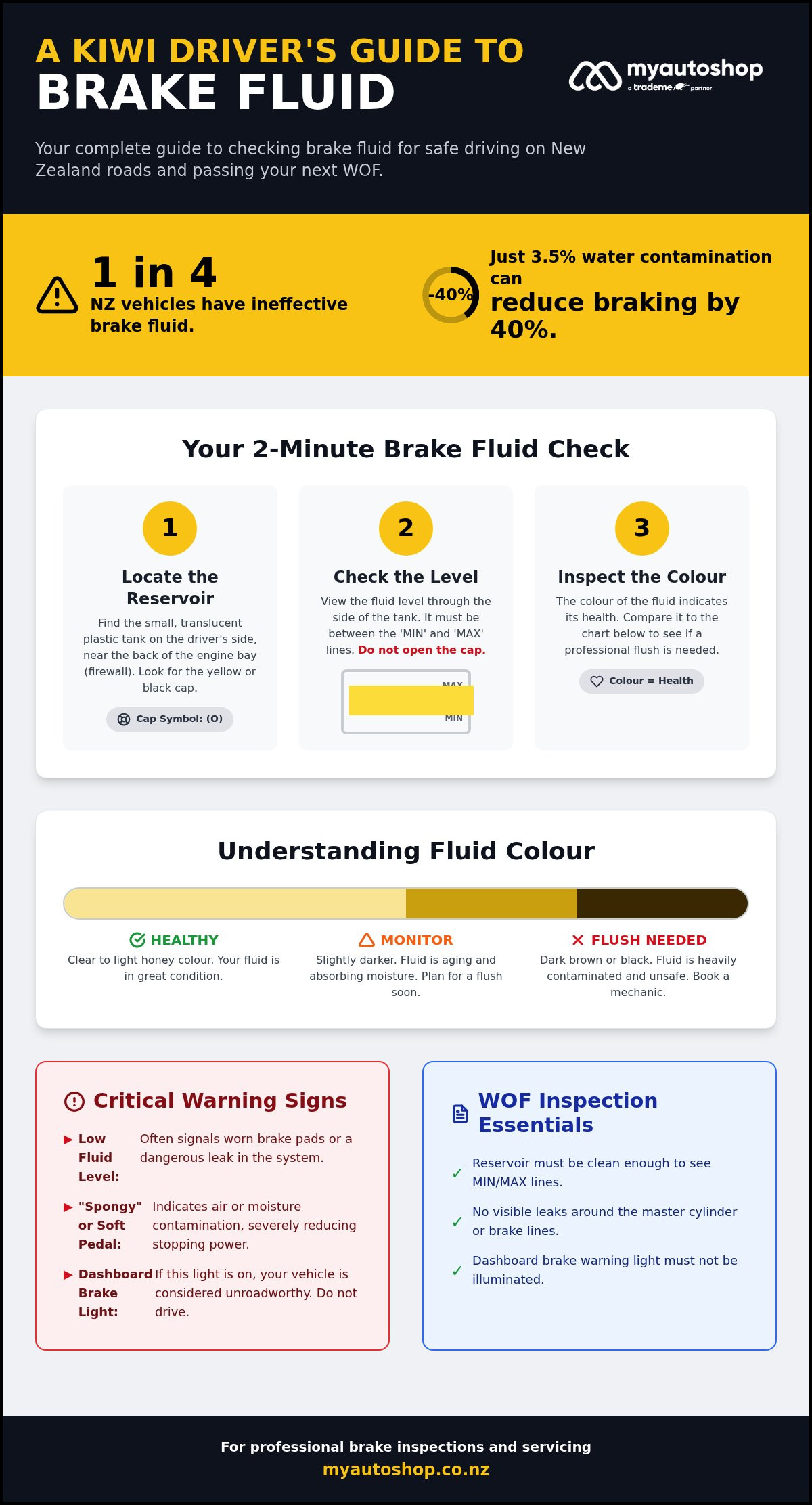
Did you know that 1 in 4 vehicles on New Zealand roads are currently driving with ineffective brake fluid? It’s a staggering statistic, especially when you consider that just 3.5% water contamination can slash your braking performance by 40%. If you’ve ever felt a “spongy” pedal while navigating a steep Kiwi hillside or felt a pang of anxiety when a dashboard light flickers on, you aren’t alone. Learning how to check brake fluid nz is one of the quickest ways to reclaim your peace of mind and ensure your vehicle is ready for its next WOF inspection.
We understand that looking under the hood can feel intimidating, but keeping your family safe shouldn’t be a mystery. We’ll show you how to perform a simple two-minute check to confirm your fluid sits safely between the “Min” and “Max” markers. You’ll also learn how to decode the colour of your fluid to spot potential trouble before it becomes a costly repair. From choosing the right DOT standard to knowing exactly when to book a professional mechanic, this guide gives you the tools to drive with total confidence.
Key Takeaways
- Locate your brake fluid reservoir quickly by looking for the translucent plastic tank near the engine firewall on the driver’s side.
- Learn how to check brake fluid nz in under two minutes by viewing levels through the side of the reservoir without opening the cap to avoid moisture contamination.
- Identify the health of your system by comparing fluid colour, where a clear honey hue is ideal and dark brown or black indicates a need for a professional flush.
- Understand why New Zealand’s high humidity and steep terrain make regular fluid checks essential for maintaining stopping power and passing your WOF.
- Recognise that a low fluid level often signals worn brake pads or a leak, requiring a professional inspection to ensure your vehicle remains safe on the road.
Why Brake Fluid is Critical for New Zealand Driving Conditions
Brake fluid isn’t just another liquid under your hood; it’s the critical link between your foot and the road. When you press the brake pedal, this specialized fluid transfers that force through your car’s hydraulic lines directly to the wheels. In a split second, it multiplies the pressure from your foot to squeeze the brake pads against the rotors, bringing your vehicle to a safe stop. Because liquids don’t compress under pressure, brake fluid is the perfect messenger for this life-saving task. However, its performance depends entirely on its condition and volume.
In New Zealand, our unique geography puts immense pressure on your braking system. Whether you’re navigating winding mountain passes, challenging coastal roads, or managing long, steep descents, your brakes generate massive amounts of friction and heat. If your fluid is old or low, it can’t handle these temperatures effectively. Knowing how to check brake fluid nz is essential because, as your brake pads wear down over time, the fluid level in your reservoir naturally drops to fill the extra space in the calipers. This means a low fluid reading is often your car’s way of telling you that your brake pads are nearing the end of their life.
The Science of Hydraulics and Heat
To understand what brake fluid is, think of it as a high-performance hydraulic oil designed to withstand extreme heat. It must remain a liquid at all times to function. If the fluid becomes contaminated with water, its boiling point drops significantly. During heavy braking on a steep Kiwi hillside, contaminated fluid can actually turn into gas bubbles. Since gas is compressible, your brake pedal will feel “spongy” or “soft,” and you might find the pedal goes all the way to the floor without stopping the car. The master cylinder acts as the heart of this system, pumping fluid through the lines to trigger the calipers the moment you hit the pedal.
WOF Requirements and Legal Safety Standards
Your brake system is a primary focus during a New Zealand Warrant of Fitness (WOF) inspection. NZ safety regulations are strict about the visibility and integrity of your brake fluid reservoir. If an inspector cannot clearly see the “Min” and “Max” markings due to dirt or a stained reservoir, it’s an immediate fail. Any sign of a leak around the reservoir, master cylinder, or brake lines will also result in a rejected WOF. Furthermore, if your dashboard brake warning light stays on, your car is legally considered unroadworthy. Keeping an eye on how to check brake fluid nz ensures you catch these issues before you’re stuck at the testing station with a failed sheet. Regular checks help you maintain the “Min” to “Max” balance, keeping you safe and WOF-ready year-round.
Locating and Identifying Your Brake Fluid Reservoir
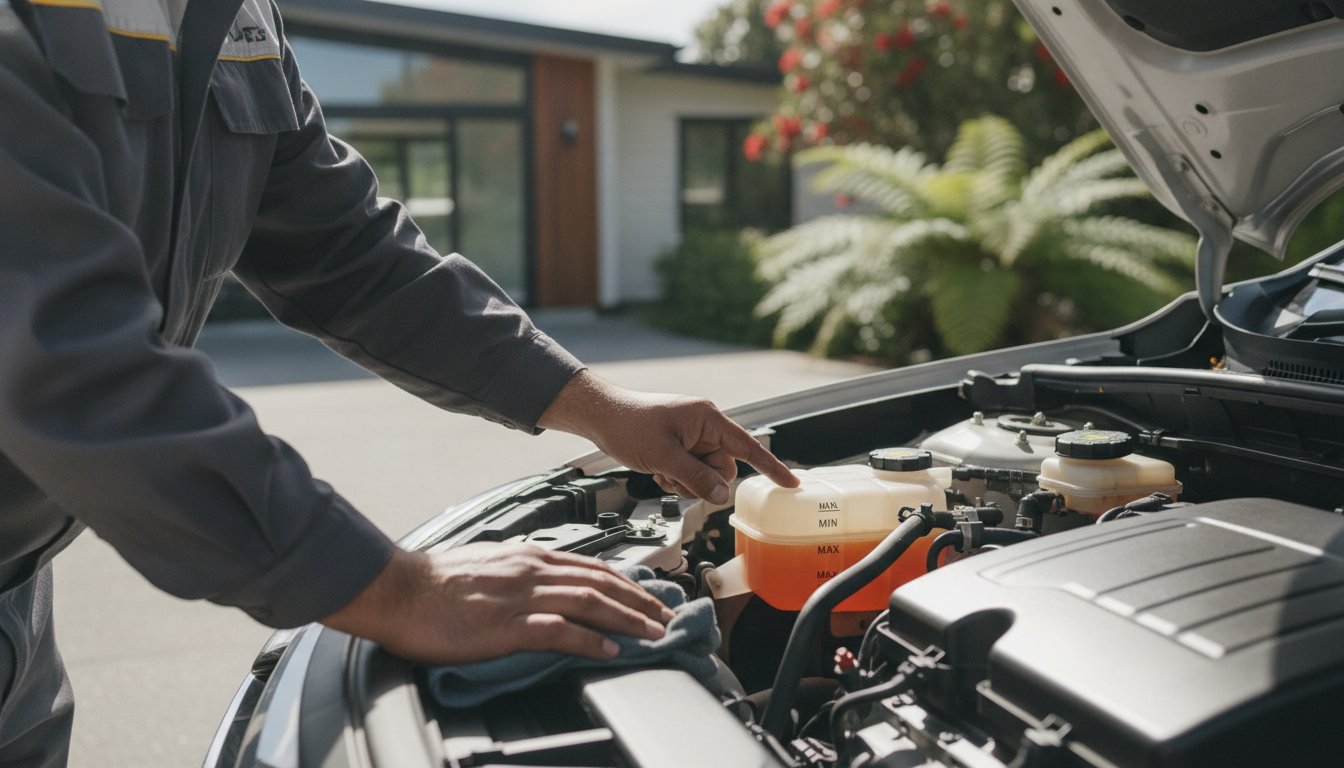
Pop the bonnet and secure it safely. To understand how to check brake fluid nz, you first need to identify the correct container. Look toward the back of the engine bay on the driver’s side. You’re searching for the brake fluid reservoir, which is a small, translucent plastic tank mounted directly on top of the master cylinder. Manufacturers use translucent plastic so you can safely check your brake fluid level without ever twisting the cap and exposing the system to the air.
Most reservoirs feature a distinct yellow or black screw-top cap. Look closely at the top of the lid; you’ll likely see embossed text specifying the required fluid type, such as “DOT 3” or “DOT 4.” On the side of the plastic tank, find the two horizontal lines moulded into the plastic. These are your “Min” and “Max” (or “Low” and “Full”) markers. For optimal safety and performance, your fluid should always sit clearly between these two points. If the plastic is grimy, a quick wipe with a clean cloth will make these levels much easier to read.
Distinguishing Brake Fluid from Other Liquids
It’s easy to confuse various tanks if you aren’t sure what to look for. While coolant reservoirs are often larger and located near the front of the car or the radiator, the brake fluid reservoir stays tucked away near the firewall. Look for the universal brake symbol on the cap: a circle inside a set of brackets (O). This icon is a global standard. Never rely on the fluid’s colour alone to identify the tank. While fresh fluid looks like light honey, older fluid can turn dark brown, which can look similar to old power steering fluid or even engine oil.
Vehicle-Specific Variations
New Zealand’s roads are a mix of Japanese imports and European models, and their layouts can differ. In most Japanese cars, the reservoir is easily accessible. However, European vehicles often hide the reservoir under plastic scuttle panels or engine covers to keep the bay looking tidy. If you can’t see it immediately, look for a removable plastic flap near the base of the windscreen. If your owner’s manual is missing or written in a language you don’t speak, don’t panic. The (O) symbol and the DOT rating on the cap are your most reliable guides. If you’re still unsure about what you’re looking at, a pre-purchase inspection is a great way to have a professional identify all the key service points in your specific vehicle.
Understanding Fluid Condition: Colour and Moisture
Once you’ve confirmed the level is correct, the next phase of how to check brake fluid nz involves a visual inspection of the liquid’s quality. While the “Min” and “Max” lines tell you how much fluid you have, the colour tells you how well it will perform. Brake fluid is hygroscopic, which is a technical way of saying it acts like a sponge for moisture. In New Zealand’s coastal environment, our high humidity is the primary enemy of your braking system. Even in a seemingly sealed system, moisture can seep through rubber hoses and seals over time.
This moisture absorption is a major safety concern because water boils at a much lower temperature than brake fluid. If you’re braking heavily while towing a boat or driving down a steep gorge, the heat can turn that trapped water into steam. Because steam is a gas, it compresses under pressure, leaving you with a brake pedal that sinks to the floor without stopping the car. This is why checking the condition is just as vital as checking the level.
The Brake Fluid Colour Scale
You can tell a lot about your car’s health just by looking through the translucent reservoir wall. Use this guide to judge what you see:
- Light Amber or Clear: This is the gold standard. It indicates fresh, healthy fluid that still possesses a high boiling point and active anti-corrosive properties.
- Dark Brown: This shade suggests the fluid has begun to oxidise. It often indicates that the internal rubber seals in your master cylinder or calipers are starting to degrade and shed microscopic particles into the system.
- Black: This is a critical warning sign. Black fluid is heavily contaminated with debris and moisture. It has likely lost its ability to protect your ABS pump and requires an immediate system flush to prevent a total brake failure.
Moisture: The Silent Performance Killer
Don’t be fooled by fluid that still looks relatively clear. Research shows that as little as 3.5% water contamination can reduce your brake fluid’s effectiveness by up to 40%. This “invisible” water doesn’t just lower the boiling point; it also causes internal corrosion in your expensive ABS modules and master cylinder. To maintain maximum safety, your brake fluid should be replaced every 2 years regardless of mileage. This preventative maintenance is far cheaper than replacing a seized brake caliper or a failed ABS pump later on.
Finally, always check the DOT rating on your reservoir cap before considering a top-up. Most NZ vehicles require DOT 3, DOT 4, or DOT 5.1, which are glycol-based. You must never mix these with DOT 5 fluid, which is silicone-based. Mixing the two will cause the fluids to react and thicken, potentially lead to a complete system blockage. If your fluid is dark or you’re unsure which type to use, booking a comprehensive service is the safest way to ensure your entire system is professionally tested and flushed.
Step-by-Step: How to Safely Check Your Brake Fluid
Start by parking your car on a flat, level surface. This ensures the fluid sits evenly in the reservoir, giving you an accurate reading. Switch off the engine and let it cool for a few minutes. Safety is paramount; you don’t want to be reaching near a hot engine block while performing your check. Once you’re ready, grab a clean rag and a bright torch. This simple preparation is the first step in mastering how to check brake fluid nz effectively.
The golden rule of car maintenance is simple: don’t open the reservoir cap unless you absolutely have to. Your braking system is a sealed hydraulic environment. Every time you twist that cap, you invite moisture and microscopic dirt particles into the system. For a standard level check, you can see everything you need to know through the translucent plastic walls of the tank. This protects the integrity of the fluid and keeps your brakes responsive.
Before you look at the level, wipe the exterior of the reservoir with your rag. New Zealand road grime and dust can build up quickly, making it difficult to see the fluid line clearly. If the plastic is stained or the engine bay is dark, shine your torch through the side of the tank. This backlighting makes the fluid level stand out sharply against the “Min” and “Max” markings. If you notice the level is consistently dropping, it’s time to book a mobile mechanic for a professional inspection before your next trip.
Always handle this process with care. Brake fluid is a powerful solvent that will strip the paint off your car’s bodywork in seconds. If you do happen to spill a drop on any painted surface, wash it off immediately with plenty of soapy water. Keeping the fluid inside the reservoir is the best way to protect both your braking performance and your vehicle’s appearance.
The 2-Minute Visual Check
Give the car a very gentle rock from the side while watching the reservoir. This causes the fluid to ripple, making it much easier to spot the exact level against the markings. If the level sits exactly halfway between “Min” and “Max”, it usually indicates that your brake pads are about 50% worn. As the pads get thinner, the calipers extend further, which pulls more fluid out of the reservoir and into the lines. This is a normal part of your car’s operation, but it’s a great reminder to keep an eye on your pad thickness.
When and How to Open the Cap (Advanced)
If you must open the cap to top up the fluid or use a test strip, timing is everything. Avoid doing this on a rainy or particularly humid NZ day to minimize the risk of moisture contamination. Thoroughly clean the cap and the area around it before you unscrew anything to prevent debris from falling into the reservoir. Once open, check that the rubber gasket inside the lid is flat and not swollen. A swollen gasket often means the fluid is already contaminated. Seal the cap tightly as soon as you’re finished to keep the system airtight.
When to Call a Professional Mechanic
While learning how to check brake fluid nz is a great first step, knowing when to put the rag down and call a pro is even more important. Many drivers make the mistake of simply topping up a low reservoir. Don’t fall into this trap. If your fluid is low, it hasn’t just evaporated; it’s either moved into the calipers because your pads are worn, or it’s leaking out of the system entirely. Topping up without an inspection can hide dangerous mechanical issues that might fail you at your next WOF or, worse, during an emergency stop.
Look for telltale signs of a hydraulic failure. If you notice the fluid level dropping rapidly over a few days, or if you spot oily puddles near the inside of your wheels, stop driving immediately. These are clear indicators of a leak in the lines or calipers. Professional mechanics use electronic moisture testers to measure the exact percentage of water in your fluid. While a visual check is helpful, these tools provide the data needed to decide if a full brake flush is required. This service is a standard part of a Comprehensive Service, ensuring your car stays safe and responsive for the long haul.
Interpreting Your Findings
Your two-minute check will likely result in one of three scenarios. Use this logic to decide your next move:
- Fluid is low but clear: Your hydraulic system is likely sealed, but your brake pads have worn down significantly. You likely need a Brake Pad Replacement rather than just more fluid.
- Fluid is at the correct level but dark: The fluid has oxidised or absorbed moisture. You need a professional system flush to protect your ABS pump and master cylinder from internal corrosion.
- Pedal feels spongy despite a full reservoir: This is a major red flag. It means air has entered the lines, usually through a tiny leak or during a poor previous service. You need a professional bleed to restore stopping power.
How My Auto Shop Simplifies Brake Care
We believe car maintenance should fit your schedule, not the other way around. If your fluid check leaves you feeling uncertain, booking a Mobile Mechanic is the easiest way to get a professional opinion at your home or workplace. Our technicians perform a rigorous check of the entire system, including the master cylinder and all four calipers. Whether you need a simple brake bleed to remove air or a full system overhaul, we provide transparent, upfront pricing so there are no surprises. Even our Pre-purchase Inspection includes a deep dive into fluid health, giving you total confidence before you buy your next vehicle. Master how to check brake fluid nz today, but let us handle the heavy lifting when the results aren’t perfect.
Drive with Total Confidence on Kiwi Roads
Your brakes are your car’s most vital safety feature. By spending just two minutes under the bonnet, you’ve learned how to spot low fluid levels and identify contaminated fluid before it compromises your stopping power. Mastering how to check brake fluid nz ensures your vehicle remains WOF-ready and capable of handling everything from Auckland motorways to the steep descents of the Southern Alps.
If your fluid is looking dark or the level is dropping faster than expected, don’t leave it to chance. Our national network of certified mechanics is here to help with transparent, upfront pricing and no hidden costs. Whether you need a mobile mechanic to come to your driveway or prefer to visit a local workshop, we make professional car care effortless and stress-free.
Book a Brake Inspection or Service with My Auto Shop to ensure your stopping power is 100% reliable. It’s the simplest way to keep your family safe and your car performing at its best. Safe driving out there.
Frequently Asked Questions
What colour should my brake fluid be?
Healthy brake fluid should be a clear, light amber or honey colour. If your fluid looks dark brown or black, it has likely absorbed significant moisture or contains debris from degrading internal seals. Dark fluid has a much lower boiling point, which can lead to dangerous brake fade during heavy use on steep New Zealand hills. Check your reservoir regularly to catch these colour changes early.
Can I just top up my brake fluid myself?
You can top it up, but doing so often hides a more serious underlying issue. A low fluid level is usually a sign that your brake pads are worn or that there’s a leak somewhere in the hydraulic system. If you must top up, always use the exact DOT rating specified on your reservoir cap. Never mix different types, as this can cause the seals to swell and fail.
Why is my brake fluid level low but there are no leaks?
Your fluid level naturally drops as your brake pads wear down over time. As the friction material on the pads gets thinner, the brake calipers must extend further to reach the rotor, which pulls more fluid into the lines. Learning how to check brake fluid nz helps you monitor this process. A level sitting near the “Min” mark is often a signal that you need a professional brake pad replacement.
How often should I change my brake fluid in New Zealand?
Most manufacturers recommend a full brake fluid flush every 24 months or 40,000km. New Zealand’s high humidity makes this service even more important, as the fluid acts like a sponge for moisture. Over time, this water contamination causes internal corrosion in expensive components like your ABS pump. Regular changes ensure your brakes remain responsive and your vehicle stays safe for every journey.
What happens if I use the wrong DOT fluid in my car?
Using the wrong fluid can lead to a complete loss of braking power. Glycol-based fluids like DOT 3, 4, and 5.1 are compatible with each other but must never be mixed with silicone-based DOT 5 fluid. Mixing these different chemistries can cause the fluid to thicken into a gel, blocking your brake lines and damaging the master cylinder. Always double-check the cap before adding any liquid.
Does brake fluid affect my car’s WOF?
Yes, the condition of your brake system is a primary focus during a New Zealand Warrant of Fitness inspection. An inspector will fail your vehicle if the reservoir level is below the minimum mark, if there are any visible leaks, or if the reservoir is too dirty to inspect. Additionally, a dashboard brake warning light is an automatic fail. Keeping your fluid at the correct level is essential for passing.
Why does my brake pedal feel spongy?
A spongy or soft pedal feel is a classic sign that air or moisture has entered your brake lines. Unlike fluid, air compresses under pressure, which means your foot’s force isn’t being fully transferred to the wheels. This is a critical safety issue that requires immediate attention. A professional mechanic will need to bleed the system to remove the air and restore a firm, reliable pedal feel.
Can I drive my car if the brake fluid light is on?
No, you should stop driving immediately if the brake warning light stays illuminated on your dashboard. This light typically indicates a dangerously low fluid level or a significant loss of hydraulic pressure in the system. Continuing to drive puts you at high risk of total brake failure. Safely pull over and book a mobile mechanic to inspect the vehicle before attempting to drive it again.
Disclaimer
This article provides general information only and should not be relied on as professional mechanical, safety or legal advice. Vehicle requirements and circumstances vary. If you are unsure about your vehicle, have it inspected by a qualified automotive professional.