
Last December, a survey of 1,200 motorists revealed that 42% of Kiwi drivers avoid opening their car’s hood because they’re anxious about “hidden” mechanical problems. It’s completely normal to feel intimidated by the tangle of wires and hot metal, especially when you’re just trying to ensure your vehicle is safe for a family trip. You probably agree that engine maintenance feels overwhelming when it’s wrapped in jargon, but ignoring it can lead to a catastrophic repair bill exceeding NZ$4,500. Learning how to check car oil is the fastest, most effective way to protect your wallet and your peace of mind.
We’ve created this straightforward guide to turn you into a confident, self-reliant driver in just five minutes. You’ll master the simple art of using a dipstick, identifying dirty oil, and knowing precisely when your car needs a professional service. We’re walking you through the exact steps our mechanics use to ensure your engine runs smoothly without any guesswork. From checking levels before a long road trip to understanding oil color, you’ll gain the transparency you need to keep your car reliable on New Zealand roads.
Key Takeaways
- Learn why waiting for your dashboard warning light is a risky move and how regular checks act as cheap insurance for your engine.
- Follow our straightforward 5-minute guide on how to check car oil to ensure your engine stays lubricated and runs smoothly on Kiwi roads.
- Discover what your oil colour is actually telling you-from healthy honey-amber to the warning signs of old or burnt oil.
- Find out how to navigate digital monitoring systems in modern European and late-model cars that no longer use a traditional dipstick.
- Identify the difference between a minor top-up and a serious leak so you know exactly when it’s time to book a professional service.
Why Checking Your Car Oil is a Kiwi Essential
Think of your engine as the heart of your vehicle. Oil is the lifeblood that keeps it beating. It provides a thin layer of protection between metal components moving at speeds of 3,000 RPM or higher. Without this lubrication, friction creates intense heat that can warp engine blocks and weld pistons in under 60 seconds. Mastering how to check car oil is the simplest way to prevent this mechanical meltdown.
Many drivers fall into the “Oil Warning Light” trap. They assume the car will tell them when it needs a top-up. By the time that red oil can icon glows on your dashboard, your engine is already starving. That light usually indicates a dangerous drop in oil pressure, not just a low level. If you’re unsure what any of your dashboard warning lights meaning actually is, it pays to have a reliable reference before you find yourself stranded. Research indicates that 75% of engine wear occurs during the first 20 minutes of operation. Waiting for a dashboard alert often means you are already paying for internal damage you can’t see yet.
New Zealand driving conditions are particularly tough on lubricants. Our steep, hilly terrain in cities like Auckland and Wellington forces engines to work harder. Many Kiwis also rely on short trips under 10 kilometres for school runs or grocery shopping. These brief journeys prevent the engine from reaching its full operating temperature. This leads to moisture buildup in the sump, which turns healthy oil into a thick, useless sludge that clogs vital passages.
The financial argument for a DIY check is undeniable. A basic manual inspection takes 5 minutes and costs exactly NZ$0. In contrast, neglecting your levels can lead to catastrophic failure. Replacing a modern 4-cylinder engine in New Zealand can cost upwards of NZ$5,000 for parts and labour. At My Auto Shop, we see these preventable bills every month. Regular monitoring keeps that money in your bank account instead of the workshop’s till.
To get an accurate reading of what is happening inside your engine, you need to use the engine oil dipstick. This simple metal tool is your most reliable source of truth. It bypasses electronic sensors and gives you a physical look at the fluid protecting your investment. It’s the first step in proactive car care.
The Difference Between Oil Level and Oil Quality
Having enough oil in the pan is only half the battle. Over time, extreme heat and combustion byproducts turn golden oil into a dark, gritty liquid full of carbon and metal shavings. This contaminated fluid loses its ability to flow and protect. Oil viscosity refers to the fluid’s resistance to flow at specific temperatures; a lower number like 0W or 5W ensures the oil reaches critical engine parts quickly during frosty Central Otago or Waikato winters. If your oil looks like thick black coffee or feels gritty between your fingers, it’s time for a change regardless of the level.
How Often Should You Really Check It?
If your vehicle is over 10 years old, you should check the level every second fuel fill. Older gaskets and seals often weep small amounts of fluid that can add up over a month of commuting. For newer cars, a monthly check is usually sufficient. Always perform a check before a long Kiwi summer road trip. Towing a boat or driving 500 kilometres to the Coromandel increases oil consumption significantly. High-kilometre vehicles, specifically those with over 150,000km on the odometer, require more frequent monitoring to catch leaks early. Learning how to check car oil ensures your holiday doesn’t end with a broken car and a massive repair bill.
How to Check Your Oil: The 5-Minute Step-by-Step
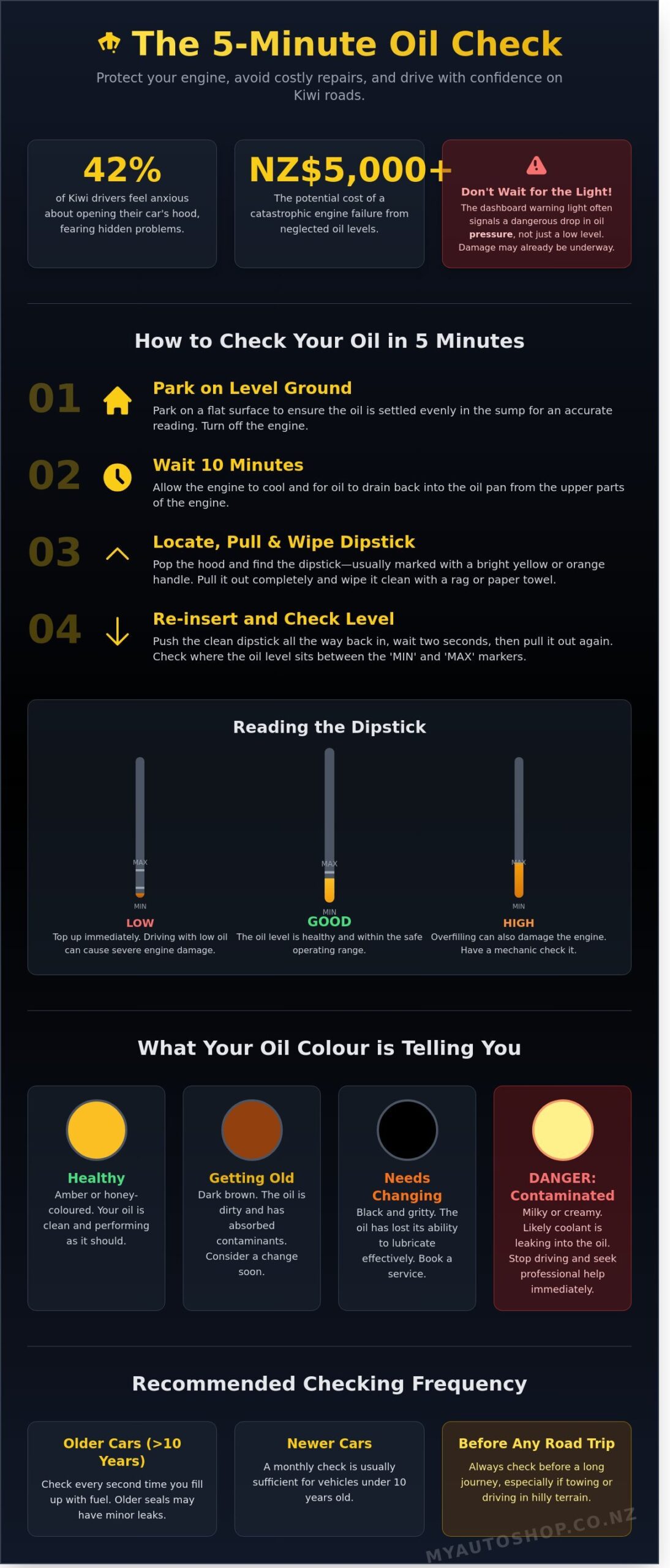
Learning how to check car oil is one of the most effective ways to extend the life of your engine. It is a simple task that requires zero mechanical experience. To get started, park your vehicle on level ground. If you are parked on a slope, gravity pulls the oil to one side of the pan, which leads to an inaccurate reading. Switch off the engine and wait at least 10 minutes. This pause allows the oil circulating in the upper engine components to drain back into the sump, ensuring you see the true volume available.
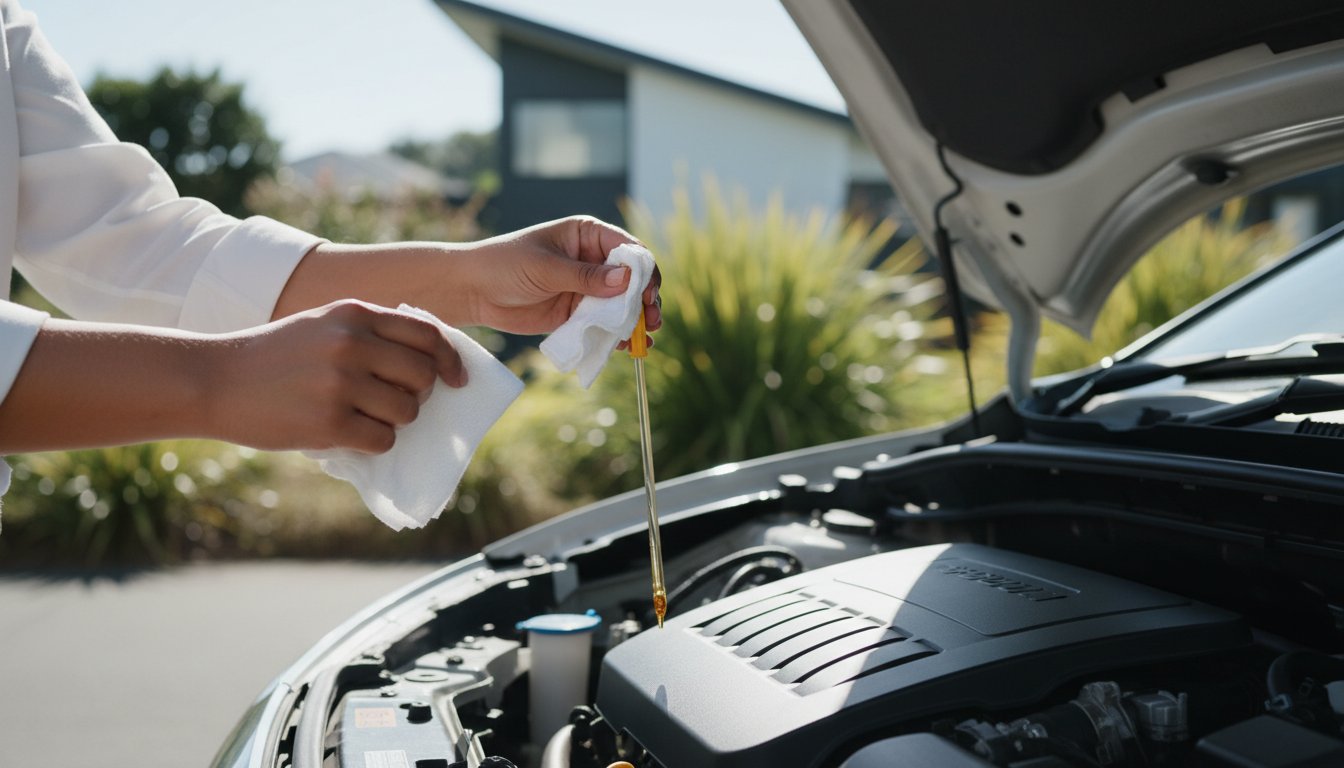
Once the engine has rested, pop the bonnet and locate the dipstick. In most modern cars, this is a bright yellow or orange plastic loop. Pull the dipstick out entirely. You will notice it is covered in oil, but do not record this measurement yet. Use a rag to wipe the metal strip completely clean. This first wipe is essential because oil splashes around the tube while you drive. You need a clean surface to see exactly where the oil level sits now that the car is stationary.
Re-insert the clean dipstick fully into the tube, wait two seconds, and pull it out again. Look at the tip. You will see two distinct markers, usually small holes or lines, indicating the ‘Min’ and ‘Max’ levels. Your oil should sit between these two points. If the level is at or below the minimum mark, you need a top-up immediately. While you have the dipstick out, take a moment to inspect the fluid quality. Understanding what your engine oil’s color should be is a great way to monitor engine health. Fresh oil is transparent and amber, while very dark, gritty, or milky oil suggests it is time for a professional change.
Tools You’ll Need (and What to Use if You’re Caught Short)
You do not need a professional workshop to do this. A lint-free rag is the best tool for the job. Old cotton t-shirts work perfectly because they do not leave behind fibres that could contaminate your oil system. If you are caught short, heavy-duty paper towels are a decent backup, but avoid cheap tissues that crumble easily. If your level is low, a plastic funnel is your best friend. It prevents messy spills on the engine block, which can smoke or smell when the car heats up. Always keep loose clothing and long hair tucked away. Modern cooling fans can trigger automatically even when the ignition is off, so stay clear of the area near the radiator.
The NZ Environmental Check
New Zealanders take pride in protecting our local landscape. When you finish, dispose of oily rags responsibly by sealing them in a leak-proof bag before placing them in your household rubbish. Never rinse oily hands or tools over a storm drain. In New Zealand, storm drains lead directly to our streams and oceans. A single litre of oil can contaminate up to one million litres of water. For those doing a full oil change at home, most Kiwi councils provide local transfer stations or recycling centres that accept used motor oil for free. This ensures the waste is processed correctly rather than damaging our soil.
If you find that your oil level is constantly dropping or the colour looks concerning, don’t leave it to chance. You can book a transparently priced service with a top-rated local mechanic through our platform to ensure your engine stays in peak condition.
Beyond the Level: What Your Oil Colour is Telling You
Learning how to check car oil is about more than just ensuring the level sits between the two markers on your dipstick. The appearance of the fluid is a direct window into your engine’s health. Fresh, high quality oil acts like a blood test for your vehicle. When you pull that dipstick out, you should see a clear, honey-like amber colour. This is the gold standard for a well maintained engine. If the oil is translucent and flows easily, your internal components are likely enjoying 100 percent of the lubrication they need to stay cool and friction-free.
Oil naturally darkens over time as it traps microscopic soot particles and endures thousands of heat cycles. In New Zealand, many diesel powered utes and SUVs will turn their oil black within the first 100 kilometres of a service. This is normal for diesel engines. However, if you drive a petrol car and the oil is jet black, thick, or smells like it has been burnt in a toaster, it’s well past its prime. At this stage, the additives that prevent corrosion and wear have likely depleted, leaving your engine vulnerable to damage.
Watch out for the “Milkshake” warning. If the oil on your dipstick looks like a frothy, light brown latte or a thick milkshake, you have a serious problem. This texture indicates that engine coolant has leaked into your oil system. This is a classic symptom of a blown head gasket or a cracked engine block. If you see this, don’t drive the car. Mixing water and oil creates a sludge that won’t lubricate your bearings, which can lead to a total engine meltdown in minutes.
You should also keep an eye out for “engine glitter.” If you see tiny metallic flakes shimmering in the oil under direct sunlight, your engine is literally eating itself. These flakes are shaved off from bearings or piston rings when lubrication fails. Spotting this early is the difference between a mid-sized repair bill and a $5,000 engine replacement.
Smell and Texture Checks
Your nose is a powerful diagnostic tool. If your oil smells strongly of petrol, it suggests that unburnt fuel is leaking past your piston rings and diluting the oil. This “fuel dilution” thins the liquid, making it less effective at protecting metal surfaces. You should also perform a tactile test. Rub a small drop of oil between your thumb and forefinger. It should feel smooth and slippery. If you feel any grittiness or sand-like particles, your oil filter is likely bypassed or clogged. If the oil feels like thick, sticky tar, your engine needs an immediate professional flush to remove the accumulated sludge before it blocks the oil pickup.
When to Top-Up vs. When to Change
Many drivers treat adding fresh oil as a permanent fix for a low dipstick reading. In reality, topping up is often just a band-aid. If your oil is dark and gritty, adding a litre of fresh synthetic won’t clean the system. It’s like pouring a glass of fresh water into a bucket of muddy silt. You might improve the volume, but the quality remains poor. While a top-up is fine to get you through the week, it won’t solve underlying issues like oil burning or leaks. If you find yourself topping up more than once every 2,000 kilometres, it’s time for a professional look. Learn more about our Basic vs Comprehensive servicing options to see which level of care your car actually needs to stay reliable on Kiwi roads.
No Dipstick? Checking Oil in Modern Vehicles
Open the bonnet of a 2024 BMW 3 Series or a late-model Audi A4 and you’ll notice something missing. The traditional yellow or orange dipstick handle is gone. European manufacturers started phasing out manual dipsticks around 2010, moving instead toward electronic oil monitoring systems (OIMS). These systems use ultrasonic sensors to measure the volume and temperature of your lubricant. This tech makes the process cleaner, but you still need to master how to check car oil using your vehicle’s digital interface.
Finding the right screen requires a bit of menu diving. Most modern infotainment systems, like BMW’s iDrive or Mercedes-Benz’s MBUX, house this under a ‘Vehicle Status’ or ‘Service’ menu. Use your center console dial or steering wheel buttons to navigate to ‘Engine Oil Level.’ If the engine is cold, the system will likely tell you that a reading is unavailable. This is a common point of confusion for Kiwi drivers used to checking their oil before the first commute of the day.
It’s also vital to distinguish between ‘Oil Life Percentage’ and ‘Oil Level.’ Your car’s computer calculates oil life based on your driving habits, cold starts, and idle time. It’s a countdown to your next service at the workshop. The ‘Oil Level’ is the actual physical amount of fluid in the engine. You can have 90% oil life remaining but still be dangerously low on actual fluid if there’s a leak. Always monitor both to keep your engine healthy.
Reading Electronic Oil Bars
Digital displays use a vertical or horizontal bar to show the oil level. The space between the ‘Min’ and ‘Max’ marks represents roughly one litre of oil. If the bar is at the halfway point, don’t rush to top it up. Only add oil if the system explicitly prompts you or if the bar sits at the minimum line. Most European systems require the engine to be at an operating temperature of roughly 90°C before providing a reading. Audi and Porsche systems often enforce a 120-second waiting period after the car is parked on level ground to allow the oil to settle into the sump for an accurate measurement.
Dealing with Sensor Anxiety
Can you really trust a computer chip over a physical metal rod? Generally, yes. Modern sensors are highly reliable, but they aren’t perfect. Approximately 4% of electronic oil sensors may report a fault or ‘Inconclusive’ reading over a ten-year vehicle lifespan. If your dashboard displays a sensor error, don’t ignore it. A failed sensor means you’re flying blind. Because you can’t manually verify the level, a sensor fault should be treated as an urgent repair. Even with a working sensor, we recommend a physical inspection by a professional once a year. A mechanic can check for leaks or sludge that a digital sensor might miss during a routine WOF or service.
If your digital display shows a ‘Fault’ or if you’re worried about the accuracy of your electronic readings, it’s time to get an expert involved. Our team of Kiwi-owned workshops can diagnose sensor issues and ensure your engine stays protected.
Need a hand with your modern car’s maintenance? Book a professional oil change and sensor check with MyAutoShop today for transparent pricing and total peace of mind.
When a Top-Up Isn’t Enough: Booking a Professional Service
Learning how to check car oil is a vital skill for every Kiwi driver, but the dipstick only tells part of the story. Sometimes, a low reading is a cry for help from your engine that a simple top-up won’t fix. You need to identify whether your vehicle is “dropping” oil or “burning” it. If you notice dark, greasy spots on your garage floor, you’re likely dealing with a leak from a sump plug, rocker cover gasket, or oil pan. If the ground stays dry but your oil level drops by more than a litre every 1,500 kilometres, your engine is likely consuming oil internally. This often points to worn piston rings or valve seals, issues that require a professional eye to prevent a total engine seizure.
While many owners attempt a DIY oil change, they frequently skip the most critical component: the oil filter. A professional service ensures this filter is replaced with a high-quality unit matched to your engine’s specifications. A clogged or low-quality filter can trigger a bypass valve, allowing unfiltered, abrasive oil to circulate through your engine. This leads to premature wear on expensive internal components. By choosing a professional service, you ensure that every drop of new oil stays clean and effective for the full duration of your service interval.
A My Auto Shop Comprehensive Service goes far beyond a basic drain and fill. It’s a preventative health check designed for the unique conditions of New Zealand roads. Our mechanics perform a detailed 40 point inspection, checking everything from brake fluid moisture levels to the condition of your CV boots. This holistic approach identifies small faults before they turn into NZ$2,000 repair bills. We don’t just change your oil; we provide a roadmap for your car’s longevity, ensuring your WOF inspections are a breeze rather than a stress.
Signs You Need a Mechanic Immediately
If you’ve mastered how to check car oil but notice any of the following red flags, stop driving and book a repair immediately. These symptoms suggest internal damage that a bottle of oil cannot repair. Understanding the full range of dashboard warning lights meaning can help you respond quickly and correctly when your car is trying to tell you something is seriously wrong:
- Blue smoke from the exhaust: This is a definitive sign that oil is entering the combustion chamber and burning alongside your fuel.
- Tapping or knocking sounds: If your engine bay sounds like a typewriter, your internal components are likely clashing due to a lack of lubrication.
- Consistently low levels: Needing to add oil more than once between 5,000 kilometre intervals suggests a significant mechanical failure or a hidden high-pressure leak.
The My Auto Shop Advantage
We’ve modernised car maintenance for busy Kiwis by removing the friction from the traditional garage experience. You don’t have to spend your Saturday morning waiting in a drafty workshop. Our platform offers a seamless digital experience with features designed around your schedule:
- Transparent pricing: We provide instant quotes with no “mechanical mystery” markups, so you know exactly what you’re paying before the work starts.
- Ultimate convenience: Use our popular pick-up and drop-off service, or have one of our mobile mechanics come directly to your home or office.
- Trusted experts: We give you access to NZ’s best local mechanics, all vetted for quality and reliability.
Don’t leave your engine’s health to chance. If your oil looks like black sludge or your levels won’t stay steady, it’s time for an expert intervention. Book your next car service with My Auto Shop today and enjoy the peace of mind that comes with a professionally maintained vehicle.
Keep Your Engine Humming on Kiwi Roads
Mastering how to check car oil is the easiest way to prevent 90% of avoidable engine wear. It takes just 5 minutes every month to ensure your levels are safe and your engine stays lubricated. If you notice your oil has turned a gritty black or a milky shade of brown, it’s a clear signal that your vehicle needs professional attention to avoid a potential NZ$4,000 repair bill. Regular checks keep you in control of your car’s health and your wallet.
When you’re ready for a full service, My Auto Shop makes the process effortless. We’re a 100% NZ owned and operated business dedicated to removing the guesswork from car maintenance. You’ll get transparent, instant pricing from a local network of top-tier mechanics in seconds. If you’re stuck at the office or home, our pick-up and drop-off service means you don’t have to pause your day for a workshop visit.
Book a mobile mechanic or car service with My Auto Shop to get your vehicle back in peak condition. Staying on top of your maintenance has never been this simple.
Frequently Asked Questions
Can I check my oil while the engine is running?
No, you must never check your oil while the engine is running. Doing so risks serious injury from moving parts and provides an inaccurate reading because the oil is circulating through the engine rather than sitting in the pan. Turn off the ignition and wait 5 to 10 minutes for the fluid to settle. This ensures you get a precise measurement when learning how to check car oil correctly.
What happens if I put too much oil in my car?
Adding too much oil creates extra pressure that can blow out gaskets and seals. If the level is more than 5mm above the Full mark on your dipstick, the crankshaft may whip the oil into a frothy foam. This aerated oil cannot lubricate your engine properly, leading to overheating or total engine failure. If you overfill it, drain the excess immediately to avoid a repair bill exceeding NZ$2,000.
Is it okay to mix different brands of engine oil?
You can mix different oil brands as long as they share the same viscosity grade, such as 5W-30 or 10W-40. All oils sold in New Zealand must meet minimum API or ACEA standards, so they are generally compatible. However, mixing a premium synthetic with a budget mineral oil will reduce the overall protection level. For the best performance, try to stick to one brand between your scheduled MyAutoShop services.
How much does it cost to get an oil change in NZ?
A standard oil and filter change in New Zealand typically costs between NZ$150 and NZ$280 depending on your vehicle type. For example, a small hatchback using mineral oil sits at the lower end, while a European SUV requiring 8 litres of high-grade synthetic oil will cost more. Use the MyAutoShop platform to get an instant, transparent price for your specific car and book a local Kiwi mechanic in seconds.
My oil looks black, do I need an immediate change?
Black oil does not always mean you need a change, as oil is designed to trap soot and contaminants to keep the engine clean. Diesel engines often turn their oil black within 50 kilometres of a fresh change. Instead of relying on colour, check your service sticker or digital records. If you have travelled more than 10,000 kilometres or it has been 12 months since your last visit, it is time to book a service.
Can I use any oil to top up my car?
No, you must use the specific oil weight and specification listed in your owner’s manual. Using a 20W-50 oil in a modern engine designed for 0W-20 can cause 15% more internal friction and lead to premature wear. If you are unsure how to check car oil requirements, look for the oil grade printed on your engine’s filler cap. Using the wrong fluid can void your mechanical breakdown insurance or manufacturer warranty.
Why is my car using so much oil but there are no leaks on the driveway?
Your car is likely burning oil internally through worn piston rings or valve stem seals. If your vehicle consumes more than 1 litre of oil every 1,500 kilometres without visible puddles, it is escaping through the exhaust. You might notice blue-tinted smoke when accelerating. This is common in older vehicles with over 150,000 kilometres on the clock. Bring it to one of our 250 partner garages for a quick diagnostic check.
What is the difference between synthetic and mineral oil?
Synthetic oil is chemically engineered to provide better protection at extreme temperatures and lasts up to 15,000 kilometres. Mineral oil is a natural byproduct of crude oil refining and usually requires changing every 5,000 to 7,500 kilometres. While synthetic costs about 40% more upfront, it offers superior engine longevity. Most cars built after 2010 require synthetic or semi-synthetic blends to meet modern fuel efficiency and emission standards in New Zealand.
Disclaimer
This article provides general information only and should not be relied on as professional mechanical, safety or legal advice. Vehicle requirements and circumstances vary. If you are unsure about your vehicle, have it inspected by a qualified automotive professional.