

A premium-petrol fill won’t wash carbon off a GDI engine’s intake valves. If you’re asking how to prevent carbon build-up in GDI engines nz, the practical answer is to follow your vehicle’s maintenance guidance and avoid relying on driving habits or additives as a guaranteed fix.
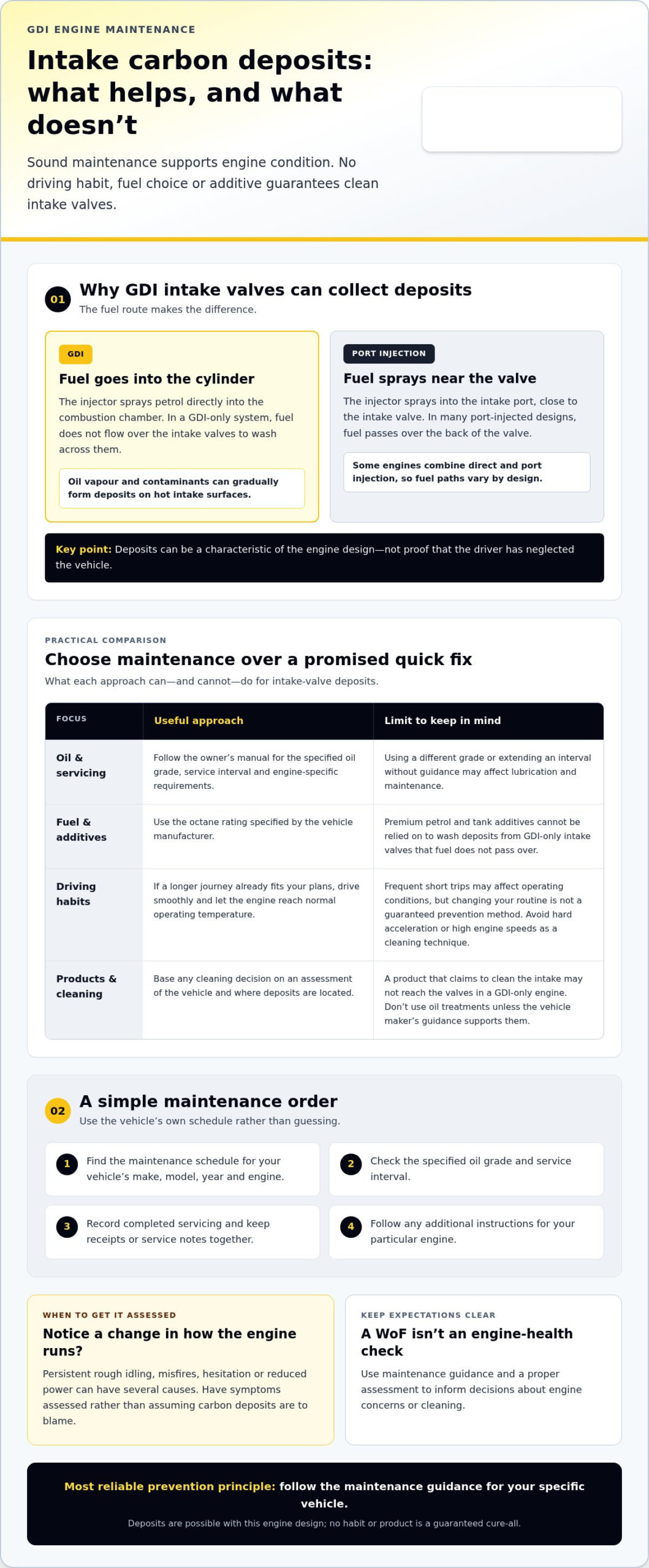
GDI engines inject petrol directly into the combustion chamber, so fuel doesn’t flow over the intake valves. Oil vapours and other contaminants can collect on these hot surfaces over time. Frequent short trips may affect how the engine operates, but deposits are a possibility with this engine design, not proof that a driver has neglected their car.
This guide explains what routine maintenance can do, why premium petrol and tank additives aren’t a sure fix for intake-valve deposits, and when symptoms such as a rough idle, hesitation or reduced power need assessment. It also explains why a WoF isn’t an engine-health check, helping you make an informed decision rather than paying for cleaning based on guesswork.
Key Takeaways
- Start with the maintenance schedule for your vehicle. Use the specified oil grade and service interval in the owner’s manual.
- For how to prevent carbon build-up in GDI engines nz, focus on sound maintenance instead of expecting an additive or premium petrol to stop intake-valve deposits.
- Keep a record of servicing and note changes in how the engine runs, particularly if most of your trips are short.
- Rough idling, misfires and reduced performance can have several causes. Get persistent symptoms assessed rather than assuming carbon deposits are to blame.
- Understand what maintenance can realistically do, and base any decision about cleaning on a proper assessment.
What causes carbon build-up in a GDI engine?
Carbon build-up is the gradual accumulation of deposits on parts of an engine’s intake system, especially the intake valves and nearby ports. Petrol direct-injection engines can be more prone to these deposits because fuel doesn’t follow the same path as it does in a port-injected engine. That’s a characteristic of the design, not proof that a driver has neglected their car.
Understanding the fuel route helps explain why deposits can form, and why intake deposits need to be distinguished from deposits elsewhere in the engine. Different locations call for different assessment and maintenance.
For a visual overview of general car maintenance, this video covers a range of tips:
How direct injection changes the fuel path
In a GDI engine, a fuel injector sprays petrol directly into the combustion chamber, where it mixes with air before ignition. In a port fuel-injection engine, the injector sprays fuel into the intake port, close to the intake valve. The valve opens to let the air-fuel mixture enter the cylinder.
That difference matters. In many port-injected designs, fuel passes over the back of the intake valve. In a GDI-only system, petrol goes straight into the cylinder, so it doesn’t provide the same wash across the valve. This is a general distinction, not a rule that every engine is identical. Some designs combine direct and port injection, so their fuel paths differ. The Gasoline Direct Injection (GDI) engines overview explains the basic system and how it differs from other injection designs.
Where deposits form and why
In a GDI engine, oil vapour from the crankcase ventilation system can enter the intake. Where an exhaust gas recirculation (EGR) system is fitted, some exhaust gas is also routed back into the engine. Vapour and contaminants can meet hot intake surfaces and gradually form deposits on valves or inside intake ports. The pattern depends on the engine’s design and operating conditions.
These are intake deposits. They’re different from residue on fuel injectors, which spray into the combustion chamber, or deposits that form inside the chamber itself. An additive may affect parts of the fuel system that treated fuel reaches, but fuel in a GDI-only engine doesn’t flow over the intake valves. Knowing where the deposits are matters before deciding what assessment or maintenance is appropriate.
So, how to prevent carbon build-up in GDI engines nz starts with understanding what can and can’t be controlled. Deposits can develop as part of the system’s operation, but the engine type alone doesn’t tell you whether deposits are present or how severe they are. The vehicle’s injection design and condition matter.
How to reduce carbon build-up in a GDI engine
You can’t guarantee that an engine will stay free of intake deposits, but sensible maintenance supports its overall condition. Start with the vehicle maker’s instructions, rather than a generic online schedule or a fuel additive promising a quick fix.
Follow the vehicle’s maintenance schedule
Use this simple order:
- Find the maintenance schedule for your vehicle’s make, model, year and engine.
- Check which oil specification and service interval it calls for.
- Record completed servicing and keep receipts or service notes together.
- Follow any additional instructions for your particular engine.
Don’t add oil treatments or other products unless the vehicle maker’s guidance supports their use. A product that claims to clean the intake may not reach the valves in a GDI-only engine. For background on the issue, SAE International on GDI carbon deposits discusses deposit formation and possible approaches. Treat product claims carefully and follow vehicle-specific advice.
Use driving habits as supporting measures
Frequent short trips, such as repeated runs around town, may mean the engine spends less time fully warmed up. That can affect normal operating conditions, but it doesn’t mean every short journey causes harmful deposits or that changing your routine will prevent them. Pair everyday driving with proper servicing instead of relying on a particular trip to clean the engine.
If a longer journey already fits your plans, drive smoothly and let the engine reach its normal operating temperature. Don’t use hard acceleration or high engine speeds as a supposed carbon-cleaning technique. Aggressive driving isn’t a substitute for maintenance or diagnosis, and it can put unnecessary strain on a vehicle.
There’s no special fuel choice that guarantees clean intake valves. Follow the octane rating specified by the manufacturer. Fuel additives and premium petrol may have other uses, but they can’t be relied on to wash deposits from valves that fuel doesn’t pass over.
The most reliable prevention principle is simple: follow the maintenance guidance for your specific vehicle. That’s the practical starting point for how to prevent carbon build-up in GDI engines nz, without treating any habit or product as a cure-all. My Auto Shop connects motorists with automotive service and repair providers through its automotive service marketplace.
Do fuel additives or premium petrol prevent GDI carbon build-up?
Fuel additives and premium petrol aren’t reliable ways to prevent or remove intake-valve deposits in every GDI engine. Their usefulness depends on which part needs attention and how that particular engine is designed. Fuel-system maintenance, mechanical assessment and cleaning address different things, so start with the vehicle maker’s advice instead of relying on a product claim.
Can a tank additive clean intake valves?
An additive poured into the tank travels with the petrol through the fuel system. It may help clean areas the treated fuel reaches, such as parts of the injectors or combustion chamber. But in a GDI-only engine, fuel is injected into the cylinder, not over the back of the intake valves. An additive therefore can’t be relied on to reach deposits there.
Some engines use both port and direct injection, so fuel may follow more than one route. Claims about an additive depend on deposit location and engine design, not simply on whether the product is labelled an engine cleaner. Check the owner’s manual and product instructions for compatibility with your vehicle. Don’t exceed the stated dose or combine products unless the instructions say to.
Does premium petrol stop deposits forming?
Use the petrol grade recommended by the vehicle manufacturer. In New Zealand, petrol is commonly sold as 91, 95 and 98 octane. The octane rating describes resistance to engine knock, not the ability to scrub carbon from intake valves. A higher-octane grade isn’t automatically a deposit-prevention treatment, so don’t assume paying more will clean a valve.
Fuel quality and mechanical cleaning are separate matters. Detergents in fuel can help keep parts of the fuel system clean, but in a GDI-only design, petrol still doesn’t wash over the intake valves. Choose fuel to meet the engine’s requirements, not as a substitute for servicing or diagnosis.
What can maintenance and assessment do?
Regular servicing supports the engine’s overall condition and helps address maintenance needs that may contribute to deposits. It doesn’t guarantee that intake valves will remain clean or remove deposits that have already formed. Follow the vehicle-specific service schedule and use the specified oil, rather than adding unapproved treatments in the hope of cleaning the intake.
If the engine develops persistent running problems, a proper assessment can help identify the cause before cleaning is considered. Similar symptoms may come from faults unrelated to carbon, and an additive won’t diagnose them. A mechanic can assess the vehicle and determine whether intake deposits are likely and whether further inspection or cleaning is appropriate.
For how to prevent carbon build-up in GDI engines nz, treat additives and premium petrol as no-guarantee options, not a maintenance plan. Use the recommended fuel and follow the maintenance schedule. Base any decision about cleaning on an assessment of the actual problem.
What symptoms could point to GDI carbon deposits?
Rough idling, hesitation when accelerating, reduced power, lower fuel economy, engine misfires or a check-engine light can occur with intake deposits. They’re clues that something may need attention, not proof of carbon build-up. Several different faults can cause similar changes, so symptoms alone can’t confirm the cause or show whether cleaning is needed.
Pay attention to what has changed from your car’s usual behaviour. A brief stumble on a cold start may have a different cause from a persistent uneven idle or repeated loss of power. Note the conditions, but don’t try to diagnose deposits from a symptom checklist alone.
When symptoms deserve attention
Arrange an assessment if a change in how the car drives persists, becomes more noticeable or returns regularly. Note when it happens, such as during a cold start, while idling at traffic lights or as you accelerate. Record any dashboard warning lights and when they appeared. These details can help a mechanic understand the pattern.
Take warning lights seriously. If a warning indicates you should stop, or the car feels unsafe to drive, follow the vehicle’s instructions and prioritise safety rather than continuing the journey. For general context on changes in how a vehicle runs, My Auto Shop’s engine symptoms guide covers common signs that may warrant attention.
Why diagnosis matters before cleaning
Misfires and poor performance can stem from ignition, fuel, air-intake or sensor problems, among other causes. A diagnostic scan may reveal fault codes, but codes don’t automatically identify carbon deposits. Depending on the symptoms, a mechanic may need to consider test results alongside checks of the engine and its service history before deciding what to investigate next.
That step can prevent an unnecessary clean. Cleaning is relevant only if deposits are present and affecting the engine. The appropriate inspection and repair depend on the vehicle’s design and what the findings show. No single cleaning approach suits every GDI engine, and symptoms alone aren’t a sound reason to book one.
Before an assessment, keep a short record of the symptom, when it occurs, whether it’s getting worse and any warning lights. Include recent servicing or repairs if you know them. This gives the mechanic useful context without assuming the problem is carbon-related.
Understanding how to prevent carbon build-up in GDI engines nz also means knowing when prevention advice isn’t enough. If symptoms persist, focus on finding the cause before deciding on a repair. My Auto Shop connects motorists with service and repair providers, and you can explore automotive service and repair options for your vehicle.
A practical GDI maintenance plan for New Zealand drivers
No routine guarantees an intake system will stay deposit-free. A sensible plan is straightforward: follow the vehicle maker’s instructions, keep a clear service history and act on engine symptoms that persist. These steps give you a better basis for deciding what your car needs than guesswork or a product claim.
Make maintenance easier to track
Use the owner’s manual for the correct oil, service requirements and intervals for your specific make, model and engine. Don’t apply a universal kilometre or time interval to every GDI vehicle. If you’ve bought a used car and don’t know when it was last serviced, review its records and arrange maintenance according to the manual.
Keep invoices or service notes together, whether in a folder in the glovebox or a digital record. After each service, note the date, odometer reading and work completed. Also jot down changes in engine behaviour, such as a rough idle while waiting at the lights or hesitation during the school run. This information can help distinguish scheduled maintenance from a developing fault.
Everyday New Zealand driving can involve short trips, stop-start traffic or longer runs between towns. You don’t need to change your driving style to try to “clean” the engine. Keep to the vehicle-specific maintenance schedule and don’t treat a longer drive as a substitute for servicing. A basic maintenance checklist can help you keep other regular checks organised alongside servicing.
Choose a next step based on the evidence
Separate scheduled maintenance from a concern that needs diagnosis. If your car is due for a service, follow the manual. If an engine symptom continues, gets worse or returns, arrange an assessment and explain what you’ve noticed. Record when it happens and any dashboard warning lights. A WoF is not a substitute for investigating engine-performance concerns; it doesn’t diagnose the cause of a rough idle, misfire or loss of power.
In short, how to prevent carbon build-up in GDI engines nz comes down to sensible, vehicle-specific care, not a promise that deposits can always be avoided. Keep records, maintain the car as directed and base any repair or cleaning decision on what an assessment finds.
My Auto Shop connects motorists with service and repair providers. You can explore vehicle service options as a next step for routine maintenance or a concern that needs attention.
Make your next maintenance step with confidence
Set a reminder to check your vehicle’s maintenance schedule and keep its service records somewhere easy to find. If the way your car runs changes, use your notes to explain what you’ve noticed and guide the next step. You don’t need to guess at a carbon clean or buy products on the promise of a guaranteed fix.
For practical advice on how to prevent carbon build-up in GDI engines nz, focus on care that matches your vehicle and arrange an assessment if a concern persists. My Auto Shop connects motorists with automotive service and repair providers. It also provides independent pre-purchase vehicle inspections for people considering a used car.
Ready to plan routine care or look into a vehicle concern? Explore vehicle service options and take the next step with a clearer idea of what your car needs.
Frequently Asked Questions
Is carbon build-up inevitable in a GDI engine?
No. There’s no fixed point at which every GDI engine develops deposits. If you’re considering a used car, don’t judge the intake’s condition by the odometer reading alone. Review the service records and note any previous engine work or unresolved concerns. A vehicle’s history provides useful context, but it can’t establish the condition of hidden engine components without an appropriate assessment.
Can petrol additives clean carbon from GDI intake valves?
Don’t treat a tank additive as a dependable way to clean GDI intake valves. Before using a product, read its instructions and check that it’s suitable for your vehicle. Avoid mixing cleaners or exceeding the stated amount. If you’ve already used an additive, keep the packaging or note its name and amount. That information may help if you later discuss an engine concern with a mechanic.
Does carbon build-up fail a New Zealand WoF?
A WoF doesn’t diagnose whether carbon deposits are present, so a WoF result can’t settle that question. Don’t interpret a pass as a report on internal engine condition or assume a deposit automatically determines the result. If you’re booking a WoF and also have a separate running concern, describe that concern separately. The inspection isn’t a substitute for investigating the engine symptom.
How often should a GDI engine’s intake valves be cleaned?
There isn’t one cleaning interval that applies to every GDI engine. Before agreeing to scheduled cleaning, check whether the vehicle maker gives engine-specific guidance and ask what evidence supports the recommendation for your car. A suggested interval based only on a general kilometre figure may not reflect your engine’s design or condition. Keep any inspection findings with your service records for future reference.
Can short trips contribute to carbon build-up in a GDI engine?
Frequent short journeys can affect engine operating conditions, but they don’t establish that deposits have formed. If most trips are brief, combine errands where practical to reduce repeated cold starts, but don’t treat that change as a carbon-cleaning method. Keep to the car’s maintenance schedule and note any change in how the engine starts or runs.
Can a mechanic diagnose carbon build-up without removing the engine?
In many cases, assessing an engine doesn’t mean removing it from the vehicle, but the inspection required varies. Access to intake components may involve removing other parts, depending on the vehicle’s layout. Ask what the proposed inspection involves and what its findings show before deciding on cleaning. The useful question is whether there’s evidence that deposits are linked to the concern, not simply whether the engine is GDI.
Will carbon deposits always cause a check-engine light?
No. Deposits won’t necessarily trigger a check-engine light, and the light alone can’t identify them as the cause. If it appears, note the exact symbol or message and check the owner’s manual for the vehicle-specific meaning and instructions. Record when it came on and any change in how the car behaved. That context is more useful for an assessment than guessing from the warning alone.
Disclaimer
This article provides general information only and should not be relied on as professional mechanical, safety or legal advice. Vehicle requirements and circumstances vary. If you are unsure about your vehicle, have it inspected by a qualified automotive professional.