
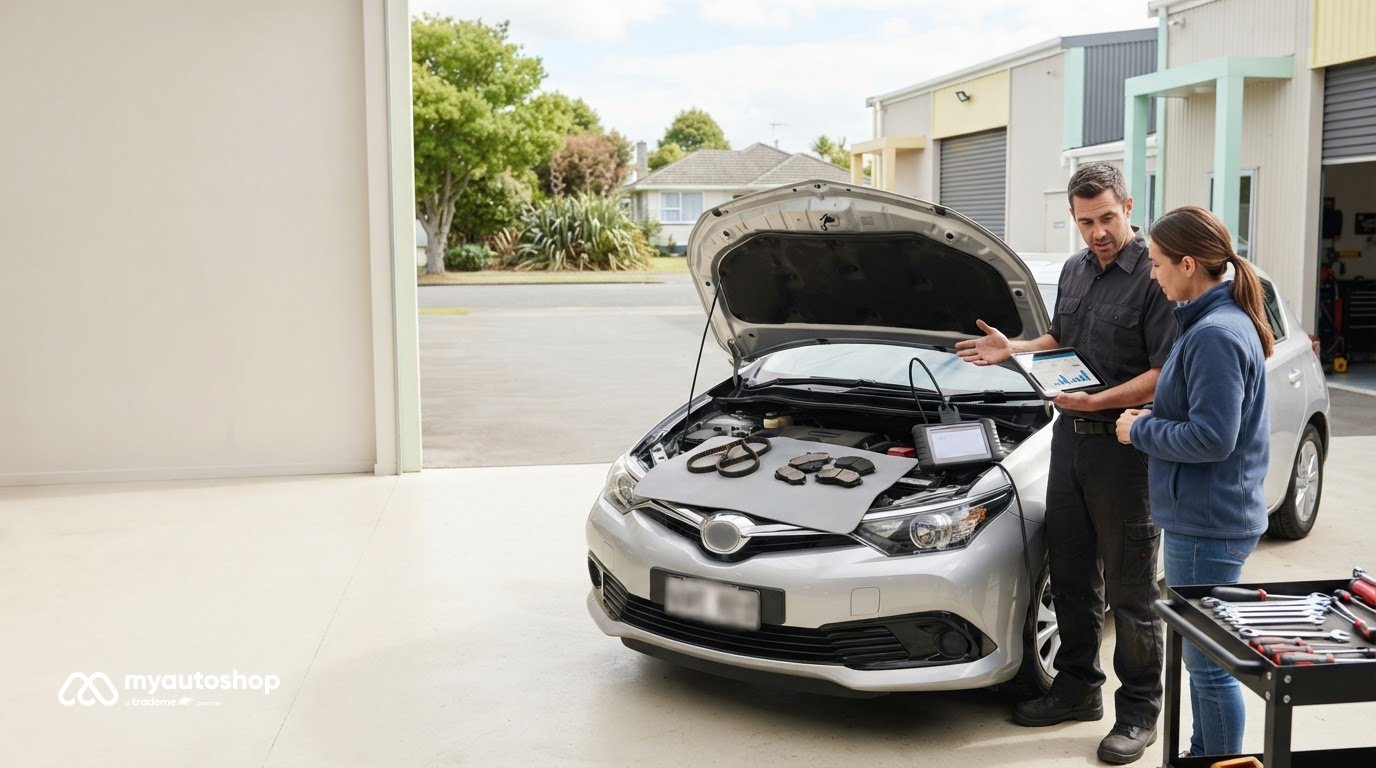
What if the cheapest repair quote ends up costing more because it leaves out important work? Unexpected faults can disrupt your budget, and it isn’t always clear which recommendations are urgent and which can wait. Learning how to save money on car repairs without cutting corners starts with making informed choices, not putting off work that keeps your car safe.
You can’t prevent every breakdown, but sensible maintenance can help you keep track of your car’s condition and spot changes early. When a mechanic recommends repairs, ask what fault they found, which work addresses it, and what the quote includes. Those details make it easier to understand the recommendation and compare options fairly.
This guide covers practical ways to reduce avoidable repair spending, assess recommendations and prioritise work around your budget. It also explains why a Warrant of Fitness (WoF) isn’t a substitute for regular servicing: a WoF checks whether your vehicle meets specified safety requirements at the time of inspection, while servicing helps maintain its condition. You’ll be better equipped to plan ahead, ask useful questions and make repair decisions without compromising safety.
Key Takeaways
- Learn how to save money on car repairs without cutting corners by preventing avoidable faults and making informed repair choices, not simply choosing the lowest price.
- Build a simple maintenance routine around your vehicle handbook, regular checks and changes you notice.
- Compare quotes by checking that the diagnosis, work, parts and exclusions match.
- Sort repairs by urgency, and don’t drive if you think your vehicle may be unsafe.
- See how My Auto Shop connects motorists with service and repair providers, with upfront pricing to help make options clearer.
How to save money on car repairs without risking reliability
The practical answer is to follow sensible maintenance guidance, get a clear diagnosis when something changes, and deal promptly with repairs that affect safety. Not every fault can be prevented, and maintenance isn’t a substitute for a mechanic’s assessment. But noticing a problem and understanding the recommended work can help you avoid unnecessary repairs and make informed decisions about what your car needs.
Cost-conscious car repairs mean avoiding unnecessary work and planning for necessary maintenance while protecting your vehicle’s safety and reliability. That’s how to save money on car repairs without cutting corners. Weigh the diagnosis, the work required and the parts being fitted instead of choosing on price alone. A lower quote may not represent better value if it leaves out work needed to address the fault.
What does saving money on car repairs actually mean?
Start by separating routine upkeep from diagnosis and repair. Following your vehicle handbook and keeping an eye out for changes can help you maintain the car, but it can’t prevent every mechanical problem. If a warning light appears or the car starts behaving differently, first find out what’s wrong rather than replacing a part based on a guess.
When you receive a recommendation, make sure you understand which problem the work is intended to fix. Ask what the assessment found and what could happen if the repair is deferred. This helps you distinguish necessary repairs from work that can be planned, without dismissing advice related to safety. Car maintenance covers a range of preventative checks, but your own vehicle handbook is the right place to start for model-specific guidance.
Why can delaying a small repair become costly?
A symptom may stay minor, or it may change as you continue driving. For example, a new squeal from the brakes could have more than one cause. The sound alone can’t tell you which one applies or indicate the condition of the brakes. If it persists, changes or affects how safely the car drives, arrange an assessment.
Pay attention to what you can observe: when a noise happens, whether a warning light stays on, or whether the steering or braking feels different. Share those details when arranging an assessment. They can help explain the issue, but they don’t replace a proper diagnosis. If you’re unsure whether the car is safe to drive, don’t take a chance. Seek advice before continuing. A symptoms guide can also help you describe what you’ve noticed.
The aim isn’t to repair every small issue immediately or to postpone everything until it becomes urgent. It’s to understand the risk, act on safety-related advice and plan less urgent work with a clear picture of what it involves. That balance protects reliability while giving you more control over repair spending.
How routine maintenance can help prevent avoidable repair bills
A steady maintenance routine can help you notice wear and changes, and keep track of work recommended by the vehicle manufacturer. It won’t prevent every fault, but it can give you a clearer picture of your car’s condition and help you plan ahead. Needs vary by model, age and how the vehicle is used, so use the handbook rather than relying on a universal service schedule.
Build a maintenance routine around your vehicle
Keep the routine simple and repeatable. Use the handbook for model-specific service requirements, and organise receipts or service records so you can see what’s been done and what’s coming up. That history is useful when arranging work, too: it gives the mechanic information to consider instead of relying on memory alone.
- Check the handbook. Note the manufacturer’s guidance for servicing and maintenance, including any requirements that apply to your vehicle.
- Inspect regularly. Look over tyres for visible damage or uneven wear, check that lights work, and pay attention to fluid leaks or anything else that looks different. Only carry out checks you can do safely.
- Record completed work. Keep invoices, service records and notes together, including the date and odometer reading where available.
- Act on changes. Arrange advice or a check if you notice a persistent warning light, new noise or change in how the vehicle drives.
Maintenance records help you track what’s been completed and what work is due next, so you can plan upkeep with fewer gaps or duplicated checks. You can turn the steps above into a basic car maintenance checklist that suits your vehicle and routine.
New Zealand driving conditions can vary from smooth urban roads to gravel routes, and wet weather may affect visibility and how the car feels on the road. Note changes in context: a new vibration after a rough stretch, for example, is worth recording. That observation doesn’t diagnose the cause, but it can help explain what happened and when.
Notice changes before they become bigger concerns
Keep a note of new noises, warning lights, visible leaks or changes in braking, steering or handling. Record when they happen and whether they persist. These details can help a mechanic investigate, but they can’t confirm the cause on their own. If a symptom continues or affects safe driving, arrange an assessment rather than guessing or leaving it unaddressed.
A car symptoms guide can help you make sense of what you’ve noticed and what to do next. Use it to describe the issue, not as a replacement for diagnosis. Consistent checks and good records make it easier to decide what needs attention and when, a practical part of how to save money on car repairs without cutting corners.
When you’re ready to review service options, use the maintenance history and observations you’ve recorded to focus on the work your vehicle needs.
How to compare car repair quotes without choosing on price alone
A useful quote comparison starts with the work being proposed, not the total at the bottom. Two quotes are like-for-like only if they address the same diagnosis, repair and assumptions. If one includes extra work, different parts or checks that the other excludes, the prices alone won’t tell you which option offers better value.
An itemised repair quote is a clear breakdown of the fault identified, the work proposed and the parts and labour included. Use that detail to understand what you’re paying for and spot differences before agreeing to the work.
What should a clear repair quote explain?
Check each quote for the reported fault, recommended repair and the parts and labour included. Then look for exclusions, such as related work that isn’t covered, and how additional work will be handled. If an inspection uncovers another issue, check whether it falls outside the original scope and how you’ll be asked to approve any change.
- Diagnosis: Does the quote explain what fault the work is meant to address?
- Scope: Are the same repair tasks included, or does one quote cover more?
- Parts and labour: Is it clear what parts are proposed and what labour is included?
- Exclusions: Does it identify work that isn’t covered in the quoted scope?
- Additional work: Does it explain how you’ll be informed if more work is recommended?
For example, two quotes for a brake concern may differ because one covers only the stated repair, while another includes additional work. That doesn’t make either quote automatically right or wrong. Ask what each item addresses and whether it relates to the same diagnosed problem. Turners Service & Repairs shares information about its fair pricing approach, which explains the importance of clear repair costs and expectations for its services.
When is a second opinion useful?
A second opinion can help if the diagnosis is unclear, the proposed work differs between quotes, or you can’t tell why a recommendation is needed. Share the same information about the symptoms and previous work, then compare what each assessment says the fault is and how the repair would address it. A different recommendation isn’t proof that the first one is wrong; it may reflect a different assessment or scope.
Ask for the explanation in plain language. What was found? Which work addresses that fault? Are any suggested items separate from the main repair? Clear answers make it easier to decide what needs attention now and what you can plan, without dismissing safety-related advice just to reduce immediate spending.
This is a practical part of how to save money on car repairs without cutting corners: compare what the quotes actually include, not just their totals. My Auto Shop connects motorists with service and repair providers, and its upfront pricing can help make options clearer. Review the available repair information and pricing before deciding which option suits your needs.
How to prioritise repairs without compromising safety
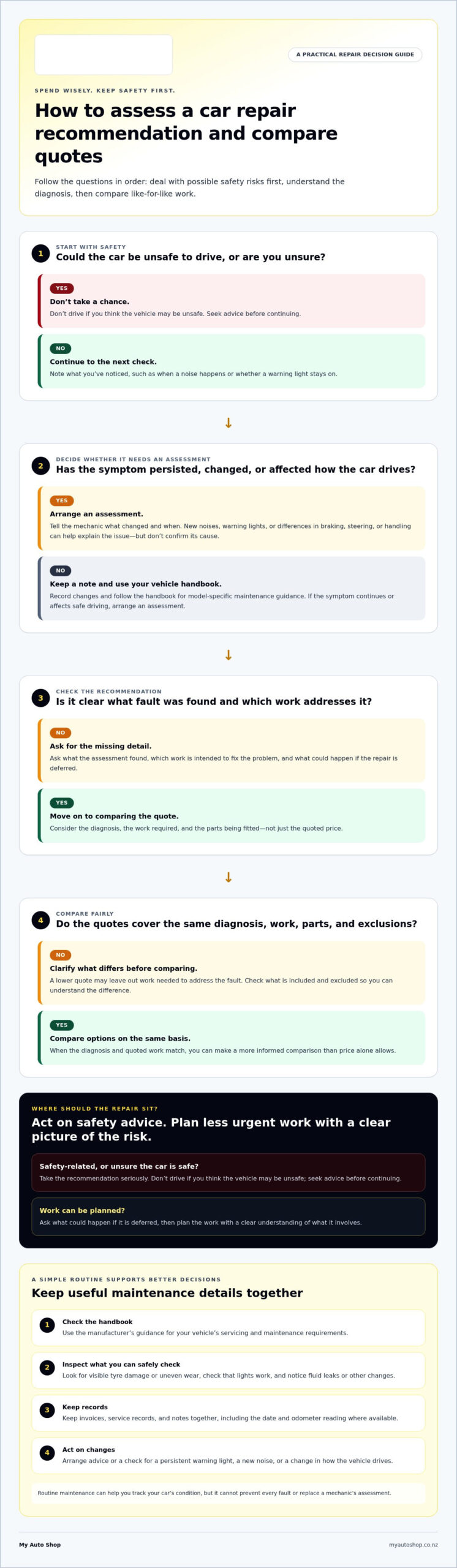
Put safety first, then consider faults that are getting worse, and plan routine or less urgent work around those priorities. This gives you a sensible order for discussing repairs without treating every recommendation as equally urgent. A symptom alone can’t confirm the cause, so use a professional assessment to understand the risk before deciding what can wait.
Which repair concerns should be dealt with promptly?
Braking or steering changes, serious warning signs and any fault that affects the car’s control need prompt attention. A noise, warning light or change in handling doesn’t identify the cause by itself, but it is a reason to seek professional advice. If you think the vehicle may be unsafe to drive, don’t drive it. Arrange an assessment and get advice about a safe next step.
Use this checklist to sort concerns into practical groups:
- Safety-critical symptoms: Brakes, steering or another issue that could affect safe control. Make this the priority and avoid driving if the vehicle may be unsafe.
- Worsening faults: A symptom that is becoming more frequent or noticeable. Arrange an assessment so you can understand what’s changing and how urgently it needs attention.
- Planned maintenance: Work identified through servicing or the vehicle handbook. Record it, clarify its recommended timing and plan for it without assuming it can be deferred indefinitely.
Immediate safety concerns come before discretionary work. If the car needs both a safety-related repair and a non-urgent item, discuss the order with the mechanic. Ask what makes the first repair urgent and what the risks are if the other work is postponed. That keeps prioritisation grounded in the vehicle’s condition rather than guesswork or the order items appear on a quote.
Can you plan work that is not immediately urgent?
A mechanic can explain which recommended work needs attention first and what may happen if other work is delayed. Ask for that assessment in plain language, then note the recommendation and any change that would bring it forward. Don’t defer a repair simply because it seems minor or because the car still drives; get the urgency assessed first.
A Warrant of Fitness (WoF) is a safety inspection at a point in time, not a full mechanical assessment or a substitute for servicing. For current New Zealand inspection requirements, refer to Waka Kotahi guidance. A WoF result doesn’t remove the need to act on a new symptom or follow up a mechanical concern.
For informed decisions about repair options, My Auto Shop connects motorists with service and repair providers. Consider the available options once you understand the vehicle’s priorities. This makes how to save money on car repairs without cutting corners a matter of clear priorities: address safety concerns first, assess changes promptly and plan other work with advice.
How My Auto Shop can make repair decisions clearer
Good repair decisions start with understanding what your car needs, what the recommended work covers and how urgent it is. My Auto Shop can help with the next step by connecting New Zealand motorists with automotive service and repair providers. Its upfront pricing gives you useful information to consider before booking, but the lowest price isn’t automatically the best choice. Look at the service and its scope as well as the cost.
What role does the My Auto Shop marketplace play?
My Auto Shop is a marketplace that connects motorists with providers. Providers on the platform aren’t employees of My Auto Shop. Turners Service & Repairs is a distinct service proposition, so it shouldn’t be confused with independent providers connected through the marketplace.
Use the services information to explore relevant repair categories and see which options may fit the work you’ve been advised to consider. For example, if a mechanic has identified a battery, brake or starting issue, the matching service category can help you focus on relevant information rather than browsing unrelated work. The diagnosis still matters: a service category helps you explore an option, but it doesn’t establish what’s wrong with your particular vehicle.
Upfront pricing supports clearer decisions because you can review the available price information before making a booking decision. It doesn’t mean an option will be the cheapest, or that every repair quote covers identical work. Check that the service matches the recommendation and consider what the stated scope includes. If something about the fault or proposed work remains unclear, get it explained before deciding.
How to take the next step with more confidence
Keep your notes on the symptoms, the diagnosis and any work already completed close at hand. Then read the recommendation carefully: identify which repair addresses the fault, which items are separate, and what the provider’s quoted scope covers. This makes it easier to compare the information fairly and choose a suitable next step without treating price as the only measure of value.
That process is the practical core of how to save money on car repairs without cutting corners. You’re not expected to diagnose the vehicle yourself or accept every recommendation without understanding it. You can make a more confident booking decision by bringing together what you’ve observed, what the assessment found and what the proposed service includes.
Explore car repair and servicing options to review relevant categories and the pricing information available. When you’re ready, explore repair options through My Auto Shop and consider the service that best matches your needs.
Make your next repair decision with confidence
Unexpected repairs can’t always be planned, but you can approach the next decision with a clearer sense of what you need to know. Keep a note of new symptoms and work already done, then use the mechanic’s explanation to understand what the recommended repair addresses. A decision based on clear information is more useful than choosing on price alone.
That’s the practical idea behind how to save money on car repairs without cutting corners: stay informed, protect safety and make choices that suit your vehicle. If you’re ready to take the next step, My Auto Shop connects motorists with automotive service and repair providers through a nationwide network of vetted mechanics, with transparent, upfront pricing to help you explore your options.
Explore car repair options with clear upfront pricing and move forward with confidence.
Frequently Asked Questions
Is it cheaper to repair a car early or wait until a fault gets worse?
Getting a persistent fault assessed early can help you understand the issue before it changes, but it doesn’t guarantee a cheaper repair. For example, a new vibration might have several possible causes, and only an assessment can identify what needs attention. Waiting may leave you with less information while the symptom changes. Ask what the mechanic found and whether continued driving could affect the problem.
How can I tell whether a mechanic has recommended necessary repairs?
Ask the mechanic to explain what they found, how the proposed work addresses it and what makes it a priority. If a part needs replacing, ask what condition showed that it was faulty. You can also ask for the recommendation to be separated into urgent work and items to monitor or plan. Clear reasoning helps you understand the advice without assuming it’s right or wrong based on price alone.
Can I keep driving if my car has a warning light or unusual noise?
It depends on the warning or symptom, so don’t assume it’s safe to keep driving. Check your vehicle handbook for the meaning of the warning light, and pay attention to changes in braking, steering, engine behaviour or handling. If the vehicle feels unsafe, stop somewhere safe and seek professional advice before continuing. A noise or light alone can’t confirm the fault or its severity.
Should I get more than one quote for a car repair?
A second quote can be useful if the repair is substantial or you don’t understand the diagnosis, provided you can compare the same work. Give each assessment the same details about the car, symptoms and previous repairs. If the recommendations differ, ask what each is based on. Don’t delay a repair that may affect safety just to collect more quotes; get advice on urgency first.
Does a WoF mean my car does not need further repairs?
No. A Warrant of Fitness is an inspection of specified safety requirements at a particular time, not a full mechanical health check or a promise that no fault will develop afterwards. A car can need servicing or diagnosis even if it has a current WoF. If you notice a new issue after passing, treat it as a separate concern and arrange an assessment when appropriate.
How can regular servicing help reduce car repair costs?
Servicing helps maintain your vehicle according to its manufacturer’s requirements and can bring developing wear or maintenance needs to your attention. For instance, a service record may show that an item is due for attention, so you can plan rather than rely on memory. Servicing can’t prevent every breakdown, but following the handbook and keeping records supports informed upkeep. That’s one part of how to save money on car repairs without cutting corners.
What should I compare when reviewing car repair quotes?
Check that each quote refers to the same fault and repair, then compare the tasks, parts and labour included. Look for exclusions and note how extra work would be discussed and approved. Make sure the quote is based on the correct vehicle details, such as its model and year, as these can affect the proposed work. If a line is unclear, ask what it covers before deciding.
Disclaimer
This article provides general information only and should not be relied on as professional mechanical, safety or legal advice. Vehicle requirements and circumstances vary. If you are unsure about your vehicle, have it inspected by a qualified automotive professional.