

What if that “critical” repair on your last WOF was actually a routine job padded with technical jargon to inflate the bill? Most Kiwi drivers know that sinking feeling when a mechanic lists problems they can’t see or understand. You aren’t alone in your suspicion. A 2023 Consumer NZ survey revealed that 15% of car owners feel they’ve been overcharged or misled by a workshop. Learning how to tell if a mechanic is ripping you off nz is the only way to swap that anxiety for total confidence.
It’s time to stop feeling patronised and start taking control of your car’s maintenance. We’ve built this 2026 guide to help you spot red flags instantly and understand your legal rights under the Consumer Guarantees Act. You’ll learn the exact verification steps and questions needed to validate any quote before you hand over your keys. We’ll show you how digital transparency and “book time” standards can guarantee you never pay for unnecessary repairs again.
Key Takeaways
- Identify the “urgency trap” and vague jargon used to pressure you into buying parts like brake pads or batteries you might not need yet.
- Use your rights under the Consumer Guarantees Act to challenge bills that haven’t been pre-agreed or seem unreasonable.
- Learn the “Book Time” secret to understand how to tell if a mechanic is ripping you off nz by checking their labour hours against industry standards.
- Gain the confidence to walk away from a workshop and learn how to legally reclaim your car if it’s already been taken apart.
- See why transparent, fixed-price digital bookings are the most reliable way to avoid hidden costs and mechanical guesswork.
The NZ Mechanic Red Flag Checklist: 7 Warning Signs
Don’t wait until you see the final bill to get suspicious. Spotting the signs early saves you hundreds of dollars and hours of stress. If you’re wondering how to tell if a mechanic is ripping you off nz, look at their behaviour the moment you hand over the keys. A 2024 industry report suggested that clear communication is the primary driver of customer trust, yet many workshops still rely on high pressure tactics to boost their margins.
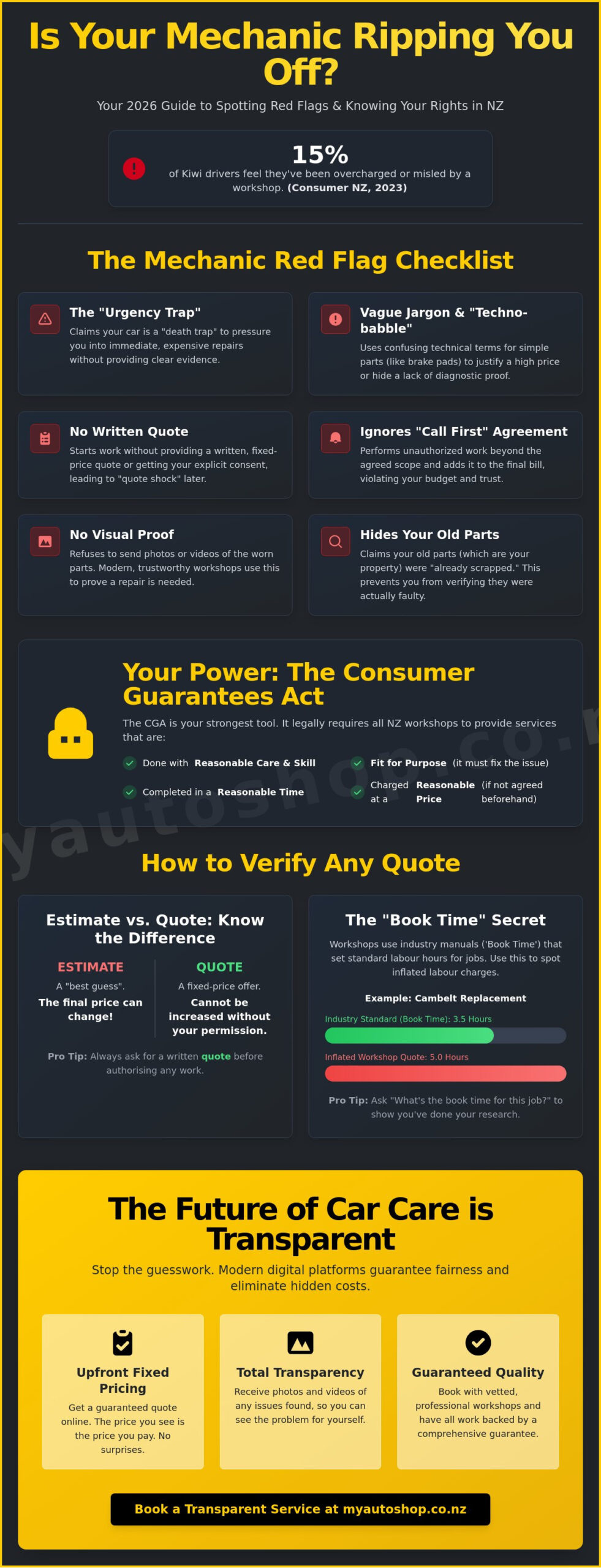
The “Urgency Trap” is a classic move. A mechanic might claim your car is a “death trap” and shouldn’t be driven another metre. While safety is vital, a professional will explain exactly why with evidence. If they pressure you to sign for a major repair like a clutch replacement without showing you the fault, take a breath. Ask for a written quote first. Starting work without a fixed estimate or a “worst case” price cap is a major red flag that often leads to quote shock.
Watch out for “techno-babble” too. If they can’t explain why you need a car battery replacement in plain English, they might be hiding a lack of diagnostic proof. A real expert knows what a mechanic does involves translating complex systems into simple choices for the customer. If they use vague jargon to explain simple parts like brake pads, they’re likely trying to confuse you into saying yes.
Spotting Dodgy Communication Early
A “cowboy” operation often avoids paper trails. In 2026, a professional workshop should provide a digital or printed job sheet before a single bolt is turned. This document protects you and the mechanic. Always insist on a “call before you start” agreement. If they perform work without your explicit consent, they’ve breached basic service standards. A trustworthy shop respects your budget and your time.
Visual Evidence: The Digital Difference
Transparency isn’t just a buzzword; it’s a measurable standard. Modern Kiwi mechanics now use smartphones to send you photos of worn brake pads or leaking radiators while your car is still on the hoist. This level of proof is the new industry benchmark. If a workshop refuses to show you the car or won’t provide visual proof of a fault, they’re stuck in the past. A transparent workshop is one that documents every fault with visual proof.
Finally, always ask to see your old parts. A reputable shop will have your old cambelt or shock absorbers ready to show you. It’s your property. If they claim the parts were “already scrapped” within minutes of the job finishing, be wary. Seeing the physical wear on a part is the best way to confirm the repair was actually necessary.
Your Rights Under the Consumer Guarantees Act (CGA)
The Consumer Guarantees Act (CGA) 1993 is your strongest tool when dealing with car repairs. It ensures every service is performed with “reasonable care and skill” and is fit for its intended purpose. If you’ve been wondering how to tell if a mechanic is ripping you off nz, knowing your legal standing is the first step toward a fair deal. This law applies to every workshop in the country, from small local garages to large franchise dealerships.
The “Reasonable Price” clause is a lifesaver for many Kiwi drivers. If you didn’t agree on a fixed price before the work started, the mechanic can only charge you a “reasonable price” for the job. They can’t simply pull a number out of thin air. If the bill feels astronomical, you have the right to ask for a breakdown of parts and labour to see how it compares to industry standards. Similarly, the “Reasonable Time” rule protects you from endless delays. A standard repair, like a radiator repair & replacement, shouldn’t drag on for weeks without a valid reason.
Always check if the workshop is an MTA member. The Motor Trade Association logo isn’t just for show. It means the business must adhere to high standards and, more importantly, gives you access to a mediation service if things go wrong. This provides an extra layer of accountability that “backyard” operations simply cannot offer.
What ‘Reasonable Care and Skill’ Actually Means
This legal standard means the mechanic must work to a professional level. For example, if you pay for a Cambelt / Timing Belt Replacement and the belt snaps just 100km later, the repair likely failed this test. To document a failure, take photos of the damage immediately and keep your original receipt. Get a second opinion from another qualified technician if needed. Don’t let a workshop brush off a genuine mistake as “fair wear and tear” if the part was recently replaced and should have lasted years.
How to Handle a ‘Surprise’ Bill
Understand the difference between an estimate and a quote before you drop your car off. An estimate is a “best guess” and can change. A quote is a fixed price that cannot be increased without your permission. You can find more detail on Your Rights Under the Consumer Guarantees Act at the Consumer Protection website.
If you’re faced with a surprise bill for unauthorised work, stay calm. Use these exact words: “I did not authorise this specific work. I am happy to pay the undisputed amount for the services I requested, but I need a written explanation for the rest.” Legally, you are only obligated to pay for what you agreed to. To avoid these awkward stand-offs entirely, look for providers who offer transparent pricing before the work even begins.
How to Verify a Quote: Parts, Labour, and ‘Book Time’
A quote is more than just a final number at the bottom of a page. It’s a detailed map of exactly where your money is going. If you want to know how to tell if a mechanic is ripping you off nz, you must look past the total and examine the individual line items for parts and labour. In 2026, transparency is the industry standard. Any workshop that provides a “lump sum” estimate without a breakdown is likely hiding something.
Labour rates in New Zealand vary significantly by region. While a shop might advertise a lower hourly rate to get you through the door, they might compensate by being “slow” on the tools. This is where the Consumer Guarantees Act for vehicle repairs protects you from being overcharged for inefficient work. Always ask for a written breakdown before any work begins on a Brake Pad Replacement or more complex engine repairs.
Breaking Down the Labour Component
Ask the service manager for the “flat rate” time of the job. ‘Book Time’ is a standardised industry guide for repair durations. If the manual says a job takes two hours but you’re being billed for five, you have a right to ask why. A 4-hour charge for a 1-hour job is the most common way Kiwis get ripped off. Unless there was a specific complication, like a rusted bolt that required extra care, the labour hours should match the guide closely.
Verifying Part Markups
Mechanics often buy parts at wholesale prices and add a markup. A 20% to 30% markup is generally considered fair in the NZ market to cover the cost of sourcing, handling, and providing a warranty. However, predatory shops might charge you for Original Equipment Manufacturer (OEM) parts while actually installing cheaper aftermarket alternatives. Do a quick sanity check. Use your phone to check the price of a Car Battery Replacement on a local retailer’s website. If the workshop’s price is double the retail cost without a clear reason, it’s time to ask questions.
Finally, look at the “Shop Supplies” or “Environmental” fees. A legitimate charge of $10 to $15 for rags, cleaners, and waste disposal is standard. If you see a miscellaneous fee that exceeds 5% of the total bill, ask for a specific list of what was used. Honest shops won’t mind explaining their costs; they value your trust as much as your business.
The ‘Second Opinion’ Strategy: When to Walk Away
Trust your instincts. It’s often the most reliable tool in your diagnostic kit. If a service advisor talks down to you or ignores your questions, they don’t value your business. Learning how to tell if a mechanic is ripping you off nz often starts with noticing how you’re treated at the front desk. A professional workshop should make you feel empowered, not intimidated. If you feel pressured to sign off on a major job like a clutch replacement without a clear explanation, it’s time to walk away.
Many drivers stay in a bad situation because they fear their car is “too far gone” to move. If your vehicle is already partially dismantled, you still have the right to your property. You own every bolt and bracket. You can pay for the diagnostic time already spent and have the car towed to another workshop. Most reputable shops charge between 0.5 and 1.0 hour of labour as a standard assessment fee. Paying this small amount is much cheaper than committing to a multi-thousand dollar repair you don’t actually need.
Bringing the expert to you is a total power move. Booking a Mobile Mechanic for a second opinion allows you to get an unbiased assessment in your own driveway. Without the overheads of a large workshop or the pressure of a car stuck on a hoist, a mobile technician can give you a straight answer on whether those shock absorbers really need replacing or if they’ve got another 10,000km of life left. This removes the “captured audience” feeling that some traditional workshops rely on to close a sale.
How to Gracefully Exit a Dodgy Workshop
You don’t need to be a mechanical expert to say no. Use a simple, firm script: “I appreciate the assessment, but I’m not ready to proceed with these repairs today. Please put the car back together, and I will pay the diagnostic fee.” Never feel guilty for seeking a second opinion. It’s your money and your safety. A 2023 industry survey found that 22% of customers who sought a second opinion saved significantly on their final bill by avoiding unnecessary “add-on” services that weren’t critical for safety or performance.
The Value of an Independent Inspection
Establishing a baseline for your car’s health is the best way to prevent future scams. We recommend booking a Pre-purchase Inspection even if you’ve owned the car for a while. This provides a comprehensive report that acts as a “truth document” you can use to cross-reference future repair claims. Waka Kotahi data from 2022 showed that roughly 40% of vehicles fail their initial WOF inspection. These failures are often used as a starting point for aggressive upsells. Having an independent health check in your glovebox ensures you know exactly what is a genuine safety issue and what is just a workshop trying to pad its monthly targets.
Ready for a transparent experience? Book your next service with My Auto Shop and see the difference that fixed, upfront pricing makes.
Why Transparent Pricing is the Future of NZ Car Care
The era of the “grease-monkey” mystery is finally over. In 2026, Kiwi car owners expect the same digital efficiency from their mechanic that they get from their banking app. This shift toward digital-first transparency is the ultimate solution for anyone wondering how to tell if a mechanic is ripping you off nz. By moving away from vague verbal estimates and toward fixed, upfront pricing, we’ve removed the guesswork that once defined the automotive industry. Transparency isn’t just a bonus anymore; it’s the only valid proof of a workshop’s honesty.
My Auto Shop acts as your transparent partner in an industry that was once intentionally confusing. We eliminate “quote shock” by providing instant, fixed-price bookings for everything from a Car Battery Replacement to a complex Cambelt / Timing Belt Replacement. Our national network of over 300 certified workshops ensures you receive a consistent standard of care regardless of your location. Whether you are in Invercargill or Whangarei, the price you see online is the price you pay at the counter. This standardized approach prevents the regional price gouging that often catches drivers off guard.
Convenience shouldn’t come with a hidden cost. Our signature pick-up & drop-off service bridges the gap between busy lives and essential car maintenance. It’s a promise of reliability. When a mechanic knows their work is being tracked through a centralized digital platform, accountability becomes the default setting. This system ensures that every Radiator Repair & Replacement or Shock Absorber Replacement is documented and justified by the industry standards we discussed earlier.
Instant Quotes: The Ultimate Accountability Tool
Knowing your total cost before you even drop your keys off completely changes the power dynamic at the workshop. It removes the anxiety of the “afternoon phone call” where costs suddenly spiral out of control. My Auto Shop only works with NZ’s best mechanics who meet our strict transparency criteria. Our “No Surprises” guarantee means that if a workshop finds additional work, they must provide visual proof and get your digital sign-off before a single cent is added to your bill. You stay in control of your budget from start to finish.
Booking with Confidence
Our platform is designed to make comparing services as simple as possible. You can view the differences between a Basic Service and a Comprehensive Service side-by-side. This centralized system doesn’t just manage your booking; it tracks your vehicle’s entire repair history. Having a digital logbook for tasks like CV Joint & Boot Repair is invaluable for maintaining your car’s resale value. It also ensures you never pay for the same repair twice. Ready for a service without the stress? Book a transparent car service with My Auto Shop today.
Take Control of Your Car Maintenance Today
You now have the tools to spot red flags before they hit your bank account. From checking “book time” standards to standing firm on your rights under the Consumer Guarantees Act, you are no longer a passive passenger in the repair process. Understanding how to tell if a mechanic is ripping you off nz is ultimately about demanding the transparency you deserve. The 15% of Kiwis who reported being misled in the 2023 Consumer NZ survey didn’t have this checklist, but you do.
Stop worrying about hidden costs and technical guesswork. We’ve built a platform that prioritizes your time and your trust. MyAutoShop is 100% NZ owned and operated, connecting you to a network of MTA-approved mechanics who value honesty. With our fixed-price instant quotes and convenient pick-up and drop-off service, you stay in the driver’s seat of every repair. Skip the guesswork and book a fixed-price car service with NZ’s most transparent network.
Driving should be about the journey, not the stress of the workshop. You’ve got the knowledge; now enjoy the peace of mind that comes with a reliable service partner.
Frequently Asked Questions
Can a mechanic keep my car if I refuse to pay a bill I didn’t authorise?
Yes, a mechanic can legally exercise a “worker’s lien” to hold your vehicle until the bill is paid, but this only applies to work you actually authorised. If they performed additional repairs without your consent, they have no legal right to hold your car for that portion of the debt. You should offer to pay the undisputed amount for the authorised work in exchange for the release of your vehicle while you resolve the remaining balance through mediation.
Is it a rip-off if a mechanic charges for ‘diagnostic time’ even if they don’t fix anything?
No, charging for diagnostic time is a standard industry practice because identifying a fault requires expert knowledge and expensive scanning equipment. Most professional Kiwi workshops charge between 0.5 and 1.0 hour of labour for an initial assessment. However, it becomes a red flag if the diagnostic fee is not disclosed upfront or if the time charged seems excessive for a simple visual inspection.
How much should a standard car service cost in New Zealand in 2026?
Service costs vary based on your vehicle’s make and model. A 2024 market review by Canstar Blue NZ suggests that basic services often fall between $200 and $300, while comprehensive services can range from $400 to $600. To avoid regional price spikes, always look for providers that offer fixed-price digital bookings so you know the exact cost before the oil is even drained.
What can I do if a mechanic has already done the work but I think the price is too high?
Request an itemised invoice that separates parts from labour hours and compare the labour time against “Book Time” standards. Under the Consumer Guarantees Act, if no price was agreed upon beforehand, you are only legally required to pay a “reasonable price” for the service. Knowing how to tell if a mechanic is ripping you off nz involves challenging any labour hours that significantly exceed industry averages for that specific repair.
Are mobile mechanics more expensive or more likely to rip me off than workshops?
Mobile mechanics are often more price-competitive because they don’t have the high overhead costs of a physical workshop. They aren’t more likely to be dishonest; in fact, they often provide more transparency because you can watch the work being done in your own driveway. Ensure your mobile technician is MTA-approved and provides a digital quote before they arrive at your home.
How do I know if the parts the mechanic said they replaced were actually new?
The most reliable way to verify a repair is to ask the mechanic to place the old, replaced parts in a box for you to inspect. New components like brake pads, filters, or a car battery replacement will have a clean, unweathered appearance compared to the rest of the engine bay. You can also ask for the part’s original packaging or a receipt that specifies the brand and warranty details of the new component.
What is the best way to report a mechanic who I believe is acting dishonestly in NZ?
Start by filing a formal written complaint with the workshop manager to give them a chance to rectify the issue. If the business is an MTA member, you can use their free mediation service to resolve the dispute. For more serious cases, you can file a claim with the Disputes Tribunal, which handled approximately 15,000 cases in the 2022/23 period, or report the business to the Commerce Commission for potential Fair Trading Act breaches.
Should I always get a written quote before any work starts?
Yes, a written quote is your strongest protection against “quote shock” and unauthorised charges. A quote is a fixed price that cannot be changed without your permission, unlike an estimate which is just a rough guess. Insisting on a written quote is the most effective way to understand how to tell if a mechanic is ripping you off nz, as it forces the workshop to commit to a price for parts and labour before the job begins.
Disclaimer
This article provides general information only and should not be relied on as professional mechanical, safety or legal advice. Vehicle requirements and circumstances vary. If you are unsure about your vehicle, have it inspected by a qualified automotive professional.