
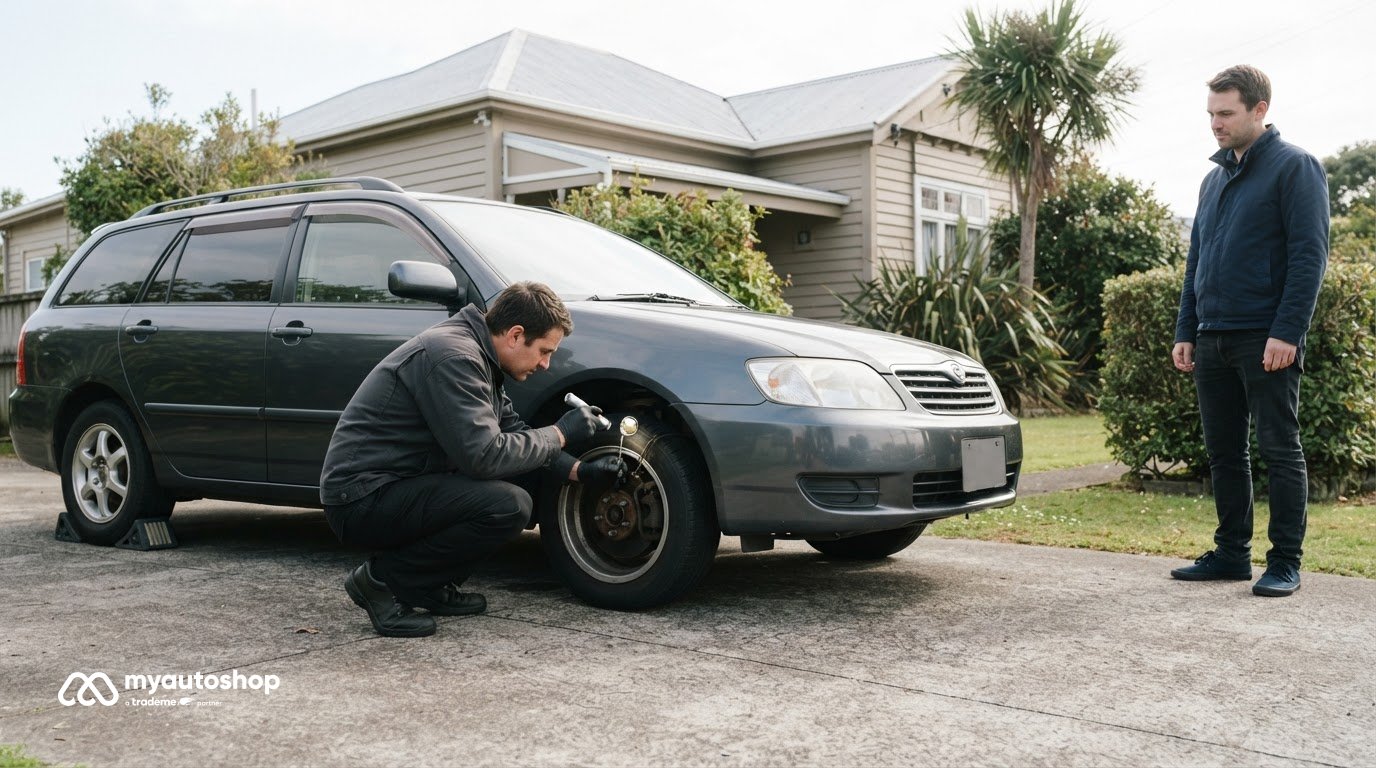
A mobile pre-purchase car inspection in NZ lets an inspector assess a vehicle at the seller’s location, so you can get an independent view before deciding whether to buy. You don’t need to take the car to a workshop.
Look beyond the WoF and test drive. Both can be useful, but neither gives you a complete picture of a vehicle’s mechanical condition. A pre-purchase inspection checks key areas such as the engine, brakes, steering, tyres and bodywork, then records any issues found.
This guide explains what a mobile inspection covers, how booking and payment work, and what to expect from the report. It also explains how inspection scope and optional checks can affect the price.
Key Takeaways
- A mobile inspection can be arranged at the seller’s home, so the car can be assessed where it’s located.
- Look beyond the WoF: an inspection checks key mechanical and bodywork areas and provides a written report of findings.
- Waka Kotahi NZ Transport Agency states that car tyres must have at least 1.5 mm of tread to meet the legal minimum.
- Understand what the standard inspection covers before deciding whether optional checks are useful for the vehicle you’re considering.
- Learn what information helps organise a booking and what can affect the price of an inspection.
1. Checking service records and vehicle condition
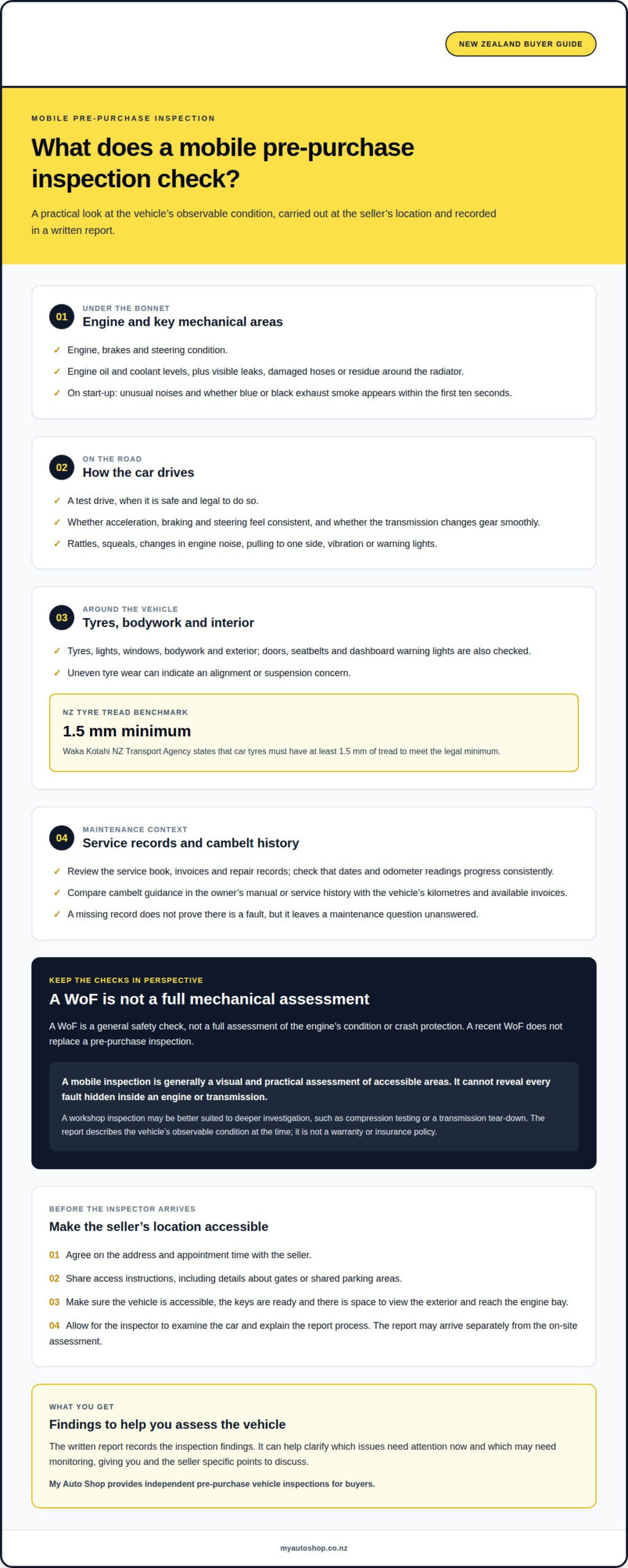
Start by reviewing the service book, invoices and repair records. Check that dates and odometer readings progress consistently. A gap in the records, for example, can make it harder to tell when the oil or cambelt was last replaced. Ask the seller about missing paperwork and compare their explanation with the documents available.
Pay particular attention to the cambelt, as replacement timing varies by vehicle. Many vehicles have a recommended interval in the owner’s manual or service history. Compare that guidance with the car’s kilometres and available invoices. A missing record doesn’t prove there’s a fault, but it leaves an important maintenance question unanswered.
Look under the bonnet with the engine cool. Check the engine oil and coolant levels, and look for leaks, damaged hoses or residue around the radiator. A low fluid level or oily film around a joint can point to a problem that needs closer assessment. On start-up, note unusual noises and whether blue or black exhaust smoke appears within the first ten seconds.
Inspect the tyres, lights, windows and bodywork. Waka Kotahi NZ Transport Agency states that car tyres must have at least 1.5 mm of tread to meet the stated legal minimum. Look for uneven wear across each tyre, which can indicate an alignment or suspension concern. Check that doors open, seatbelts latch, and dashboard warning lights behave normally after starting.
What are the NZ rules for buying a used car privately or from a dealer? A dealer must ensure the vehicle isn’t registered as stolen. For either type of sale, check the vehicle details and the seller’s authority to sell before paying, and keep a written record of the agreed terms.
How can you check a used car’s history, money owing and ownership in NZ? Match the registration and vehicle identification details against the paperwork, then review service invoices and ownership documents. A vehicle history check can help reveal recorded history or finance interests. Resolve any uncertainty about ownership or money owing before completing the purchase.
A pre-purchase car inspection in New Zealand checks the engine, brakes, steering, tyres, interior, bodywork and exterior, as well as including a test drive. It assesses the vehicle’s condition at the time, rather than providing a warranty or insurance policy. The findings are recorded in a written report.
Should you get an inspection if the car has a recent WoF? Yes. A WoF is a general safety check, not a full assessment of the engine’s condition or crash protection. A recent WoF doesn’t replace a pre-purchase inspection.
During a test drive, listen for rattles, squeals or changes in engine noise. Check whether the car accelerates, brakes and steers consistently, and whether the transmission changes gear smoothly. On a safe, legal road test, notice pulling to one side, vibration or warning lights. A pre-purchase inspection brings these checks together with a written account of the vehicle’s condition.
2. Independent inspections versus a dealer’s preferred mechanic
An independent inspection gives the buyer a separate assessment before they decide. The key difference is who arranges the inspection and receives the findings. A seller’s preferred mechanic may know the vehicle’s service history, but ask whether that mechanic has worked on it before. Prior involvement doesn’t prove bias, but it’s useful context when interpreting the assessment.
When you arrange the inspection, the findings go directly to you. The report can clarify which issues need attention now and which may need monitoring. It also gives you and the seller specific points to discuss, such as uneven tyre wear or a visible fluid leak. Keep the report with the vehicle’s service records when weighing the purchase.
Which companies offer mobile pre-purchase car inspections in New Zealand? Buyers can arrange an inspection through automotive service marketplaces or businesses that carry out vehicle inspections. The key is to have the car assessed for you as the buyer, rather than relying only on the seller’s description or preferred mechanic. My Auto Shop provides independent pre-purchase vehicle inspections to help buyers make informed decisions.
A mobile inspection is generally a visual and practical assessment at the vehicle’s location. The inspector can assess accessible areas and road-test the vehicle only when it’s safe and legal. It can’t reveal every fault hidden inside an engine or transmission, and a workshop inspection may be better suited to deeper investigation, such as compression testing or a transmission tear-down. Treat the mobile report as an assessment of the vehicle’s observable condition at the time, not as a warranty or insurance policy.
How long does a mobile pre-purchase inspection take? The time depends on the vehicle’s condition, access and whether a safe, legal road test is possible. Allow time for the inspector to examine the car and explain the report process. The report may arrive separately from the on-site assessment.
For a seller’s driveway visit, practical details matter: the car needs to be accessible, and the keys must be available. A clear parking area helps the inspector view the exterior and reach the engine bay. This guide to mobile mechanic visits explains why access and location affect mobile work.
3. Can you inspect a car at the seller’s house?
Yes. A mobile inspector can visit the seller’s home or another agreed location in New Zealand. Agree on the address and timing with the seller before arranging the inspection.
Provide clear location details, including the street address and any access instructions. If the car is behind a gate or parked in a shared area, explain that beforehand. The inspector needs access to the interior and space around the vehicle. Make sure the seller knows the appointment is for an independent inspection.
Ask the seller to have the keys ready and the vehicle accessible at the agreed time. A cramped garage can make it harder to inspect the body panels or reach the engine bay. An open driveway or suitable parking space gives the inspector room to work. The seller’s permission is also needed for access and any road test.
A road test is possible only when it’s safe and legal to drive the car. If it can’t be driven, the inspector can still assess it while stationary, but the report won’t include observations from driving. A road test may reveal symptoms such as vibration under acceleration or a steering pull that aren’t apparent while parked.
Before booking, ask the seller practical questions to clarify the car’s condition and availability:
- Can the car be inspected at this address, and will it be accessible?
- Will the keys be available when the inspector arrives?
- Can the seller provide service records, repair invoices or the owner’s manual?
- Has the car had recent repairs, warning lights or recurring faults?
- Can the vehicle be driven safely and legally for a road test?
Specific answers help put the findings in context. An invoice, for example, may show that a noise was assessed, while the seller’s explanation can help establish when it began. Keep your questions factual and note the answers. You can then consider the inspection report alongside what the seller has shared.
If the seller can’t be present, agree beforehand on who will provide access and answer questions. Don’t assume a neighbour or property manager can hand over the keys. Confirm the arrangement directly with the seller, including where the vehicle will be parked. Clear access avoids a wasted visit and lets the inspector focus on the car.
A mobile inspection suits buyers who want the vehicle assessed at the seller’s location. It’s a practical check, not a workshop examination with a hoist or removed components. If a complex fault requires invasive testing, a workshop assessment may be more suitable.
4. Booking and payment
Gather the vehicle details before arranging an inspection. The registration number, make, model and year help identify the car. Note the seller’s address and preferred appointment time, along with any specific concern, such as a warning light or unusual noise. Clear details help match the booking to the vehicle and location.
Agree on access with the seller before confirming the visit. The car should be at the agreed address, with the keys ready. Tell the seller the inspector will need access to the interior and engine bay. If the car is behind a gate or in a shared garage, include those instructions when arranging the appointment.
Have these details ready when you book:
- The vehicle’s registration, make, model and year.
- The inspection address and any entry or parking instructions.
- The seller’s contact details and their agreement to provide access.
- Your main concerns, such as smoke, noises or a dashboard warning.
- Whether a safe and legal road test can take place.
Check the appointment details before paying. An incorrect address or registration number can cause confusion on inspection day. If the seller changes the location, pass on the new details promptly. For example, if the car moves from a driveway to a workplace, the address and access arrangements need updating.
Payment is required before an Auckland inspection to secure the booking. Treat payment as part of confirming the appointment, rather than leaving it until the inspector arrives. Keep the booking details and payment confirmation together so you can refer to the agreed vehicle, location and appointment.
Prepare the seller by sharing the appointment time and access requirements. Ask them to have the vehicle present, the keys ready and service records accessible. If the car can’t be driven safely and legally, the inspector can’t road-test it. Clear arrangements help avoid delays and keep the focus on the vehicle.
After the assessment, the written report gives you a record of the findings to consider before deciding. For Auckland inspections, the report is emailed within 2–4 hours. Read it alongside the seller’s service documents, and note any findings you want clarified before agreeing to buy. A report describes the car’s condition at inspection time, so keep its timing in mind if the vehicle is used or repaired afterward.
5. Standard inspection pricing and optional extras
How much does a pre-purchase vehicle inspection cost in NZ? The price depends on the inspection’s scope and any optional checks. Request a quote for the inspection you need before booking.
First, identify what the standard assessment covers. A mobile inspection is a visual and practical check of accessible parts. Its value is in assessing the vehicle’s overall condition and recording the findings. Compare the scope with the questions you need answered.
Optional checks can address a specific concern. A head gasket leak test, for example, investigates a possible leak between engine components. High-resolution photos can add useful visual detail to a report, especially if you’re reviewing the vehicle remotely. These are separate additions, so consider whether each is relevant to your purchase.
Before accepting a quote, separate the standard inspection from any extras. Note the base scope, each requested addition and the total quoted price. If you’re considering a head gasket test and report photos, ask for both to appear as separate line items. This makes the cost easier to understand against your budget.
Let the vehicle’s condition guide your choice. A car with a documented service history may raise different questions from one with unclear maintenance records. A reported coolant issue, for instance, could make a targeted engine check more relevant. An extra isn’t automatically useful just because it’s available; choose it to investigate a specific concern.
Keep in mind what a mobile inspection can’t provide. It doesn’t involve removing major components or checking the vehicle on a workshop hoist. If a complex fault needs invasive testing, such as a transmission tear-down, a workshop assessment may be more appropriate. An extra check doesn’t remove the limits of an on-site visual inspection.
Keep the booking clear by confirming the vehicle details, inspection location and requested scope together. Ask for the standard checks and optional extras to be listed before payment. For example, “inspection plus head gasket leak test” is clearer than a general request for a more thorough check. Save the quoted scope with your booking details.
Choose the checks that answer your buying questions, not every available add-on. A clearly itemised pre-purchase inspection quote helps you understand what the assessment covers before you commit.
There’s no single set price; the total depends on the checks selected. Request an itemised quote for the inspection and any extras you need.
My Auto Shop: Pre-purchase Inspection
My Auto Shop offers a Pre-purchase Inspection to help you assess a used car before deciding whether to buy. It’s a practical next step when the seller’s description, service records or your own test drive leave questions about the vehicle’s condition.
An inspection provides a written assessment of the car’s condition at the time it’s checked. Use the findings to understand which issues may need attention and make a more informed buying decision. If you buy the car, My Auto Shop’s Basic Service or Comprehensive Service can help with ongoing maintenance.
Have the vehicle details and seller’s location ready when arranging an inspection. For help with your next step, contact My Auto Shop.
Make your next move with confidence
Buying a used car involves more than assessing its appearance. Consider how it fits your everyday driving, the maintenance it may need and whether the inspection findings change your view of the asking price. A clear report gives you a basis for deciding, discussing concerns with the seller or walking away.
A mobile pre-purchase car inspection in NZ can turn uncertainty into practical information before you commit. Read the findings carefully and consider how they affect your plans for the vehicle. If the report identifies a concern, use it to decide what you need to understand before proceeding.
Ready to take the next step? Contact My Auto Shop to book an inspection. A more informed decision starts with knowing what you’re buying.
Frequently Asked Questions
Can you inspect a car at the seller’s house?
Yes, a mobile inspection can take place at the seller’s home. Agree on the visit with the seller, who needs to authorise access to the vehicle. If the car is kept elsewhere, arrange the inspection at its actual location. This avoids confusion if the seller has several vehicles or uses a separate storage site.
Do you scan for fault codes?
A fault-code scan reads codes stored by a vehicle’s electronic systems, but a code doesn’t identify the failed part on its own. A warning light, for example, can have several possible causes. Don’t treat a code as a complete diagnosis or proof that no other faults exist. If a warning has appeared, note when it shows and what the car is doing.
How much does a PPI cost in Auckland?
The price depends on the inspection scope and any optional extras. Request a quote that separates the standard assessment from add-ons, then compare the total with the questions you need answered. Photos may help if you’re buying from elsewhere in the country, while a targeted test may suit a specific engine concern. Choose extras for a clear reason.
Mobile inspection vs workshop: what’s the difference?
A mobile assessment takes place where the vehicle is located; a workshop can provide equipment and access for further investigation. A workshop may be better if the concern needs testing beyond an external assessment, such as examining internal transmission components. Start with the issue you’re trying to resolve, then choose the setting that can investigate it.
When is payment required for the inspection?
For an Auckland inspection, payment is required before the appointment to secure the booking. Keep the payment record with your appointment details so you can refer to the agreed vehicle and location if plans change. Inspection payment is separate from any purchase arrangement with the seller. Paying for an assessment doesn’t commit you to buying the car.
How do I book a mobile car inspection in NZ?
Have the vehicle’s registration, make and model, location and seller’s contact details ready. Include the concern that prompted the inspection, such as an intermittent warning light or a noise that occurs only when turning. This gives the booking a clear purpose and helps you decide whether a standard assessment addresses your main concern.
What checks are included in an NZ pre-purchase inspection report?
The report records the inspector’s observations of the vehicle’s condition at the time of assessment. Use it as a decision aid, not a forecast of future repairs. If a finding includes a technical term, note the exact wording and ask what it means for the car’s operation. If you proceed with the purchase, keep the report with the vehicle’s records.
What should I do if an inspection finds problems with the car?
Before committing, identify which findings matter most for your intended use. Ask the seller whether they have repair records or other documents relating to those issues. Weigh the likely implications against the vehicle’s condition and your budget. You could discuss the findings with the seller, arrange further investigation or decide the car isn’t the right fit.
Disclaimer
This article provides general information only and should not be relied on as professional mechanical, safety or legal advice. Vehicle requirements and circumstances vary. If you are unsure about your vehicle, have it inspected by a qualified automotive professional.