

What if the best negotiating tool you have when buying a used car isn’t your charm or your research, but a single professional report? Getting a pre purchase inspection Christchurch buyers rely on isn’t just about peace of mind. It’s about cold, hard financial leverage before you hand over a single dollar.
You already know that sinking feeling. You find a car that looks perfect, the seller seems genuine, and then a quiet voice asks: what am I actually missing here? That instinct is worth listening to. Hidden rust, worn brake components, a cambelt that’s overdue, these aren’t things you can spot on a test drive, and a failed Warrant of Fitness down the track can turn a bargain into a money pit fast.
This article cuts through the confusion. You’ll learn exactly what a professional pre-purchase inspection covers, how to read the report without needing a mechanical degree, and how to use the findings to either negotiate a better price or walk away with your savings intact. Here’s everything you need to buy your next car with genuine confidence.
Key Takeaways
- A current Warrant of Fitness is a legal minimum, not a reliability guarantee — discover why a professional pre purchase inspection Christchurch buyers trust goes far deeper than any WoF check.
- A thorough inspection covers the “Big Three” — engine, transmission, and drivetrain — plus dozens of additional components that a test drive will never reveal.
- Timing your inspection request correctly can make or break the deal — learn when to ask and how to handle sellers who push back.
- Your inspection report is a negotiation weapon: use the “Recommended Repairs” section to justify a lower price or protect yourself with a clean exit.
- Booking through a network of vetted, MTA-approved mechanics — including mobile technicians who come to the car — means no logistical headaches before you’ve even bought the vehicle.
The Real Value of a Pre Purchase Inspection in NZ
A pre-purchase inspection is a comprehensive mechanical and safety audit carried out by a qualified technician before you commit to buying a used vehicle. It’s not a quick look under the bonnet. It’s a systematic examination of a car’s engine health, structural integrity, wear patterns, and maintenance history, designed to tell you what the car has been through, not just what it looks like today.
That distinction matters more than most buyers realise.
Buying a used car is one of the largest financial decisions most New Zealanders make outside of property. The stakes are real. A car that looks clean on a sunny Saturday afternoon in a seller’s driveway can be hiding thousands of dollars in deferred maintenance, unresolved accident damage, or components that are weeks away from failure. A professional pre purchase inspection Christchurch buyers book before signing anything is the single most effective way to close that information gap.
WoF vs. Pre-Purchase Inspection: What’s the Difference?
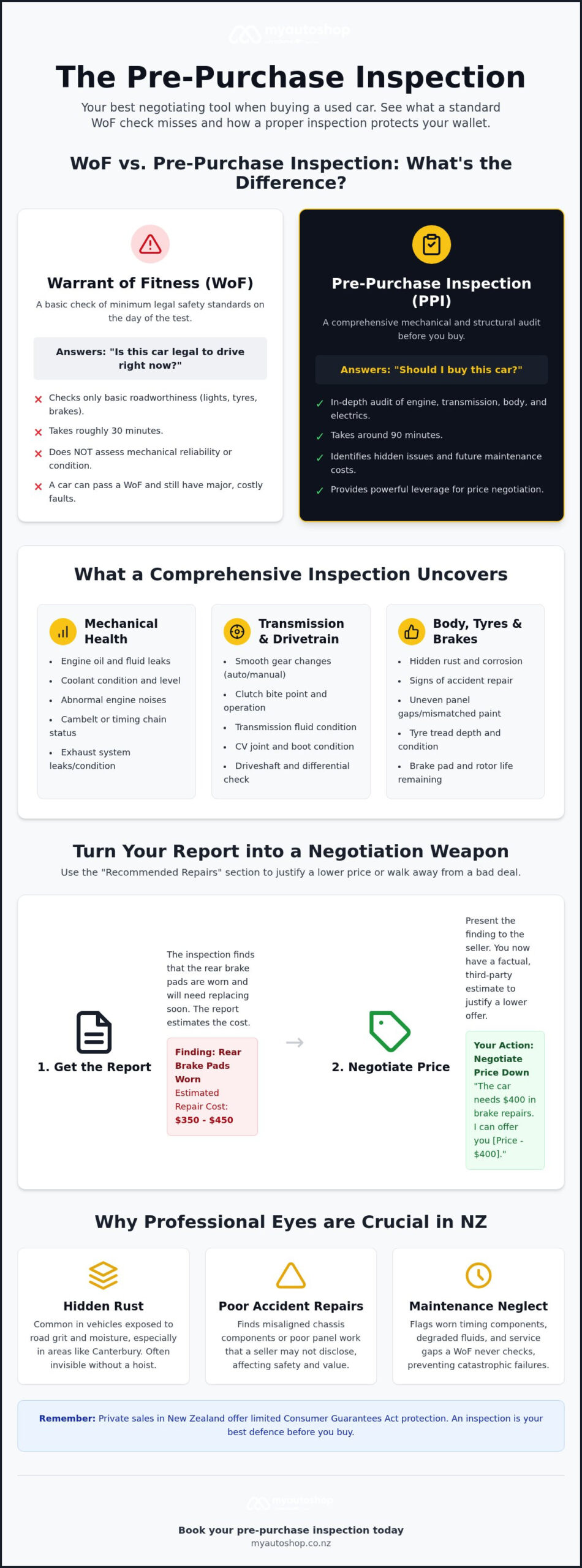
This is where a lot of buyers get caught out. A Warrant of Fitness confirms that a vehicle meets New Zealand’s minimum safety standards on the day it’s tested. It checks lights, tyres, brakes, and steering for basic roadworthiness. That’s it. A WoF takes roughly 30 minutes and answers one narrow question: is this car legal to drive right now?
A pre-purchase inspection answers a completely different question: should you buy this car? A thorough PPI runs closer to 90 minutes and examines components that a WoF inspector never touches, including engine compression, transmission behaviour, fluid condition, rust in hidden body cavities, and the overall wear trajectory of key mechanical systems. A car can hold a current WoF and still be an expensive mistake.
Why NZ Buyers Need Professional Eyes
Private sales in New Zealand come with limited Consumer Guarantees Act protection. Once money changes hands, your options narrow fast. That’s not a scare tactic; it’s the legal reality of buying from a private seller.
There’s also a practical problem. Modern vehicles are complex. Diagnosing engine health, identifying poor repair work after an accident, or spotting signs of flood damage requires specialist diagnostic tools and trained eyes, not just a careful look. A pre purchase inspection Christchurch buyers trust connects them with MTA-approved mechanics who carry that equipment and know exactly where to look.
- Hidden rust: Common in Canterbury vehicles exposed to road grit and moisture, often invisible without lifting the car
- Accident repairs: Poor panel work or misaligned chassis components that suggest a history the seller hasn’t disclosed
- Maintenance neglect: Worn timing components, degraded fluids, and service gaps that a WoF will never flag
Professional inspection isn’t a luxury. It’s the only way to see the full picture before your money is gone.
The Comprehensive Inspection Checklist: What to Expect
Knowing a professional inspection exists is one thing. Understanding exactly what it covers is what turns that knowledge into confidence. A thorough pre purchase inspection Christchurch buyers book through a vetted technician isn’t a vague “look over” — it’s a structured audit with specific checkpoints across every major system in the vehicle.
Mechanical and Under-the-Hood Checks
The engine is the starting point. A qualified technician checks for oil leaks around gaskets and seals, assesses coolant condition for signs of contamination, and listens for abnormal noises that suggest worn bearings or valve train issues. These aren’t things you’ll notice from the driver’s seat.
Timing components get specific attention here. For any vehicle where the cambelt or timing chain service interval is approaching or unknown, a failure mid-drive doesn’t just leave you stranded — it can destroy the engine entirely, turning a manageable maintenance cost into a write-off.
Transmission health is assessed through real-world behaviour: smooth gear changes, clutch bite point position, and fluid quality. A clutch that bites high or fluid that’s dark and burnt tells a story the seller probably won’t.
Exterior, Interior, and Safety Systems
Outside the car, technicians look beyond surface-level presentation. Structural corrosion in chassis rails and sill sections, evidence of panel beating or mismatched paint, uneven panel gaps — these are the fingerprints of accident history that a tidy detail job can mask. Tyre tread depth and remaining brake pad life are measured, not estimated, giving you a clear picture of near-term costs.
Inside, the electrical audit covers air conditioning performance, infotainment functionality, and the operation of safety sensors. A malfunctioning reversing camera or a non-responsive lane assist system might seem minor, but replacement costs add up quickly on modern vehicles.
The Modern Necessity: OBD Computer Scans
This is where most inspections — and almost every competitor checklist — fall short. An On-Board Diagnostic scan connects directly to the vehicle’s computer and reads stored fault codes across every electronic system. Engine management, ABS, airbag modules, traction control: all of it gets interrogated.
A clear dashboard tells you nothing useful. Warning lights can be reset by anyone with a basic code reader, masking faults that are still active in the system. An OBD scan reveals those hidden codes before they become your problem to fix.
Airbag faults are a particularly important find. A vehicle that’s been in a collision may have deployed airbags that were replaced incorrectly or not at all, with the fault code simply cleared. You’d never know without a proper scan.
Every finding across all these checks is compiled into a professional digital report you keep for your records — clear, plain-English, and built for negotiation. If you want to see exactly what that report looks like before you commit, explore how My Auto Shop structures its inspection process and what’s included as standard.
Handling the Seller: When and How to Organize an Inspection
Timing matters here. Don’t lead with an inspection request the moment you express interest in a car. Do your test drive first, ask your questions, and let the seller feel that genuine interest from you. Once you’re satisfied the car is worth pursuing, that’s when you make the call: “I’d like to get a professional inspection done before we move forward.” It’s a reasonable request. Any seller who’s dealt with informed buyers before will expect it.
Keep the conversation straightforward. You’re not accusing them of hiding anything. You’re doing your due diligence, the same way a seller would want to if the roles were reversed. Frame it that way and most genuine sellers won’t push back.
Organizing the Logistics Smoothly
The practical side is simpler than most buyers expect. Coordinate a time that works for the seller and confirm the car’s location with your mechanic before booking. Mobile mechanics are often the easiest option here because they come to wherever the car is, whether that’s the seller’s home, their workplace, or a car yard. There’s no need to arrange a test drive to a workshop, no awkward logistics, and no reason for the seller to feel inconvenienced.
One practical detail that often gets overlooked: make sure the car has enough fuel for a proper road test. A meaningful drive of at least five to ten kilometres is part of any thorough pre purchase inspection Christchurch buyers should expect, and a near-empty tank can cut that short.
What if the Seller Refuses?
Treat refusal as the loudest red flag in the entire transaction. A seller who won’t allow a qualified mechanic to look at their car is telling you something, even if they won’t say it directly.
Common excuses include being “too busy,” not wanting a stranger on their property, or claiming the car’s current WoF is proof enough. None of these hold up. If cost is the stated concern, offer to cover the inspection fee yourself. Remove every reasonable objection. If they still say no, walk away.
- Seller is “too busy”: A mobile mechanic works around their schedule, not the other way around
- Claims the WoF is sufficient: A WoF and a pre purchase inspection Christchurch buyers trust answer completely different questions
- Flat refusal with no explanation: Stop negotiating and start looking at the next car on your list
A reputable seller has nothing to hide and everything to gain from a clean report. It validates their asking price and speeds up the sale. Reluctance doesn’t protect them; it protects you from making a costly mistake.
Cost vs. ROI: Using Your Report to Negotiate
Think of the inspection fee as the cheapest insurance policy you’ll ever buy. A professional pre purchase inspection Christchurch buyers book before committing to a vehicle doesn’t just tell you what’s wrong — it hands you a documented, third-party audit that you can use to shift the financial conversation entirely in your favour.
Here’s the practical reality. A single flagged issue, say, brake pads at minimum thickness, a tyre with illegal tread depth, or a cambelt service that’s overdue, can represent hundreds of dollars in immediate costs. Multiple findings compound fast. The inspection fee pays for itself the moment your report surfaces one legitimate repair item, and most reports surface several.
That’s not a lucky outcome. That’s the point.
Strategic Negotiation Tips
Present the report to the seller as exactly what it is: an objective fact sheet produced by a qualified, independent mechanic. You’re not making accusations. You’re sharing data. That framing keeps the conversation professional and puts the findings beyond dispute.
- Target “must-fix” items first. Brakes, tyres, and safety-critical components are non-negotiable repairs. Ask for a price reduction that directly reflects the cost of addressing them before or after purchase.
- Use upcoming maintenance as leverage. A cambelt service due within the next few thousand kilometres is a known, quantifiable expense. It’s entirely reasonable to factor that into what you’re willing to pay today.
- Anchor to actual condition, not asking price. Fair market value assumes a vehicle is in reasonable condition for its age and mileage. If your report shows it isn’t, the asking price needs to reflect that reality, not the seller’s optimism.
A well-structured digital report from a vetted mechanic gives you everything you need to make that case clearly and calmly. No guesswork. No he-said-she-said. Just documented findings you can point to line by line.
When to Walk Away Completely
Some findings aren’t negotiating points. They’re exit signals. Structural rust in load-bearing chassis sections, signs of engine sludge from chronic oil neglect, or transmission behaviour that suggests internal damage — these aren’t problems you can discount your way out of. Repair costs for issues at this level can dwarf the purchase price itself.
The cheapest-looking car on Trade Me can easily become the most expensive vehicle you’ve ever owned. A low sticker price means nothing if you’re absorbing a repair bill that follows immediately after. Check our guide on used car red flags to understand exactly which findings should end the negotiation on the spot.
Walking away from the wrong car isn’t a loss. It’s the inspection doing its job. Ready to get that report in your hands? Book a pre purchase inspection through My Auto Shop and go into your next negotiation with facts, not hope.
Book Your Pre Purchase Inspection with My Auto Shop
You’ve done the research. You know what to look for in a report and how to use it at the negotiating table. The last step is straightforward: book a qualified mechanic who’ll actually show up, do the job properly, and hand you a report you can act on.
My Auto Shop takes the logistical headache out of the equation entirely. Instead of hunting through directories or cold-calling workshops hoping someone’s available, you compare vetted, MTA-approved mechanics in one place, pick a time that suits you, and get the inspection done. No back-and-forth. No guesswork on who’s actually qualified.
The mobile mechanic option is where this gets genuinely convenient. Your technician comes directly to wherever the car is sitting, whether that’s the seller’s driveway in Riccarton or a dealership forecourt in the CBD. You don’t need to organise a test drive to a workshop before you’ve even decided to buy the car. The process fits around the sale, not the other way around.
Pricing is fixed and visible before you confirm anything. What you see when you book is what you pay. No surprise add-ons when the invoice arrives, no vague “it depends” conversations. For buyers organising a pre purchase inspection Christchurch-wide, that kind of financial clarity matters.
Why Choose an MTA-Approved Mechanic?
MTA membership isn’t a rubber stamp. The Motor Trade Association sets defined standards for training, professional conduct, and workshop practices. Every mechanic in the My Auto Shop network meets those standards, which means you’re not rolling the dice on who turns up. You’re getting a professional with verified credentials and accountability to an industry body, not just a friendly bloke with a toolbox.
That accountability matters when the report findings are the basis for a price negotiation. A seller is far less likely to dismiss findings from an MTA-approved technician than from an unverified third party. The credibility of the inspector strengthens the credibility of the report.
Ready to Secure Your Next Car?
The process is genuinely simple:
- Enter your car details: Make, model, year, and the vehicle’s current location
- Pick a time: Choose a slot that works for you and the seller
- Receive your report: A clear, plain-English digital report lands with you after the inspection, ready to use
Check the booking page for current payment options, including any flexible payment methods available at checkout. Transparent pricing means you’ll see exactly what’s included before you confirm.
Every pre purchase inspection Christchurch buyers book through My Auto Shop is carried out by a vetted professional, documented in a structured report, and designed to put you in control of the transaction. Book your Pre-Purchase Inspection today and go into your next car purchase with facts, not hope.
Your Next Car Purchase Starts Here
Buying a used car doesn’t have to feel like a gamble. A pre purchase inspection Christchurch buyers book before signing anything gives you something most private sales don’t: verified facts about what you’re actually paying for.
The core logic is simple. Know what the car’s hiding before your money changes hands. Use the report to negotiate from a position of strength. Walk away cleanly if the findings say you should.
My Auto Shop makes that process straightforward. MTA-approved mechanics, mobile service that comes to wherever the car is sitting, and transparent fixed pricing mean you know exactly what you’re getting before you confirm the booking. No surprises on the invoice. No logistics headaches before you’ve even decided to buy.
You’ve done the hard work of understanding what a proper inspection covers and how to use it. The next step takes minutes. Book your pre-purchase inspection with My Auto Shop today and go into your next negotiation knowing exactly what you’re dealing with. That kind of confidence is worth every cent.
Frequently Asked Questions
Is a pre-purchase inspection worth it for a cheap car?
Yes, arguably more so than for an expensive one. A lower purchase price gives you less financial buffer if something goes wrong after you’ve bought it. A car listed at a few thousand dollars can still carry repair costs that exceed its value, and a single flagged fault from an inspection can justify a price reduction that more than covers the inspection fee itself.
The logic is straightforward: the inspection cost stays the same regardless of what the car is worth. What changes is how little room you have to absorb a nasty surprise once the money’s gone.
How long does a car inspection take to complete?
A thorough pre-purchase inspection typically takes around 90 minutes from start to finish. That includes a road test of at least five to ten kilometres, a full under-vehicle assessment, an OBD computer scan, and a systematic check of all major mechanical and safety systems. A basic visual check takes far less time, but it also tells you far less.
Plan for roughly two hours if you want to factor in travel time and any follow-up questions you have for the technician on the day.
Can a mobile mechanic do a full pre-purchase inspection?
Yes, a qualified mobile mechanic carries the same diagnostic tools and follows the same structured checklist as a workshop-based technician. That includes OBD scanning equipment, under-vehicle inspection capability, and everything needed to assess engine health, transmission behaviour, and safety systems. The inspection comes to wherever the car is sitting, which removes the logistical hassle of organising a drive to a workshop before you’ve decided to buy.
Every mobile technician in the My Auto Shop network is MTA-approved, so the credentials are consistent regardless of where the inspection happens.
Do I need to be present during the inspection?
You don’t have to be there in person, but it’s worth attending if your schedule allows. Being present lets you ask the technician direct questions as findings come up, and hearing the explanation in real time often clarifies things that a written report alone can’t fully convey. It also signals to the seller that you’re a serious, informed buyer.
If you can’t make it, a comprehensive digital report is issued after the inspection regardless. Every finding is documented in plain English so you can review it and act on it without needing a mechanical background.
What happens if the inspection reveals major faults?
You have two clear options: negotiate a price reduction that reflects the cost of addressing the faults, or walk away from the deal entirely. The inspection report gives you documented, third-party evidence to support either position. For safety-critical findings like structural rust or internal transmission damage, walking away is often the smarter financial call, regardless of how attractive the asking price looked initially.
A pre purchase inspection Christchurch buyers book through My Auto Shop is specifically designed to surface this information before any money changes hands, which is exactly when it’s most useful to you.
Will the inspection report include a price valuation of the car?
No. A pre-purchase inspection is a mechanical and safety audit, not a market appraisal. The report documents the condition of the vehicle’s systems and components, not what the car is worth in the current market. For a price comparison, tools like the NZTA registration data or used car valuation services give you a market reference point to use alongside your inspection findings.
Used together, a condition report and a market valuation give you a complete picture of whether the asking price is fair.
Does a pre-purchase inspection cover the hybrid battery health?
An OBD scan will retrieve any stored fault codes related to the hybrid battery management system, which can flag issues that aren’t visible on the dashboard. That said, a full hybrid battery capacity test is a specialist procedure that goes beyond a standard pre-purchase inspection scope. If you’re buying a hybrid vehicle, it’s worth asking specifically about hybrid battery assessment when booking so you understand exactly what’s included.
Hybrid battery replacement is one of the more significant costs associated with these vehicles, so knowing the battery’s condition before you commit is genuinely important.
Can I use the inspection report to get a warranty?
A clean inspection report can strengthen your position when negotiating a warranty with a dealer, as it provides documented evidence of the vehicle’s condition at the point of sale. For private sales in New Zealand, Consumer Guarantees Act protections are more limited, and warranties aren’t typically part of the transaction. The report itself doesn’t create a warranty, but it does create a clear record of what was known about the car’s condition on a specific date.
That documentation can be genuinely useful if a dispute arises later about pre-existing faults versus new issues that developed after purchase.
Disclaimer
This article provides general information only and should not be relied on as professional mechanical, safety or legal advice. Vehicle requirements and circumstances vary. If you are unsure about your vehicle, have it inspected by a qualified automotive professional.