

Did you know that a valid Warrant of Fitness doesn’t actually mean your car is ready to handle the Crown Range or a dusty trek through the East Cape? It’s a common trap to think a legal sticker on the windscreen is a total green light for any journey. While a WoF confirms basic safety, it isn’t a guarantee of mechanical reliability over a long haul. When you’re 50 kilometres from the nearest cell tower with a steaming radiator, you’ll want more than just the basics. That’s why preparing your car for a road trip nz requires a specific, proactive approach tailored to our unique backroads.
We know the feeling of loading up the family while secretly worrying about that faint ticking sound under the bonnet. You deserve a holiday free from the stress of remote breakdowns or unexpected repair bills. This guide will show you how to audit your vehicle for New Zealand’s demanding terrain so you can drive with total confidence. We’ll walk you through the critical components to check, from ensuring your tyres meet the 1.5mm legal limit to inspecting your cooling system. You’ll finish this article with a clear plan to keep your car reliable and your family safe for the entire adventure.
Key Takeaways
- Understand why New Zealand’s steep alpine passes and gravel roads demand more from your brakes and suspension than your daily commute.
- Master the essential checklist for preparing your car for a road trip nz, focusing on tyre safety and cooling system health to prevent overheating.
- Learn how to choose between a Basic Service and a Comprehensive Service based on your vehicle’s mileage and the intensity of your planned route.
- Discover the vital safety items every boot needs for remote stretches where cell service and fuel stations are few and far between.
- See how booking a Mobile Mechanic can streamline your pre-trip maintenance, getting your car road-ready without leaving your driveway.
Understanding the Unique Demands of New Zealand Roads
New Zealand roads are legendary for their scenery, but they’re notoriously hard on vehicles. A car that performs perfectly in a 50km/h suburban zone faces a completely different reality when hitting the open road. From the thermal stress of the Southern Alps to the abrasive nature of our rural highways, your vehicle needs to be more than just legal. It needs to be resilient. Preparing your car for a road trip nz isn’t just about ticking a box; it’s about making sure your holiday doesn’t end on the back of a tow truck.
The Difference Between Safety and Reliability
Many drivers mistake a Warrant of Fitness (WoF) for a mechanical health check. It isn’t. A WoF confirms your car meets minimum safety standards at the exact moment of inspection. It checks that your lights work and your tyres aren’t bald, but it won’t predict a failing water pump or a dying battery. Components like cambelts or clutches often show no symptoms before they fail. Adopting a reliability mindset means looking ahead. While the New Zealand Road Code provides the framework for safe driving, mechanical preparation provides the means. Don’t assume a “pass” sticker means your car is ready for a 2,000km loop of the South Island.
Terrain-Specific Stress Points
Our geography acts as a gauntlet for your car’s vital systems. The Southern Alps and coastal ranges demand constant gear changes and heavy braking. On long descents, your brakes can reach incredible temperatures. Brake fade is the temporary loss of stopping power caused by the overheating of brake components during heavy or prolonged use. If your brake fluid is old or your pads are thin, this becomes a major safety risk.
The road surface itself is another factor. New Zealand often uses “chip seal,” a mix of bitumen and small stones. It’s durable but highly abrasive. It provides excellent grip in the wet, but it wears down tyre tread much faster than smooth asphalt. If your route includes unsealed gravel roads, the challenges multiply. Fine dust particles can quickly clog your air filter, choking the engine and spiking your fuel costs. Suspension components also take a beating from the constant vibration of corrugated metal roads. When preparing your car for a road trip nz, you must account for these environmental extremes to ensure a smooth journey.
The Essential Mechanical Checklist for Long-Distance Driving
Before you pack the chilly bin and head for the coast, you need to look under the bonnet. Most holiday breakdowns are preventable with a few basic safety checks. While your car might handle the daily school run without complaint, a five-hour stint on the highway is a different beast. Preparing your car for a road trip nz means moving beyond the basics to ensure every critical system is ready for the long haul.
Tyres and Traction
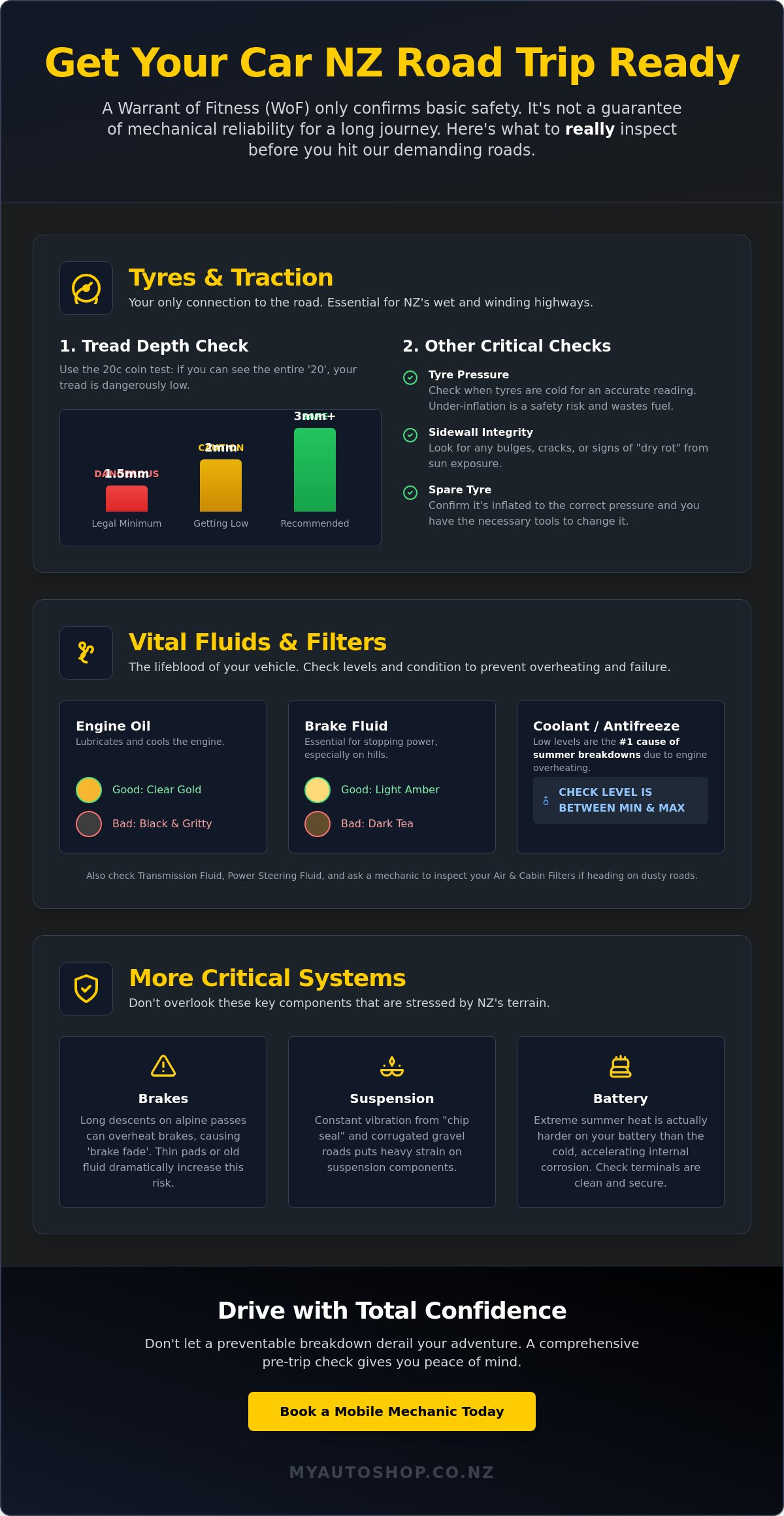
Your tyres are the only thing between you and the road. Check your tread depth using the 20c coin test; insert the coin into the tread, and if you can see the whole “20” digit, you have less than 2mm of tread left. While the legal minimum in New Zealand is 1.5mm, we recommend at least 3mm for driving on our famously wet and winding roads. Look closely at the sidewalls for any bulges or “dry rot” cracks caused by UV exposure. Don’t forget to check your spare tyre’s pressure too. Always check pressures when the tyres are cold for an accurate reading, as heat from driving will cause the air inside to expand and give a false high reading.
Vital Fluids and Filters
Think of fluids as the lifeblood of your vehicle. Check your oil, transmission fluid, and power steering levels. Fresh engine oil should be a clear gold or light brown; if it’s black and gritty, it’s lost its lubricating power. Similarly, brake fluid should be a light amber colour. If it looks like dark tea, it has likely absorbed moisture, which leads to dangerous brake fade on steep descents. Low coolant is the number one cause of summer breakdowns because it leads to rapid engine overheating under the load of holiday gear and hilly terrain. If you’re planning to tackle dusty gravel roads, ask your mechanic to check the cabin filter. A clean filter keeps that fine Waikato or Otago dust out of your lungs and ensures your air conditioning works efficiently.
Your battery also deserves a look. Many people think cold weather is the enemy, but extreme heat is actually harder on car batteries as it accelerates internal corrosion and evaporates the liquid electrolyte. If your battery is more than three years old, it’s worth testing before you leave. If you’re unsure about the state of your cooling system or battery health, booking a Comprehensive Service can give you total peace of mind before you hit the road. A radiator flush now is much cheaper than a tow truck later.
Finalise your mechanical audit by testing every exterior light and replacing any streaky wiper blades. Visibility is safety, especially when caught in a sudden West Coast downpour. By systematically preparing your car for a road trip nz, you transition from hoping for a good trip to knowing you’re ready for one.
Choosing Between a Basic Check and a Comprehensive Service
Deciding how much maintenance your car needs before a big trip shouldn’t feel like guesswork. While you can handle some official vehicle safety checks yourself, professional intervention provides a layer of security that a DIY audit can’t match. Preparing your car for a road trip nz requires a strategy based on your vehicle’s age, its service history, and the specific terrain you plan to tackle.
When a Basic Service is Enough
If your car is relatively new or has been serviced within the last six months, a Basic Service is often the perfect choice. This level of care acts as an affordable insurance policy for your holiday. It covers the essentials: an oil and filter change, a check of all fluid levels, and a visual safety inspection of the tyres and brakes. It’s ideal for drivers who stay on top of their maintenance but want professional confirmation that the car is fit for a few hundred kilometres of highway driving without any hidden surprises.
Why Go Comprehensive for a Road Trip?
When you’re planning to cross the 1,000km mark or your vehicle is more than five years old, a Comprehensive Service becomes essential. Long-distance travel puts sustained pressure on components that usually survive short city trips just fine. A deeper inspection looks at spark plugs, fuel filters, and drive belts; parts that can leave you stranded if they fail in a remote area without cell service. It also catches “hidden” issues like leaking CV boots or worn suspension bushings that might not be obvious during a quick visual check but could fail under the load of a fully packed car.
Sometimes, your car tells you it needs professional help before you even open the bonnet. Watch for these red flags as you start preparing your car for a road trip nz:
- Unusual Noises: Squealing or grinding when you apply the brakes or a clicking sound during tight turns.
- Vibrations: A steering wheel that shakes at highway speeds often indicates a need for wheel balancing.
- Fluid Spots: Any fresh puddles on your driveway after the car has been parked overnight.
- Starting Issues: A slow engine crank in the morning usually means your battery is on its last legs.
Investing in a professional eye before you set off removes the anxiety of “what if.” You gain the confidence that your vehicle isn’t just safe for today, but reliable for the entire duration of your Kiwi adventure. This proactive approach is the best way to ensure your holiday memories are about the scenery, not the side of the road.
Safety First: Preparing for Remote NZ Stretches and Emergencies
Driving in New Zealand often means leaving the safety net of city services behind. Once you’re on the Haast Pass or winding through the Coromandel, help can be hours away. Preparing your car for a road trip nz involves more than just a healthy engine; it requires a survival strategy for the unexpected. You need to be self-sufficient when the cell signal drops to zero and the sun goes down.
Visibility and Lights
Visibility is your first line of defence. You can check your brake lights solo by backing up to a garage door or a large window and looking for the red reflection in your rearview mirror. Do the same for your indicators and hazards. In New Zealand, highways are often plagued by large insects that can smear your windscreen in minutes. Top up your washer fluid with a dedicated bug-remover additive to keep your view clear. If your wiper blades feel hard or crunchy to the touch, they’ve likely been damaged by the sun and will smear during a West Coast downpour. Replace them now to avoid a dangerous loss of vision during a sudden storm.
The “Just in Case” Boot Kit
Your boot should contain more than just luggage. Every vehicle needs a functional spare tyre, a jack, and a wheel brace. Check the pressure in your spare before you leave; a flat spare is useless in an emergency. For older vehicles, carrying a one-litre bottle of the correct engine oil is a smart move, as long-distance driving can cause minor oil consumption. Your safety kit should also include:
- High-visibility vest: This is essential if you need to change a tyre on a narrow, winding roadside.
- First-aid kit: Ensure it is stocked with fresh bandages, antiseptic, and any personal medications.
- Jumper leads: A simple tool that can save you from a dead battery in a remote campsite.
- A powerful torch: Always check the batteries or charge level before you pack it.
Don’t forget the logistical safety checks. Ensure your vehicle licensing (rego) and WoF are current for the entire duration of your trip. As of January 2026, annual rego for a private petrol passenger vehicle is approximately $172.97. If yours is due to expire mid-trip, renew it online before you leave. Finally, always carry a physical map or download offline versions. While digital maps are convenient, New Zealand’s mountainous terrain creates frequent “no-service” zones where GPS can fail. If you want a professional to double-check your safety gear and vehicle health, book a Mobile Mechanic to come to your home. It’s the most convenient way to ensure you are preparing your car for a road trip nz correctly before heading into the wilder parts of the country.
Streamlining Your Pre-Trip Maintenance with My Auto Shop
Preparing for a holiday is stressful enough without the added worry of workshop logistics. Between packing the gear and sorting the itinerary, finding time to drop the car at a garage can feel impossible. My Auto Shop was built to remove this friction. We act as your transparent partner, connecting you with the best local expertise so you can focus on the road ahead. Our goal is to ensure that preparing your car for a road trip nz is the easiest part of your holiday planning.
The Convenience of Mobile Mechanics
One of the biggest hurdles to pre-trip maintenance is the time lost sitting in a waiting room or arranging a lift from a workshop. A Mobile Mechanic changes that dynamic completely. Instead of you going to the tools, the tools come to you. This is the ultimate solution for busy parents or professionals prepping for a Friday afternoon getaway. You can have your oil changed and safety systems checked while you finish work or pack the chilly bin at home.
Every technician in our network is a qualified local professional. They arrive with everything needed to perform a high-standard service on-site. This isn’t just about convenience; it’s about quality you can trust. You get a face-to-face explanation of the work performed, stripping away the mystery often found in the automotive industry. It’s professional service delivered with the friendliness of a helpful neighbour, ensuring you feel empowered rather than intimidated by the process.
Booking Made Easy
We value your time as much as your safety. Our digital platform offers a 30-second booking process that bypasses the need for endless phone calls or vague quotes. You get instant access to a national network of vetted workshops and mechanics across New Zealand. Whether you are in a major city or a regional hub, reliable help is only a few clicks away. We prioritize financial clarity, providing upfront pricing so you don’t face any “holiday surprises” when the bill arrives.
Our commitment to openness means you always know where you stand. By bridging the gap between traditional manual labor and modern digital efficiency, we make vehicle health accessible to everyone. Don’t leave your family’s safety to chance or wait until you’re halfway through the Desert Road to wonder about your brake pads. Book your pre-trip service today and drive with total confidence. Preparing your car for a road trip nz has never been this streamlined, leaving you free to enjoy the very best scenery our country has to offer.
Hit the Road with Total Confidence
You’ve mapped out the route and packed the gear. Now it’s time to ensure your vehicle is as ready as you are. Remember that a simple WoF isn’t a substitute for a mechanical audit. By focusing on high-stress points like your cooling system and tyre tread, you avoid the anxiety of a roadside breakdown in the middle of the Southern Alps. Matching your service level to the intensity of your journey ensures that your car handles the unique demands of our coastal ranges and gravel backroads without complaint.
Preparing your car for a road trip nz should be the easiest part of your holiday prep. My Auto Shop removes the guesswork with a vetted network of professional NZ mechanics and transparent, upfront pricing. Whether you need a comprehensive workshop check or the ultimate convenience of a mobile mechanic at your driveway, we have you covered. We strip away the jargon and hidden costs so you can focus on the adventure ahead.
Get your car road-trip ready—Book a service with My Auto Shop today and enjoy the peace of mind that comes with a reliable ride. New Zealand’s best views are waiting for you. Drive safe and enjoy every kilometre of the journey.
Frequently Asked Questions
Is a WOF enough to ensure my car is ready for a road trip?
No, a Warrant of Fitness is not a guarantee of mechanical reliability. It only confirms that your vehicle meets minimum safety standards at the time of inspection. A WoF doesn’t check the health of your engine, cooling system, or clutch. For total peace of mind, professional servicing is the best way of preparing your car for a road trip nz to avoid being stranded.
How far in advance should I book my car service before a holiday?
Aim to book your service at least two weeks before your departure date. This timeframe gives the mechanic enough room to identify any issues and order necessary parts. If you leave it until the day before you head off, you might find yourself stuck in town waiting for a component to arrive from another region while your holiday time ticks away.
What are the most common causes of car breakdowns on NZ road trips?
The most frequent culprits are cooling system failures, flat batteries, and tyre damage. New Zealand’s steep terrain and abrasive chip-seal roads put immense pressure on these specific components. Overheating is especially common during summer as cars struggle with the combined heat of the sun and the effort of climbing alpine passes with a full load of passengers and gear.
Should I check my car battery before a summer road trip?
Absolutely. While many people worry about batteries in winter, summer heat is actually more damaging to the internal components. High temperatures accelerate internal corrosion and can evaporate the liquid electrolyte inside the battery. If your battery is more than three years old, have a professional test its health before you head into remote areas where a jump start is hard to find.
How do I check my tyre tread depth using a 20c coin?
Place a 20c coin into the main tread grooves of your tyre with the number facing you. If you can see the entire “20” digit, your tread is likely less than 2mm deep and needs attention. While the legal minimum is 1.5mm, having more tread is vital for safety on wet, winding Kiwi roads. Check multiple spots across the tyre to ensure it is wearing evenly.
What should I do if my car starts overheating on a steep hill?
Pull over to a safe spot immediately and turn off the engine. Leave the ignition in the “on” position so the electric cooling fans can continue to pull air through the radiator. Never attempt to open the radiator cap while the engine is hot, as pressurized steam can cause severe burns. Wait at least 30 minutes for the system to cool down before checking fluid levels.
Can a mobile mechanic do a full service before I leave?
Yes, a mobile mechanic can complete both Basic and Comprehensive services right in your driveway or at your workplace. This is a highly efficient way of preparing your car for a road trip nz without losing a day at a workshop. They can handle oil changes, filter replacements, and full safety inspections, ensuring your vehicle is trip-ready while you finish packing.
How much oil should I carry in my car for a long trip?
Carrying a one-litre bottle of the correct grade of engine oil is a smart precaution for any long journey. Long-distance driving, especially when climbing hills or towing, can cause even healthy engines to consume a small amount of oil. Having a top-up on hand ensures you won’t have to pay premium prices at a remote petrol station or risk engine damage if the level drops.
Disclaimer
This article provides general information only and should not be relied on as professional mechanical, safety or legal advice. Vehicle requirements and circumstances vary. If you are unsure about your vehicle, have it inspected by a qualified automotive professional.