
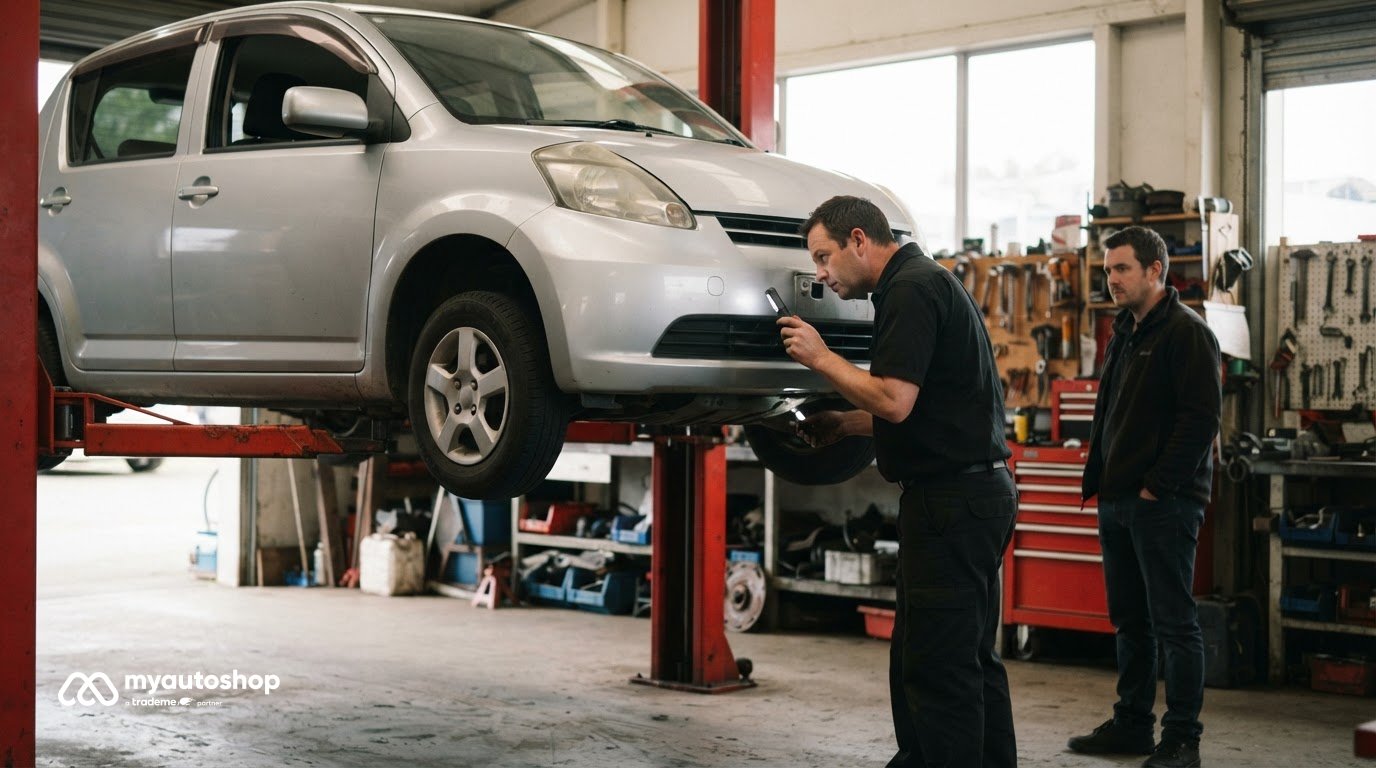
A CVT may be failing if the engine revs without the car picking up speed, the vehicle shudders or accelerates unevenly, or Drive takes longer to engage. Whining noises, a burning smell, fluid under the vehicle or a transmission warning light are also signs of a failing CVT transmission. These symptoms need attention, but only an assessment can identify the cause.
It’s understandable to worry when your car starts behaving differently, especially if the change appears during everyday New Zealand driving. Not every unusual noise or hesitation means the transmission needs replacing, but ignoring worsening symptoms can leave you with a more serious fault.
This guide explains how common CVT symptoms feel and sound, what may cause them, and when to arrange an assessment. You’ll also learn how a mechanic can investigate the issue by checking the transmission fluid, scanning for fault codes and road-testing the vehicle. That can help you describe what’s happening and understand the next steps.
Key Takeaways
- Notice how the car behaves during acceleration and when shifting into Drive or Reverse; changes can help pinpoint a transmission concern.
- Burning smells, fluid leaks and unusual noises can point to overheating or other faults that need prompt attention.
- Incorrect or deteriorated transmission fluid can contribute to CVT problems, so use the fluid type and maintenance schedule specified for your vehicle.
- Warning lights and loss of drive deserve attention; a diagnostic scan can help identify what the vehicle’s systems have detected.
- A professional assessment can help distinguish a fluid or control issue from more serious internal damage and clarify the next step.
Overheating, burning smells and fluid leaks
A burning smell, overheated fluid or fresh fluid beneath the vehicle can point to CVT trouble. Note when the smell or leak appears and whether the vehicle also hesitates or makes unusual noises.
Burnt Fluid Odors
A burnt transmission-fluid smell is acrid and can indicate overheating. CVT fluid may overheat through heavy towing, aggressive driving or deterioration over time. Because heat can affect internal transmission parts, take a new burning smell seriously, even if the vehicle still moves properly. The smell alone doesn’t confirm a CVT fault, as another vehicle problem can cause it too.
Fluid Checks and Leaks
A CVT fluid check assesses the fluid’s level and condition, while a leak check looks for fresh fluid beneath the vehicle. Transmission fluid is typically red to dark red, and a puddle can indicate a serious transmission concern. Some fluid may appear pink, but colour alone doesn’t identify the cause. Don’t assume every red mark is transmission fluid: its source needs to be identified.
CVT failure differs from conventional automatic transmission failure because a CVT uses a belt-connected pulley system rather than a series of fixed gears. Both transmission types can develop fluid or mechanical problems, but symptoms need to be assessed in the context of the vehicle’s transmission design.
To help prevent problems, follow the vehicle manufacturer’s maintenance schedule and use the specified original-equipment-manufacturer fluid. The correct fluid matters: using the wrong type can contribute to CVT failure. Don’t apply a generic service interval to different vehicles. The required fluid and timing depend on the manufacturer’s specifications for the model.
There isn’t one fixed cost for CVT repair or replacement in New Zealand. The amount depends on the fault, vehicle and work required, such as a fluid service, diagnosis or replacement of damaged components. A transmission assessment helps identify the problem before the repair scope and price are determined.
CVT repairs aren’t automatically covered by every vehicle warranty in New Zealand. Coverage depends on the warranty’s terms, the vehicle and the fault. Read the policy for its exclusions and conditions. A transmission problem alone doesn’t establish that a repair is covered.
If a transmission-overheat warning appears, pull over immediately. A leak combined with delayed engagement, jolts or a burning smell needs prompt attention. Avoid driving if symptoms are worsening: low fluid can cause significant CVT damage quickly. Record when the warning or odour began and where you noticed fluid, so you can explain the issue during diagnosis.
Shuddering, slipping and uneven acceleration
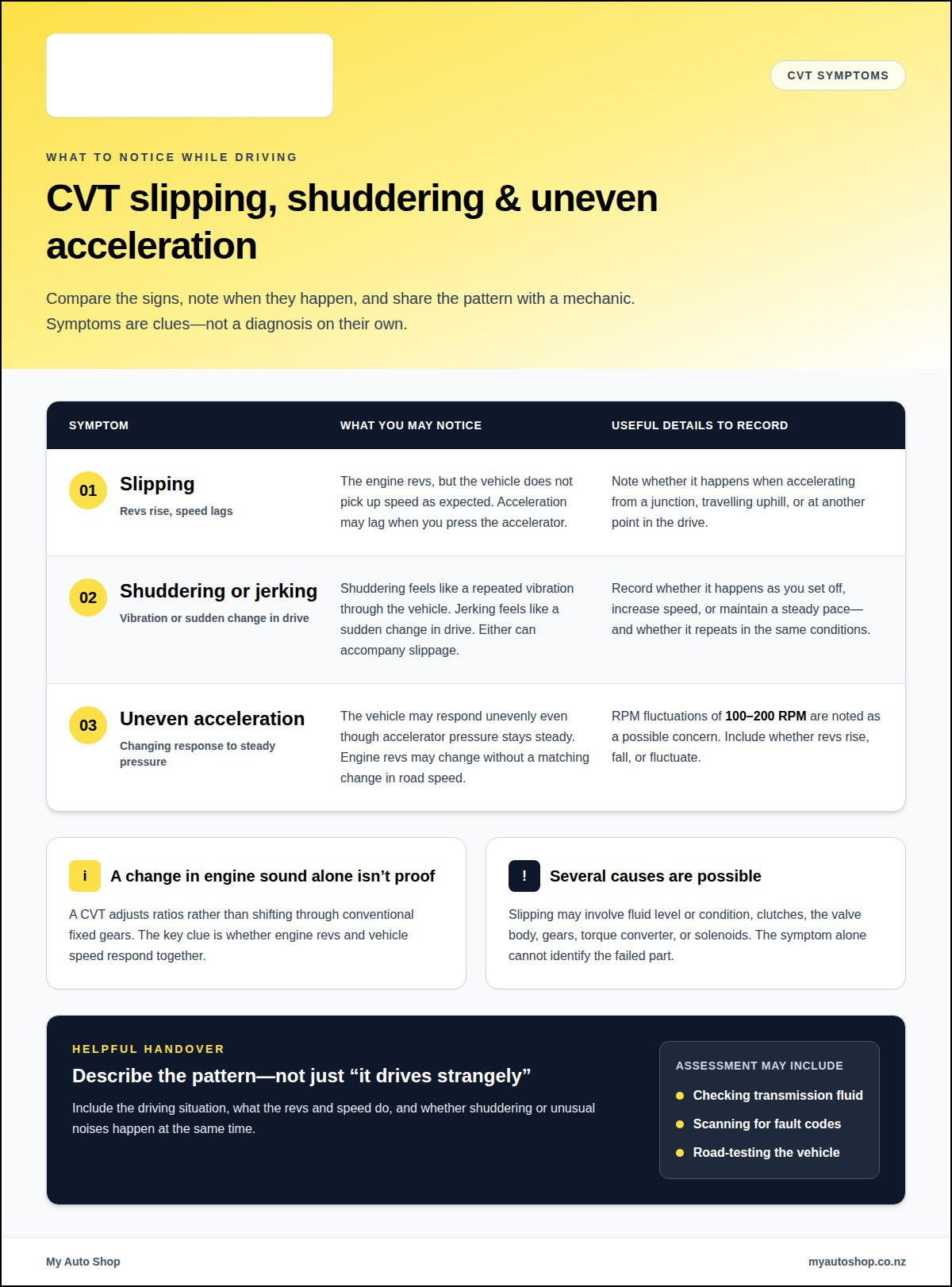
A CVT may be slipping if the engine revs rise but the vehicle’s speed doesn’t increase as expected. Shuddering or uneven acceleration can also point to a transmission fault.
Transmission Slippage and Power Loss
Transmission slippage happens when engine power isn’t transferred smoothly to the wheels. The European Union describes a CVT’s belt-connected pulley mechanism, which can experience friction and slippage. You may notice the engine revving while acceleration lags, especially as you press the accelerator. This mismatch matters because it can make merging or climbing a hill feel less predictable.
Slipping has several possible causes, so the symptom alone can’t identify the failed part. The transmission fluid’s level or condition, clutches, valve body, gears, torque converter or solenoids may be involved. A mechanic can assess these possibilities alongside the vehicle’s symptoms instead of treating every loss of power as the same fault.
Shuddering and Jerking
Shuddering is a repeated vibration through the vehicle, while jerking feels like a sudden change in drive. Either symptom during acceleration can accompany CVT slippage. Note whether vibration happens as you set off, increase speed or maintain a steady pace. This detail helps distinguish a recurring pattern from a single jolt.
Pay attention to how symptoms change over time. For example, record whether shuddering occurs on the same part of a commute or after the vehicle has been travelling for a while. Also note any burning smell or transmission noises, but don’t assume they share one cause. An assessment considers the full pattern.
Uneven Acceleration
Uneven acceleration means the vehicle’s response changes despite steady pressure on the accelerator. The engine may rev higher without a matching increase in road speed, then respond differently moments later. Such RPM fluctuations during steady cruising can be an early warning sign; fluctuations of 100-200 RPM are noted as a possible concern.
When describing the symptom, include the driving situation: accelerating from a junction, travelling uphill or holding a steady pace. Explain whether the engine revs rise, fall or fluctuate, and whether the vehicle shudders at the same time. These observations help a mechanic investigate slippage and power loss more effectively than a vague description such as “it drives strangely”.
A continuously variable transmission adjusts ratios rather than shifting through conventional fixed gears. So a change in engine sound alone doesn’t prove a failure. The key clue is whether revs and vehicle speed respond together. If slipping or jerking is becoming more pronounced, arrange an assessment before the pattern worsens.
Loss of drive and dashboard warning lights
A CVT fault may cause delayed engagement, loss of drive or a dashboard warning. Treat these signs as clues, not a diagnosis on their own.
Loss of Transmission Drive
Loss of drive means the vehicle doesn’t move as expected after you select Drive or Reverse. Engagement that feels slow, or drive that cuts out, can make pulling into traffic or crossing an intersection difficult. A healthy CVT should engage Drive within 1-2 seconds after shifting from Park. A noticeable delay beyond that deserves attention, especially if the vehicle also jolts or loses power.
Note which selector position causes the problem, such as Reverse on a driveway or Drive when leaving a parking space. Record whether the engine revs while the vehicle stays still, or whether it starts moving and then stops. These details can help distinguish an engagement problem from a complete loss of drive. Don’t keep trying to force movement if the vehicle won’t respond reliably.
Overheating and Warning Lights
A transmission-overheat warning means the vehicle has detected a high-temperature condition. Pull over immediately when it appears, as continued driving can add strain while the CVT is hot. Follow the vehicle’s instructions for stopping safely, and note whether the warning clears or returns after the vehicle stops. A recurring alert needs investigation, even if the vehicle seems to drive normally again.
Overheating can occur alongside sluggish response or delayed engagement, but the warning light doesn’t identify the cause by itself. A technician can consider the alert alongside stored fault codes and the vehicle’s symptoms. Share whether the warning appeared during steady driving, acceleration or a hill climb. That context can make the diagnostic check more targeted.
Dashboard Warning Indicators
A transmission warning light or check-engine light may indicate that the vehicle has detected a fault affecting the CVT. An illuminated Overdrive light can also point to hydraulic, electrical or mechanical transmission concerns. If overdrive is unavailable, engine RPM may rise at highway speeds. Note which light appears and whether it stays on or comes and goes.
A dashboard light is a warning sign, not proof that the transmission needs replacing. A technician can connect an OBD-II scanner to read trouble codes stored in the Transmission Control Module. The codes help identify what the vehicle’s systems have detected, but need to be considered alongside how the vehicle drives. Record any change in engagement or speed when the light appears.
For a useful diagnosis, describe the sequence clearly: the selected gear, the warning shown and what happened next. For example, report that the check-engine light appeared before Drive became slow to engage. Mention any separate noises or burning smells, as these observations may help explain the wider fault. Avoid clearing a warning before the codes are read, because the stored information can support diagnosis.
Whining, humming and grinding noises
A new whine, hum or grinding sound can indicate CVT problems, especially if it grows louder as the vehicle accelerates. Note when it happens and how it changes while driving.
Whining and Humming Sounds
A CVT-related whine or hum is a persistent high or low sound that may intensify as the vehicle accelerates. How the sound changes with speed gives technicians a pattern to investigate instead of a general report of “noise”. Note whether it occurs while accelerating, cruising or slowing down. A sound that grows louder with acceleration can indicate a faulty CVT, but it doesn’t identify the cause by itself.
Describe the sound in familiar terms, such as a steady hum or rising whine. Include what the vehicle was doing when you first noticed it, such as accelerating uphill or travelling at a steady speed. If the sound changes between those situations, record the difference. This helps a technician compare the noise with the vehicle’s behaviour during diagnosis.
Grinding and Other Unusual Noises
Grinding is a harsh, rough noise that may point to a serious transmission problem. If it comes from the transmission, or the vehicle enters limp mode or emits smoke, pull over and request a tow. Don’t keep driving to see if the noise disappears. Stopping promptly avoids putting more strain on a vehicle that may no longer respond reliably.
Other unusual noises can include a whine or hum that increases with acceleration. Consider the whole pattern: a new sound paired with slipping or a warning light gives technicians more context than sound alone. Note whether the noise occurs during one manoeuvre, such as reversing from a parking space, or continues throughout a drive. Don’t assume replacement is needed before diagnosis.
To make your description useful, focus on what you can observe rather than guessing about internal damage. Record whether the sound is continuous or intermittent, whether it changes as speed rises, and whether it happens in Drive or Reverse. For example, “a hum starts during acceleration and gets louder as speed increases” is clearer than “the gearbox sounds wrong”. Don’t try to reproduce a grinding noise by driving further.
During diagnosis, technicians can consider the reported sound alongside fluid condition, fault codes and a road test. Each check provides different information: fluid condition may reveal a maintenance issue, codes can show detected faults, and a road test helps assess how the sound relates to driving. No single noise description establishes that the transmission needs repair or replacement.
Pay attention to changes, not just volume. A whine that becomes grinding, or a new sound accompanied by loss of drive, calls for urgent attention. If there’s smoke, limp mode or transmission grinding, stop driving and arrange a tow. For a quieter whine or hum that intensifies with acceleration, arrange an assessment and share the specific conditions you noticed.
Common causes of CVT failure
CVT problems can begin with fluid, heat or internal component faults. Symptoms overlap, so a familiar sign won’t reveal the failed part. Understanding what changed before the fault appeared can help narrow down possible causes.
Fluid-related problems: Using the incorrect transmission-fluid type can contribute to failure. Fluid deterioration can also reduce its ability to protect the transmission. A previous fluid change, a leak or a recent change in vehicle behaviour may provide useful context. Don’t assume that adding fluid alone will resolve the underlying problem.
Heat and operating demands: Aggressive driving and heavy towing loads can contribute to CVT fluid overheating. Fluid deterioration over time can also increase the risk. If symptoms began during or after towing, mention that history during the assessment. It can help distinguish a problem linked to operating conditions from one that developed without an obvious change in use.
Internal component faults: Slipping can involve the valve body, solenoids, clutches, gears or torque converter. In a CVT, friction or slippage can also affect belt-and-pulley operation. These causes can produce similar symptoms, so a single jolt or change in engine revs can’t identify the responsible component.
Causes can interact. For example, a leak may reduce fluid level, while heat can affect fluid condition and transmission operation. When several symptoms appear together, describe their sequence instead of treating each as a separate fault. Note whether a noise came before slipping or a warning appeared after the vehicle began behaving differently.
A diagnostic assessment can combine fluid-condition checks, fault-code scanning and a road test. Each result adds evidence, but a code alone doesn’t prove that a particular part has failed. The vehicle’s symptoms and history help technicians interpret the findings and distinguish a fluid concern from a control or mechanical fault.
Share relevant history, including when the symptoms started, any recent fluid work, towing or changes in how the vehicle was driven. This gives the assessment useful context without assuming a cause in advance. The findings can then guide the next repair decision instead of jumping straight to transmission replacement, though if major repairs prove uneconomical, getting in touch with an automotive dealership like MyCar can provide guidance on affordable replacement vehicle options.
My Auto Shop
My Auto Shop can help you consider the next step when a vehicle needs attention. A Basic Service or Comprehensive Service may suit general maintenance needs. For mobile servicing or repairs, Turners Service & Repairs is the provider, operating in selected New Zealand regions.
Describe the issue you’ve noticed, such as delayed engagement, unusual noises or a warning light. Clear details help explain what’s happening and what kind of assistance you need. A routine service isn’t a substitute for investigating a suspected CVT fault; the cause needs to be assessed.
If you’d like help with your next step, contact My Auto Shop.
Plan your next step with confidence
If a transmission concern affects how reliably you can use your car, plan your next trip rather than waiting for a breakdown to dictate it. An assessment can clarify repair options and help you decide how to manage the vehicle. In cases where major repairs outweigh the vehicle’s value, replacing it with a dependable vehicle becomes a practical alternative, and drivers can explore pre-owned inventory through dealerships like anycreditautosales.net. If it’s your main transport, consider how you’ll get around while the issue is investigated.
My Auto Shop offers Basic Service and Comprehensive Service for general vehicle care, plus a Pre-purchase Inspection if you’re considering a used car. These options suit different needs; a routine service isn’t a substitute for investigating a suspected CVT fault. The signs of a failing CVT transmission can raise questions about your car’s condition, but a diagnosis gives you a clearer basis for deciding what to do next.
Get help planning your next step with My Auto Shop. With a clearer picture of the vehicle’s condition, you can make a more informed plan.
Frequently Asked Questions
How to Diagnose CVT Transmission Issues?
Diagnose CVT issues by combining the vehicle’s symptoms with mechanical checks, fault codes and a road test. Describe when the problem occurs, such as after a cold start or during a hill climb, and note any dashboard warning. A technician can assess fluid condition, scan for codes and compare the results with the vehicle’s behaviour. This helps distinguish a transmission fault from symptoms caused elsewhere.
Is It Safe to Drive with a Failing CVT?
Driving with worsening CVT symptoms can become unsafe if the vehicle hesitates, loses drive or responds unpredictably. Delayed movement when pulling away may affect how confidently you can join traffic, while slipping can make acceleration unreliable. Avoid a long trip if the vehicle’s behaviour is changing. Arrange an assessment and choose another way to travel if you can’t rely on the car to respond consistently.
When You Should Stop Driving Immediately?
Pull over immediately if a transmission-overheat warning appears. Stop driving and request a tow if the vehicle enters limp mode, emits smoke or makes grinding transmission noises. Choose a safe place to stop, then follow the vehicle’s instructions. Don’t continue the journey while these warning signs are present: the vehicle may not respond reliably, and continued operation can add strain.
What are the most common signs of a failing CVT transmission?
Common warning signs include delayed engagement, shuddering, slipping, uneven acceleration, unusual whining or grinding, fluid beneath the vehicle, and a transmission or check-engine warning light. Notice whether several symptoms occur together. For example, delayed engagement in Drive alongside a new whine gives a mechanic more useful context than either detail alone. Record what changed and under which driving conditions.
What noises indicate a CVT transmission problem?
Whining, humming or grinding that grows louder as the vehicle accelerates can indicate a CVT problem. Notice whether the noise starts at a particular point, continues at a steady speed or changes when you slow down. Harsh grinding needs urgent attention, especially if the vehicle also enters limp mode or emits smoke. Don’t keep driving to reproduce the noise.
Can CVT shuddering, slipping, or delayed acceleration mean the transmission is failing?
Yes, shuddering, slipping or delayed acceleration can be symptoms of a CVT fault, but they don’t identify the cause by themselves. For example, engine RPM rising without a matching increase in road speed suggests slipping. Note whether the symptom happens when pulling away, climbing a hill or accelerating onto a faster road. This context helps a mechanic assess the fault.
What dashboard warning lights indicate a CVT fault?
A transmission warning light or check-engine light may indicate a detected fault in the CVT system. An illuminated Overdrive light can also point to hydraulic, electrical or mechanical transmission concerns. Note the exact light and whether it stays on or reappears after restarting. A diagnostic scan can retrieve trouble codes from the Transmission Control Module, helping a technician investigate what triggered the warning.
What causes CVT transmissions to fail, and how long do they usually last?
Incorrect transmission fluid, fluid deterioration, overheating and faults in internal components can contribute to CVT failure. Use the fluid specified for the vehicle and follow its manufacturer’s maintenance schedule. There isn’t one lifespan that applies to every CVT: model, maintenance history and driving conditions affect durability. Regular servicing can help address fluid-related concerns, while new symptoms call for diagnosis rather than guessing how much life remains.
Disclaimer
This article provides general information only and should not be relied on as professional mechanical, safety or legal advice. Vehicle requirements and circumstances vary. If you are unsure about your vehicle, have it inspected by a qualified automotive professional.