

You’re standing at the mechanic’s counter, staring at a printout filled with technical codes and tiered labor rates. That sinking feeling in your stomach isn’t just about the car; it’s the fear that you’re paying for things you don’t actually need. Mastering the art of understanding your car repair estimate nz is the best way to replace that anxiety with total confidence.
We know how frustrating it is to feel like you’re speaking a different language just to get your vehicle back on the road. You deserve to know exactly what’s happening under the hood and on your invoice. Our transparent guide breaks down the jargon and explains how New Zealand’s Consumer Guarantees Act protects your wallet. We’ll show you how to read every line item, the crucial difference between a quote and an estimate, and the specific questions that ensure you never pay for unauthorized work. We even cover your legal rights if things go wrong, including how the Disputes Tribunal can now handle claims up to $60,000 as of 2026.
Key Takeaways
- Differentiate between a flexible estimate and a fixed quote to ensure you agree to a price that fits your expectations before work begins.
- Break down your invoice into parts, labor, and consumables to see exactly how your total cost is calculated line-by-line.
- Master the technical jargon for understanding your car repair estimate nz so you can discuss specific repairs with your mechanic like a pro.
- Know your rights under the Consumer Guarantees Act to ensure you receive quality service at a fair, reasonable price every time.
- Learn how to manage “additional damage” calls by understanding which extra repairs are essential for safety and which can be scheduled for later.
Estimate vs. Quote: Knowing the Difference in NZ
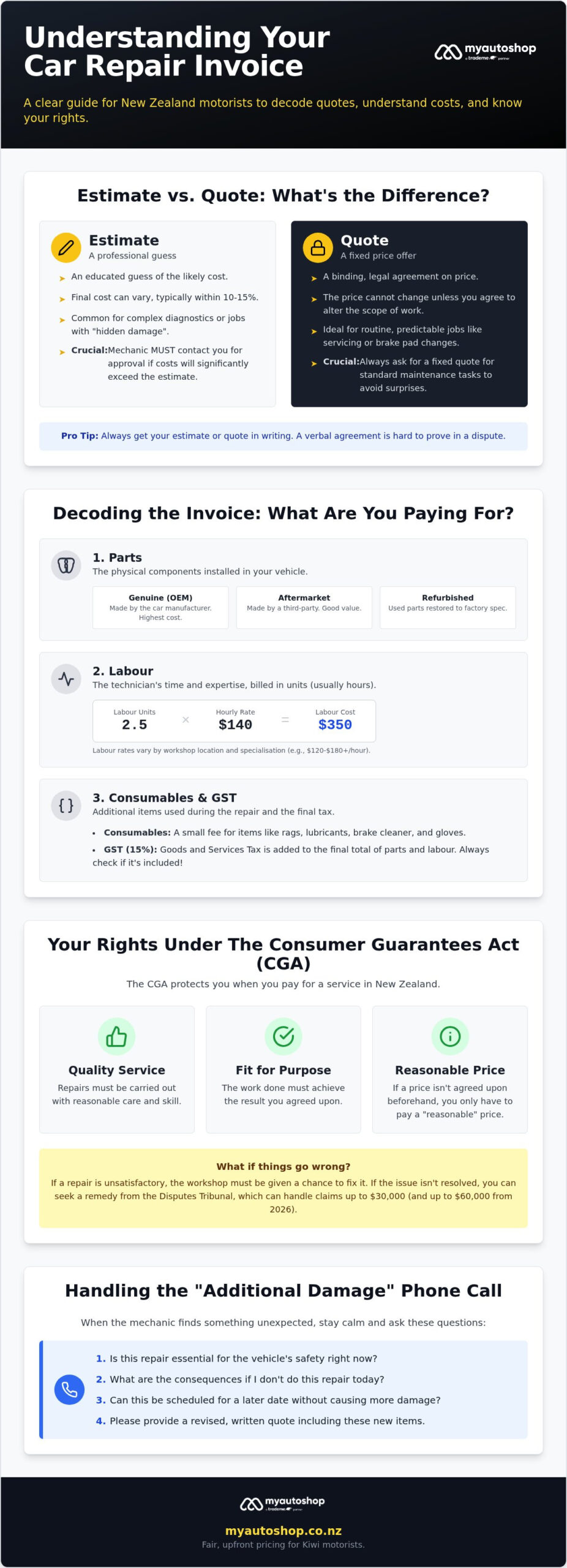
Walk into any Automobile repair shop in New Zealand, and you’ll likely hear two words used interchangeably: “quote” and “estimate.” They aren’t the same thing. A quote is a binding legal agreement. It’s a fixed price for specific work. Once you accept a quote, the mechanic cannot charge you more unless you both agree to change the scope of the job. An estimate, however, is a professional guess. It’s based on an initial inspection and serves as a ballpark figure for the likely cost.
Industry standards in NZ suggest that an estimate should stay within a 10% variance of the final bill. Think of this as a rule of thumb for financial planning. If the final price creeps significantly higher without any prior warning, you have every right to question the invoice. Understanding your car repair estimate nz starts with identifying which document you are holding. Always check the header of your paperwork. If it doesn’t explicitly say “Quote,” treat the total as a flexible number that could shift as the work progresses.
When an Estimate Becomes a Commitment
Don’t view an estimate as a blank cheque for a mechanic to spend your savings. It’s a starting point for clear communication. If a technician discovers that a repair will cost significantly more than the original estimate, they must stop and contact you. They cannot legally proceed with expensive additions without your explicit green light. Always get your estimate in writing. Verbal guesses over the phone are notoriously difficult to prove if a dispute reaches the Tribunal. A written document creates a clear paper trail of your expectations and the agreed-upon limits.
Why Estimates are Common for Mechanical Repairs
Some automotive jobs are inherently unpredictable. When you book a Clutch Replacement or a CV Joint & Boot Repair, the mechanic often cannot see the full extent of the wear until they disassemble the vehicle. This “hidden damage” is exactly why estimates are the standard for complex mechanical work. For example, during a Cambelt / Timing Belt Replacement, a mechanic might find a leaking water pump that wasn’t visible during the initial check. Because this requires extra parts and labor, the initial estimate will change.
Diagnostic fees also play a role in this process. You might pay for an hour of labor just to find the root cause of a mystery engine knock. Once the mechanic identifies the problem, the estimate becomes much more accurate. For routine, predictable tasks like a Basic Service or a Brake Pad Replacement, skip the guesswork and ask for a fixed quote. These jobs have standard labor times, and a transparent provider should be able to give you a set price before you hand over the keys.
Decoding the Line Items: Parts, Labour, and Consumables
Most Kiwi drivers feel a bit lost when they look at a car repair invoice. It’s usually divided into three core pillars: parts, labour, and consumables. Mastering these categories is the secret to understanding your car repair estimate nz without the stress. Parts are the physical items, like a new radiator or air filter. Labour covers the technician’s time and expertise. Consumables are the small but necessary essentials like shop rags, brake cleaner, and specialized lubricants. These are the items that don’t have a unique part number but are used up during the repair. Finally, remember that New Zealand’s 15% GST is often added at the very bottom of the page. An estimate might look significantly lower than the final bill if you forget to account for that tax.
Understanding Labour Rates and Units
Mechanics don’t just guess how long a job takes. Most workshops use “flat rate” manuals. These guides tell the mechanic that a specific job, like a Brake Pad Replacement, should take a set amount of time based on industry data. A labour unit typically represents one hour of work. Rates vary significantly across the country. For example, a specialist dealership in Auckland might charge $180 per hour, while a general workshop in a smaller town might be closer to $120. This difference reflects their specialized diagnostic tools, overheads, and brand-specific training. If a job is estimated at two units, you’re paying for two hours of that workshop’s specific rate.
New vs. Aftermarket Parts
You have choices regarding the components used for your repair. Genuine (OEM) parts come from your car’s manufacturer. They are the exact parts used on the assembly line when your vehicle was new. Aftermarket parts are made by third-party companies and are usually more budget-friendly. You might also see refurbished or “reman” parts, which are used components that have been restored to factory standards. For many common repairs, high-quality aftermarket options are excellent. Sticking to OEM is often better for sensitive electronics or complex engine sensors.
Following Consumer Protection guidance on car repairs ensures you know your rights regarding part quality and service standards. My Auto Shop uses actual part pricing to keep estimates fair and accurate. If you want a clear look at your costs, book a Comprehensive Service online to see your specific breakdown and avoid any surprises at the counter.
Dealing with ‘Additional Damage’ and Extra Costs
It happens to the best of us. You drop your car off for a routine check, and an hour later, your phone buzzes. The mechanic found “additional damage.” This is the number one fear for most Kiwi drivers, but it doesn’t have to lead to a blank check. Understanding your car repair estimate nz means knowing how to handle these mid-repair discoveries with a cool head. Most of the time, these findings are genuine results of disassembling the vehicle. You just need a consistent process to validate them before spending your hard-earned money.
The “While We Are In There” Logic
Sometimes, a mechanic suggests extra work because it saves you money on labour in the long run. This is often called “overlapping labour.” For example, if you book a Cambelt / Timing Belt Replacement, the technician already has the front of the engine stripped down. Replacing the water pump at the same time might only add the cost of the part and ten minutes of work. If that pump fails next month, you’ll pay the full labour cost to strip the engine all over again. It’s a frustrating but logical part of vehicle maintenance.
You’ll see similar logic during a Clutch Replacement. While the gearbox is out, it’s common practice to replace the rear main seal. It’s a small part that sits behind the flywheel and is otherwise impossible to reach. To make a smart choice, ask the mechanic to categorize the repair. Is it an “urgent safety” issue that makes the car unroadworthy? Or is it “preventative” maintenance that can wait until your next pay cycle? Distinguishing between these two categories helps you stay in control of your budget.
How to Respond to Unexpected Repair Needs
Don’t feel pressured to give an immediate “yes” over the phone. Use this checklist to validate the request. First, ask for photos or a short video of the identified fault. Most modern workshops are happy to text these to you. Second, request a revised written estimate that includes the new parts and labour. Third, ask how many extra “labour units” the new job adds to the total. Finally, tell the workshop you want to see the old, damaged parts when you collect the car. A transparent mechanic will have no problem showing you exactly what went wrong.
You have clear protections under the Consumer Guarantees Act 1993. This law ensures that services are provided with reasonable care and skill. If a mechanic performs unauthorized work and tries to charge you for it, they are likely in breach of these regulations. You have the right to say no to any non-safety repairs that fall outside your current budget. By staying informed and asking for evidence, you turn a stressful phone call into a transparent business transaction.
Your Rights Under the Consumer Guarantees Act (CGA)
The Consumer Guarantees Act (CGA) is your ultimate safety net when dealing with automotive workshops. It mandates that every service must be provided with reasonable care and skill. This isn’t just a professional courtesy; it’s a legal requirement. If a repair fails shortly after you leave the shop, the mechanic is obligated to fix the issue at no extra cost. Understanding your car repair estimate nz involves knowing that these protections are non-negotiable. You cannot be contracted out of your CGA rights, regardless of what a disclaimer on an invoice might say.
Pricing is also covered under this legislation. If you didn’t agree on a specific price before the work began, the law states you only have to pay a “reasonable price.” This is determined by looking at the standard market rate for that specific job in your region. If a workshop tries to charge $400 for a Battery Replacement that typically costs half that amount, they may be in breach of the Act. You are only legally required to pay what is fair and standard for the industry.
The Role of the MTA in New Zealand
Looking for the blue MTA badge is one of the smartest things a driver can do. MTA members must adhere to a strict code of ethics that prioritizes honesty and professional standards. If a dispute arises over the quality of a CV Joint & Boot Repair or an unexpected bill, the MTA provides a dedicated mediation service. This helps you resolve issues without the stress of a formal court hearing. My Auto Shop only partners with MTA-approved workshops to ensure every customer receives this extra layer of protection and accountability.
What to Do if the Final Bill Exceeds the Estimate
An estimate is a professional guess, but it shouldn’t be wildly inaccurate. If your final bill is significantly higher than the estimate without any prior communication, you have the right to challenge it. Use a direct script like this: “This total is significantly higher than the written estimate we agreed upon. Can you walk me through why I wasn’t contacted for approval before this extra work was carried out?” This forces a conversation about transparency and helps negotiate a fair resolution.
Be aware that mechanics have a legal right known as a “possessory lien.” This allows them to keep your vehicle until the bill is paid in full. If you have a genuine dispute, the best path is often to pay the bill “under protest.” This gets your car back on the road while you take the matter to the Disputes Tribunal to recover the overcharged amount. If you want the peace of mind that comes with vetted professionals and upfront pricing, book a Comprehensive Service through My Auto Shop to ensure your rights are always protected.
How My Auto Shop Ensures Fair, Upfront Pricing
The primary goal of My Auto Shop is to bring total transparency to the New Zealand automotive industry. Understanding your car repair estimate nz shouldn’t require a mechanical engineering degree. Our platform acts as a bridge between you and a network of trusted professionals, ensuring every interaction is based on clear data rather than vague guesses. We’ve digitized the traditional workshop experience to eliminate the price shock that often occurs at the service desk. By standardizing how repairs are quoted, we put the power back in the hands of the driver.
Our technology calculates upfront, car-specific quotes based on your vehicle’s make, model, and the manufacturer’s recommended labor times. This means you see a fixed price for standard jobs like a Brake Pad Replacement or a Basic Service before you even book. If a mechanic finds extra work during a Comprehensive Service, our in-house team of experts reviews the recommendation. We validate the parts and labor required to ensure the suggestion is fair and necessary for your safety. You can also easily compare ratings and locations of MTA-approved mechanics across the country. This national network gives you the freedom to choose based on quality and proximity within a single interface.
No More “Mechanical Jargon” Stress
Stop worrying about technical terms you don’t understand. Our platform translates complex mechanical needs into simple, actionable choices. If you’re still unsure, our local support team is available to answer your technical questions in plain English. We ensure that pricing is tailored specifically to your vehicle’s requirements, whether you drive a common Japanese hatchback or a complex European sedan. This ensures you never pay a “mystery tax” based on your level of mechanical knowledge. Every quote is car-specific, ensuring you only pay for what your vehicle actually needs.
Booking with Confidence
Follow our streamlined 3-step process to get back on the road. First, choose the service your car needs from our extensive list of offerings. Second, pick a time and a local workshop that fits your schedule. Finally, relax while the work is completed. For those with busy lives, we also offer a Mobile Mechanic service that brings the workshop to your driveway or office. This removes the logistical headache of drop-offs and pick-ups entirely. You get the same price transparency and professional standards without leaving your home.
Book your next service or repair through My Auto Shop for total price transparency.
Drive Away with Confidence and Clarity
You now have the tools to navigate the workshop with total confidence. By distinguishing between a fixed quote and a flexible estimate, you’ve already eliminated the biggest source of billing confusion. Remember that your rights under the Consumer Guarantees Act ensure you always receive fair value for skilled work. Mastery of understanding your car repair estimate nz means you never have to feel intimidated by technical jargon or unexpected phone calls again. You’re in the driver’s seat now.
We believe every Kiwi driver deserves total financial clarity. That’s why we only partner with MTA-approved mechanics and provide transparent pricing with no hidden surprises. It’s the reason we’re already trusted by thousands of drivers across the country. Stop guessing what your next service will cost and start booking with certainty. Use our streamlined platform to find a local expert who values your time as much as your safety. It’s the modern way to manage your vehicle maintenance without the traditional stress.
Get an upfront, transparent price for your car repair today. You’re ready to get back on the road with total peace of mind.
Frequently Asked Questions
Is a car repair estimate legally binding in New Zealand?
No, an estimate is not a legally binding fixed price. It serves as a professional guess based on an initial inspection. Unlike a quote, which is a set price for specific work, an estimate can fluctuate as the technician begins the job. However, the Consumer Guarantees Act still requires the final price to be reasonable if no specific cost was agreed upon at the start.
Why is the labour cost on my estimate so much higher than the part cost?
Labour costs reflect the technician’s specialized expertise and the significant overheads of running a modern workshop. You’re paying for expensive diagnostic tools, specialized equipment, and the time required to perform the work safely. In New Zealand, labour typically accounts for 40% to 60% of a total repair bill. A small part can be cheap, but reaching it might require hours of complex disassembly.
What are “consumables” on a car repair bill?
Consumables are the essential shop supplies used during your repair that don’t have unique part numbers. This category includes items like cleaning solvents, grease, rags, and specialized lubricants. Instead of billing you for every individual squirt of cleaner, workshops usually charge a small flat fee. This ensures the technician has the right materials on hand to complete your service to a high standard.
Can a mechanic charge more than the estimated price without telling me?
No, a mechanic must seek your approval before performing extra work that significantly increases the cost. While estimates have a small amount of natural flexibility, usually around 10%, major discoveries require a new conversation. Clear communication is the key to understanding your car repair estimate nz. If you didn’t authorize the work, you have the right to question the additional charges on your final invoice.
Do I have to pay GST on car repairs in NZ?
Yes, all automotive repairs and parts in New Zealand include a 15% Goods and Services Tax (GST). This tax is almost always added to the bottom of your estimate. Always check whether the prices you’re quoted are “GST inclusive” or “GST exclusive.” This prevents a surprise 15% increase when you go to pay the final bill at the counter.
What should I do if I think my car repair estimate is too high?
Ask for a line-by-line breakdown of the parts and the number of labour units assigned to the job. You can also use online platforms to compare the price with other MTA-approved workshops in your area. If a dispute arises after the work is finished, you can contact the Disputes Tribunal. From early 2026, the Tribunal can handle claims for car repairs up to $60,000.
Can I provide my own parts to a mechanic to lower the estimate?
Most workshops prefer to supply their own parts to guarantee the quality and fitment of the repair. If you bring your own components, many mechanics will not provide a warranty on the labour. Some may also increase their hourly rate to cover the lost margin on the parts. Always call ahead to check the workshop’s policy before you buy any parts yourself.
What is a “diagnostic fee” and do I have to pay it?
A diagnostic fee covers the expert time and specialized technology used to find the source of a fault. Modern cars require expensive scanning tools to read engine codes and identify hidden issues. You are paying for the technician’s knowledge and the equipment required to provide an accurate repair plan. This fee is a standard part of understanding your car repair estimate nz and is usually charged as a set labour unit.
Disclaimer
This article provides general information only and should not be relied on as professional mechanical, safety or legal advice. Vehicle requirements and circumstances vary. If you are unsure about your vehicle, have it inspected by a qualified automotive professional.