

With the average price of a new car now exceeding $50,000, your vehicle is likely one of your most valuable assets. Handing over the keys for maintenance is a big step, but the real work starts when you get them back. If you’re feeling unsure about what to do after a major car service, you’re in the right place. It’s common to feel overwhelmed by technical jargon or worried that you’ve been overcharged for work you can’t actually see.
We believe maintenance should be transparent, not a mystery. You deserve to know that your car is safe and that your money was well spent. This guide teaches you how to verify your major service, interpret your mechanic’s report, and protect your investment for the long haul. We’ll give you a clear plan to handle upcoming repairs and show you how to turn a complex invoice into a simple roadmap for future reliability. Let’s move from uncertainty to total confidence in your ride.
Key Takeaways
- Learn why a major service is a deep-dive into your vehicle’s health and how it differs from a standard oil change.
- Follow our 48-hour checklist to understand exactly what to do after a major car service to verify the work and spot potential issues early.
- Decode your mechanic’s “Traffic Light” report to prioritize safety-critical repairs over preventative maintenance with confidence.
- Master the “Monthly Five” maintenance routine to keep your car running smoothly between professional workshop visits.
- Discover how transparent, fixed-price quotes and mobile mechanic services can strip away the anxiety of future vehicle maintenance.
Understanding the “Major” in Your Major Car Service
Think of a major service as a total health overhaul for your vehicle. While a standard visit focuses on the basics, this level of care goes much deeper into the mechanical heart of your car. In New Zealand, most manufacturers recommend this intensive check-up every 24 months or 30,000km. It acts as a “reset button” for your car’s reliability, catching wear and tear that shorter service intervals might miss. By the time you start looking into the details of a motor vehicle service, critical tasks like replacing spark plugs or performing a full coolant flush are already underway. This thoroughness ensures your engine stays efficient and your safety systems remain responsive for the long haul.
Key Differences: Basic vs. Comprehensive vs. Major
Understanding the scope of work helps you appreciate the investment in your vehicle. A Basic Service primarily covers your oil and filter, which keeps the engine lubricated. A Comprehensive Service adds more detailed inspections of your brakes and suspension. A Major Service is the ultimate preventative measure. It often includes replacing your cambelt (timing belt) or transmission fluids. These are safety-critical tasks that prevent catastrophic engine failure. Many Kiwi drivers choose to align this major milestone with their Warrant of Fitness (WOF). This strategy ensures the car is mechanically sound and legally compliant in one go, giving you total peace of mind on the road.
Why the First Few Kilometres Post-Service Matter
The moment you drive away from the workshop is when the new components begin their real-world work. Fresh fluids need a short settling period to circulate through the system, and new filters must establish their flow. You’ll likely notice your car feels more responsive or runs more quietly. This is also when your fuel efficiency should start to improve. The engine is no longer fighting against old, thick oil or clogged air filters. Knowing what to do after a major car service starts with paying attention during this initial drive. It sets the stage for the verification steps we’ll cover next. This ensures that everything from your battery to your brake pads is performing exactly as it should. Your awareness during these first few trips is the best way to validate the work performed by your mechanic.
The 48-Hour Post-Service Checklist: What to Verify
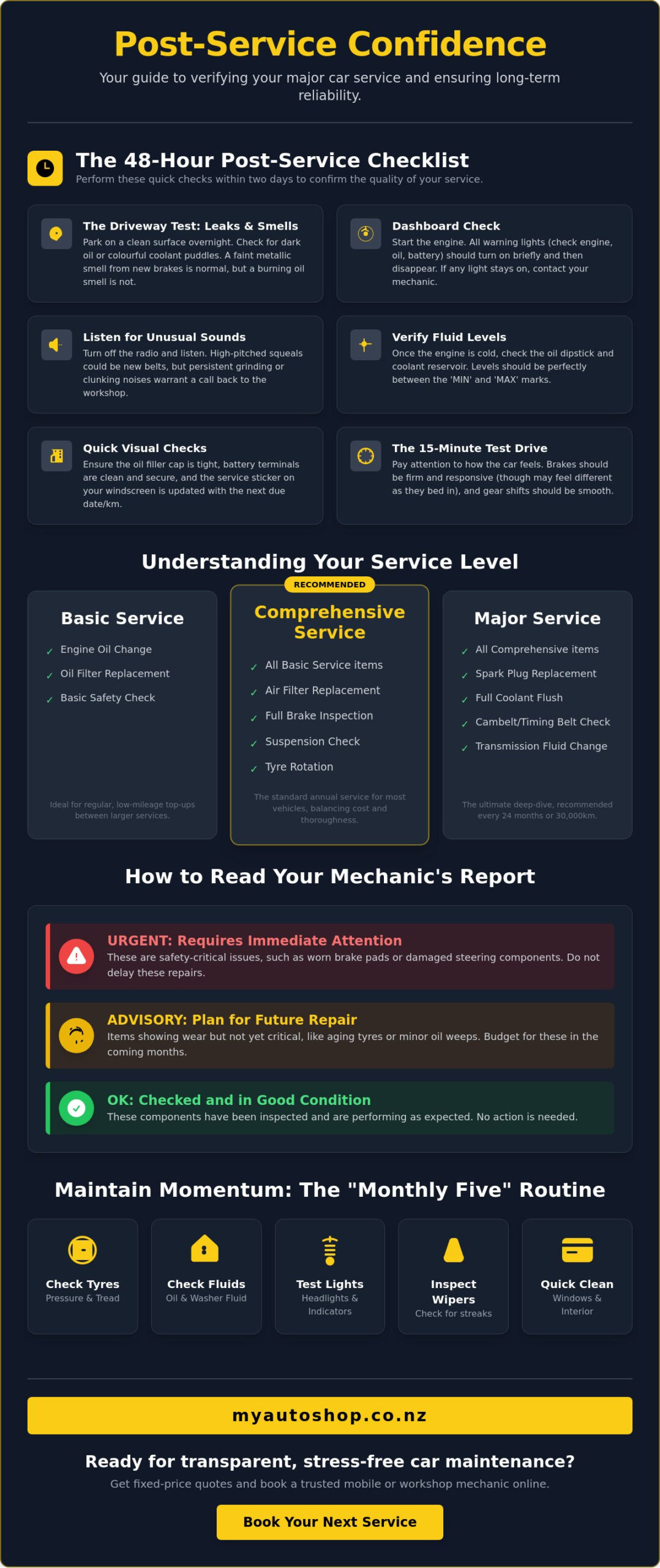
The first two days after picking up your vehicle are the most important for confirming the quality of the work. You aren’t just driving home; you’re performing a vital verification. Knowing what to do after a major car service involves a quick, active inspection to ensure your investment is protected. This short window allows you to spot minor installation errors before they become major mechanical headaches. Set aside ten minutes over the next 48 hours to run through these essential checks.
Start by parking your car on a flat, clean surface overnight. Check the ground beneath the engine bay the following morning. While a major service involves many fluid changes, everything should remain sealed tight. Next, turn your attention to the dashboard. Start the engine and watch the instrument cluster closely. All warning lights should vanish within seconds. If a check engine or oil light persists, the technician might have missed a sensor reset or a deeper issue requires immediate attention. Use your ears as well. Turn off the radio and listen for high-pitched squeals from newly tensioned belts or unusual grinding from fresh brake pads.
Verify your fluid levels once the engine is cold. Pull the oil dipstick, wipe it clean, and reinsert it to check that the level sits exactly between the minimum and maximum marks. Do the same for the coolant reservoir. Finally, take a 15-minute test drive. Pay close attention to how the car handles gear shifts and how the brake pedal feels under your foot. If you recently had a brake pad replacement, the pedal might feel slightly different as the parts bed in, but it should always feel firm and responsive.
Visual Checks Under the Bonnet
Ensure the oil filler cap is twisted on tight and sits perfectly flush against the engine cover to prevent leaks. Check that the battery terminals are clean, free of white corrosion, and that the cables do not move when wiggled. Finally, confirm that the technician updated the service sticker on your windscreen with the correct date and mileage for your next visit.
The “Driveway Test” for Leaks and Smells
Distinguish between harmless clear water from your air conditioning condensation and slippery, dark engine oil. You might notice a faint metallic scent if you have new brakes, which is a normal part of the bedding-in process. However, the thick, acrid smell of burning oil often suggests a spill on the exhaust or a loose seal. If you find a fresh, colourful puddle on your garage floor, contact your mechanic immediately. Following official consumer advice on auto repair helps you understand your rights if the service wasn’t completed to a professional standard.
How to Decipher Your Mechanic’s Report
When you collect your vehicle, the most valuable thing you receive isn’t the keys; it’s the service report. This document is a detailed health check of every major system. Many New Zealand workshops now use a “Traffic Light” system to make this data accessible. A green light means the component is in peak condition. Amber indicates items that are wearing down but don’t require immediate action. Red signals a safety-critical failure that needs fixing right away. Understanding these distinctions is a vital part of what to do after a major car service. It allows you to move past the technical jargon and focus on what actually keeps you safe on the road.
The report often includes specific measurements for high-wear items. You’ll likely see a millimetre reading for your tyre tread depth and a percentage for your brake pads. In NZ, the legal minimum for tyre tread is 1.5mm, but most experts recommend replacing them once they hit 3mm for better wet-weather grip. If your brake pads are at 15% or lower, you’re nearing the end of their lifespan. Don’t forget to check your glovebox for a fresh logbook stamp. This small mark of professional care is essential for maintaining your vehicle’s resale value. It proves to future buyers that you didn’t just do the bare minimum, but invested in high-level maintenance.
Prioritising Recommended Repairs
Not every “Amber” item needs an immediate fix. Focus your budget on safety-critical repairs first, such as your steering, suspension, or a necessary Brake Pad Replacement. These components directly affect your ability to control the car. Treat the report with the same logic you would use during a Pre-purchase Inspection. If a fault would prevent you from buying the car, it’s worth fixing now. For other items, ask your mechanic to help you schedule them over the next three to six months to spread out the costs.
Asking the Right Follow-Up Questions
Clear communication prevents future surprises. Ask your mechanic which brands they used for any replaced parts and confirm the warranty period for the labour. This is also the best time to clarify your next service date. While the sticker on the windscreen gives a general idea, your specific driving habits might mean you need to come back sooner. Finally, always ask for a formal quote on any recommended repairs. This financial clarity ensures you can plan your maintenance budget without any guesswork or hidden fees later on.
Maintaining the Momentum: Care Between Services
Don’t treat your vehicle like a “set and forget” appliance. A major service provides a clean slate, but your daily habits determine how long that reliability lasts. Part of what to do after a major car service involves using your mechanic’s feedback as a 12-month roadmap. This report tells you exactly when components like your air filters or spark plugs will need their next check. By staying proactive, you ensure the high performance you just paid for doesn’t degrade over time.
Perform the “Monthly Five” to catch small issues before they become expensive repairs. Check your oil level, coolant (water), tyre pressure, exterior lights, and wiper blades. While the major service replaced your fluids with high-quality fresh oil, “topping up” over the coming months is just a temporary fix. It doesn’t replace the deep cleaning effect of a full oil and filter change. Fresh fluids are vital for moving heat away from engine components, especially during a hot Kiwi summer.
New Zealand driving is notoriously tough on vehicles. Our mix of high humidity, coastal salt air, and hilly terrain means parts wear faster than in other countries. If you mainly take short trips around town, your engine rarely reaches its optimal operating temperature. This can lead to moisture buildup in the oil. Conversely, frequent open-road driving at 100km/h requires your cooling system to be in top shape. Tailor your checks to your environment. If you live near the coast, wash your undercarriage regularly to prevent salt corrosion on your suspension.
Tyre and Brake Vigilance
Check tyre pressure monthly. This preserves the wheel alignment performed during your service and prevents uneven wear. Keep a close eye on your stopping power. If you notice a high-pitched squeal or a vibrating pedal while descending steep hills, check out these Signs You Need New Brake Pads. Maintaining your tyres and brakes ensures your car remains safe for the family.
Protecting Your Engine and Battery
Cold winter mornings in places like Christchurch or the Central Plateau put immense strain on your electrics. If your engine cranks slowly or the lights seem dim, consult our Car Battery Replacement Guide to see if it’s time for a swap. Keeping your radiator clear of leaves and road debris ensures your cooling system can handle summer heatwaves. If you’re unsure about any “Amber” items on your report, book a mobile mechanic for a quick check-up at your home or office.
Why Book Your Next Service with My Auto Shop?
Now that you’ve mastered what to do after a major car service, you need a partner who makes the entire process simple. My Auto Shop removes the mystery and guesswork from vehicle maintenance. We’ve built a bridge between traditional mechanical expertise and modern digital efficiency. You get instant access to a national network of MTA-assured workshops, ensuring your car is in the best possible hands. Our platform also stores your entire service history digitally. This means you’ll never have to dig through your glovebox for faded receipts or lost logbooks again. It’s organized, honest, and highly competent.
Financial clarity is our signature promise. We offer fixed-price quotes for all our services, ensuring that the price you see on your screen is exactly what you pay at the workshop. This commitment to openness is the ultimate signature of our communication style. If your recent major service report highlighted upcoming needs like a Brake Pad Replacement or a Car Battery Replacement, you can plan those expenses with total confidence. We act as your transparent partner, stripping away the jargon and helping you navigate mechanic reports without the usual anxiety.
Transparent Pricing and Professional Advice
My Auto Shop provides clear, upfront costs for every repair, from a Radiator Repair & Replacement to a Shock Absorber Replacement. This transparency helps you prioritize the “Amber” and “Red” items mentioned in your service report. When it’s time for your next maintenance interval, you can easily book a Comprehensive Service through our streamlined online platform. We give you the professional advice you need to understand which repairs are safety-critical and which can wait, ensuring you always feel empowered rather than intimidated.
Logistical Convenience Across New Zealand
We understand that your life is busy, so we prioritize logistical convenience. If you can’t get your vehicle to a garage, our Mobile Mechanic option brings the expert to you. This is a perfect solution for busy owners who need a Car Battery Replacement or a quick check-up at their home or office. Our online booking system is available 24/7, moving at the speed of a mobile app to fit your schedule. Stop worrying about hidden costs and start enjoying a smoother ride. Book your next car service with My Auto Shop today.
Drive with Total Confidence
Your major service is the most important “reset” your car will ever receive. By following the 48-hour verification checklist and using your mechanic’s report as a roadmap, you’ve already done more than most owners to protect your investment. Remember to keep up with the “Monthly Five” checks and prioritize any safety-critical repairs highlighted in your report. Taking the guesswork out of what to do after a major car service ensures your vehicle stays reliable and holds its value for the long haul.
We make high-quality maintenance simple and stress-free. With our national network of MTA Assured workshops and a 4.8/5 star average customer rating, you’re always in good hands. We provide transparent, upfront pricing with no hidden costs, so you can plan your budget without any surprises. Our platform is designed to put you in the driver’s seat of your own vehicle health.
Book your next comprehensive car service with My Auto Shop and experience a better way to care for your car. We’re here to help you stay safe and keep your engine running smoothly for years to come.
Frequently Asked Questions
Is it normal for my car to smell like burning oil after a major service?
A faint smell of burning oil is often normal for the first few kilometres of driving. This happens if a small amount of oil spills onto the exhaust manifold during a filter change. The residue should burn off quickly. If the acrid smell persists after 48 hours or you see smoke, contact your mechanic immediately to check for a loose seal or a fresh leak.
What should I do if a warning light comes on right after a service?
Pull over safely and check your fluid levels using the dipstick and reservoirs. Sometimes a technician might forget to reset the service light or a sensor connection may be loose. However, a warning light can also signal a genuine mechanical fault. Contact the workshop right away to report the issue. They should prioritize a follow-up check to ensure your vehicle remains safe to drive.
Do I still need a WOF if I just had a major car service?
Yes, you still need a valid Warrant of Fitness (WOF) because a service and a WOF serve different purposes. A major service focuses on the internal health and longevity of your engine. A WOF is a mandatory safety inspection required by New Zealand law to ensure your car is roadworthy. Booking them together is a smart way to handle all your vehicle compliance in one visit.
How long does a major car service typically take to complete?
A major car service usually takes between four and six hours to complete. This timeframe allows the mechanic to perform deep-dive inspections and replace multiple filters and safety-critical fluids. Because it’s more intensive than a basic oil change, you should plan to leave your car at the workshop for the full day. Using a mobile mechanic can sometimes save you the travel time involved in drop-offs.
Can a major service improve my car’s fuel economy?
A major service can definitely improve your fuel efficiency by reducing engine strain. Replacing old spark plugs and clogged air filters allows your engine to breathe and combust fuel more effectively. This is a vital part of what to do after a major car service if you want to lower your running costs. Fresh oil also reduces internal friction, helping your car run as efficiently as possible.
What is the difference between a major service and a timing belt replacement?
A major service is a comprehensive maintenance package that covers fluids, filters, and wide-ranging inspections. A timing belt, or cambelt, replacement is a specific and labor-intensive repair. While a cambelt check is part of a major service, the actual replacement is usually a separate task scheduled every 100,000km. If your mechanic identifies a worn belt during the service, they’ll provide a separate quote for the replacement.
Should I keep the paper receipts from my major service?
You should keep your receipts to build a verified maintenance history for your vehicle. While digital records are becoming the standard, having physical proof of work like a Cambelt / Timing Belt Replacement adds significant value when you sell the car. If you book through a digital platform, your service history is often stored online. This gives you instant access to your records whenever you need to prove your car’s upkeep.
What happens if the mechanic finds more problems during the service?
The mechanic will contact you with a clear explanation and an upfront quote before starting any additional repairs. You have the right to decide which repairs to authorize immediately and which can wait. Use the “Traffic Light” system in your report to prioritize safety-critical items like brakes or steering. This transparency ensures you stay in control of your budget while keeping your car safe on the road.
Disclaimer
This article provides general information only and should not be relied on as professional mechanical, safety or legal advice. Vehicle requirements and circumstances vary. If you are unsure about your vehicle, have it inspected by a qualified automotive professional.