

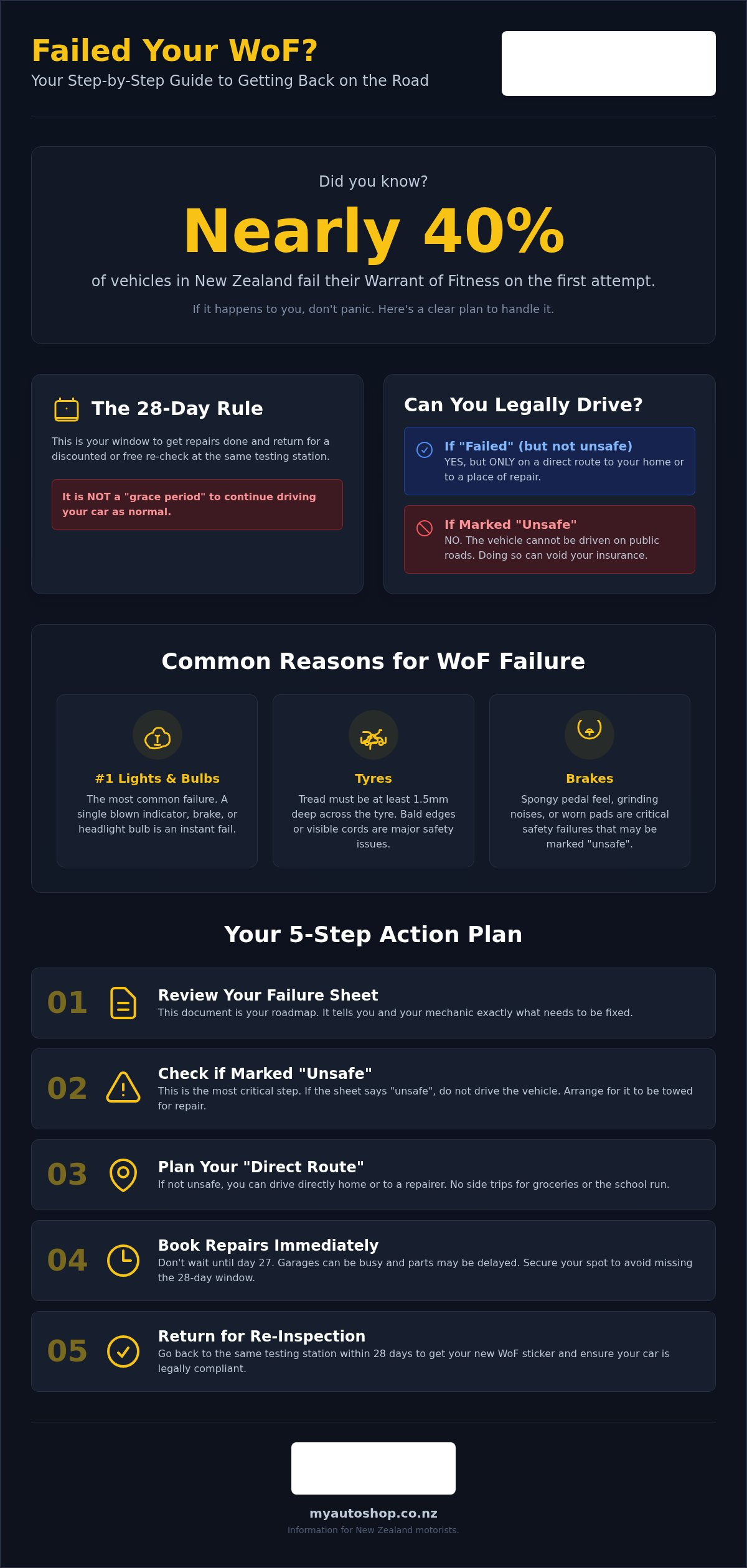
Did you know that nearly 40% of vehicles in New Zealand fail their Warrant of Fitness on the first attempt? If you’ve just been handed a “refused” sheet, you’re certainly not alone. It’s a stressful moment that leaves most drivers worried about repair costs and whether they can legally drive home. Knowing exactly what to do if you fail a wof is the best way to turn that frustration into a simple, manageable plan.
We know you rely on your car to keep your life moving. A fail notice shouldn’t mean a week of logistical headaches or confusing technical jargon. This guide will help you handle the 2026 regulations with total confidence. We promise to clarify the 28-day rule and provide a clear path to getting your repairs finished without the usual stress.
We’ll explain the legalities of driving a failed vehicle, the impact of the upcoming November 2026 regulation changes, and how to handle common issues like brakes or suspension. You’ll finish this article with a step-by-step strategy to get your car compliant and back on the road safely.
Key Takeaways
- Understand the 28-day re-inspection window and the legal difference between a simple “fail” and an “unsafe” vehicle notice.
- Get a clear action plan on what to do if you fail a wof so you can prioritize repairs and stay compliant with 2026 NZTA standards.
- Save time and money by identifying the most common failure points like lighting and tyre tread before you even head to the testing station.
- Learn how to use mobile mechanic services to fix failed items at your driveway, removing the logistical stress of multiple garage trips.
- Follow our 10-minute DIY pre-check strategy to catch easy-to-fix issues and boost your chances of passing on the first go.
Understanding Your Failed WoF: The 28-Day Rule and Driving Legality
Receiving a “refused” Warrant of Fitness (WoF) notice is frustrating, but it doesn’t have to be a disaster. The biggest mistake drivers make is assuming the 28-day re-inspection window is a “grace period” for driving. It isn’t. The 28-day rule is strictly a financial and administrative window. It gives you time to fix the issues and return for a free or discounted re-check at the same testing station. It does not give you a month of legal driving while your car is in a failed state.
If your inspector marks the vehicle as “unsafe,” the rules change instantly. An unsafe label means the vehicle cannot be driven on public roads at all. Driving an unsafe vehicle puts you at risk of immediate fines and can void your insurance policy entirely. In 2026, the NZTA digital system updates your vehicle status the moment the inspector hits “submit.” This means any police officer or automated camera system can see your failed status in real time. Knowing exactly what to do if you fail a wof starts with respecting these digital records.
Can I Drive My Car Home After a Failure?
If your car failed but wasn’t deemed “unsafe,” you can generally drive it home or to a repairer. This is known as the “direct route” exception. You are only permitted to drive the vehicle for the express purpose of getting it repaired or re-inspected. If a police officer stops you, showing them your failure sheet and explaining your route to a mechanic is your best defense. However, if you’re caught using the car for groceries or school runs, you are operating an illegal vehicle. If you’re caught with non-compliant tyres, you face a $350 infringement fee under the 2026 rules. Safety-critical failures like worn brake pads are high-risk. If you have an accident while driving with a known failure, your insurance provider will likely reject your claim.
The 28-Day Re-inspection Window
The 28-day rule is designed to save you money. Most testing stations won’t charge you for a second look if you return within this timeframe. If you miss this deadline by even one day, you’ll have to pay for a brand-new, full inspection. Keep your failure sheet in your glovebox; it’s the specific roadmap your mechanic needs to see. Don’t wait until day 27 to book your repairs. If the garage is full or parts are delayed, you’ll lose your re-inspection discount and risk driving an illegal vehicle. Act fast to keep your costs low and your car legal.
Common Reasons for WoF Failure in New Zealand
Nearly 40% of Kiwi vehicles fail their first inspection. It’s a high number, but many of these issues are predictable and preventable. According to the NZ Transport Agency (NZTA), lighting is the single most common reason for failure. A single blown indicator bulb or a dim headlight can result in a “refused” sticker. It’s the easiest fix on the list, yet it catches thousands of drivers off guard every year. Knowing what to do if you fail a wof for these common issues helps you plan your repairs quickly.
Tyres and brakes follow closely behind. Your tyres must have a minimum tread depth of 1.5mm across the entire width. If they’re bald on the edges or have visible cords, you won’t just fail; you could be fined $350 under 2026 regulations. Brakes are equally critical. If your pedal feels “spongy” or you hear grinding noises, your brake pads are likely below the safety limit. These are often deemed “unsafe” failures, meaning you can’t drive the car away. If you’re stuck with a brake fail, booking brake pad replacement through a mobile mechanic can save you a risky trip to the garage.
NZ roads take a toll on steering and suspension. Potholes and gravel tracks lead to worn shock absorbers and CV joints. If your car pulls to one side or makes a clicking sound when turning, these components are likely failing. Inspectors look for leaks in shocks and torn rubber boots on CV joints. These aren’t just WoF requirements; they’re what keep your car stable at 100km/h and ensure your steering remains responsive in an emergency.
Structural Issues and Rust
Living near the coast is great for the soul but terrible for your car. Salt air accelerates rust, particularly on the undercarriage. While surface rust is usually fine, structural rust is a different story. If the corrosion is within 150mm of a suspension mounting point or a seatbelt anchorage, it’s an automatic fail. In severe cases, you’ll need a specialist certified repair. Don’t ignore small bubbles of rust on the sills, as they often hide deeper structural damage that an inspector will find.
Windscreen and Wiper Safety
Your windscreen is divided into specific zones for testing. The Critical Vision Area (CVA) is the space directly in front of the driver. Any chip larger than 10mm or a crack that enters this zone will cause a failure. Even outside the CVA, large cracks are a no-go. Don’t forget the basics: worn wiper blades that smear water or an empty washer bottle are common, avoidable fail points. Checking these simple items before your booking is the best way to avoid wondering what to do if you fail a wof over a five-dollar bulb or a dry washer bottle.
Your Action Plan: What to Do Immediately After Failing
Failing your inspection is frustrating, but it provides a clear checklist for your car’s health. The first step in knowing what to do if you fail a wof is to stay calm and talk to the person who performed the test. They aren’t just there to hand out “refused” stickers; they’re experts on the NZ Transport Agency (NZTA) WoF regulations. Use their knowledge to your advantage before you even leave the site.
Follow these four steps to get back on the road:
- Review the failure sheet: Ask the inspector to explain every item. If you don’t understand a mechanical term, ask for a plain-English explanation.
- Prioritize ‘Unsafe’ items: These are non-negotiable. If your car has major brake or steering issues, it shouldn’t be driven. Focus your budget here first.
- Get transparent quotes: Use the failure sheet to get specific pricing for repairs. Whether it’s a CV joint or new brake pads, knowing the cost upfront prevents surprises.
- Book the re-check: Don’t leave it until the last minute. Schedule your repairs and your return visit to the inspection center within the 28-day window to avoid paying for a full test again.
Decoding the WoF Failure Sheet
Your failure sheet might look like a mess of codes, but it’s actually quite logical. Look for the difference between a “Fail” and an “Advisory” note. A “Fail” means the car is currently non-compliant and requires immediate attention. An “Advisory” is a friendly heads-up about something that will likely fail soon, like a tyre nearing the 1.5mm limit. Ask the inspector to show you the fault while the car is still on the hoist. Seeing a leaking shock absorber or a frayed seatbelt makes the problem real and helps you explain it to a mechanic later.
Why ‘Inspector Shopping’ Doesn’t Work Anymore
In the past, some drivers would try their luck at a different station if they didn’t like a failure result. Don’t waste your time or money on this. Every failure is now logged instantly in the national NZTA database against your vehicle’s VIN. When you pull into a new station, the inspector sees the existing fail record on their screen. This digital system ensures consistency across New Zealand. It’s much cheaper and safer to simply fix the issues listed on your original sheet rather than paying for multiple inspections that will lead to the same result. Focus on what to do if you fail a wof by tackling the repairs head-on.
Managing Repairs Efficiently: Mobile Mechanics and Booking Platforms
Failing a Warrant of Fitness used to mean a stressful week of phone calls and multiple trips to the garage. You’d have to drop the car off, find a ride to work, and wait for a vague phone call about the bill. Modern booking platforms have changed the game. If you’re stressed about what to do if you fail a wof, the answer is to leverage technology to bring the repair shop to your driveway. This approach strips away the logistical nightmare and puts you back in control of your schedule.
Choosing a professional network like My Auto Shop ensures that every repair meets strict NZTA standards. Whether you need a Brake Pad Replacement or a Shock Absorber Replacement, using a vetted technician means your re-inspection will be a breeze. You’ll get a digital record of the work, which provides the transparency required for a fast pass at the testing station.
The Mobile Mechanic Advantage for WoF Fails
If your vehicle was deemed “unsafe” or has serious safety-critical issues, driving it across town to a workshop is a massive legal and safety risk. A Mobile Mechanic is the smartest solution for these scenarios. They arrive at your home or workplace with all the tools needed to handle common fail items. You can continue your day while a professional handles the heavy lifting. This is the ultimate way to manage a failure without the “double trip” hassle of dropping off and picking up your car from a traditional garage.
Transparent Pricing vs. Garage Guesswork
Financial anxiety is one of the biggest pains of a WoF failure. Never accept a “verbal estimate” from a mechanic. These often lead to hidden costs and “bill shock” when you go to collect your keys. Use a digital platform to compare costs and secure fixed-price quotes for the specific repairs listed on your failure sheet. If your car requires CV Joint & Boot Repair or a Car Battery Replacement, you should know exactly what you’ll pay before the tools even come out. This commitment to openness is what sets modern service providers apart from the old-fashioned, opaque industry standards. Get your car sorted with total clarity and zero guesswork.
Ready to clear that failure sheet? Book a mobile mechanic repair today and get back on the road without the traditional garage stress.
How to Avoid a WoF Failure: The Pre-Inspection Strategy
Instead of scrambling to figure out what to do if you fail a wof, why not stop the failure before it happens? Most first-time fails are for simple, visible issues that take minutes to check at home. Developing a pre-inspection habit keeps you off the “refused” list and saves you the hassle of a return trip to the testing station. It turns a potential half-day ordeal into a quick pass and a fresh sticker. Prevention is always more efficient than a 28-day repair race.
A proactive strategy doesn’t require mechanical expertise. It just requires a bit of attention to detail. By catching the small things early, you avoid the logistical stress of organizing repairs under a deadline. If you do find a minor issue like a blown bulb or a worn wiper, you can sort it on your own terms rather than being forced into an immediate fix after a failed test.
The 10-Minute DIY Checklist
Walk around your car tonight and perform a basic safety sweep. Check every external light, including your indicators, brake lights, and park lights. If you don’t have a helper to stand behind the car, park near a glass storefront or a garage door to see the reflections of your lights. Test your horn; it needs to be loud and clear to pass. Pull every seatbelt out to its full length and let it retract. If the belt is frayed or the retractor is sluggish, it’s an instant fail. Finally, run your hand over the windscreen to feel for new chips or cracks. Catching these early means you can get them repaired before the inspector ever sees them.
Long-term Maintenance for WoF Success
Regular servicing is the backbone of vehicle safety. While a WoF is a safety check at a single point in time, a comprehensive service looks at the long-term health of your car. Inspectors in 2026 are looking closer at advanced safety systems, including warning lights for emergency braking and lane keep assist. A well-maintained engine runs cleaner, ensuring you don’t fail on exhaust or emission standards. Regular oil changes and professional brake inspections catch worn pads or leaking shocks before they become safety hazards. This proactive approach is the most efficient way to manage your car’s life. It ensures that when you do pull into the testing station, you’re doing so with total confidence. Staying ahead of the maintenance curve is the ultimate answer to what to do if you fail a wof because it ensures you simply don’t let it happen in the first place.
Get Your Vehicle Back on the Road with Confidence
A Warrant of Fitness failure is just a temporary setback. By understanding the 28-day rule and the digital tracking systems in place for 2026, you can navigate the repair process without the usual anxiety. You now know that “unsafe” vehicles must stay off the road and that simple DIY checks can prevent future headaches. Keeping your failure sheet as a roadmap and acting quickly ensures you save on re-inspection fees. Knowing what to do if you fail a wof means prioritizing safety while taking advantage of modern, transparent repair options.
Don’t let a “refused” sheet disrupt your schedule. Our national network of certified mechanics is ready to help. Whether you need a mobile mechanic to come to your home or a specific fix like new brake pads, we provide transparent, upfront pricing so you’re never left guessing about the bill. This commitment to openness ensures you get the service you deserve without the traditional garage stress.
Failed your WoF? Book a repair with a trusted mechanic today and enjoy the peace of mind that comes with a safe, compliant car. You’ve got this.
Frequently Asked Questions
Can I drive my car if it has failed its WoF but the old one hasn’t expired?
No, you cannot. A failed inspection notice immediately overrides any existing warrant you have on the windscreen. Once the vehicle is officially “refused” a warrant, it’s legally considered non-compliant. You are only permitted to drive it to a place of repair or back for a re-inspection using the most direct route possible.
Is the 28-day re-check window free at all NZ testing stations?
Free re-checks are common but not a legal requirement for every business. Most large testing chains and many independent garages offer a free or discounted re-inspection if you return within 28 days. Always confirm the specific fee policy with your inspector at the time of the initial failure to avoid any surprises when you return.
What happens if my car fails on rust or structural damage?
Structural rust is a serious failure that often requires specialist attention. If the corrosion is within 150mm of a major mounting point, such as suspension or seatbelt anchorages, it’s an automatic fail. You’ll need to have this repaired by a professional, and in some cases, a specialist repair certificate is required before the car can pass a re-test.
Can I do the repairs myself to pass the WoF re-check?
Yes, you are allowed to perform your own repairs for many common failure items. Simple tasks like replacing a blown indicator bulb or fitting new wiper blades are easy DIY fixes. However, for safety-critical components like brakes or steering, it’s best to use a professional to ensure the work meets the required NZTA safety standards.
How much does a WoF re-inspection cost if I exceed the 28 days?
If you miss the 28-day deadline, you must pay for a full new inspection. This typically costs between $50 and $90 depending on your chosen provider. Because the original inspection record expires after 28 days, the inspector is legally required to check the entire vehicle again rather than just the items that failed previously.
Do I need to bring my failure sheet back for the re-test?
Yes, you should always bring your physical failure checksheet back to the station. While the inspector can access your records through the digital NZTA database, the physical sheet allows them to quickly identify the specific faults that were found. This makes the re-check process much faster and ensures you get back on the road sooner.
What are the most common reasons for WoF failure in 2026?
Blown light bulbs, worn tyres, and brake issues continue to top the list of failures. In 2026, the inclusion of checks for advanced driver-assistance systems means that warning lights for AEB or Lane Keep Assist are also frequent fail points. Keeping your dashboard clear of warning lights is essential for a first-time pass.
Can a mobile mechanic fix my car so it passes the re-inspection?
Absolutely, and this is often the most convenient way to handle what to do if you fail a wof. A mobile mechanic can come to your home or work to replace brake pads, batteries, or CV joints. This ensures your car is fully repaired and safe before you drive it back to the testing station for your final re-check.
Disclaimer
This article provides general information only and should not be relied on as professional mechanical, safety or legal advice. Vehicle requirements and circumstances vary. If you are unsure about your vehicle, have it inspected by a qualified automotive professional.