

Last Tuesday, Sarah was driving, perhaps navigating a steep descent or a busy road, when her steering wheel started vibrating under her grip. It’s a terrifying moment that approximately 18% of Kiwi drivers will experience this year due to worn rotors or pads. We know you value your family’s safety above all else, but the thought of dealing with confusing mechanical jargon or facing an unexpected NZ$600 bill is enough to make anyone anxious. You deserve to know exactly what’s happening under your wheel arches without the stress of the unknown.
In this guide, we’ll help you master the common signs you need new brakes by teaching you what to listen for, feel, and see. You’ll learn to distinguish a minor squeak from a major safety risk so you can stay in control of your car and your budget. We’ve simplified the technical bits into a seven-point checklist you can use in your own driveway today. By the end, you’ll know exactly when it’s time to book a transparent, fixed-price repair that keeps your life moving and your passengers safe.
Key Takeaways
- Identify the difference between a high-pitched squeal and a dangerous metal-on-metal grind before your rotors are damaged.
- Recognize the physical signs you need new brakes, including steering wheel vibrations and a soft, spongy pedal feel.
- Master the 3mm Rule to visually inspect your brake pads through your wheels and ensure your vehicle remains safe for NZ roads.
- Learn how modern wear indicators act as a built-in alarm system to warn you of thinning friction material.
- Find out how to skip the workshop wait with transparent, instant quotes and mobile mechanics who service your car at home or work.
Understanding Your Brakes: How They Warn You of Wear
Brake pads are sacrificial components. They are engineered to wear down over time so your more expensive parts don’t have to. Think of them as the shield for your car’s stopping power. Modern braking systems include a built-in brake wear indicator, which is a small metal tab designed to make a distinct noise once the pad thickness hits a critical level, usually around 3mm. Recognizing these signs you need new brakes early prevents a minor maintenance task from turning into a major mechanical headache.
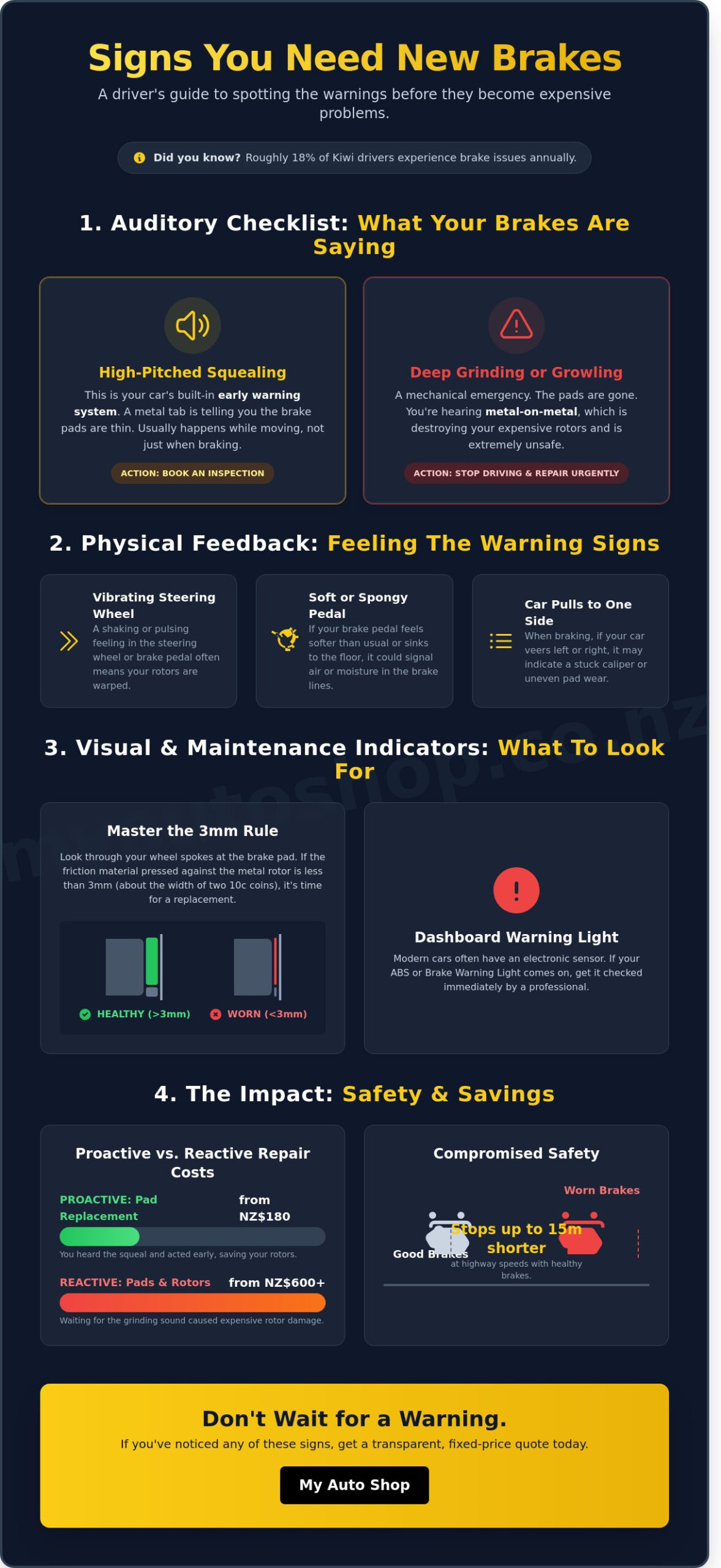
There is a big difference between your pads and your rotors. The pads are the friction material that grips, while the rotors are the heavy metal discs that spin with your wheels. Replacing pads is a standard service task, but ignoring the warning sounds leads to metal-on-metal contact. This contact ruins the rotors, often doubling or tripling your repair bill from a simple NZ$180 service to a NZ$600 overhaul. Being proactive is the most transparent way to keep your car safe without breaking the bank.
The Anatomy of a Stop
Stopping a 1.5-tonne vehicle requires immense pressure. When you press the pedal, brake fluid transfers roughly 800 PSI of force to the calipers. These calipers then squeeze the pads against the rotors to create friction. In New Zealand, our hilly terrain and 12% gradients like those on the Kaimai Range put extra strain on this system. This constant use generates heat exceeding 300°C, which naturally thins the friction material every time you slow down for a corner.
Why Early Awareness Saves Money
Catching wear early protects your wallet and your safety. If you wait until you hear grinding, you have likely damaged the rotors beyond repair, which will fail a WOF inspection instantly. Worn pads also compromise your vehicle’s safety tech. Your Anti-lock Braking System (ABS) relies on consistent friction levels to prevent skidding during an emergency on a slick Auckland motorway. Brake fade is the loss of stopping power due to excessive heat build-up. Monitoring the signs you need new brakes ensures your car can stop up to 15 meters shorter at highway speeds compared to a car with dangerously thin pads.
Auditory Checklist: What Your Brakes Are Saying
Your car uses sound as a primary communication tool. When those sounds shift from a quiet hum to a piercing shriek, it’s time to pay attention. Modern brake pads include a small metal shim called a wear indicator. When your friction material wears down to approximately 3mm, this shim touches the rotor. It creates a high-pitched squeal that acts as one of the most reliable signs you need new brakes before expensive damage occurs.
- High-pitched squealing: This is a deliberate warning. It often happens while the car is moving and may disappear when you actually apply pressure to the pedal.
- Deep grinding or growling: This indicates your pads are completely exhausted. You are now pressing metal against metal, which can scar your rotors beyond repair in under 50 kilometres.
- Rhythmic clicking or rattling: This often points to loose mounting hardware or a rattling brake caliper. It suggests a component isn’t sitting flush or a clip has snapped.
- Loud thumping: Usually felt through the pedal as well, this suggests a warped rotor or an out-of-round rear drum that’s hitting the shoes unevenly.
Squealing vs. Grinding
Distinguishing between these two sounds saves you significant money. A squeal is your early warning system. However, a grind is a mechanical emergency. If you hear grinding, your stopping distance can increase by up to 20 percent. Sometimes, morning dew causes a light layer of surface rust on the rotors, leading to a temporary squeak. This should disappear after your first three or four stops. According to the Car Care Council, any persistent noise requires a professional inspection to ensure your safety on NZ roads.
Identifying Intermittent Noises
Pinpointing the source helps your mechanic diagnose the issue faster. Does the noise happen only when you turn the wheel? That might be a wheel bearing or a sticking caliper rather than the pads themselves. Try the “Window Down” test. Find a quiet side street, roll down your windows, and listen as you brake gently. You can usually tell which specific corner of the car is protesting.
If you aren’t sure what you’re hearing, you can book a brake inspection to get a transparent report. Clear descriptions of these sounds help us ensure your car remains safe and passes its next WOF without surprises. Identifying these signs you need new brakes early prevents a small maintenance task from turning into a major mechanical overhaul.
Physical Feedback: Feeling the Warning Signs
Your car communicates through more than just sound. Sometimes, you feel the problem through your hands and feet before you hear a single squeak. Paying attention to these tactile cues is vital for your safety on NZ roads. These physical sensations are often the most urgent signs you need new brakes, indicating that components have moved past simple wear and into the territory of mechanical failure.
The Shudder and the Pulse
If your steering wheel shakes when you slow down on the motorway, your front rotors are likely the culprit. This shudder happens when brake rotors become warped from excessive heat. New Zealand’s hilly terrain and stop-start city traffic can push rotor temperatures above 300 degrees Celsius. When they cool unevenly, they develop “disc thickness variation.” Even a 0.05mm variation in thickness causes that annoying vibration. This pulsation isn’t just a nuisance; it reduces your stopping power during high-speed emergency stops and puts extra strain on your suspension components.
Pedal Resistance and Travel
A firm brake pedal is a healthy one. If your pedal feels like stepping on a marshmallow or sinks straight to the floor, you have a serious issue. This sponginess often points to air in the hydraulic lines or a brake fluid leak. Brake fluid is hygroscopic, meaning it absorbs moisture over time. In New Zealand’s humid climate, old fluid can boil under pressure. This creates air bubbles that prevent the system from building the necessary pressure to stop your wheels. Just as overheating can affect your braking system, it can also signal wider cooling system issues — understanding whether you need a radiator repair or replacement is equally important for keeping your vehicle safe on NZ roads.
If you ever find yourself needing to pump the pedal to get the car to stop, pull over immediately. It is also a good idea to learn What To Do If Your Brakes Fail to stay safe in an emergency. Another physical red flag is the pulling effect. If the car tugs toward the left or right when you brake, a caliper has likely seized. One brake is working harder than the other, which ruins your car’s alignment under pressure. These are clear signs you need new brakes or a caliper service. Don’t wait for your next WOF to get this checked. A seized component can increase your stopping distance by over 15 percent, which is the difference between a close call and a collision.
- Vibration: Usually indicates warped rotors or uneven pad deposits.
- Sponginess: Signals air in the lines or degraded brake fluid.
- Pulling: Suggests a seized caliper or a collapsed brake hose.
- Pulsating: Often felt through the pedal when the ABS engages prematurely due to mechanical issues.
Visual and Maintenance Indicators
Your ears often catch the first warning, but your eyes provide the proof. Modern alloy wheels make it easy to spot signs you need new brakes without even grabbing a jack. Look through the spokes to find the brake caliper. You’ll see the metal pad backing pressed against the circular rotor. Between them sits the friction material. If this material looks thinner than a couple of stacked NZ$2 coins, you’re approaching the danger zone.
The 3mm Rule is your best guide for safety. While some mechanics suggest waiting longer, 3mm of friction material is the point where heat dissipation drops and stopping distances increase. If your dashboard displays a red “Brake” icon or an amber “ABS” light, your car’s sensors have already detected a problem. Don’t wait for these lights to go out on their own; they won’t. These systems monitor fluid levels and electronic sensors that trigger the moment tolerances are breached.
The DIY Visual Check
Grab a torch and point it at your front wheels. You want to look for three specific red flags that indicate wear:
- Pad Thickness: Aim for at least 3mm of “meat” on the pads. Anything less means a replacement is due soon.
- Rotor Scoring: Look for deep, circular grooves on the shiny metal disc. This indicates debris or worn-out pads are “machining” your rotors, which leads to expensive repairs.
- Fluid Leaks: Check the inside of your tyre and the suspension components for dark, oily patches. This often signals a leaking brake line or caliper seal.
WOF Requirements and Safety
In New Zealand, the Warrant of Fitness (WOF) includes a “rolling road” test to measure braking efficiency and balance. A vehicle must meet specific deceleration targets to pass. However, a WOF is only a snapshot in time. A car can pass with 1.5mm of pad material, which is the legal minimum, but those pads might wear out completely just 1,500 kilometres later.
Most Kiwi drivers only get a WOF every 12 months, leaving a huge gap where safety can degrade. Relying solely on your annual inspection is a risky strategy for your safety and your wallet. Regular servicing between inspections ensures you aren’t driving on the edge of legality. If you’ve noticed a change in how your pedal feels, book a professional brake inspection to get a transparent health report on your vehicle’s stopping power.
Taking Action: Stress-Free Brake Repairs with My Auto Shop
Ignoring the signs you need new brakes isn’t just a safety risk; it’s a financial gamble. We’ve simplified the entire repair process to remove the guesswork and anxiety. You can get an instant quote for your specific vehicle make and model online in under 60 seconds. This means no more waiting for a callback or wondering if you’re being overcharged. Our pricing is transparent and fixed, so the NZ$ amount you see on your screen is exactly what you pay at the end of the day.
We know your schedule is packed. That’s why we offer mobile mechanics who can service your vehicle at your home or office while you get on with your life. If your car needs to head into a workshop for more intensive work, our ‘Pick up & drop off’ service handles all the logistics. We collect your car from your driveway, get the work done by one of NZ’s best mechanics, and return it before you’ve even finished your workday. It’s automotive care designed for the digital age.
Why Choose My Auto Shop for Brakes?
We’ve eliminated the mystery from mechanical work. Our digital platform lets you book a service at any time, day or night, without needing to learn a second language of mechanical jargon. You won’t find any hidden costs or surprise invoices here. Every repair comes with guaranteed workmanship from a network of over 200 vetted Kiwi workshops. If you’re currently shopping for a used car, our professional pre-purchase inspections provide the peace of mind that your potential new ride won’t need an immediate, expensive brake overhaul.
Next Steps for Your Safety
Don’t wait until you hear metal grinding on metal to take action. If you’ve identified two or more signs you need new brakes from our checklist, it’s time to secure your safety. Delaying a simple pad replacement often leads to damaged rotors, which can easily double your repair bill from approximately NZ$180 to over NZ$500. Your safety and your budget are our priorities. Book your brake service with My Auto Shop today and experience the most convenient way to keep your car on the road.
Don’t Wait for the Squeal to Become a Stop
Your car’s braking system is its most vital safety feature. Ignoring high-pitched squeals, steering wheel vibrations, or a spongy pedal puts you and other road users at risk. Most brake pads are manufactured with a small metal shim that emits a warning sound when they reach their final 2mm of thickness. Recognising these signs you need new brakes helps you avoid costly rotor damage and ensures your vehicle remains WOF-compliant on New Zealand roads.
Maintenance shouldn’t be a headache or a guessing game. My Auto Shop connects you with a network of over 2,500 certified mechanics across the country to get you back on the road quickly. We provide 100% transparent, upfront pricing so there are no surprises when the bill arrives. If you’re stuck at the office or home, our signature pick up and drop off service means your day doesn’t have to stop just because your car does. It’s professional mechanical care built around your busy schedule.
Ready to restore your stopping power? Get an instant quote for brake repairs today and enjoy the peace of mind that comes with a safe, reliable ride.
Frequently Asked Questions
Is it safe to drive if my brakes are squeaking?
It’s generally safe for short trips, but a squeaking sound is a clear warning that you should book an inspection immediately. Most brake pads feature a small metal shim called a wear indicator that emits a high pitched squeal when the friction material drops below 2mm. This is one of the most common signs you need new brakes before they reach the dangerous metal on metal stage.
How much does it cost to replace brake pads in New Zealand?
Expect to pay between NZ$150 and NZ$350 per axle for standard passenger cars in New Zealand. This price range covers both the parts and the professional labour required for the fitment. High performance vehicles or heavy 4WDs can cost upwards of NZ$500 per axle. We provide transparent pricing upfront so you know the exact cost before our mechanics start the job.
Can I just replace the brake pads and not the rotors?
You can replace just the pads if your rotors are still above the minimum thickness, which is usually a measurement found stamped on the rotor itself. If your rotors are thinner than the manufacturer’s limit or show signs of warping, new pads won’t function correctly. Our NZ mechanics measure your rotors with micrometers to ensure they have enough life to safely last another 12 months.
How long do brake pads typically last on NZ roads?
Brake pads typically last between 30,000 and 70,000 kilometres on New Zealand roads. If you frequently drive hilly terrain or sit in heavy Auckland traffic, your pads might wear out closer to the 30,000km mark. We recommend a quick visual check of your brake system every 10,000km or during your annual service to track the wear rate accurately.
What happens if I ignore the grinding sound in my brakes?
Ignoring a grinding sound leads to a metal on metal situation that destroys your brake rotors and significantly increases your stopping distance. This grinding is one of the critical signs you need new brakes right now. You’ll likely face a repair bill that jumps from NZ$200 for simple pads to over NZ$600 once you factor in the cost of replacing damaged rotors and calipers.
Will my car fail its WOF if the brake light is on?
Yes, your car will automatically fail its Warrant of Fitness (WOF) if the brake warning light is visible on your dashboard. NZTA safety regulations require all dashboard warning lamps related to the braking system to be functional and clear of faults. This light often triggers when your brake fluid level drops or when sensors detect your pads have less than 1.5mm of material left.
Can a mobile mechanic replace my brakes at my house?
Yes, our mobile mechanics can complete a full brake pad and rotor replacement right in your driveway or at your workplace. We arrive with all the specialized tools and quality parts needed to get you back on the road safely. If your schedule is tight, you can also use our pick up and drop off service to have the work done at a local workshop without leaving your desk.
Disclaimer
This article provides general information only and should not be relied on as professional mechanical, safety or legal advice. Vehicle requirements and circumstances vary. If you are unsure about your vehicle, have it inspected by a qualified automotive professional.