
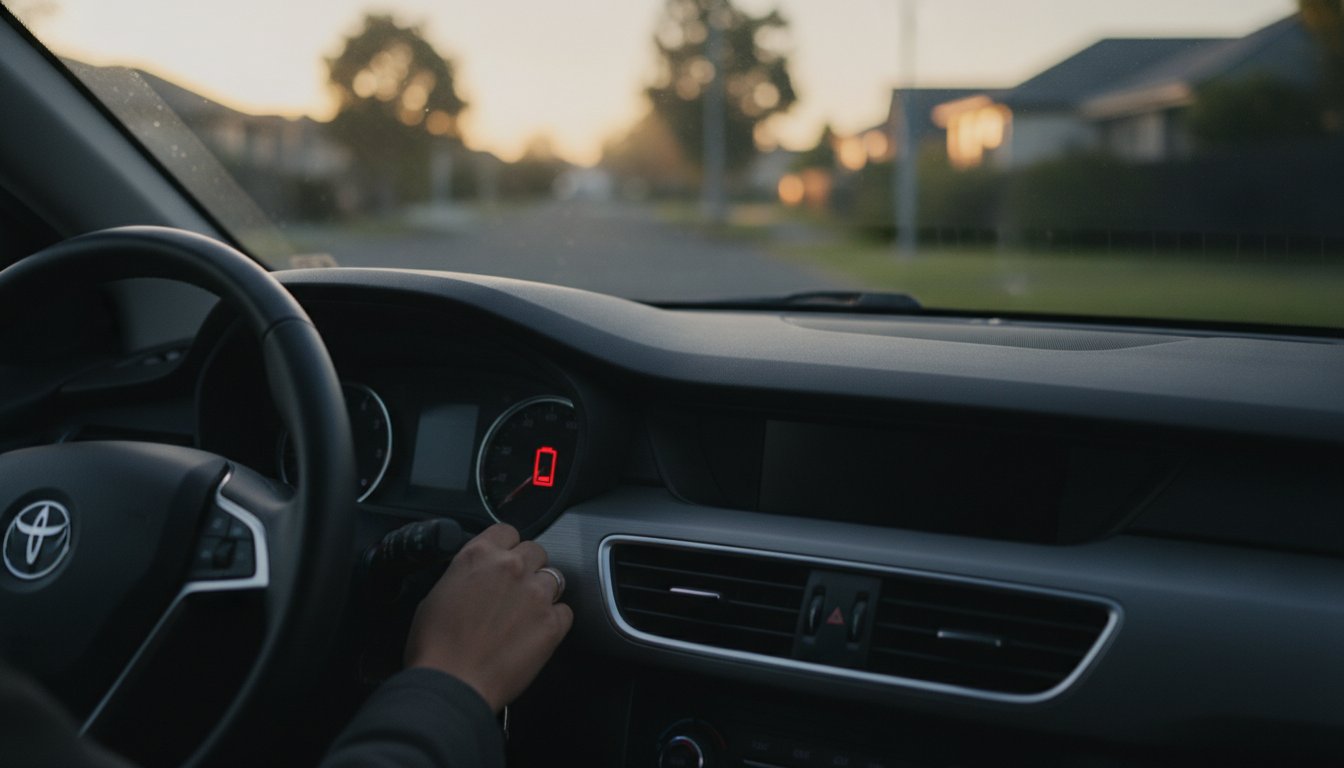
Did you know that battery failure remains the number one cause of vehicle breakdowns in 2026, accounting for 25.9% of all roadside assistance calls? It is a sinking feeling when you turn the key and hear nothing but a click, especially when you have a busy day ahead. You might be staring at a dashboard light and wondering if your car is safe to drive or if you are about to be hit with an unexpected bill. We know you value your time and your safety, and the last thing you need is the anxiety of being stranded on the side of a busy New Zealand road.
This article will help you identify the specific signs your car battery is about to die before it actually leaves you stuck. We will provide expert advice tailored for Kiwi drivers, helping you understand if your battery is simply struggling with the weather or if it is time for a professional car battery replacement. We will preview the seven most common red flags, explain how to tell the difference between battery and alternator issues, and show you a convenient way to get back on the road without ever visiting a workshop.
Key Takeaways
- Learn how to recognize the early warning signs your car battery is about to die, such as a sluggish engine start or strange clicking sounds.
- Discover why modern vehicle features like auto start-stop and dashboard electronics are often the first things to malfunction when a battery weakens.
- Understand how New Zealand’s unique climate and frequent short trips can accelerate battery wear and lead to unexpected failures.
- Master a simple two-minute health check using your headlights to gauge battery strength before you get stuck.
- Find out why professional installation is essential for modern vehicle computers and how to arrange a mobile car battery replacement to save time.
Immediate Red Flags: The Obvious Signs of Battery Failure
Recognizing the early signs your car battery is about to die can save you from a stressful morning on the driveway. Your vehicle often tries to tell you it’s struggling before it gives up completely. Most drivers ignore the subtle warnings until they are left with a car that simply won’t budge. Understanding the basics of your Automotive battery helps you spot these red flags early.
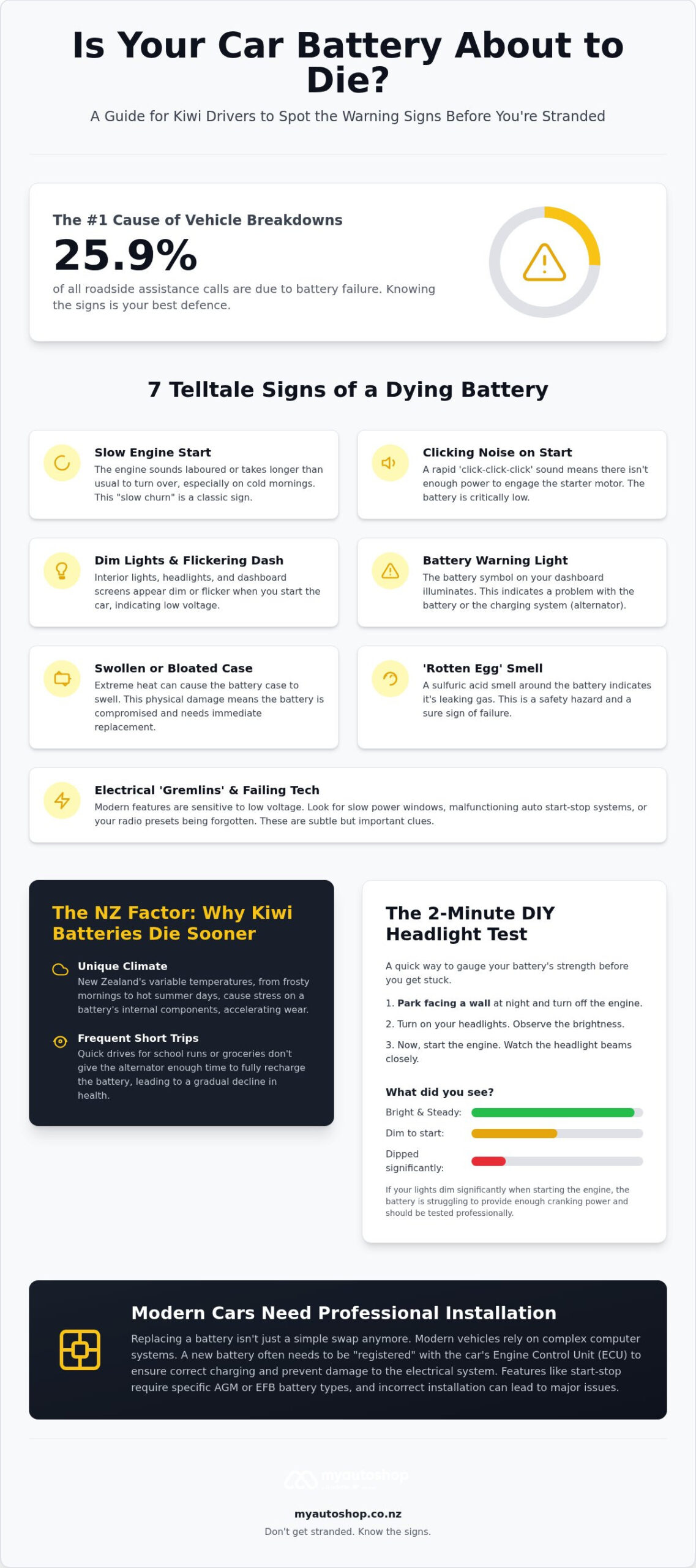
The most common sign is the ‘slow churn.’ This is when the engine sounds laboured, taking several seconds longer than usual to fire up. It’s like the car is dragging its feet. Then there’s the infamous clicking. You turn the key or push the start button, and instead of a roar, you get a rapid-fire ‘click-click-click.’ This happens because there isn’t enough voltage to fully engage the starter motor solenoid. It is a clear signal that the battery can no longer hold the charge required for high-demand tasks.
Keep an eye on your dashboard and headlights. If your interior lights look dim or the dashboard screens flicker when you start the car, your battery is likely gasping for air. Modern cars rely heavily on stable voltage, and these components are the first to show signs of a drop in power. Finally, the battery warning light is your car’s final plea for help. While this light can sometimes indicate an alternator issue, it always means your charging system isn’t working correctly. Don’t wait for it to turn off on its own; it won’t.
The Engine Crank Test
Cold mornings are the ultimate test for any battery. Listen closely when you first start your car after it has sat overnight. If the crank feels sluggish but improves after you’ve driven for twenty minutes, the battery might be ‘recovering’ temporarily as the alternator feeds it. However, this is a false sense of security. Cold Cranking Amps (CCA) represent the amount of current a battery can provide for 30 seconds at -18°C while maintaining a functional voltage level. If your battery’s CCA capacity has dropped, it will eventually fail you when the temperature dips.
Visual and Olfactory Clues Under the Bonnet
Pop the bonnet and use your senses. A distinct ‘rotten egg’ smell usually points to a leaking battery releasing sulfuric gas, which is a significant safety hazard. Look at the terminals for white, ashy, or powdery buildup. This corrosion creates resistance, blocking the flow of electricity to your car’s systems. Also, check the physical shape of the battery. A swollen or bloated battery case is a sign that extreme heat has caused the internal plates to expand, which is a common but silent killer of batteries in New Zealand. If you notice these physical signs your car battery is about to die, it’s time to act before you are stranded.
The Sneaky Symptoms: How Modern Tech Hides Battery Death
In the past, identifying a dying battery was simple because your lights would dim and your horn would sound weak. Today, modern vehicles are equipped with sophisticated Engine Control Units (ECUs) and “smart” alternators that work overtime to hide these flaws. The car’s computer prioritizes essential functions, pushing the charging system to compensate for a failing battery until it finally reaches a total collapse. This technological mask means you might not notice the typical signs your car battery is about to die until the moment your car refuses to start.
One subtle indicator is power window lag. If your windows move up or down slower than they used to, or if they struggle when you try to operate two at once, your battery’s voltage is likely dropping. Modern electronics are extremely sensitive to these fluctuations. When the battery can’t provide a steady flow, the motors in your doors are often the first to lose performance. If you notice these electrical “ghosts,” it is a good idea to book a professional Car Battery Replacement before the issue escalates.
Why Start-Stop Systems are the ‘Canary in the Coal Mine’
If your car features auto start-stop technology, pay close attention to how it behaves at traffic lights. The ECU is programmed to disable this feature if it detects that the battery charge has dropped into its final 20% of life. This is a safety measure to ensure there is always enough power left to crank the engine. If your car suddenly stops “eco-driving” and stays running at every stop, it is one of the seven signs the battery may be on its last legs. Remember that Start-Stop batteries, usually AGM or EFB types, require specific replacement models to function correctly with your car’s charging logic.
Memory Loss and Electronic Gremlins
Modern cars rely on a constant “trickle” of power to maintain digital memories. If you find your radio presets have vanished or your clock has reset after a cold night, your battery is failing to maintain even a basic charge. These electronic gremlins can also affect your central locking, making it feel sluggish or unresponsive. In more advanced vehicles, a weak battery can even cause erratic transmission shifting. Since modern automatic gearboxes rely on precise electrical solenoids, low voltage can lead to “noisy” data signals, causing the car to hunt for gears or shift harshly. These are critical signs your car battery is about to die that many drivers mistake for mechanical transmission problems.
The NZ Factor: Why Kiwi Batteries Die Sooner
New Zealand drivers face a unique set of challenges that can significantly shorten the life of a vehicle’s power source. While we often blame a frosty morning for a car that won’t start, the real damage usually happens months earlier during the Kiwi summer. High temperatures under the bonnet cause the liquid electrolyte inside the battery to evaporate. This process degrades the internal lead plates and weakens the overall structure. When the first cold snap hits, the damaged battery lacks the chemical strength to turn over a cold engine. Recognizing these key warning signs is the first step in avoiding a breakdown during a winter getaway.
Our geography also plays a major role. With much of the population living near the coast, salt-laden air and high humidity are constant factors. This moisture accelerates the oxidation process on battery terminals, leading to that crusty white or blue powder you might see when you pop the bonnet. This buildup acts as an insulator, forcing the battery to work harder to push electricity through the cables. In New Zealand, the realistic expectation for a battery lifespan is between three and five years. If yours is approaching the five-year mark, you are likely on borrowed time.
The Impact of Short-Distance Driving
Modern driving habits in our cities are often the biggest culprit behind premature failure. Many Kiwi cars are used primarily for the “school run” or short commutes to the local shops. Your battery loses a significant amount of energy every time you start the engine. The alternator typically needs about 20 minutes of continuous driving at higher speeds to fully replenish that lost power. Frequent five-minute trips keep the battery in a permanent state of discharge. Over time, this leads to acid stratification, where the chemistry inside the battery becomes unbalanced and permanently reduces its capacity. If you only use your car for weekend errands, consider taking it for a longer run once a week to keep the voltage healthy.
Temperature Fluctuations and Chemistry
The “four seasons in one day” climate we experience puts immense physical stress on lead-acid plates. Constant expansion and contraction due to rapid temperature changes can cause internal components to crack or shed active material. This is one of the most common physical signs your car battery is about to die, even if it looks fine from the outside. Parking in a garage can actually add up to a year to your battery’s life by shielding it from these extreme swings. Don’t be fooled by the “maintenance-free” label on modern units. While you don’t need to top them up with water, they are not indestructible and still require regular checks to ensure they can handle the demands of New Zealand’s variable weather.
The 2-Minute DIY Battery Health Check
You don’t always need to visit a workshop to confirm your suspicions. If you have noticed the subtle signs your car battery is about to die, you can run a few simple tests on your driveway in less than two minutes. These DIY methods help you decide if you need a quick charge or a professional Car Battery Replacement before you get stuck in the supermarket car park. Taking a proactive approach ensures you stay in control of your schedule and your budget.
Start with a simple physical inspection. Pop the bonnet and look for any cracks in the battery casing or a “fuzzy” white buildup around the terminals. This corrosion acts like a wall, preventing electricity from flowing freely into your car’s electrical system. Also, check for the “Magic Eye” on the top of the casing. Many batteries sold in New Zealand feature this built-in hydrometer. A green light usually indicates a healthy state, while a black or clear window suggests the battery is discharged or failing. If the physical signs your car battery is about to die are visible, your next step is a functional test.
Performing the Headlight Test
This is the easiest way to judge your battery’s strength without any special tools. Follow these steps tonight once the sun goes down:
- Step 1: Park facing a wall or garage door and turn on your headlights while the engine is off.
- Step 2: Start the engine and watch the brightness of the beam.
A healthy battery will show a significant brightness surge the moment the engine fires up and the alternator takes over the electrical load. If the lights stay dim or, even worse, get dimmer when you rev the engine, your charging system is failing to keep up. This is a clear indicator that your battery can no longer hold a sufficient buffer of power.
Using a Multi-meter at Home
If you have a multi-meter in the garage, you can get a professional-grade reading in seconds. Set your device to DC voltage and touch the probes to the battery terminals. The magic number you want to see is 12.6V; this indicates a fully charged, healthy battery. If the reading sits at 12.2V, your battery is only operating at about 50% capacity and is likely on its way out. To check the alternator, keep the probes attached while the engine is running. You should see a jump to between 13.5V and 14.5V. Anything lower means the alternator isn’t providing enough juice to recharge the battery while you drive. Always wear gloves and eye protection when working near battery acid to stay safe.
If your DIY tests confirm the battery is failing, don’t risk another trip. You can book a convenient Car Battery Replacement and have a mobile mechanic come to your location to get you sorted without the hassle of a tow truck.
Don’t Get Stranded: Replacing Your Battery the Smart Way
It is tempting to think you can squeeze one more week out of a struggling vehicle. However, the signs your car battery is about to die are usually an urgent countdown rather than a gentle suggestion. Most modern batteries don’t fade away slowly; they crash. This failure almost always happens at the most inconvenient moment, such as a rainy Monday morning or when you are miles from the nearest town. Taking a proactive approach is the only way to stay in control of your schedule and avoid the stress of a dead engine.
Professional fitting is no longer just about turning a wrench. Modern vehicles are essentially computers on wheels, and cutting the power can lead to unexpected complications. In New Zealand, we see many drivers attempt a DIY swap only to find their dashboard lit up like a Christmas tree afterward. Once the job is done, remember that disposing of your old unit responsibly is a legal and environmental priority. Most professional services handle the recycling of lead-acid components for you, ensuring toxic materials stay out of our local landfills.
Why DIY Replacement is Getting Harder
Modern European and Japanese cars often require “Battery Coding” through the Engine Control Unit (ECU). This process tells the car’s charging system that a new unit is installed so it can recalibrate the alternator’s output. If you skip this step, the car might continue to charge the new battery as if it were the old, failing one, significantly shortening its lifespan. There is also the risk of losing critical data, such as steering angle sensor settings or automatic window limits. A professional car battery replacement saves you from accidentally “bricking” your car’s computer or facing expensive resets at a dealership later.
The Convenience of Mobile Service
Why bother with the hassle of a tow truck or a long wait in a workshop waiting room? If you have identified the signs your car battery is about to die, the most efficient solution is to have the expert come to you. A mobile mechanic turns a potential breakdown into a minor blip in your day. You get transparent pricing and know the cost of the unit and labour before the service van even arrives at your home or office. It is a streamlined, digital-first way to handle a traditional mechanical problem. Don’t risk a non-start tomorrow morning. Book a mobile battery replacement with My Auto Shop and let the experts come to you.
Secure Your Journey Before the Next Cold Snap
Understanding the early signs your car battery is about to die gives you the power to avoid a breakdown on your own terms. Whether it is the sluggish engine start on a frosty morning or the strange behavior of your auto start-stop system, these warnings are your car’s way of asking for help. Remember that New Zealand’s variable climate and frequent short trips put unique pressure on your battery’s chemistry, making regular DIY checks a smart habit for every Kiwi driver.
Don’t wait for a complete failure to leave you stranded. You can easily Book Your Car Battery Replacement with My Auto Shop to get back on the road with total confidence. We offer a national network of certified mechanics and transparent, upfront pricing so there are never any surprises. Our mobile mechanics can even come directly to your home or office, saving you time and the cost of a tow truck. Take the stress out of car maintenance and enjoy the peace of mind that comes with a reliable start every single time.
Frequently Asked Questions
How long does a car battery typically last in New Zealand?
A car battery in New Zealand typically lasts between three and five years. This lifespan depends heavily on your driving frequency and local climate conditions. Frequent short trips prevent the alternator from fully recharging the unit, leading to a shorter life. If your battery is over four years old, it is wise to start watching for signs your car battery is about to die to avoid being stranded unexpectedly.
Can a completely dead battery be recharged and used again?
It depends on why the battery is flat. If you left your lights on and the battery is relatively new, a slow charge might bring it back to life. However, if the battery is “dead” because the internal lead plates have degraded over several years, it cannot be revived. In these cases, the battery will no longer hold a charge and requires a full replacement to ensure vehicle reliability.
Why does my car make a clicking sound but won’t start?
That rapid clicking sound usually means your starter motor isn’t receiving enough electrical current to engage. While there is enough power to click the solenoid, there isn’t enough “juice” to actually spin the engine over. This is one of the most common signs your car battery is about to die or has a loose connection at the terminals that is preventing power flow.
Is it the battery or the alternator that is causing my car to fail?
You can often tell by attempting a jump start. If your car starts with a jump and stays running, the battery is likely the culprit. If the car starts but dies shortly after you remove the jumper cables, your alternator probably isn’t charging the system correctly. A professional diagnostic test can confirm whether you need a new battery or an alternator repair.
Can I replace my own car battery in a modern vehicle?
While physically possible, replacing a battery in a modern vehicle is increasingly complex due to electronic systems. Many European and late-model Japanese cars require “battery coding” to update the Engine Control Unit. Without this, the car may not charge the new battery correctly. You also risk losing sensitive data like steering sensor calibrations if the power is cut without using a memory saver.
Does cold weather actually kill car batteries?
Cold weather doesn’t usually “kill” the battery, but it reveals the damage caused by summer heat. Low temperatures thicken the engine oil and slow down the chemical reactions inside the battery, making it harder to start the car. If the battery was already weakened by evaporation during a hot Kiwi summer, the first frosty morning will likely be its last.
How much does a car battery replacement cost in NZ?
The cost of a new battery in New Zealand varies based on the technology your car requires. Standard flooded batteries generally range from $100 to $200, while high-performance AGM or EFB batteries for start-stop vehicles can cost between $200 and $400. Specialized lithium-ion 12V batteries found in some modern cars can be significantly more expensive, often reaching several hundred dollars for the unit alone before installation costs.
What should I do if my battery warning light comes on while driving?
If the battery warning light appears while you are driving, pull over to a safe location as soon as possible. This light indicates that the charging system is no longer powering the vehicle, meaning you are running solely on the remaining battery reserve. Turn off non-essential electronics like the radio and air conditioning to save power while you head to a workshop or call for assistance.
Disclaimer
This article provides general information only and should not be relied on as professional mechanical, safety or legal advice. Vehicle requirements and circumstances vary. If you are unsure about your vehicle, have it inspected by a qualified automotive professional.