
Did you know that 41,688 potholes were repaired on New Zealand state highways in 2025 alone? That is an average of one bone-shaking jolt every 260 metres of road. If your daily commute on local chip-seal feels more like a boat ride than a drive, you are likely wondering how to test shock absorbers without booking a garage visit first. It is a valid concern, especially with WOF fines for non-compliance set to increase to $350 in late 2026. Ignoring that bouncy ride does not just hurt your comfort; it can lead to longer stopping distances and an expensive failed inspection.
We understand the anxiety of a mysterious clunk or a car that dives when you hit the brakes. You want a vehicle that is safe for the family and ready for the next Warrant of Fitness. This guide shows you how to accurately diagnose worn shocks at home using simple visual checks and specific driving tests. We will break down what inspectors look for and provide a clear path to getting things fixed. You will gain the confidence to identify faults yourself and decide when a professional shock absorber replacement is actually necessary.
Key Takeaways
- Identify telltale signs of wear like nosediving under heavy braking or excessive body roll through tight corners.
- Distinguish between harmless oil misting and critical leaks on the shock absorber body that will trigger a WOF failure.
- Follow our safe, step-by-step guide on how to test shock absorbers using the bounce test and low-speed car park maneuvers.
- Understand the specific suspension standards required to pass your next NZ Warrant of Fitness (WOF) inspection with confidence.
- Determine when your DIY results signal it is time to book a professional shock absorber replacement to restore your car’s safety and comfort.
Signs of Worn Shock Absorbers: What Your Car is Telling You
Your car communicates through movement. If you’ve ever jammed on the brakes and felt like you were about to do a somersault, your suspension is shouting at you. Understanding how to test shock absorbers starts with a simple drive around the block to observe how your vehicle handles weight shifts. These signs are often subtle at first, but they quickly become safety issues if left unchecked.
Understanding the ‘Nosedive’ and ‘Squat’
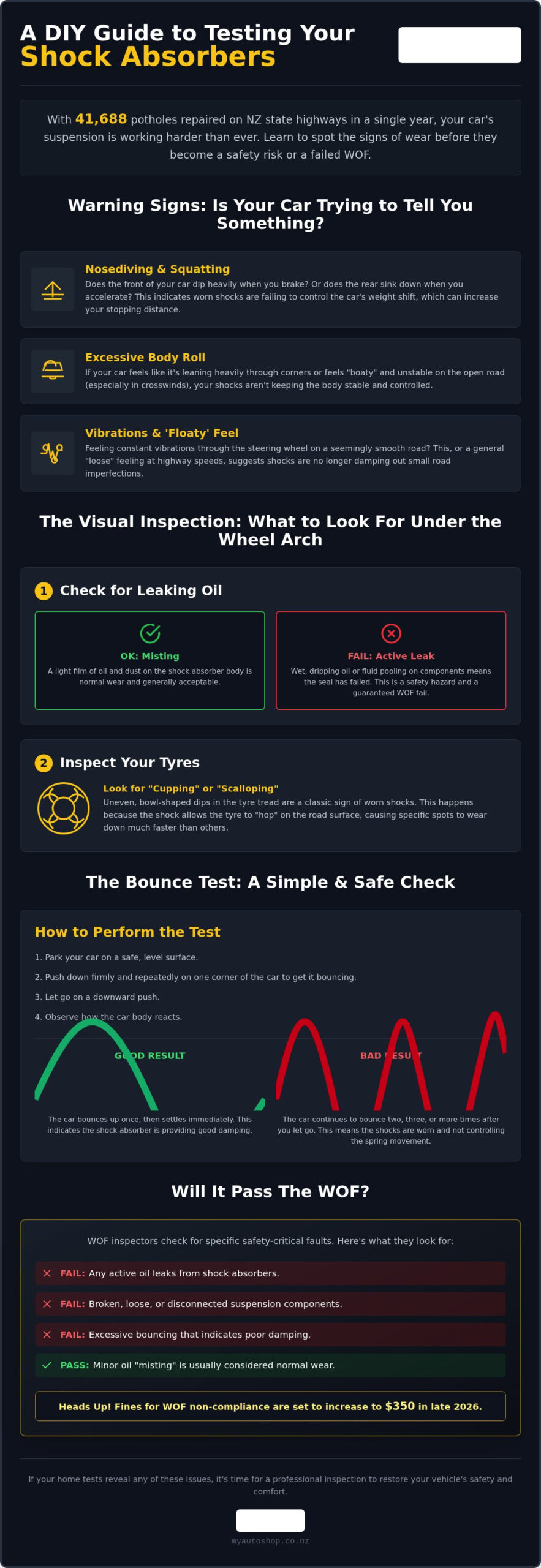
When you hit the brakes, the car’s weight naturally wants to pitch forward. A healthy suspension system manages this energy and keeps the chassis level. If the front of your car dips significantly toward the road, you’re experiencing a nosedive. This isn’t just an uncomfortable sensation. It’s a major safety risk because it lifts weight off the rear wheels, reducing traction and potentially increasing your stopping distance. To understand the mechanics, it helps to look at what a shock absorber does: it dampens the movement of the springs by converting kinetic energy into heat. When the internal valves or seals fail, that energy is no longer controlled, leading to that uncontrolled pitching.
‘Squatting’ is the opposite effect. This happens during acceleration when the rear of the vehicle sinks toward the ground. If you notice your headlights pointing at the stars every time you pull away from a green light, your rear shocks are likely past their best. You can observe these symptoms easily from the driver’s seat by watching the horizon line against your bonnet during stops and starts. If the nose stays up or down for more than a second after you’ve finished the manoeuvre, the damping is insufficient.
Handling and Steering Instability
Have you ever felt like you’re steering a boat on a choppy harbour? That “floaty” or “loose” sensation at highway speeds is a classic sign of worn components. On New Zealand’s open roads, your car should feel planted and responsive. If crosswinds on the Canterbury Plains or the Desert Road make you feel like you’re being pushed across the lane, your shocks aren’t providing the necessary resistance to keep the body stable. This “rock and roll” effect is even more obvious in corners. Excessive body roll makes the car feel unpredictable and forces the outer tyres to do all the work.
Beyond the lack of comfort, this instability leads to premature wear on other steering components. Because the shocks aren’t absorbing the impact of our local chip-seal roads, that energy travels into the ball joints, bushes, and tyres. If you feel constant vibrations through the steering wheel on a road that looks smooth, your shocks may be failing to dampen high-frequency ripples. Learning how to test shock absorbers by identifying these handling quirks is your first step toward a safer ride and a successful WOF.
The Visual Inspection: What to Look for Under the Wheel Arch
Pick up a torch and park your car on a level surface. A visual check is one of the most reliable ways to confirm your suspicions when learning how to test shock absorbers. You don’t need to be a qualified mechanic to spot physical evidence of failure. Focus your attention on the shock body, the rubber components, and the tyres. These parts often show signs of distress long before a total breakdown occurs.
Leaking Oil: Misting vs. Failure
Shock absorbers rely on hydraulic fluid to control your car’s movement. Over thousands of kilometres, the internal seals can begin to weep. You might notice a light film of oil covered in road dust on the shock body. This is known as “misting” and is generally considered normal wear. However, if you see wet, dripping oil or fluid pooling on the strut housing, the unit has failed. Look closely at the seal where the shiny piston rod enters the main shock body. If fluid is actively escaping here, the shock can no longer provide the damping required for a safe ride. Active leaks are a safety hazard and a guaranteed WOF failure.
Reading Your Tyres for Suspension Clues
Your tyres often reveal the story your suspension is trying to hide. Look for “cupping” or “scalloped” wear patterns on the tread. These appear as uneven, bowl-shaped dips around the circumference of the tyre. This happens because a worn shock allows the tyre to “hop” as you drive. Instead of staying firmly pressed against the road, the tyre bounces, causing specific spots to wear down faster than others. If you notice this pattern, it is a clear indicator of how to test shock absorbers through secondary symptoms. If your tyres look uneven, it is a smart move to book a Comprehensive Service to ensure your entire suspension and steering system is still aligned and safe.
Rubber Bushes and Physical Damage
Don’t ignore the smaller details under the wheel arch. Inspect the rubber dust boots that protect the internal piston rod. If these are torn or missing, road grit will quickly destroy the seals. Check the rubber bushes at the mounting points as well. If they look perished, cracked, or squeezed out of place, you will likely hear a metallic knocking sound when driving over bumps. Finally, look for any visible dents or bends in the metal strut housing. Even a small dent can jam the internal piston, making the shock absorber completely useless. If the metal is deformed, the part must be replaced immediately to maintain your vehicle’s structural integrity.
Active DIY Testing: The Bounce Test and Car Park Test
Once you have finished your visual walk-around, it is time to get hands-on. Physical testing provides the proof you need before deciding on a repair. These tests simulate real-world driving conditions in a controlled environment. If you are still unsure how to test shock absorbers, these two methods are the industry standard for home diagnostics. They help you feel and hear the suspension in action, revealing faults that a stationary inspection might miss.
Performing the Bounce Test Correctly
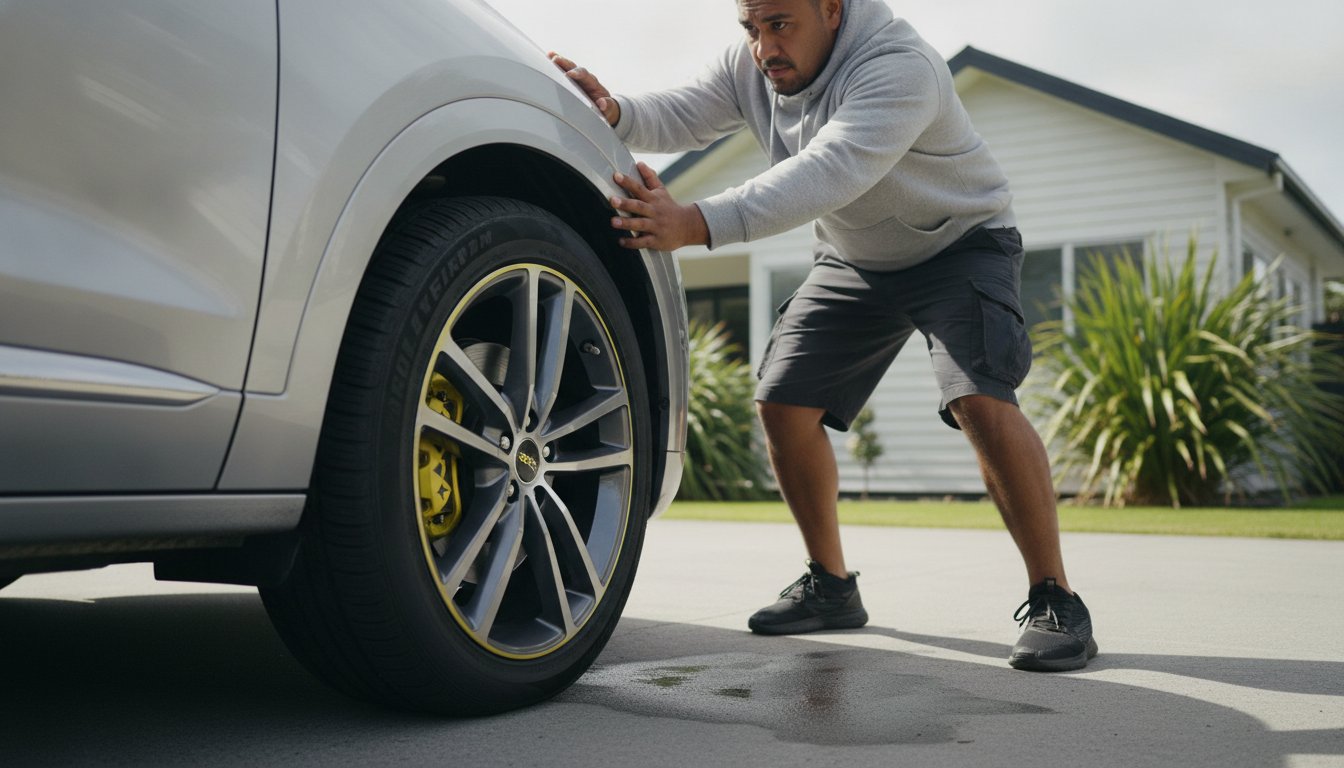
The bounce test is a classic technique, but modern cars require a careful touch. Many newer vehicles use thin-gauge steel or aluminium for body panels and bonnets. If you push down on the centre of a modern bonnet, you risk leaving a permanent dent. Follow these steps to test safely:
- Walk to one corner of the vehicle.
- Identify a structural point, such as the upper edge of the wing or the top of the strut tower under the open bonnet.
- Place your palms flat on this reinforced area.
- Push down firmly with your body weight and release the car suddenly.
- Watch the rebound carefully.
A healthy suspension should return to its original height and stop moving almost immediately. If the car settles in 1.5 cycles or less, your shocks are likely still functional. If the corner continues to oscillate or “bobs” up and down several times, the internal damping is gone. Repeat this process for all four corners. Listen for any metallic clunks or squeaking noises during the movement. These sounds often point to worn mounting bushes or internal valving failure.
The 20km/h Car Park Maneuver
Find an empty, level car park to perform a low-speed driving test. This is the most practical way to see how to test shock absorbers under load. You don’t need high speeds to find a fault. A steady 20km/h provides enough momentum to reveal suspension instability.
Start with a sharp stop. Accelerate to 20km/h and apply the brakes firmly. If the nose of the car dips excessively and then bounces after you’ve stopped, the front shocks are weak. Next, drive in a figure-eight pattern. This transfers weight from side to side. If the car feels like it is leaning heavily or “rolling” onto its shoulders, the shocks aren’t controlling the body roll. Finally, perform a brisk take-off from a standstill. If the rear end squats and the front feels light, your rear suspension needs attention. These simple maneuvers give you a clear picture of your car’s health before you book a professional inspection.
Shock Absorbers and the NZ Warrant of Fitness (WOF)
In New Zealand, the Warrant of Fitness (WOF) is the ultimate safety gatekeeper for our roads. While earlier sections showed you how to test shock absorbers using DIY methods, a professional inspector follows a strict legal checklist. Your car must meet specific damping performance and structural standards to remain road-legal. With WOF non-compliance fines increasing to $350 in November 2026, catching these issues early is a smart financial move. Suspension is not just about comfort; it is a critical safety system that keeps your tyres in contact with the road.
One of the most common reasons for failure is “excessive bounce.” This is a subjective test where the inspector manually oscillates the vehicle. If the car continues to move after they release it, the damping is insufficient. On our unique road network, where 41,688 potholes were repaired in 2025 alone, worn shocks are particularly dangerous. Corrugated rural roads and uneven chip-seal can cause a car with weak suspension to “skate” across the surface, leading to a loss of control that no amount of driver skill can fix.
Common WOF Failure Points for Suspension
Inspectors look for physical evidence of failure that goes beyond the bounce test. A primary failure point is hydraulic fluid leakage. While light misting is often noted as an advisory, an active leak that is dripping or has reached the lower mounting point is an immediate fail. They also check for perished or cracked suspension bushes. These rubber components provide the pivot points for your suspension, and if they are worn, your wheel alignment and steering precision suffer. Finally, inspectors verify mounting security. Any loose bolts, cracked mounting points, or significant rust in the strut towers will result in a “reject” sticker.
Safety Beyond the Inspection
A WOF is a snapshot in time, not a guarantee of future health. Industry professionals in NZ recommend a dedicated suspension check every 20,000km. This is because shock absorbers degrade slowly, and you might not notice the gradual loss of performance. Worn shocks also compromise your Electronic Stability Control (ESC). If your tyres are bouncing, the ESC system cannot accurately apply the brakes to individual wheels to prevent a skid. This systemic failure increases your risk in emergency maneuvers. If you are concerned about your vehicle’s safety, you can book a Pre-purchase Inspection to get a comprehensive view of your car’s mechanical health, including the suspension and brakes.
Your shock health also directly impacts other WOF items. If your shocks are failed, you will likely see uneven tyre wear and increased brake component stress. By learning how to test shock absorbers and addressing faults early, you protect your wallet and ensure your car remains safe for every Kiwi journey.
Professional Suspension Solutions: My Auto Shop
Knowing how to test shock absorbers gives you a head start on vehicle maintenance, but DIY checks have their limits. You might spot a leak or feel a bounce, but a professional technician can measure internal damping force and identify microscopic wear in the mounting hardware. If your home tests were inconclusive or confirmed your fears, it is time for a professional opinion. We act as a bridge between traditional manual labour and the high-speed expectations of the digital age, making car care simple and transparent.
The My Auto Shop Advantage
Forget the hassle of dropping your car off at a workshop and finding a ride back. Our Mobile Mechanic service brings the expert to your driveway or office. We perform thorough suspension checks while you get on with your day. You will receive a clear, digital report that strips away the jargon. We explain exactly what is happening under your wheel arches without the mystery. We work with a national network of certified NZ mechanics to ensure your car stays safe on our demanding roads. We value your time as much as your safety, providing a streamlined experience from the first click to the final repair.
Next Steps for Your Car
If your shocks have failed, replacing them in pairs is essential. Even if only one side is actively leaking, the other has covered the same distance and suffered similar internal wear. Replacing them together ensures your vehicle remains balanced. This prevents unpredictable handling or pulling to one side during emergency braking. It is a fundamental rule for maintaining the structural integrity of your suspension system.
Getting your car back to peak condition is straightforward. You can get an instant quote for a Shock Absorber Replacement through our platform. We prioritise financial clarity, so you know exactly what you are paying before the work begins. No hidden costs. No guesswork. If you are looking at buying a used car and want to avoid future WOF headaches, a professional Pre-purchase Inspection provides total peace of mind. Take control of your car’s safety and future-proof your vehicle against upcoming WOF changes.
Book a suspension check with a My Auto Shop mobile mechanic today and restore the smooth, reliable ride your car was built for.
Secure Your Ride for the Road Ahead
You now have the tools to identify suspension issues before they lead to a failed WOF or a dangerous moment on the road. By combining visual checks with active driving tests, you’ve learned exactly how to test shock absorbers from the comfort of your own driveway. Whether you spotted a leak or felt an unsettling bounce, taking action early protects your vehicle’s safety and your wallet.
If your DIY tests confirmed it’s time for a professional fix, we are here to help. We provide access to a national network of MTA-assured mechanics and offer transparent, upfront pricing with no hidden costs. Our mobile mechanics can even come to your home or work, ensuring your car care fits into your busy lifestyle without the stress of workshop waiting rooms.
Get a Quote for Shock Absorber Replacement today and get back to enjoying New Zealand’s roads with total peace of mind. Your car will thank you for the smoother ride.
Frequently Asked Questions
Can I drive with worn shock absorbers?
You can physically drive the car, but it is not safe to do so for long. Worn components significantly increase your stopping distance and reduce your control during emergency swerves. Your tyres will lose contact with the road more often, especially on bumpy backroads. This puts extra stress on your brakes and steering joints. It is better to address the issue before a minor handling quirk becomes a major safety incident.
How much does it cost to replace shock absorbers in NZ?
Costs vary significantly depending on your vehicle’s make and model. Luxury European cars often require more specialised parts and labour compared to a standard Japanese hatchback. Instead of guessing, you can get an accurate, upfront price through our platform. This ensures you have financial clarity before any work begins on your suspension. We provide transparent quotes so you can plan your maintenance without any hidden surprises.
Should I replace all four shocks at the same time?
You don’t necessarily need to replace all four, but you must replace them in pairs on the same axle. If the front left shock has failed, the front right should be replaced too. This maintains a balanced ride and ensures consistent handling. Replacing just one side can cause the car to pull or lean unevenly, which compromises your safety and causes lopsided tyre wear. Always think in pairs for suspension health.
Is a leaking shock absorber an automatic WOF fail?
A light film of oil, known as misting, is often acceptable for an inspection. However, an active leak that is dripping or has reached the lower mounting bush is an automatic WOF fail. Inspectors look for fluid that has escaped the internal seals. This proves the unit can no longer dampen movement effectively. If you’ve used our guide on how to test shock absorbers and found wet oil, it is time for a replacement.
How long do shock absorbers typically last on NZ roads?
Most shock absorbers last between 80,000km and 100,000km. New Zealand’s hilly terrain and high number of unsealed roads can shorten this lifespan. Constant vibration from chip-seal surfaces wears out internal valves faster than smooth asphalt. We recommend a professional suspension check every 20,000km. This helps catch gradual degradation before it impacts your vehicle’s safety or WOF compliance. Regular checks are the best way to avoid unexpected repair bills.
What is the difference between a shock and a strut?
A shock absorber is a standalone component that dampens movement. A strut is a structural part of the suspension system that also supports the vehicle’s weight and holds the coil spring. While they perform the same damping job, they are not interchangeable. Struts are generally more complex to replace because they affect the car’s wheel alignment directly. Most modern cars use struts on the front and shocks on the rear.
Can worn shocks cause my car to shake at high speeds?
Yes, worn shocks allow the tyres to bounce or “hop” rather than staying planted. This movement creates vibrations that you feel through the steering wheel or seat, especially at highway speeds. Over time, this bouncing leads to cupped tyre wear, which makes the shaking even worse. If your car feels unstable or vibrates on smooth motorways, your suspension is a likely culprit. Don’t ignore these wobbles as they indicate a loss of road grip.
Will new shock absorbers make my car ride higher?
New shocks won’t usually change your ride height because the springs support the vehicle’s weight. However, if your old shocks were completely collapsed or “blown,” you might notice the car sits more level after a shock absorber replacement. If your car is sagging significantly, the issue is likely with the coil springs rather than the shocks themselves. Replacing worn units will restore the original handling characteristics and comfort your car had when it was new.
Disclaimer
This article provides general information only and should not be relied on as professional mechanical, safety or legal advice. Vehicle requirements and circumstances vary. If you are unsure about your vehicle, have it inspected by a qualified automotive professional.