

Could a hybrid pass its WoF while its main battery is losing capacity? Yes. A WoF checks general safety, not the battery’s State of Health, so a clean result doesn’t tell you how well the high-voltage battery is performing. A hybrid battery health check can offer useful evidence, but it isn’t a crystal ball.
It’s understandable to want a clear verdict, especially if you’re buying a used hybrid or noticing changes in fuel use, acceleration or the battery gauge. Depending on the vehicle and test method, a report may show system fault codes, battery readings or differences between battery sections. It can also help distinguish a traction-battery concern from a problem with the smaller 12-volt battery, which can cause its own electrical symptoms. The detail depends on what the assessment covers.
This guide explains what a check can and can’t measure, how diagnostic testing compares with a broader inspection, and what to consider before relying on a result. You’ll also learn how to interpret a report that flags an issue, and why one snapshot can’t predict exactly how long a battery will last.
Key Takeaways
- A hybrid battery health check can show useful condition indicators, but it can’t predict exactly how long a battery will last.
- Check that the assessment covers the high-voltage traction battery, not just the separate 12-volt battery.
- Compare test options by their scope, how clearly they explain results, and whether they suit your vehicle.
- Distinguish a warning light or stored fault code from a confirmed battery fault before making decisions about repairs.
- If you’re buying a used hybrid, consider the report alongside a broader pre-purchase inspection.
What does a hybrid battery health check actually assess?
A hybrid battery health check looks at available indicators of the high-voltage battery’s condition. Depending on the vehicle and test method, these may include diagnostic fault codes, battery readings, differences between battery sections and temperature information. The aim is to describe what the system shows at the time of assessment, not to promise how the battery will perform in future.
Hybrid systems vary by make, model and design. Before interpreting a report, identify the exact vehicle and check which battery and assessment method it covers. A scan that retrieves fault codes can provide useful clues, but it isn’t automatically a complete assessment of battery condition.
If you’re unfamiliar with how the battery fits into the powertrain, this overview of the Hybrid electric vehicle (HEV) explains the basic role of the battery pack.
Hybrid traction battery versus the 12-volt battery
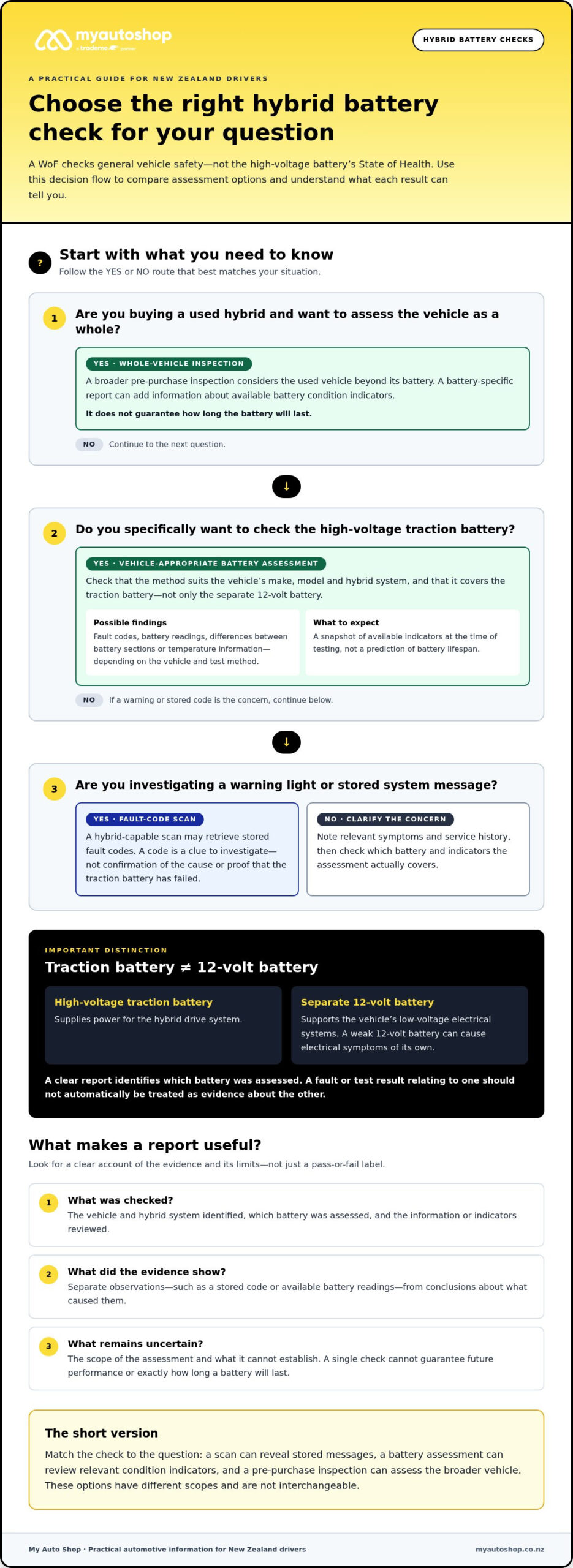
The traction battery supplies power for the hybrid drive system. The separate 12-volt battery supports the vehicle’s low-voltage electrical systems. They have different roles, so a test or fault relating to one shouldn’t automatically be treated as evidence about the other.
A weak 12-volt battery can cause electrical symptoms that may be mistaken for a larger hybrid-system problem. A clear report should identify which battery was assessed and what was tested. For more on the smaller battery’s role, see this guide to choosing your car battery.
What a battery health result can and cannot tell you
Battery health describes observed condition indicators at the time of testing; battery lifespan is how long the battery will continue to work, which a single check can’t guarantee. A result can help show whether readings or stored system information raise concerns. It can’t account for every future journey, operating condition or change in the vehicle.
One measurement is only part of the picture. Battery behaviour can differ as the vehicle operates under varying loads and conditions, while a scan captures information within the scope of that particular test. Read the report for its evidence and limitations, not just a pass-or-fail label. A useful report explains what was measured, which battery it refers to, and what the result does and doesn’t establish.
How is a hybrid battery health check carried out?
A useful assessment follows a clear sequence: identify the vehicle, gather relevant diagnostic information, interpret the findings, then explain possible next steps. The checks should suit the vehicle’s make, model and hybrid system. A process used for one vehicle shouldn’t automatically be assumed to suit another.
Once the vehicle is identified, a hybrid-capable scan may retrieve fault codes or, where supported for that model and test method, relevant battery data. The findings are then interpreted, with an explanation of what was checked, what the information indicates and what remains uncertain. A scan that can access hybrid systems isn’t automatically a complete battery assessment. It may retrieve codes without reviewing other available battery condition indicators.
For New Zealand drivers, the vehicle’s make, model and service history help put the assessment in context. The report should make clear which findings relate to the hybrid battery and which may concern another part of the vehicle.
What diagnostic information may be reviewed?
A fault code is a stored message showing that a vehicle system has detected an issue or condition. It can point to an area for investigation, but it doesn’t confirm the cause by itself. Depending on the vehicle and assessment method, a report may also include relevant battery readings or live data. These are useful evidence only when the method supports them for that model.
A diagnostic code is a clue to investigate, not a diagnosis by itself; its meaning depends on the vehicle and the surrounding evidence.
How should the findings be explained?
A clear report separates what was observed, what the assessment didn’t cover and what follow-up may help clarify the concern. For example, a stored code should be described as a code, not presented as proof that the traction battery has failed. A brief assessment also shouldn’t promise a pass, a repair outcome or an estimate of remaining battery life.
Relevant symptoms and available service history help put findings in context. This information doesn’t replace test evidence, but it can make the results more meaningful. If further automotive assessment or repair is needed, My Auto Shop connects motorists with automotive service and repair providers. Explore My Auto Shop’s automotive services.
Which hybrid battery health check option should you compare?
Choose the assessment that answers your actual question. A basic fault-code scan, a vehicle-specific battery assessment and a whole-vehicle pre-purchase inspection have different scopes. They’re not interchangeable, and none can guarantee how long a battery will last.
Scan, battery assessment, or whole-vehicle inspection?
A fault-code scan can identify stored system messages. A model-appropriate battery assessment focuses more directly on available battery condition indicators. A broader inspection considers the used vehicle as a whole, giving context beyond the battery. If you’re buying a hybrid, My Auto Shop’s independent pre-purchase inspection can help assess the vehicle, but it isn’t a guarantee of battery life.
SAE International publishes technical work on battery testing standards. That material concerns battery safety and testing methods, not a promise that a consumer health check will predict a particular vehicle’s remaining service life.
How to judge whether a report is useful
Look for the vehicle assessed, what was checked, the findings in plain language, and the limits of the assessment. A list of codes without interpretation may show what the system recorded, but leave the underlying cause unresolved.
Basic fault-code scan
Scope: Retrieves relevant stored codes.
Useful for: Initial clues when a warning or symptom needs investigation.
Limitation: A code alone doesn’t confirm a battery fault or explain its cause.
Model-appropriate battery assessment
Scope: Reviews battery condition indicators supported for that vehicle and test method.
Useful for: A focused question about the hybrid battery.
Limitation: Findings depend on the assessment’s coverage and don’t guarantee future performance.
Whole-vehicle inspection
Scope: Assesses the broader condition of a used vehicle.
Useful for: Buyers weighing the hybrid battery alongside other vehicle concerns.
Limitation: A general inspection shouldn’t be assumed to include a detailed battery assessment unless its scope says so.
Before booking an assessment, define the question: are you investigating a particular warning, seeking battery-focused information, or deciding whether the whole car is a sound purchase? Compare reports by their scope, explanation and stated limitations. That makes it easier to understand what a hybrid battery health check can establish, and where further assessment may be needed.
What should you do if a hybrid battery check finds a concern?
Start by separating what’s been observed from what it might mean. A dashboard warning light signals that the vehicle has detected a system issue. A stored fault code records information that may help with investigation. Neither one, by itself, proves the hybrid traction battery has failed. A confirmed battery fault requires findings that support that conclusion.
Before deciding on repair, read the report carefully. Check which battery and systems were assessed, what evidence was recorded, and what the test didn’t cover. A hybrid battery health check can guide a decision, but its result needs to be understood within the limits of the method used.
When the result is unclear or inconsistent
If the report, warning lights and how the car behaves don’t seem to match, avoid jumping to a conclusion. Note the symptoms and when they occur, then compare them with the report’s findings. A useful explanation should set out the test scope, what the evidence supports, and what remains uncertain. A code or unexpected reading may call for further interpretation, not an assumption that the battery has failed.
Keep a copy of the report and any related service records. These details give useful context if the vehicle is assessed again or further diagnostic work is considered. Make decisions based on the evidence and the stated limits, rather than a code list or a broad label alone.
Using a battery check when buying a used hybrid
For a used vehicle, consider the battery finding alongside the car’s overall condition, service history and any other inspection results. A battery-focused assessment can help answer a specific question about the hybrid system, while a broader inspection looks at the vehicle as a whole. My Auto Shop’s independent pre-purchase inspections help buyers assess a used vehicle.
A battery report is one part of a used-car decision, not a guarantee of future battery life or the vehicle’s overall condition. If a report raises a concern, use it to identify what needs clarifying before deciding whether to proceed, seek further assessment or discuss repairs.
For buyers, a My Auto Shop pre-purchase inspection can add context about the vehicle beyond the hybrid battery alone.
Where can New Zealand drivers take the next step?
Start with the question you need answered. Is a warning light or symptom prompting an assessment, do you want clearer information about the hybrid battery, or are you deciding whether to buy a used vehicle? Then check that the proposed test covers the right system and suits your vehicle. Once you have the report, use its findings and limitations to decide whether further assessment is needed.
Choosing a next step for your situation
If you already own the car, focus on what the test actually found and what follow-up, if any, is suggested. Keep the report with your service history so the information is available if the concern needs further investigation.
For a used hybrid purchase, consider battery information as part of the wider vehicle picture. My Auto Shop provides independent pre-purchase inspections to help buyers make better-informed decisions. These inspections can add broader context, but neither a general inspection nor a battery check guarantees future battery performance. My Auto Shop also provides a marketplace connecting motorists with automotive service and repair providers. Providers in the marketplace are not necessarily My Auto Shop employees.
What to take away from a hybrid battery report
A useful report should help you answer four straightforward questions:
- What was tested? Identify the vehicle systems and battery covered by the assessment.
- What did it find? Look for observations and results, not just a broad label or code list.
- What are the limits? Note what the test didn’t assess and what it can’t predict.
- What happens next? Understand whether the report suggests monitoring, clarification or further assessment.
A hybrid battery health check gives you information to support a decision, not certainty about future reliability or freedom from repair risk. Keep the report, compare it with the vehicle’s symptoms and history, and make the next decision based on evidence you understand.
For a used hybrid, My Auto Shop’s independent pre-purchase inspections offer a broader view of the vehicle to help inform your decision.
Make your next hybrid battery decision with confidence
A hybrid battery health check is most useful when you know what it tested and what its findings can establish. A fault code or warning light is a reason to understand the evidence, not automatic proof that the traction battery has failed. And no single check can guarantee how long the battery will last.
For a used hybrid, weigh battery results alongside the vehicle’s wider condition and service history. My Auto Shop provides independent pre-purchase inspections to help buyers make better-informed decisions. The inspection can help inform your decision, but it isn’t a guarantee of future battery performance.
To assess a used hybrid as a whole, explore My Auto Shop’s independent pre-purchase inspection.
Frequently Asked Questions
What is included in a hybrid battery health check?
The checks depend on the vehicle and assessment method. A report may cover diagnostic fault codes, battery data or other condition indicators, while a general scan may only retrieve available system information. Read the stated scope to see which battery and systems were assessed. A clear explanation should also tell you what the findings suggest, what the check didn’t cover and what remains uncertain. No standard result guarantees a battery’s remaining lifespan.
Can a hybrid battery health check predict how long the battery will last?
No. A hybrid battery health check can provide information about observed condition at the time of testing, but it can’t give a precise forecast of remaining life. Treat the result as a snapshot, interpreted alongside the vehicle’s symptoms, history and the method used. A reassuring result isn’t a guarantee the battery won’t need attention later, and a concerning result alone doesn’t establish exactly when replacement may be needed.
How is a hybrid battery health check different from a 12-volt battery test?
They assess separate batteries with different roles. A hybrid’s traction battery supports the hybrid drive system, while its 12-volt battery supplies low-voltage electrical systems. Testing one doesn’t automatically assess the other, so check which battery the report covers. A 12-volt fault isn’t proof that the traction battery has failed. For general information about the smaller battery, read this guide to choosing your car battery.
Does a hybrid battery warning light mean the battery has failed?
Not necessarily. A warning light means the vehicle has detected an issue, but the light alone doesn’t identify its cause or confirm a traction-battery failure. Diagnostic information needs to be interpreted in the context of the vehicle and its symptoms. Note any changes you’ve noticed and have the warning investigated rather than assuming what it means or ignoring it. The resulting findings can help clarify what needs attention.
Is a hybrid battery health check useful before buying a used hybrid?
Yes, it can give you useful information about battery condition indicators, provided you understand the assessment’s scope and limitations. Use the report alongside the vehicle’s service history and overall condition, not as a substitute for a wider inspection. Neither a battery check nor a whole-vehicle inspection can guarantee future reliability or battery life.
Can a basic diagnostic scan check hybrid battery health?
A basic scan may retrieve fault codes or other information available for that vehicle, but what it can assess depends on the vehicle and method. Reading a code isn’t always the same as confirming its underlying cause or completing a battery-focused assessment. Check what the scan covered, which battery it relates to and what questions remain unanswered. That helps you decide whether the findings are enough or further assessment may be useful.
Disclaimer
This article provides general information only and should not be relied on as professional mechanical, safety or legal advice. Vehicle requirements and circumstances vary. If you are unsure about your vehicle, have it inspected by a qualified automotive professional.