
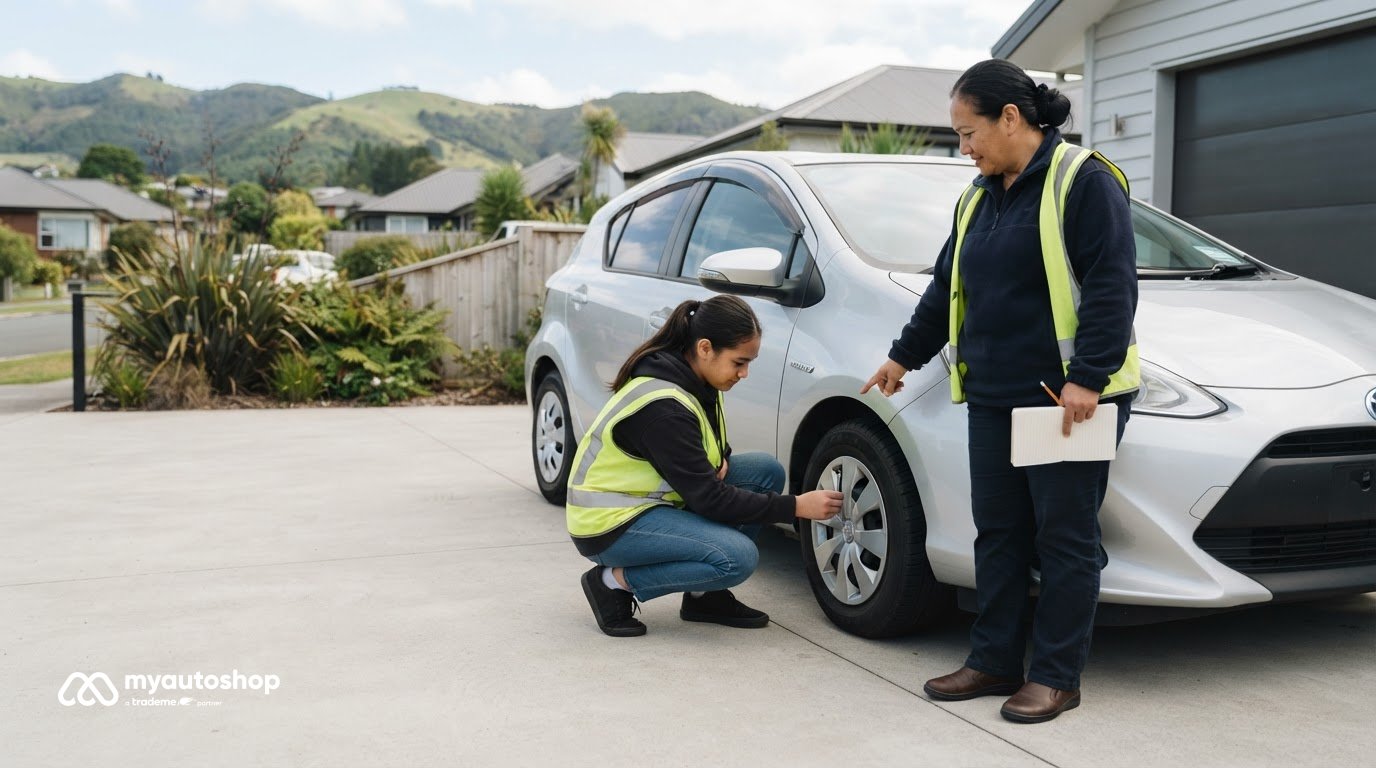
What if your teenager’s most useful car-care skill isn’t fixing a fault, but noticing a change early? Teaching your teenager basic car care can feel daunting when they’re unsure what to check and you’re not sure which tasks are suitable for a beginner. Keep the aim simple: help them observe, check and report, not diagnose or repair beyond their experience.
A few repeatable checks can build confidence without turning a driveway lesson into a mechanical project. Practise safely and make the checks part of your teenager’s routine, focusing on things that matter on New Zealand roads, such as tyre condition and working lights.
Show them what to do when something seems wrong: describe what they noticed, avoid driving if the car may be unsafe, and get professional help when the issue is beyond a basic check. A WoF is a useful safety check, but it doesn’t replace looking after the car between inspections. The goal is a calm, practical habit your teen can carry into every trip.
Key Takeaways
- Teaching your teenager basic car care works best when you start with safe observations and repeatable checks, not repairs.
- Use a simple walk-around to help your teen notice tyre condition, visible damage, working lights and number plates.
- Show them where the vehicle handbook explains tyre pressures, fluid checks and the manufacturer’s maintenance schedule.
- Practise responding to warning lights by checking the handbook and stopping safely when appropriate, rather than guessing what a symbol means.
- Keep a shared log of checks, changes and questions so your teenager can report concerns clearly and know when to seek professional help.
Teaching your teenager basic car care starts with simple, safe habits
Start by reassuring your teenager that they don’t need to know how to repair a car. Help them notice what looks, sounds or feels different, then practise straightforward routine checks together. This gives them a useful role without asking them to make mechanical decisions they aren’t ready for.
Basic car care means carrying out simple checks, keeping a record of what you notice, and getting timely help when something seems wrong.
Teaching your teenager basic car care is most effective as a gradual process. Short, regular practice helps a young driver learn what the car normally looks and sounds like. If something changes, they can describe what happened, when they noticed it and whether it has happened before. Those details can help an adult or mechanic understand the concern.
Agree on safe boundaries before lifting the bonnet
Set the safety rules before you begin. Choose a stable place away from moving traffic, park the car securely and read the relevant section of the vehicle handbook together. Follow its instructions and warnings before any under-bonnet check. If either of you is unsure about a task, pause and leave it to someone with the right experience.
- Keep hands, loose clothing and tools away from hot or moving parts.
- Don’t touch components just to find out what they do.
- Keep the lesson to observation and routine checks, not repairs.
Make it clear that stopping is a sensible decision, not a failure. Your teenager should feel comfortable saying, “I’m not sure,” or calling you over before continuing. These boundaries apply whether you’re checking around the vehicle or looking under the bonnet.
Make each lesson practical, not overwhelming
Choose one task at a time. Demonstrate it, explain what you’re looking for and show what a normal result looks like for that particular car. Then let your teenager repeat the check while you watch and answer questions. Focus on careful observation, not speed or perfect terminology.
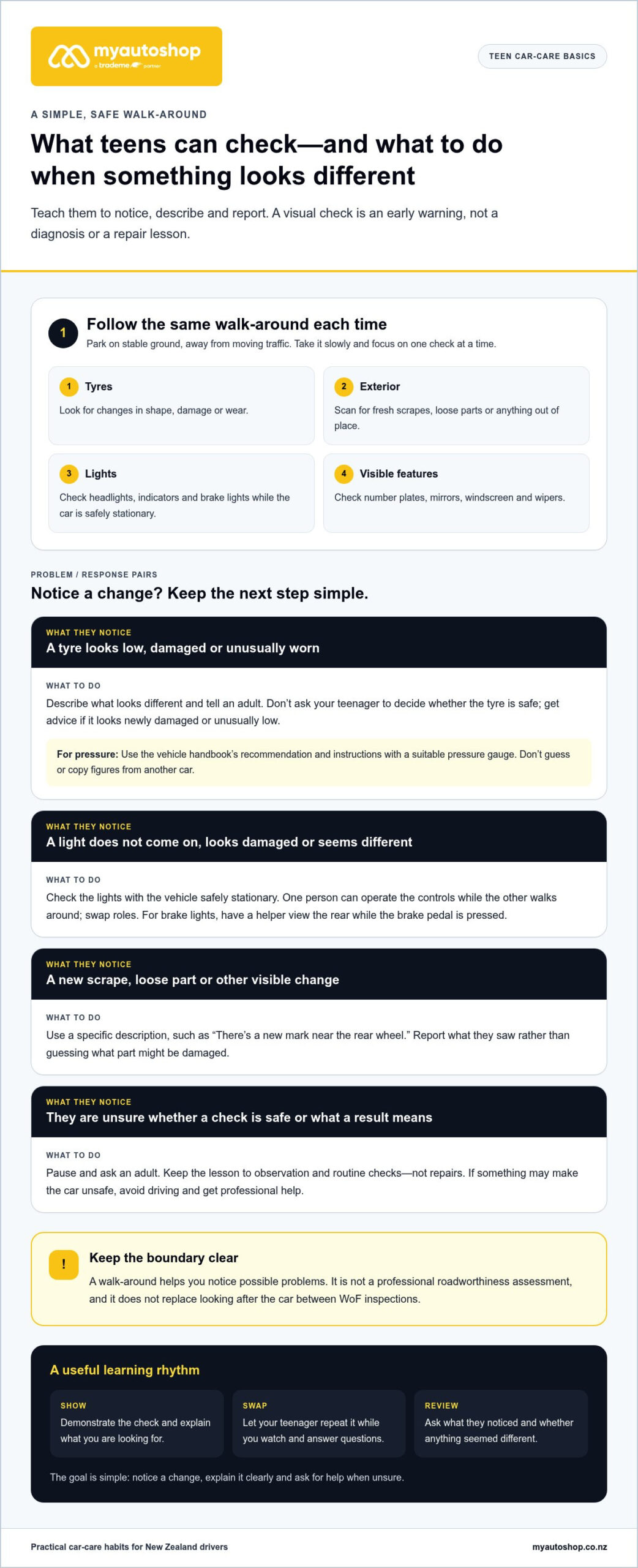
- Show: Carry out the check and explain each step in plain language.
- Swap: Let your teenager repeat it while you watch and answer questions.
- Review: Ask what they noticed and whether anything seemed different.
Encourage specific descriptions instead of guesses. “There’s a new mark near the rear wheel” is more useful than an incorrect guess about which part is damaged. Praise careful attention and sensible questions. A broad overview of routine upkeep is available in Car maintenance on Wikipedia, but use the vehicle handbook for instructions that apply to your family’s car.
Keep practice calm and predictable. Revisit familiar checks before introducing another task, and finish by agreeing what should be reported and what needs an adult’s help. The aim isn’t instant expertise. It’s a young driver who knows how to look, explain and ask before a small concern becomes a bigger worry.
Show your teenager how to check tyres, lights, and the car’s exterior
A consistent walk-around gives your teenager an easy sequence to follow and makes changes easier to spot. Park on stable ground away from traffic, then walk around the car together. Look at each tyre and the bodywork, check the lights, and finish with the number plates, mirrors, windscreen and wipers. Keep the first few checks slow and focused.
- Tyres: Look for obvious changes in shape, damage or wear.
- Exterior: Scan for fresh scrapes, loose parts or anything that looks out of place.
- Lights: Check that headlights, indicators and brake lights work.
- Visible features: Check number plates, mirrors, windscreen and wipers.
Practise a simple tyre check
Show your teen how to look across each tyre’s tread and sidewall. Point out a visibly low tyre, cuts, bulges, embedded objects or uneven wear. A visual check can alert you to a concern, but it can’t confirm a tyre’s full condition or replace a proper inspection.
To check pressure, find the vehicle-specific recommendation in the handbook and show your teenager how to use a suitable pressure gauge. Don’t guess or copy figures from another car. Follow the handbook’s instructions for the checking conditions, and make a note if a tyre repeatedly needs attention.
If a tyre looks newly damaged, unusually low or worse than before, don’t ask your teenager to decide whether it’s safe. Have them tell you what they noticed and get advice. A visual check is an early warning, not a diagnosis.
Check that lights and visible features are working
Test the lights while the car is safely stationary. Operate the controls while your teen walks around and checks each light, then swap roles. To check the brake lights, have a helper stand where they can see the rear of the car while you press the brake pedal. Follow the handbook for operating the vehicle’s systems during these checks.
Ask your teen to describe what they see: for example, whether a light doesn’t come on, looks damaged or appears different from the one on the other side. Check that number plates are present and visible, mirrors are intact, the windscreen isn’t visibly damaged, and the wipers appear in good condition. These observations need a careful look, not mechanical knowledge.
A visual check helps you notice possible problems; it isn’t a professional roadworthiness assessment. Keep that distinction clear, especially if the car is due for a WoF or something looks unsafe. If a concern needs a mechanic’s attention, My Auto Shop connects motorists with automotive service and repair providers through its marketplace.
Teach safe under-bonnet checks for oil and other fluids
Under-bonnet checks are about knowing what to look at and when to stop. Before opening the bonnet, find the relevant instructions in the owner’s manual. Explain that the manufacturer’s handbook gives the vehicle-specific method and maintenance schedule. Generic online intervals or instructions for a different car may not apply.
Use the handbook to identify the bonnet release and prop. Keep the car parked safely, and follow any instructions about whether the engine should be off, cool or left to stand before checking a fluid. Don’t open a hot cooling system. If a part is unfamiliar, a warning is unclear or the instructions don’t make sense, stop and get adult or professional help.
Demonstrate an oil-level check safely
Show your teenager where the handbook explains the oil-check procedure for that car. Some vehicles use a dipstick; others may display oil-level information electronically. Follow the specified steps rather than assuming every vehicle is checked the same way. If there’s a dipstick, use the manual to identify it and explain what the markings mean before your teen tries the check.
Keep the lesson to reading and reporting. If the level appears low, or there’s oil visible around the engine or underneath the car, ask your teenager to tell you what they found. Don’t have them add oil or investigate a leak unless you’ve checked the correct procedure and can guide them safely. A new or worsening concern needs adult attention and, where appropriate, professional advice.
Explain washer fluid and other visible fluid concerns
Use the handbook to locate the washer-fluid reservoir and learn how the manufacturer says to check it. Show your teen how to recognise the correct cap and label, but don’t let them guess. Compartments under the bonnet serve different systems, and putting the wrong fluid in the wrong place can cause a problem.
If a top-up is appropriate, follow the handbook’s instructions and supervise the task. Don’t ask a beginner to handle an unfamiliar fluid, open a pressurised container or decide what another reservoir needs. The lesson is to find the right information and know when to pause.
- Report a puddle beneath the parked car, without touching or tasting it.
- Tell an adult about an unfamiliar smell, visible fluid or dashboard message.
- Note where the concern appeared and whether it was there before, without trying to diagnose it.
- Stop if the handbook’s instructions are unclear or a component looks unfamiliar.
These clear stop points make teaching your teenager basic car care practical without asking them to take on repairs. A careful report is useful: “There’s a fresh-looking patch under the front” gives an adult a place to start. Leave diagnosis and any work beyond the handbook’s routine checks to someone equipped to assess it.
Help your teenager respond calmly to warning lights and car trouble
A dashboard warning can be unsettling, especially for a new driver. Give your teenager a plan before they need it: notice the warning, pay attention to how the car behaves, stop safely if appropriate, then check the handbook and contact someone for help. The right next step depends on the vehicle and situation, so teach them not to guess.
Use the handbook to understand dashboard warnings
Before a warning appears, find the dashboard-symbol section in the vehicle handbook together. Explain that symbols and messages vary between makes and models, so colour alone isn’t enough to decide what to do. If a battery symbol appears, for example, the handbook and the car’s behaviour provide important context. My Auto Shop’s guide to the battery warning light explains why that warning needs proper interpretation.
Practise reading a warning while the car is parked. Ask your teenager to identify the symbol or message and describe any change they notice, such as unusual noise, loss of power or a change in how the car handles. They should never ignore a warning or assume its meaning from a symbol they’ve seen in another vehicle.
Agree on a clear decision point: follow the handbook’s instructions. If it says to stop, or the car feels unsafe or behaves unusually, find a safe place to pull over as soon as it’s safe to do so. Don’t ask your teen to troubleshoot while driving. They can tell you what appeared and what happened just before or after it.
Plan a safe response to a breakdown
Talk through what to do if the car develops a problem on a New Zealand road. If it can be moved safely, your teenager should aim for a safe stopping place rather than stopping in a risky position. If the vehicle can’t be moved safely, they shouldn’t attempt roadside checks or put themselves in danger to inspect it.
Agree in advance who they’ll contact, such as a trusted adult or their roadside assistance provider. Make sure they know how to share their location and the vehicle’s details, what the dashboard shows, how the car is behaving and whether there’s an immediate hazard. If they’re unsure what to say, a calm, factual description is enough to start.
- “A warning message appeared” is more useful than guessing what caused it.
- Describe what the car is doing, including any unusual sound or change in handling.
- Give the location and explain whether the car is safely stopped.
Rehearsing this plan can make a real problem feel more manageable. If a warning or symptom needs professional attention, My Auto Shop’s marketplace connects motorists with automotive service and repair providers: find automotive service and repair providers through My Auto Shop.
Build a car-care routine and know when to get professional help
Turn the checks into a shared habit, not a one-off lesson. Choose a practical moment, such as before a regular trip or while you’re washing the car, and use the same simple sequence. A brief walk-around and dashboard check helps your teenager notice changes and gives you a chance to discuss anything they’re unsure about.
Make checks and service records part of the routine
Keep a shared log in a notebook or phone note. Record the date, checks completed, anything unusual and questions to follow up. Write down what happened rather than a conclusion: “new noise when braking” is more useful than guessing what needs repair. Add service work and other maintenance records so you can see what’s been done and what still needs attention.
Use the vehicle handbook to understand the manufacturer’s maintenance schedule and follow its vehicle-specific guidance. Don’t substitute a personal checking routine or generic online interval for scheduled servicing. A New Zealand basic car maintenance checklist can be a useful prompt for regular observations, but the handbook should guide requirements for your particular vehicle.
Make the boundary clear: routine checks help you notice concerns, but they don’t replace servicing or the vehicle’s current Warrant of Fitness (WoF) requirements. A WoF inspection checks whether a vehicle meets minimum safety standards at the time of inspection; it isn’t a substitute for ongoing maintenance. Keep track of the vehicle’s WoF due date and use current NZTA/Waka Kotahi guidance for requirements.
Set a clear boundary between checking and repairing
Encourage your teenager to report a change, not attempt an unfamiliar repair. If they’re unsure what a sound, warning or visible issue means, their next step is to tell you and avoid using the car if it may be unsafe. This helps them understand that asking for help is part of responsible car care, not a sign they’ve failed the lesson.
Keep the shared log practical and easy to use. It might include:
- What the teen noticed and when it happened.
- Any warning message or change in how the car behaved.
- Checks completed, servicing recorded and questions still to resolve.
Teaching your teenager basic car care is about building good judgement as much as learning checks. When an issue needs a mechanic, My Auto Shop connects motorists with automotive service and repair providers through its marketplace. Marketplace providers are independent, not My Auto Shop employees. More information is available at My Auto Shop.
Make car care a habit your teenager can own
Confidence grows through practice, not a single lesson. Let your teenager take a little more responsibility over time, such as remembering to check the handbook or add a note to your shared log. Stay available for questions, and keep the boundary clear: they can take initiative without being expected to diagnose a fault or carry out a repair.
Teaching your teenager basic car care is also a chance to build good judgement for the years ahead. Reinforce that noticing something unusual and asking for help are responsible choices. Keep the conversation open, and treat each question as a useful part of learning to care for a vehicle.
If a concern needs professional attention, My Auto Shop connects motorists with automotive service and repair providers through its marketplace. Explore car-care support through My Auto Shop, and keep building your teen’s confidence one sensible step at a time.
Frequently Asked Questions
How can I make basic car-care lessons less intimidating for a teenager?
Let your teenager choose a familiar task to practise first, such as checking whether the headlights switch on. Keep the lesson brief and avoid testing them with surprise questions. Explain unfamiliar words as they come up, then ask what would make the next practice easier. A teen who’s nervous around the car can start by observing while you demonstrate, then take over when they feel ready.
Is a WoF the same as regular car maintenance?
No. A WoF checks whether a vehicle meets minimum safety standards at the time of inspection, while maintenance follows the manufacturer’s schedule and addresses the car’s ongoing upkeep. A valid WoF doesn’t tell you when the next scheduled service is due. Keep WoF information and service records together, but treat them as separate reminders with different purposes.
What should a teenager do if they put the wrong fuel in a car?
Tell an adult straight away and don’t start the engine or turn the ignition on. If the car has already been started, stop somewhere safe as soon as possible and switch it off. Don’t try to drain the tank or drive to a workshop. Contact roadside assistance or a mechanic and explain which fuel went in, how much, and whether the engine was started.
Can a teenager check a car battery or jump-start a vehicle?
A teenager can report a battery warning or describe symptoms such as the engine struggling to start, but battery testing and jump-starting need extra care. Don’t let them connect cables based on guesswork: vehicle procedures can differ, and the handbook should be followed. If the battery is damaged, leaking or unfamiliar, keep clear and ask an adult to arrange professional help.
What information should a teenager give when reporting a car problem?
They should describe what happened in order: where they were, what they noticed first and what changed next. Include any dashboard message, sounds, smells or effect on steering, braking or engine performance. For example, “The engine lost power after a warning appeared” is more useful than “The car feels weird.” They should also say whether the vehicle is safely parked or creating an immediate hazard.
How can my teenager remember routine car checks?
Attach the check to an existing habit, such as looking over the car before a regular trip. A shared calendar reminder can prompt the check, while a tick-box note makes it easy to record what’s been done. Keep the reminder general and use the handbook for vehicle-specific schedules. If a check is missed, restart the routine at the next suitable opportunity rather than letting the log become another source of pressure.
Disclaimer
This article provides general information only and should not be relied on as professional mechanical, safety or legal advice. Vehicle requirements and circumstances vary. If you are unsure about your vehicle, have it inspected by a qualified automotive professional.