

A Honda Fit Hybrid battery may last around 6 to 10 years, but its age alone doesn’t tell the whole story. The Honda Fit hybrid battery life expectancy depends on factors such as temperature, driving patterns and how well the battery’s cooling system can manage heat. A health check can help show whether its condition is changing.
It’s reasonable to want a clear answer before deciding whether to buy or keep a used hybrid. This guide explains why Honda Fit hybrid battery life expectancy varies, what can affect battery condition, how to review warranty coverage and which checks may help assess battery health. You’ll also learn the warning signs to watch for and when a diagnostic assessment may be useful, so you can make your next decision with less guesswork.
Key Takeaways
- Honda hybrid batteries may last around 6 to 10 years, but age alone doesn’t determine their condition.
- Heat, driving patterns and battery cooling can all influence how the battery performs over time.
- Warranty cover depends on the vehicle and its terms, so understand what applies before making a purchase decision.
- Reduced fuel economy or dashboard warning lights can be signs to arrange a battery health check.
- Considering a used Honda Fit Hybrid? A pre-purchase inspection can help you assess the vehicle before you buy.
How Long Do Hybrid Car Batteries Last?
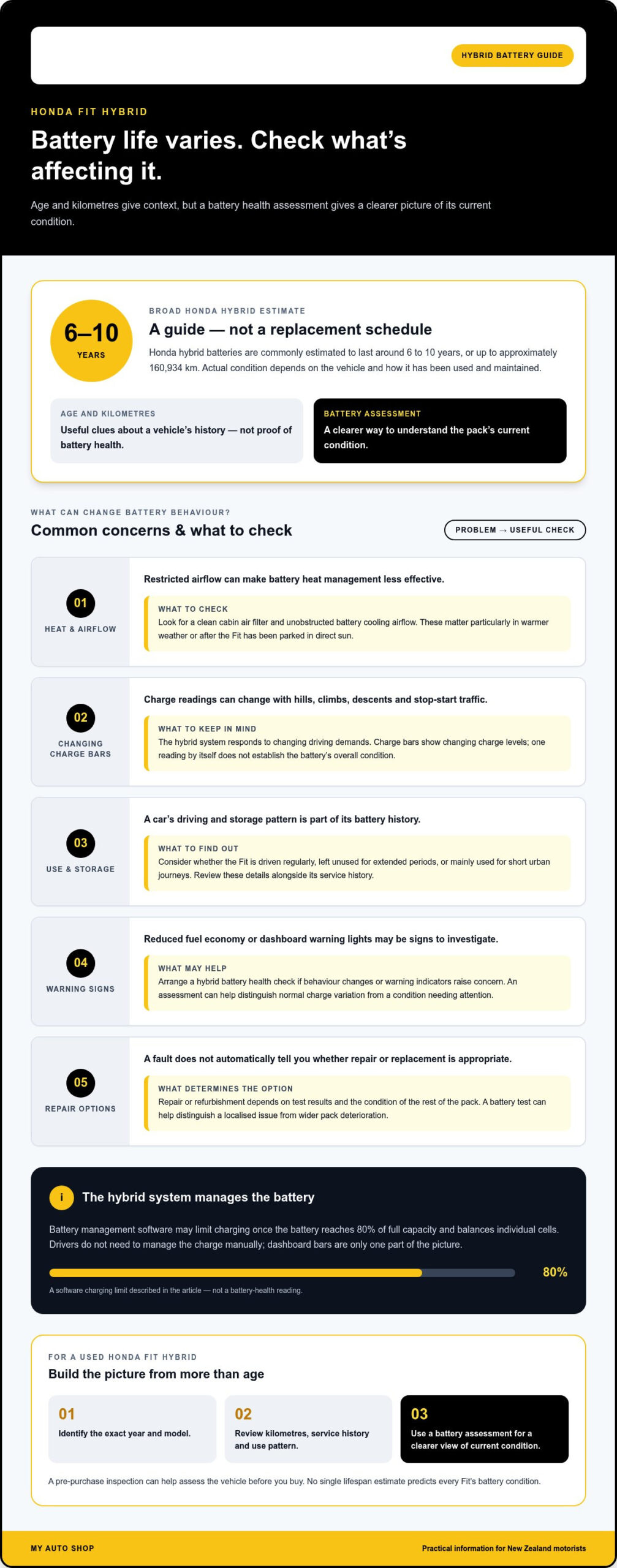
Honda hybrid batteries are commonly estimated to last 6 to 10 years, though driving and battery condition affect the result. For a used Honda Fit Hybrid, treat age and kilometres as clues, not a substitute for checking battery health.
Battery Life in Years and Miles
Battery lifespan describes how long a pack can support the hybrid system before its condition or performance makes replacement necessary. Honda hybrid estimates commonly range from 6 to 10 years or up to approximately 160,934 km. Some estimates extend to 8 to 10 years and approximately 160,934 to 241,402 km. These are broad estimates, not a fixed replacement schedule. Age and kilometres help frame questions about a car’s history, while a health assessment gives a clearer picture of its current condition.
General hybrid battery estimates range from at least 5 years to more than a decade. A hybrid battery may need replacement at approximately 241,402 km or 15 years, whichever comes first. A hybrid car’s overall lifespan is sometimes described as approximately 241,402 to 321,869 km, but that isn’t a battery-life guarantee. The pack’s condition, how the vehicle has been driven and its maintenance history all matter. For background on choosing a replacement battery, see this car battery selection guide.
Lifespan Differences Across Honda Fit Generations
Honda Fit hybrid battery life varies by generation, model year and vehicle condition, so one estimate can’t predict every Fit’s lifespan. Different versions may use different hybrid systems, and an older car may have a different maintenance and storage history from a newer one. If you’re buying, identify the exact year and model to put battery age in context. A condition check is more useful than assuming every Fit battery will last the same length of time.
There isn’t one lifespan figure that applies equally to a Honda Fit, Toyota Aqua and every other hybrid. Compare the specific vehicle’s age, kilometres, maintenance history and battery health instead of assuming one model lasts longer. This is especially useful when considering an imported car with a different service history.
Prius battery lifespan also varies, so broad hybrid estimates shouldn’t be treated as a Prius-specific guarantee. The same applies to the Fit: a general range can help set expectations, but it can’t establish an individual battery’s condition. Consider the vehicle’s history alongside evidence from a battery assessment.
Honda Fit hybrid battery replacement cost in New Zealand depends on the battery type, vehicle model and year, parts and labour. The price depends on the case and is provided after a quote request; relevant factors include the required battery and the work involved.
A hybrid battery may sometimes be repaired or refurbished, but the right option depends on test results and the condition of the rest of the pack. Reliability depends on the fault, the work completed and whether other components are also degraded. A battery test can help distinguish a localised issue from wider pack deterioration.
Factors affecting battery life
Temperature, charging patterns and the way the battery management system operates all affect a Honda Fit Hybrid’s battery. Honda Fit hybrid battery life expectancy depends on how these factors shape the battery’s workload over time. This helps explain why two Fits of similar age can show different battery behaviour on New Zealand roads.
A hybrid battery produces and absorbs heat during operation. Honda hybrid battery management systems monitor temperature and charge levels to help prevent overcharging and deep discharge. Restricted airflow around the battery can make heat management less effective. Keeping the cabin air filter clean is recommended to support battery health in hot conditions, particularly during warmer weather or after the Fit has been parked in direct sun.
Charge management also shapes how the pack is used. Battery management software may limit charging once the battery reaches 80% of full capacity. It also balances individual cells, which helps keep the pack operating as a coordinated unit. This matters because the hybrid system manages the battery rather than relying on the driver to control charge manually. Dashboard charge bars show changing charge levels, but a particular reading alone doesn’t establish the battery’s overall condition.
Driving conditions can change those readings from trip to trip. A Honda Jazz Mk4 Crosstar owner living in a hilly area reported seeing 10 battery bars frequently on 24 March 2024. That example shows how terrain can affect displayed charge behaviour, not that hills prove a battery is damaged. Long climbs, descents and stop-start traffic place different demands on the hybrid system. The car’s management software responds to those demands as the drive changes.
Regular driving is recommended to support Honda hybrid battery health. A vehicle left unused for extended periods misses the ordinary operation that cycles its hybrid system. This doesn’t mean every short trip harms the battery, but the Fit’s use pattern is part of its history. Note whether it’s driven regularly, stored for long stretches or mainly used for short urban journeys. These details put Honda Fit hybrid battery life expectancy into context.
For a used Fit, consider these factors together rather than treating any one of them as a verdict:
- Check whether the cabin air filter is clean and the battery cooling airflow is unobstructed.
- Notice whether charge bars change as driving conditions change, including hills and stop-start traffic.
- Consider the vehicle’s storage and driving pattern alongside its service history.
- Arrange a hybrid battery assessment if changing behaviour or warning indicators raise concern.
These details give a more useful picture than age alone. A battery assessment can help distinguish normal charge variation from a condition that needs attention.
Hybrid battery warranty coverage
Honda hybrid battery warranty figures vary across general descriptions, so don’t treat one duration as applying to every Fit in New Zealand. One commonly cited description gives Honda hybrid batteries an 8-year/160,934-kilometre warranty. Another describes an 8-year or 128,747-kilometre warranty, whichever comes first, for Honda, Toyota and Ford hybrid battery packs. These figures differ, making the vehicle’s own warranty documents important.
A warranty period sets the time and distance limits for specified repairs or replacement. It doesn’t predict when a battery will wear out or automatically cover every battery-related concern. For example, a car may show reduced performance without meeting the warranty conditions for a covered fault. The written terms explain what’s covered and how a claim is assessed.
For a Honda Fit Hybrid, identify the exact model year and original in-service date first. Then compare the current odometer reading with the warranty’s stated distance limit. General figures are broad descriptions, not a promise of New Zealand coverage. Check that the warranty terms apply to the specific vehicle and market rather than assuming all Fit models have identical cover.
For a used Fit, review the warranty booklet or other written warranty records alongside the service documents. Look for the battery component wording, start date, distance limit, conditions and any transfer rules. A seller’s verbal statement that “the hybrid battery is covered” doesn’t explain those details. Written evidence gives you specific terms to compare with the car’s age and odometer reading.
Warranty cover and battery testing answer different questions. A battery assessment describes its current condition; warranty terms describe possible cover for an eligible fault. If a test identifies a concern, the results can help explain it, but they don’t establish that a warranty claim will be accepted. The warranty’s requirements determine how a claim is handled.
Before buying, use this short document check:
- Match the vehicle identification details in the records to the Honda Fit you’re viewing.
- Compare the warranty start date and distance limit with the car’s age and odometer.
- Read the battery wording and any conditions, including rules for a change of owner.
- Keep written warranty documents with the vehicle’s service history.
These steps help separate a general 8-year warranty description from actual cover attached to a particular car. If the paperwork gives a different term from a broad estimate, rely on the vehicle’s written terms when considering its protection. For a New Zealand buyer, that distinction matters: overseas warranty figures alone don’t establish what applies to an individual Fit.
Maintenance and battery health checks
Regular use, clear airflow for battery cooling and timely assessment support informed care of a Honda Fit Hybrid. Dashboard readings can help you notice changes, but they don’t replace a diagnostic check. To understand Honda Fit hybrid battery life expectancy, consider maintenance records alongside battery assessment results.
Keep the cabin air filter clean, especially in hot weather, to support hybrid battery health. Where possible, avoid leaving the Fit unused for long stretches. Regular driving is recommended, though it doesn’t guarantee a particular result. Follow the vehicle’s scheduled maintenance guidance and record changes in fuel economy, warning lights or battery display behaviour.
Watch the charge display in context. A Honda Jazz Mk4 hybrid owner’s estimate places normal operation around 3 to 7 bars, or roughly 30% to 70%. That is an owner estimate, not a health reading for every Fit generation. Hybrid battery management software may indicate an empty battery when charge falls to almost 20%. The display reflects charge available at that moment, not a direct measurement of long-term battery capacity.
For an older vehicle, a diagnostic assessment can provide more useful information than the dashboard alone. One recommendation is to diagnose the hybrid battery once the car is more than 8 years old or has exceeded approximately 128,748 km. After either threshold, the recommendation is to arrange a battery check every 12 months. These are inspection intervals, not a prediction that the battery has failed. The results add vehicle-specific context to its expected lifespan.
A hybrid battery health check assesses system data and battery performance. It can help identify whether readings suggest deterioration or another issue affecting hybrid operation. Ask for the results in plain language: what was tested, what the readings indicate and whether follow-up is needed. Keep the report with the Fit’s service history to help track changes over time, particularly if symptoms appear between assessments.
Some servicing shops offer battery health tests and services intended to restore weak cells. A claim that this can return a battery to almost 97% of its original strength appears in general market information, but it shouldn’t be treated as a guaranteed result for a particular Fit. Test findings, the fault and the pack’s overall condition affect what can be done. A proper assessment should distinguish a measured result from a possible outcome.
- Keep the cabin air filter clean and the vehicle regularly driven.
- Note changes in dashboard warnings, fuel economy and charge display behaviour.
- Consider assessment after 8 years or approximately 128,748 km, then every 12 months.
- Keep test findings with the vehicle’s maintenance records.
What are the signs a Honda Fit hybrid battery is failing?
Reduced fuel economy and dashboard warning lights are recognised warning signs for Honda hybrid batteries. Neither proves the battery is the cause. Look for changes over several drives and arrange a diagnostic assessment if concerns persist.
Start by checking fuel use. Compare recent consumption with the Fit’s usual pattern on similar routes and in similar driving conditions. A change in colder weather, heavy traffic or frequent short trips doesn’t point to a specific fault by itself. Note when the change began and whether it continues on familiar journeys. This record gives a technician useful context, rather than relying on a single trip or impression.
Pay attention to dashboard alerts. A hybrid-system warning deserves attention, especially if it returns after you restart the vehicle. Record the warning’s wording and any other lights that appear at the same time. Don’t ignore an alert just because the Fit still drives. The warning signals a system concern; diagnostic testing helps determine whether the hybrid battery is involved.
Also watch how the hybrid system behaves during ordinary driving. Note changes in how often the petrol engine runs, whether electric-motor assistance seems different or whether the charge display changes unusually quickly. These are useful clues, not a diagnosis. The Honda Fit’s battery display shows current charge, so a single low or high reading doesn’t establish battery failure.
Separate recurring patterns from one-off changes. For example, if fuel economy drops and a dashboard warning appears over several trips, record both details and arrange a hybrid battery assessment. If you notice only one symptom, note the route, traffic and conditions. This helps distinguish a recurring pattern from a change linked to one journey.
A diagnostic test checks system information that the dashboard can’t explain on its own. It can help identify whether battery performance has changed or another hybrid-system issue needs attention. Share the Fit’s warning details, fuel-use observations and service history during the assessment. These specifics put the test results in context and help clarify the next step.
- Record changes in fuel economy across comparable trips.
- Write down dashboard warning messages and when they appear.
- Note repeated changes in engine use or charge-display behaviour.
- Arrange a hybrid battery assessment when warning signs persist.
If these signs appear in your Honda Fit, arrange hybrid battery testing to assess its condition.
My Auto Shop: Pre-purchase Inspection
My Auto Shop offers a Pre-purchase Inspection to help you assess a used Honda Fit Hybrid before buying. It’s a practical next step if the vehicle’s age, service history or dashboard warnings leave questions unanswered. An inspection gives you a clearer view of the car’s overall condition, so you can make a more informed decision than you could from a brief test drive alone.
Battery life estimates can’t tell you the present condition of the specific Fit you’re considering. Treat the vehicle’s history and any warning signs as useful context when arranging an inspection. Learn more about the pre-purchase inspection and what it can help you assess.
Visit My Auto Shop to explore your next step.
Make your next decision with confidence
Use Honda Fit hybrid battery life expectancy as context, not as a verdict on an individual car. If you’re considering a used Fit, bring together its service history, any warning signs and the inspection results before deciding what to do next. A clearer picture of the vehicle means fewer unknowns as you plan for ownership.
My Auto Shop offers Pre-purchase Inspection, Basic Service and Comprehensive Service options for different stages of car ownership. Choose the next step that suits your situation, whether you’re assessing a Fit before buying or arranging ongoing care.
Contact My Auto Shop for help with your next step. A considered decision starts with the information that matters to you.
Frequently Asked Questions
How long does a Honda Fit hybrid battery last in years and kilometres?
Honda hybrid batteries are commonly estimated to last around 6 to 10 years, with some estimates reaching about 150,000 miles. These mileage estimates aren’t a precise kilometre replacement point for every New Zealand Fit. Use the odometer as one part of the vehicle’s history, not as a battery diagnosis. A battery assessment provides more specific information about the pack’s current condition than converting a general estimate into a fixed distance.
What affects the lifespan of a Honda Fit hybrid battery?
Heat management, charging patterns and driving habits all influence battery condition. For example, a Fit used on steep roads may show different charge behaviour from one driven mainly on flat urban routes. That difference alone doesn’t establish battery damage. Consider how the car is used alongside its maintenance history and test results. This gives you a better basis for comparing two used Fits than model year or odometer readings alone.
What maintenance or driving habits can extend Honda Fit hybrid battery life?
Keep the cabin air filter clean, drive the Fit regularly and pay attention to changes in its behaviour. These habits may support battery care, but battery condition can still change over time. If you’re considering a used Fit, compare its service records with its current condition rather than relying on the seller’s description alone. A pre-purchase inspection can help you assess the wider vehicle before deciding whether it suits your needs.
How does Honda Fit hybrid battery lifespan compare with Toyota Aqua and other hybrids?
There isn’t one lifespan figure that applies equally to a Honda Fit, Toyota Aqua and other hybrids. Compare each vehicle’s age, kilometres, maintenance history and battery health instead of assuming one model lasts longer.
Disclaimer
This article provides general information only and should not be relied on as professional mechanical, safety or legal advice. Vehicle requirements and circumstances vary. If you are unsure about your vehicle, have it inspected by a qualified automotive professional.