
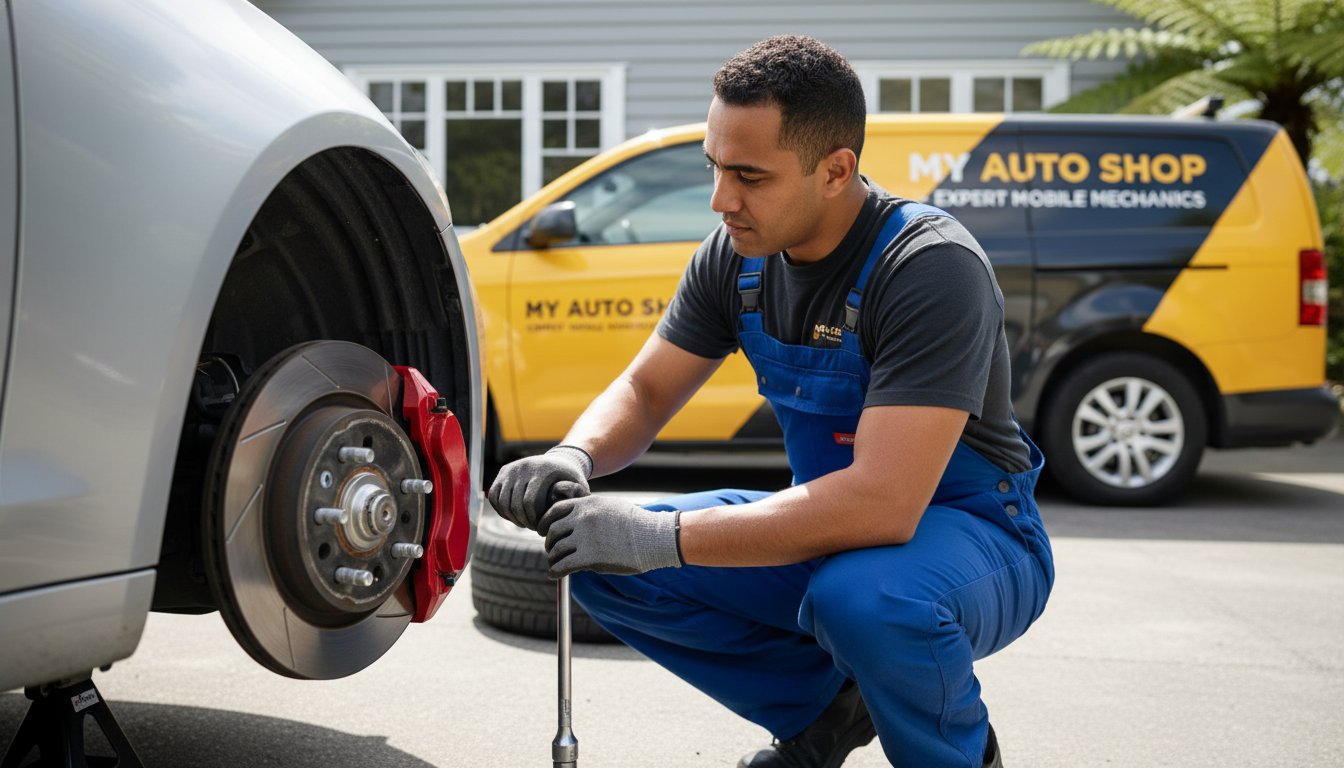
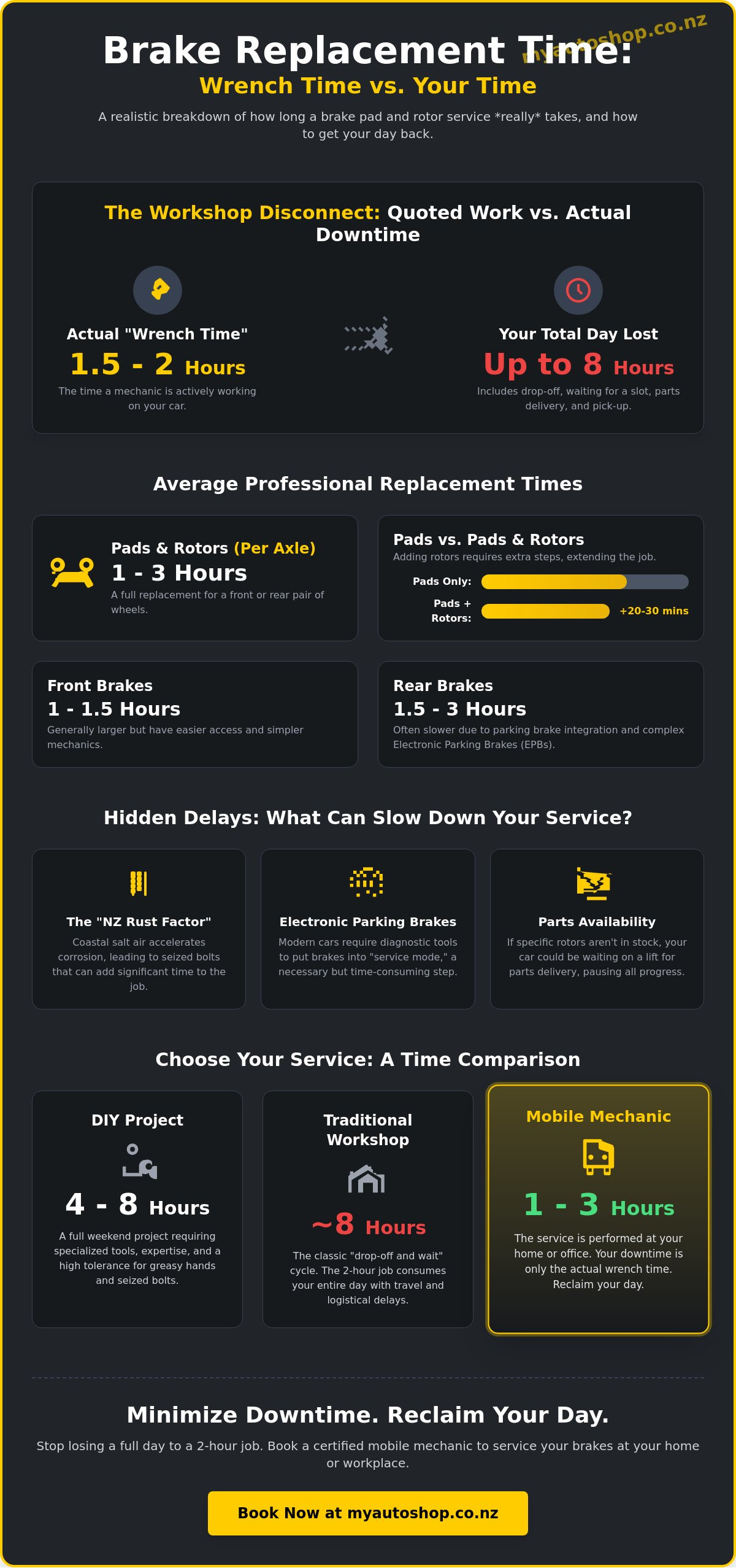
What if the biggest delay in your brake pad and rotor replacement time isn’t the mechanic’s wrench, but the logistics of the workshop floor itself? It’s a common frustration; you’re told the job is simple, yet you still end up losing an entire day to the “drop-off and wait” cycle. We understand that your time is just as valuable as your safety. Being without a vehicle for eight hours just to complete a repair that typically takes a professional 1.5 to 2 hours is a massive headache you shouldn’t have to deal with.
Getting a clear handle on the clock is the first step to taking back control of your schedule. This article provides a realistic breakdown of how long the service actually takes, from the moment the wheels come off to the final safety check. You’ll learn why replacing rotors adds extra steps to the process compared to a simple pad swap and how 2026 vehicle inspection standards might affect your repair timeline. We also explore how to bypass traditional workshop delays by bringing an expert mobile mechanic directly to your home or office.
Key Takeaways
- Plan for a professional brake pad and rotor replacement time of 1 to 3 hours per axle, noting that rotors typically add 30 minutes to the labor.
- Identify how modern features like Electronic Parking Brakes and local factors like coastal rust can unexpectedly extend your repair timeline.
- Contrast the 4-8 hour commitment of a DIY project against professional service times to determine the best use of your weekend.
- Navigate the 28-day Warrant of Fitness (WoF) re-check window efficiently if your vehicle fails for brake thickness or rotor scoring.
- Reclaim your day by booking a mobile mechanic to perform the service at your home or office, eliminating the need for workshop drop-offs.
The Quick Answer: Average Brake Pad and Rotor Replacement Time
Your brake pad and rotor replacement time usually falls between 1 and 3 hours per axle. Precision takes time. If you’re looking at a full vehicle overhaul for all four wheels, expect to block out 3 to 5 hours of workshop time. This isn’t just about how fast a technician can turn a wrench. It’s about safety. While a set of pads can be swapped quickly, rotors require extra care. You have to clean the hub surface, install new hardware, and ensure the rotor sits perfectly true. This prevents future vibrations and ensures a smooth stop.
Adding new rotors to the job typically extends the brake pad and rotor replacement time by 20 to 30 minutes compared to a pad-only replacement. This happens because the caliper must be fully removed and secured. It can’t just be swung out of the way. Understanding how disc brakes work helps explain why this extra time is vital. Since the pads squeeze the rotor to create friction, any debris or misalignment can ruin your stopping power. An expert takes that extra half hour to get it right the first time.
Wrench Time vs. Total Workshop Time
Don’t confuse wrench time with the total time your car spends at the shop. Wrench time is the active minutes a mechanic spends physically working on your vehicle. Total workshop time includes the logistical steps that keep things organized. Expect 15 to 30 minutes for intake and paperwork when you arrive. Once the mechanical work finishes, a mandatory road test follows. This isn’t a joyride. The technician performs a bedding-in process to transfer friction material from the pads to the rotors. It ensures maximum performance before you drive home.
Front vs. Rear Brake Replacement Duration
Front brakes usually take 1 to 1.5 hours. They are typically larger but provide easier access because they don’t have integrated parking brake mechanisms. Rear brakes are a different story. These often take longer because the system might be integrated with your handbrake or involve complex drum-in-hat setups. If your car has an Electronic Parking Brake, the mechanic needs specialized diagnostic tools to retract the calipers safely. This adds significant time to the procedure but prevents damage to the electronic motors.
Think about efficiency when booking your service. If your front pads are nearly gone and the rears are close behind, replace them together. Bundling services saves you from two separate trips and two separate intake processes. It keeps your vehicle’s maintenance cycle predictable and ensures your entire braking system is balanced. You’ll spend less time in a waiting room and more time on the road. We prioritize your schedule without ever cutting corners on your safety.
Factors That Can Speed Up or Slow Down the Clock
While we have established the baseline average brake replacement times, several variables can either trim or extend your visit. The most common culprit is vehicle age. In New Zealand, coastal humidity creates what we call the “NZ Rust Factor.” Salt air accelerates corrosion on undercarriage components. A simple bolt that should take ten seconds to remove can turn into a thirty-minute battle if it is seized. These mechanical hurdles are the primary reason why a quote for two hours might occasionally stretch into three.
Parts availability also dictates your downtime. If a workshop has your specific rotors on the shelf, you are in and out. If they have to wait for a delivery from a central warehouse, your car sits on the lift while the clock ticks. Performance vehicles with multi-piston calipers or specialized cooling ducts require even more specialized handling, which naturally extends the service window compared to a standard economy car.
The Impact of Modern Vehicle Technology
Modern cars are computers on wheels. If your vehicle features an Electronic Parking Brake (EPB), the service workflow changes completely. A technician cannot just compress the rear calipers manually. They must use a diagnostic tool to put the braking system into “service mode.” This digital handshake adds time but protects the expensive electronic motors from damage. Brake wear sensors also play a role. These fragile wires often need replacing alongside the pads, adding small but vital steps to the job. European models often demand even higher precision, requiring specific torque sequences that make the process slower but much safer.
Environmental and Mechanical Hurdles
Cleanliness determines longevity. A professional does not just slap on new parts. They spend time cleaning and lubricating the caliper slide pins. If these pins are dry or gunked up, your new pads will wear unevenly and fail early. This meticulous work is why your brake pad and rotor replacement time might feel longer than a “quick” DIY attempt. You might also choose to include a brake fluid flush during the service. This is highly recommended when opening the system and typically adds about 30 minutes to the total downtime. If you want to skip the workshop waiting room entirely, booking a mobile mechanic allows this work to happen in your driveway while you stay productive.
DIY vs. Workshop vs. Mobile Mechanic: A Time Comparison
When calculating your brake pad and rotor replacement time, you have to look beyond the “wrench time.” Total downtime is what actually impacts your life. If you choose the DIY route, a beginner should set aside 4 to 8 hours. This includes the time spent researching your specific car model, driving to the parts store, and the physical labor of jacking up the vehicle. While some online forums claim it’s a quick Saturday job, they often ignore the cleanup and the inevitable second trip to the store for a tool you didn’t know you needed. For most, this turns a minor repair into a full-day commitment.
Traditional workshops usually need your car for 2 to 4 hours. However, the hidden time costs are much higher. You have to factor in the morning traffic during drop-off and the logistical puzzle of getting back to the shop later in the day. Often, your car sits idle for an hour or more while waiting for an open lift. This “waiting room lag” means you are effectively without your vehicle for the better part of a business day, even if the actual mechanical work is relatively brief.
The Convenience Factor of Mobile Repairs
A mobile mechanic streamlines the entire process into a 1.5 to 2.5-hour window. This is the most efficient path because it eliminates travel time entirely. While the technician works on your driveway, you stay productive in your home office or relax with your family. There are no shuttle runs, no expensive Uber rides, and no distractions from other customer vehicles. The mechanic focuses exclusively on your car from start to finish. This dedicated attention ensures a faster turnaround without compromising on safety or quality. It’s the modern way to handle maintenance without losing your afternoon.
Why Professional Tools Save Time
Professional equipment makes a massive difference in speed. A technician using a high-torque pneumatic or cordless impact wrench can remove lug nuts and caliper bolts in seconds. Doing the same job with a hand ratchet and a breaker bar can easily add 20 minutes of physical struggle per wheel. Professionals also carry specialized diagnostic software. If your car requires an electronic reset for the braking system, they can do it instantly. A DIYer might spend an hour just figuring out how to clear a dashboard warning light. Using the right tools doesn’t just make the job easier; it ensures the work is completed within the promised timeframe. If you want to reclaim your day, booking a mobile mechanic is the smartest logistical move you can make.
WOF Inspections and Brake Replacement Urgency
Failing a Warrant of Fitness (WoF) turns a routine maintenance task into a high-pressure deadline. In New Zealand, a failure for “brake thickness” or “rotor scoring” triggers a 28-day window for a re-check. While this provides a small buffer, it forces you into a scheduling scramble. You don’t want to be the person calling every workshop in town on day 27. As of November 1, 2026, the stakes are even higher with fines for non-compliance increasing to $350 for warrants expired by more than two months. Planning your brake pad and rotor replacement time before your inspection date keeps you in control and avoids the stress of a “safety-critical” fail.
Waiting until the WoF inspector finds a problem is the least efficient way to manage your car. By then, the damage to your rotors might have progressed from a minor “lip” to deep scoring that requires an immediate, mandatory replacement. This reactive approach often leads to longer wait times at the workshop because you are competing for a slot with everyone else who just failed their inspection. Pre-emptive action is the smarter move for your schedule and your safety.
Understanding NZ Safety Standards for Brakes
The NZTA recently tightened assessment criteria in May 2026. These revised guidelines focus heavily on rotor condition and rear drum brake integrity. Inspectors now look for even minor hydraulic fluid seepage or drum scoring that might have passed in previous years. To pass a WoF, your brake pads must meet minimum thickness requirements, usually 1.5mm, but most professionals recommend replacement well before that limit. A professional inspection is often faster than a WoF re-check because it allows the technician to address issues before they become legal failures. It keeps your vehicle’s record clean and your downtime predictable.
Bundling Services to Save Time
Efficiency is about doing the right jobs at the right time. Replacing pads and rotors together is significantly faster than performing two separate jobs months apart. Since the wheels are already off and the calipers are removed, the incremental time to swap a rotor is minimal. You can easily bundle a Brake Pad Replacement with a Basic or Comprehensive service to maximize your workshop visit. This proactive strategy ensures your car is always WoF-ready. If you are looking at a new vehicle, a Pre-Purchase Inspection is a vital tool. It identifies thin pads or lipped rotors before you sign the paperwork, ensuring you don’t inherit an immediate repair timeline.
Minimize Your Downtime with My Auto Shop
We have spent this article breaking down the technical side of your brake pad and rotor replacement time. Now, it’s time to focus on the solution that fits your busy life. My Auto Shop was built to eliminate the logistical friction that usually comes with car maintenance. Traditionally, booking a brake service meant calling multiple shops, waiting for callbacks, and chasing quotes. We have replaced that outdated cycle with a streamlined digital platform. You get instant access to a national network of MTA-approved workshops and expert mobile mechanics without the frustrating back-and-forth.
Transparency is our hallmark. You shouldn’t have to guess what you’re paying or how long your car will be out of action. Our platform provides upfront pricing, allowing you to make an informed decision in seconds. If you want to reclaim your entire day, our mobile mechanic service is the ultimate time-saver. Instead of navigating morning traffic to reach a workshop, the expert comes directly to your home or office. This removes the “drop-off and wait” factor entirely. You can stay productive at your desk or relax with your family while we handle the heavy lifting on your driveway.
The My Auto Shop Booking Advantage
Our platform narrows down the best local options based on your specific vehicle and location in seconds. You don’t just see a list of names; you see real-time availability. This means you can book a slot that actually works for your schedule, not the workshop’s. We also maintain a digital service history for every vehicle on our platform. This organized record-keeping is invaluable when your next WOF rolls around. It provides clear evidence of professional maintenance, helping your car pass its inspection with flying colors and maintaining its resale value.
Ready to Stop Squealing? Book Now
Delaying your brake work doesn’t just waste time; it risks your safety and leads to more expensive repairs. As we discussed earlier, worn pads quickly damage rotors, turning a simple swap into a major overhaul. Our booking process is simple and takes less than two minutes. Just enter your registration, choose your service, and select a time that suits you. It’s the most efficient way to manage your brake pad and rotor replacement time without the typical industry headaches. Book your brake pad and rotor replacement with My Auto Shop today and experience a faster, more transparent way to keep your car safe.
Take Back Your Day with Smarter Brake Service
Understanding your brake pad and rotor replacement time helps you plan without the stress of “hidden” delays. You now know that while the mechanical work takes roughly 1 to 3 hours per axle, the real time-saver is choosing a service that eliminates the logistical commute. Whether you’re facing a tight 28-day WOF re-check window or just want to avoid the squeal, being proactive prevents more complex repairs down the road.
We make this process effortless by connecting you with MTA Approved Mechanics across New Zealand. You get transparent, fixed-price quotes instantly, so there’s no guesswork involved. With nationwide coverage, a reliable partner is always nearby. Stop worrying about workshop waiting rooms and start reclaiming your schedule with a service that respects your time.
Get an instant quote for your brake replacement
Safe driving starts with reliable brakes. We’re here to help you get back on the road quickly and confidently.
Frequently Asked Questions
Can I just replace my brake pads and not the rotors to save time?
You can replace only the pads if your rotors are still above the minimum legal thickness and free of warping. This “pad slap” saves about 20 to 30 minutes of labor per axle. However, if your rotors have deep grooves or a significant lip, new pads won’t seat correctly. This results in poor stopping power and annoying squeals, which eventually wastes more time when you have to return for a second repair.
How do I know if my rotors need replacing or just my pads?
A professional technician uses a micrometer to measure the rotor’s thickness against the manufacturer’s safety limits. You can look for physical clues like deep circular grooves or a heavy rusted lip on the outer edge. If your steering wheel vibrates when you hit the brakes, your rotors are likely warped and need to be swapped. We check these measurements during every brake pad and rotor replacement time to ensure your car remains safe.
Does a mobile mechanic take longer than a traditional workshop?
Mobile mechanics are often more efficient because they focus entirely on your car without the distractions of a busy shop floor. In a traditional workshop, a technician might juggle multiple jobs at once, leading to significant idle time for your vehicle. A mobile service happens right on your driveway, eliminating the time you would normally spend driving to a garage or sitting in a waiting room. It is the fastest way to get the job done while staying productive at home.
What happens if the mechanic finds more issues during the brake job?
The technician will stop work and explain the situation clearly before any extra steps are taken. They might find a seized caliper or a perished brake hose that wasn’t visible during the initial quote. While these discoveries can extend the repair time, addressing them immediately prevents a future breakdown. We prioritize transparency and safety, ensuring you understand exactly what is needed to get your car back on the road securely.
Why do European cars take longer for brake replacements?
European vehicles often use specialized hardware and complex electronic systems that require a more methodical approach. Many models feature single-use stretch bolts that must be replaced with every service, requiring extra precision and care. Additionally, these cars often have integrated sensors that need careful recalibration using diagnostic software. This technical complexity ensures high performance but requires a slightly longer service window than a standard economy vehicle.
Is it safe to drive my car while waiting for my brake appointment?
It depends on the symptoms you are experiencing. If you hear a faint squeak, you are likely okay for a few days of essential driving. However, if you hear a loud metal-on-metal grinding sound, your pads are completely worn out and you risk total brake failure. A soft or “spongy” brake pedal is another major red flag. If your car feels unsafe or takes longer to stop, park it and wait for your professional service to avoid a dangerous situation.
How often should I have my brakes checked in New Zealand?
Plan for a professional brake inspection every 10,000 to 15,000 kilometers or during your annual service. New Zealand’s steep hills and salt-heavy air can accelerate wear and corrosion on your braking components. Regular checks allow you to budget for your brake pad and rotor replacement time in advance. This proactive habit helps you avoid the stress of a surprise Warrant of Fitness failure and keeps your vehicle performing at its best year-round.
Disclaimer
This article provides general information only and should not be relied on as professional mechanical, safety or legal advice. Vehicle requirements and circumstances vary. If you are unsure about your vehicle, have it inspected by a qualified automotive professional.