
Last Tuesday, Mark noticed a grinding sound while driving through Christchurch. He knew his brakes needed work, but he spent the next three hours scrolling through forums trying to find a straight answer on the brake pad replacement cost nz. It’s frustrating when you can’t get a clear price without leaving your car at a workshop for half a day. We agree that the traditional mechanical experience is often opaque and unnecessarily stressful for busy Kiwis.
As a Kiwi owned business, we’re here to fix that. This guide provides a transparent breakdown of what you’ll likely pay in 2026, helping you plan your budget without the fear of surprise add-ons at the counter. We’ve analyzed service data from NZ’s best mechanics to give you the most accurate picture possible for your specific vehicle type. You’ll learn about the price difference between ceramic and semi-metallic pads, when your rotors actually need a change, and how our pick up and drop off service removes the workshop hassle entirely. Let’s get your car back to stopping safely and smoothly.
Key Takeaways
- Get a clear breakdown of current market rates for front and rear sets to ensure you pay a fair price for your vehicle.
- Understand the price gap between European and Japanese models and how your car’s origin impacts your maintenance budget.
- Calculate a more accurate brake pad replacement cost nz by identifying hidden essentials like rotor health and safety-critical fluid flushes.
- Weigh the risks of DIY against the security of professional receipts and the convenience of modern pick-up and drop-off services.
- Learn how to bypass “mechanic anxiety” with instant, upfront quotes that put you back in control of your car’s maintenance.
Average Costs for Brake Pad Replacement in New Zealand (2026)
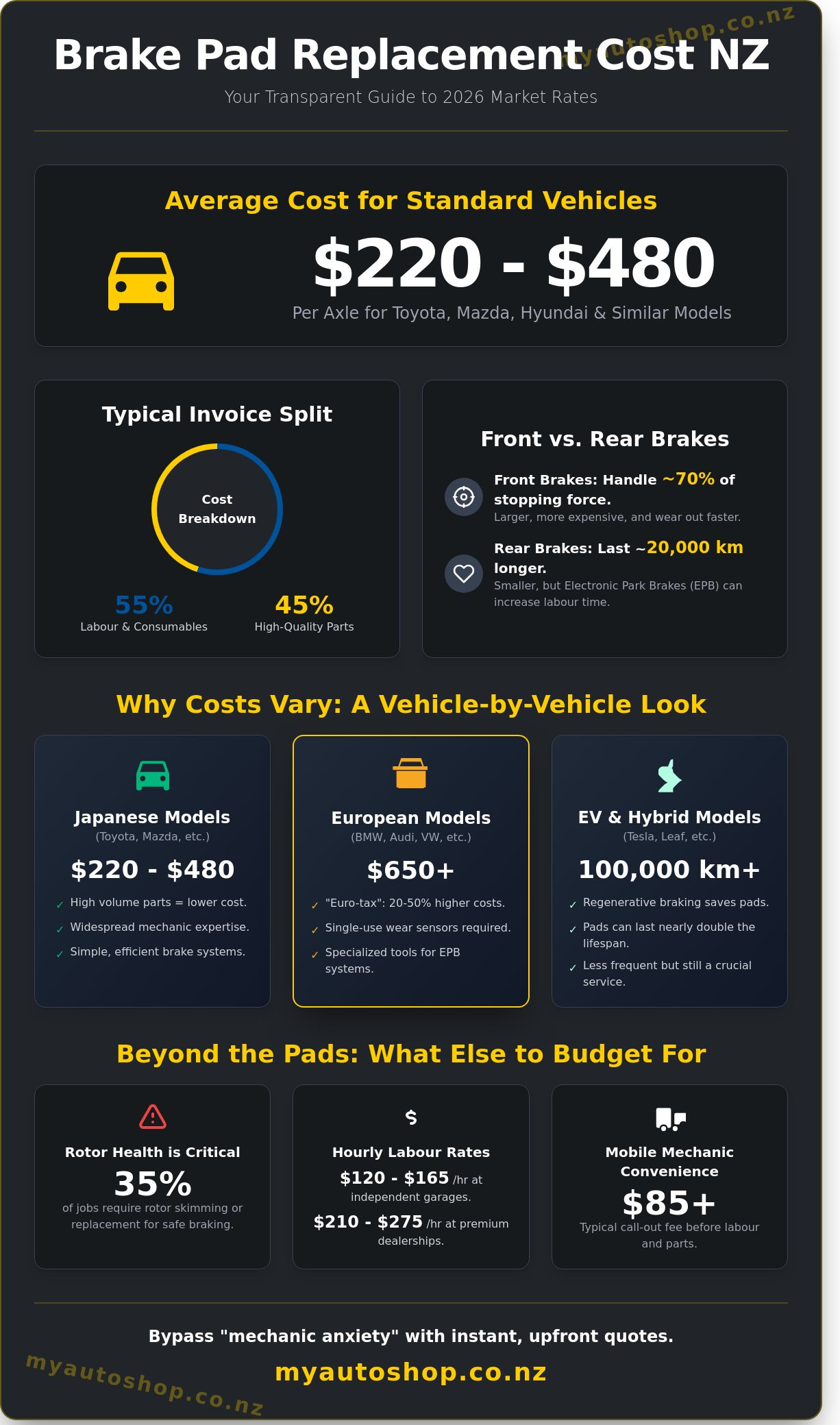
Understanding your brake pad replacement cost nz starts with a clear look at current market rates. By 2026, local workshop prices have adjusted to reflect a 4.2% annual increase in operational costs and ongoing shifts in global shipping. For a standard passenger vehicle, you can expect to pay between $220 and $480 per axle. This range covers the essentials for most Toyotas, Mazdas, and Hyundais on Kiwi roads. If you drive a European brand or a heavy 4WD, those figures often climb above $650 due to specialized part requirements.
The total invoice usually splits into two main categories. High-quality parts account for roughly 45% of the cost, while professional labour and workshop consumables make up the remaining 55%. It helps to understand what brake pads are and how different materials, like ceramic or semi-metallic, influence the price and performance of your car. Choosing the cheapest pads often leads to more brake dust and a shorter lifespan, which increases your long-term maintenance spend.
Transparency is key when you get a quote. Many drivers feel frustrated when an initial estimate for “just pads” increases once the car is on the hoist. Mechanics often discover that rotors have hit their minimum thickness or that caliper slide pins have seized. In 2026, about 35% of brake pad jobs require additional rotor skimming or replacement to ensure the new pads bed in correctly. A reliable mechanic will provide photos or show you the wear indicators before starting any extra work.
Labour Rates and Service Timeframes
Labour costs vary depending on where you book. Independent NZ garages currently charge between $120 and $165 per hour. Dealerships for premium brands often sit between $210 and $275 per hour. A standard axle replacement takes 1 to 1.5 hours. Mobile mechanics are a popular choice for busy Kiwis. While they offer the convenience of home service, they often charge a call-out fee starting at $85 to cover travel and specialized mobile equipment.
Front vs. Rear Brake Pads: Why the Price Differs
Front brakes handle about 70% of the stopping force. Because they deal with more heat and weight, front pads are physically larger and contain more friction material. This makes them more expensive than rear sets. Rear pads are smaller and usually last 20,000 kilometres longer than the fronts. However, many modern vehicles now feature electronic park brakes (EPB). These require a technician to use a scan tool to retract the calipers, which can add 20 minutes to the labour time and narrow the price gap between front and rear services.
Why the Cost Varies: Japanese vs. European & EV Models
Your car’s country of origin is the biggest factor in your final bill. In New Zealand, the brake pad replacement cost nz fluctuates based on how easily parts can be sourced and the complexity of the installation. Toyota, Mazda, and Hyundai dominate our local roads. Because these parts move in high volumes, local suppliers keep massive stock levels, which drives the price down for the average Kiwi driver.
Performance vehicles and heavy SUVs sit at the other end of the scale. If your car features a Brembo-style braking system with 4 or 6-piston calipers, expect to pay more. These systems require larger pads and more intensive labor to ensure the high-performance hardware is cleaned and shimmed correctly. It’s a precision job that demands a higher level of technical expertise.
Owning a premium brand often comes with what locals call the “Euro-tax.” This isn’t a literal tax, but a reflection of the sophisticated engineering involved. Data highlights that repair costs for European cars are typically 20% to 50% higher than their Asian counterparts. This gap exists because European manufacturers prioritize high-friction materials that offer superior stopping power but wear out faster.
The European Car Factor
Modern BMW, Audi, and VW models don’t just use simple metal slabs for brakes. They utilize integrated wear sensors that trigger a warning light on your dashboard when the material hits a specific thickness, usually 3mm. These sensors are often single-use and must be replaced alongside the pads. Additionally, many European vehicles require specialized diagnostic tablets to retract the electronic parking brake (EPB) before the mechanic can even touch the hardware. This adds time and technology costs to the service.
Hybrid and EV Brake Maintenance
Electric vehicles (EVs) and hybrids change the maintenance game through regenerative braking. This technology uses the electric motor to slow the car, which saves the physical pads from daily wear. It’s common for EV brake pads to last over 100,000 kilometers, nearly double the lifespan of a traditional internal combustion engine vehicle. However, don’t ignore them entirely. Because the pads aren’t used as often, they can become prone to corrosion or seizing in New Zealand’s coastal humidity.
- Weight Matters: EVs are roughly 25% heavier than petrol cars due to battery weight, requiring specialized high-torque pad compounds.
- Fluid Health: Heavy EVs put immense pressure on brake fluid, making regular 2-year flushes non-negotiable for safety.
- Precision Parts: While you replace them less often, the specific materials required for heavy-duty EV braking can carry a higher price tag per set.
If you aren’t sure which category your vehicle falls into, you can get a transparent, fixed-price quote through MyAutoShop to see exactly what to expect for your specific make and model.
Beyond the Pads: Hidden Costs and Necessary Brake Repairs
Your brake pad replacement cost nz often involves more than just the friction material itself. If you feel a shudder through the steering wheel while braking at 80km/h, your rotors are likely the culprit. These components work together as a system. Ignoring a secondary issue usually leads to faster pad wear and higher costs later. We focus on transparent pricing so you understand exactly what your car needs to stay safe on Kiwi roads.
The Rotor Replacement Debate
Brake rotors, or discs, have a specific lifespan. NZTA safety standards for a Warrant of Fitness (WOF) require rotors to meet a minimum thickness, which is usually stamped on the part itself. A mechanic can sometimes “skim” a rotor to remove surface imperfections and stop vibrations. This process costs less than a full replacement but only works if there is enough metal left to remain above the legal limit. Many modern vehicles, especially European models, use “soft” rotors designed for better stopping power. These typically require a full replacement with every second set of pads. Fitting new pads to heavily lipped or thin rotors is a safety risk and will likely result in a WOF failure.
- Warped Rotors: Causes the steering wheel to shake during deceleration.
- Skimming: A cost-effective fix for minor surface rust or light grooves.
- Minimum Thickness: A legal requirement in NZ; rotors below this mark must be scrapped.
Calipers and Brake Lines
A seized caliper is a common reason for a repair bill to double. When the piston inside the caliper gets stuck, it keeps the pad pressed against the rotor even when you aren’t braking. You might notice a burning smell or the car pulling to one side. This generates extreme heat that can ruin brand-new pads in a matter of days. Our mechanics check the slider pins and seals to ensure everything moves freely before finishing the job.
Brake fluid is another critical factor. It is hygroscopic, meaning it absorbs moisture from the air over time. This water lowers the boiling point of the fluid and causes internal corrosion in your brake lines. Most manufacturers recommend a full brake fluid flush every 24 months. It’s a small investment that prevents total brake failure during an emergency stop. A compromised braking system can also place extra strain on your suspension, so it’s worth checking for signs of worn shock absorbers at the same time to ensure your entire safety system is in peak condition.
Don’t forget the brake wear sensors. These electronic components trigger the warning light on your dashboard when pads get dangerously thin. They are often fragile and can’t always be reused. Budgeting an extra $50 to $100 for these sensors ensures your brake pad replacement cost nz remains accurate without surprise additions at the workshop. We believe in keeping things simple and honest, giving you the confidence to get back on the road.
Professional Replacement vs. DIY: Calculating the Real Value
Many Kiwi drivers consider the DIY route to lower their total brake pad replacement cost nz. While the price of a set of pads might look cheap at a retail store, the hidden costs of doing it yourself quickly add up. You’ll need a high-quality floor jack, jack stands, and a calibrated torque wrench. Buying this equipment from a local retailer in 2025 can easily cost over $250. If you don’t already own these tools, your initial savings vanish instantly.
Professional receipts are more than just paper. They’re a vital part of your car’s service history. If you’re involved in an accident, insurance companies often look for proof that safety-critical components were fitted by a qualified technician. Without a professional invoice, you might face complications with your claim. A mechanic’s signature also simplifies your next inspection. In 2024, NZTA data showed that brake-related defects were a leading cause of WOF failures. A pro job ensures you pass the first time.
Warranty protection is another major factor. Most premium brake pad brands only honor their part warranties if a certified workshop performs the installation. If a DIY pad fails or squeaks, you’re on your own. Professional fitment keeps those protections active and keeps your bank account safe from double-handling costs. While your car is in for a brake service, it’s also the ideal time to ask your mechanic to check other time-sensitive components — understanding when to replace your cambelt is equally critical, as a snapped timing belt can result in a NZ$6,000 engine repair with no warning at all.
The Risks of DIY Brake Work
Brake systems are unforgiving. A small mistake can lead to total pedal failure. Common DIY errors include leaving air in the lines, which creates a spongy, dangerous pedal feel. Many home mechanics also use the wrong type of high-temp grease or over-tighten caliper bolts, leading to snapped hardware or seized brakes. Modern vehicles add another layer of complexity. If your car has an Electronic Park Brake (EPB), you generally cannot retract the rear pistons without a specialized diagnostic scan tool. Forcing these manually can result in a $700 repair bill for a ruined electronic motor.
Why Professional Service Wins
Choosing a professional workshop gives you access to precision gear that doesn’t fit in a home garage. Mechanics use workshop lathes to check rotor thickness and run-out, ensuring your new pads don’t vibrate or wear unevenly. Every professional job ends with a road test by a qualified expert to confirm the “bite” is perfect. It’s also the most efficient time to maintain your vehicle. You can have a Basic Service performed alongside your brake work to keep your engine as healthy as your stopping power. This holistic approach ensures your brake pad replacement cost nz provides the best long-term value for your safety.
Ready to stop safely? Book your transparent, fixed-price brake service with MyAutoShop today.
Seamless Brake Repairs with MyAutoShop’s Transparent Pricing
Traditional car repairs often involve a cloud of uncertainty. You drop your car off, wait for a phone call, and hope the bill doesn’t exceed your budget. MyAutoShop eliminates this “mechanic anxiety” by providing instant, upfront quotes. We believe your brake pad replacement cost nz should be clear before the first bolt is turned. Our platform connects you with a network of vetted, high-quality NZ mechanics who have passed rigorous quality checks. This ensures your safety isn’t compromised by cut-rate parts or rushed labor. Every garage in our network is held to a high standard of workmanship, giving you peace of mind that your vehicle is in expert hands.
We also tackle the biggest hurdle of car maintenance: time. Our signature Pick-up & Drop-off service means you can stay at your desk or on the couch while we handle the logistics. A professional driver collects your vehicle, takes it to one of our top-rated local garages, and returns it once the job is finished. You receive a transparent invoice that matches your initial quote exactly. There are no hidden fees, no “surprise” additions, and no technical jargon designed to confuse you. It is honest, professional service delivered with Kiwi reliability.
The Convenience of Mobile Mechanics
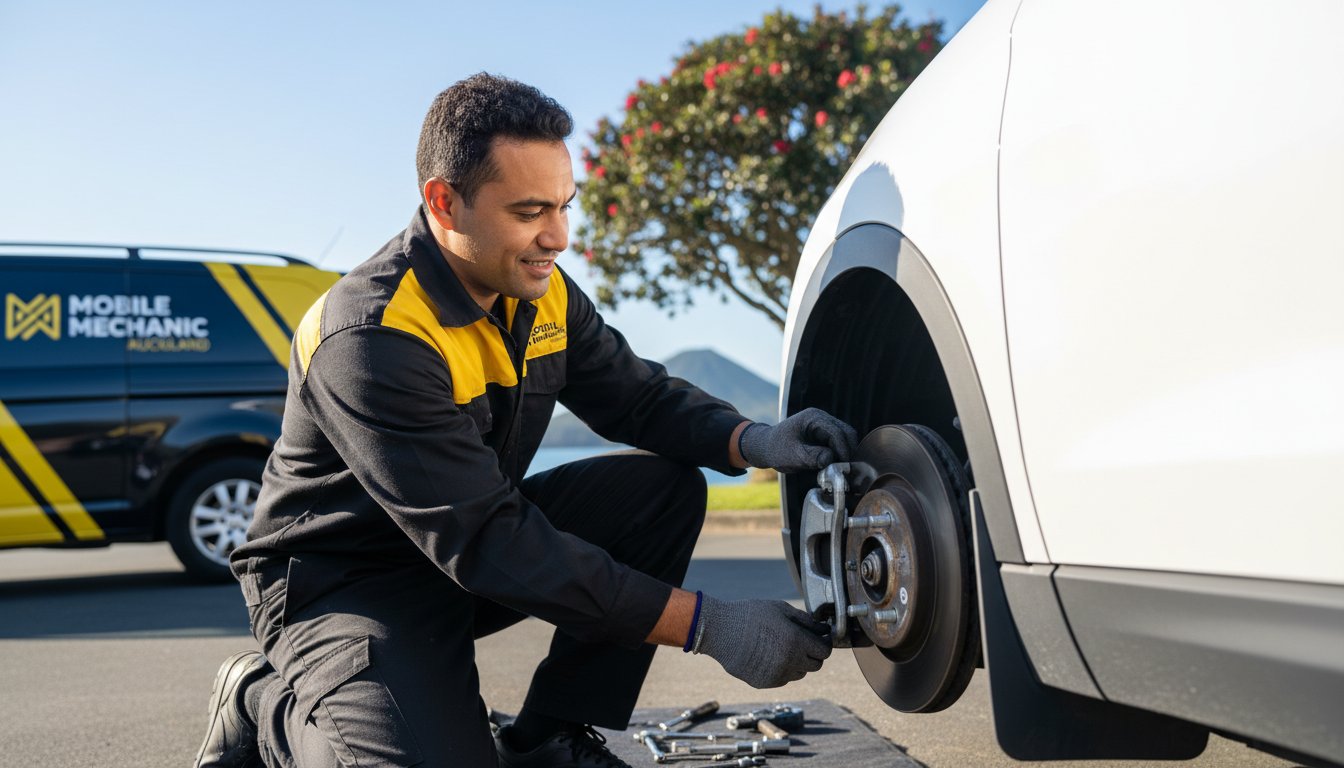
Sometimes, even a trip to the garage is too much for a packed schedule. That is where a Mobile Mechanic comes in. These experts perform brake swaps right in your driveway or office parking lot. You avoid the crowded waiting room and the hassle of arranging a ride. Every mobile technician arrives with professional-grade equipment and high-quality parts to ensure your car meets NZ safety standards. It is the ultimate way to stay mobile while keeping your vehicle in peak condition. This service is perfect for busy parents or professionals who can’t afford to lose their car for a full day.
Booking Your Brake Service Online
Efficiency is at the heart of our platform. Our 30-second booking process is designed for the modern driver. Simply enter your registration number, and our system matches your vehicle to the exact brake pads and components required by the manufacturer. This precision removes the guesswork and ensures an accurate quote every time. You can compare prices from local workshops and select the one that fits your budget and timeline. If you want to lock in a competitive brake pad replacement cost nz, our digital tools make it effortless. Book your brake pad replacement today to experience a smarter, faster way to manage your car’s health.
Drive Safer with Transparent Brake Care
Navigating the brake pad replacement cost nz doesn’t need to be a guessing game as we head into 2026. You’ve seen how vehicle origin impacts your bill, with European models and modern EVs often requiring different components than standard Japanese imports. It’s also vital to remember that pads are just one part of the system; skipping rotor checks or fluid flushes can lead to bigger repairs later. Choosing a professional service ensures your car stays compliant with NZ safety standards while saving you the frustration of a DIY project gone wrong.
MyAutoShop brings car maintenance into the digital age with a focus on your convenience. We’ve hand-picked an NZ-wide network of top-rated mechanics to ensure you get expert care regardless of your location. Our platform delivers transparent, upfront pricing with no hidden fees, so you stay in control of your budget. We even offer a signature pick-up and drop-off service to keep your day moving. It’s about making car care seamless, honest, and entirely stress-free.
Get an instant, transparent quote for your brake pads here
Ready to hit the road with total confidence? Give your car the treatment it deserves and enjoy the smooth, reliable stopping power that keeps you and your family safe.
Frequently Asked Questions
Is it okay to only replace the front brake pads?
Yes, you can replace only the front brake pads because front and rear axles wear at different rates. Front pads typically handle 70 percent of the braking force, which often causes them to wear out twice as fast as the rears. Always replace pads in pairs across the same axle to keep your stopping power balanced. This prevents the car from pulling to one side during a sudden stop.
How long do brake pads usually last in New Zealand conditions?
Brake pads in New Zealand generally last between 30,000 and 70,000 kilometers depending on your specific driving habits. If you regularly drive through steep terrain like the Kaimai Range or sit in Auckland’s stop-start traffic, your pads will wear faster. Heavy braking generates intense heat that thins the friction material. Check your pad thickness during every 10,000 kilometer service to stay ahead of your brake pad replacement cost nz.
Why are my brakes squeaking even though they are new?
New brakes often squeak during the first 300 kilometers while the pads bed into the rotor surface. This noise usually comes from high-frequency vibrations between the pad and the caliper. Our mechanics apply specialized anti-seize lubricant to the back of the pads to stop this. If the high-pitched sound continues after 500 kilometers of city driving, a technician should check for glazing or fitment issues.
Can I pass a WOF with thin brake pads?
You’ll fail your Warrant of Fitness (WOF) if your brake friction material is less than 1.5 millimeters thick. Waka Kotahi NZ Transport Agency inspectors use precise gauges to measure this during your inspection. Even if you have 2 millimeters remaining, we recommend a replacement immediately. Thin pads increase your stopping distance and risk damaging your rotors, which significantly increases your total brake pad replacement cost nz.
What is the difference between ceramic and semi-metallic brake pads?
Ceramic pads use dense ceramic material and copper fibers to provide quiet operation and 80 percent less visible brake dust. Semi-metallic pads contain 30 to 60 percent metal, making them much more durable for heavy towing or high-performance driving. While ceramic pads offer a smoother pedal feel for daily Kiwi commuting, semi-metallic pads perform better in the extreme heat conditions found on long mountain descents.
How much extra does it cost to replace rotors with the pads?
Replacing rotors alongside your pads is efficient because the labor for removing wheels and calipers is already done. Most workshops charge for the additional parts and roughly 30 minutes of extra labor per axle. Combining these tasks ensures your new pads have a perfectly flat surface to grip. This prevents the 10 percent loss in braking efficiency that happens when you fit new pads to old, grooved rotors.
Do I need to replace all four brake pads at once?
You don’t need to replace all four sets at once, but you must replace both sets on the same axle. If your left front pad is worn, the right front pad must also be replaced to maintain even braking pressure. Mixing new and old pads on the same axle causes 15 percent more strain on your suspension and steering components. Focus on the axle that has reached the 1.5 millimeter limit first.
What happens if I ignore the brake wear warning light?
Ignoring the brake wear warning light leads to metal-on-metal contact that destroys your rotors within 100 kilometers of driving. Once the friction material is gone, the steel backing plate grinds against the disc and reduces your stopping power by over 50 percent. This creates an immediate safety risk for you and your passengers. It also turns a simple pad swap into a complex repair involving rotors and calipers. If you notice your car bouncing or swaying during hard stops, it may also be time to look for signs of worn shock absorbers, as failing suspension compounds the danger of degraded braking performance.
Disclaimer
This article provides general information only and should not be relied on as professional mechanical, safety or legal advice. Vehicle requirements and circumstances vary. If you are unsure about your vehicle, have it inspected by a qualified automotive professional.