

A weak battery can threaten a car’s computer indirectly, but it’s often a charging fault or sudden voltage change that causes the real trouble. The answer to “Can a bad battery damage a car’s computer?” is yes: unstable voltage, a faulty alternator, or a surge during a jump-start or battery change can disrupt electronic control modules. That doesn’t mean every flat battery has damaged your vehicle.
It’s natural to suspect the battery when a car struggles to start or warning lights appear. But a battery-only test can miss the cause, and replacing the battery without checking the charging system may leave the fault unresolved. A weak battery can also trigger voltage or communication fault codes that clear once power is restored.
This article explains how battery condition, alternator undercharging or overcharging, loose or corroded terminals, deep discharge and repeated short trips can affect vehicle electronics. You’ll learn why battery and charging tests belong together, what the results may reveal, and when symptoms suggest a separate electrical problem. The goal is to help you understand the cause before a starting issue becomes an ongoing fault.
Key Takeaways
- Learn why a weak battery can cause electronic glitches without proving that a computer module is damaged.
- See how undercharging and overcharging can point to different faults in the charging system.
- Understand why battery, starting-system and charging-system tests work best together.
- Spot how loose or corroded terminals and repeated deep discharges can affect reliable starting.
- Find out why frequent short trips may leave a battery undercharged and what a mechanic can assess.
Alternator undercharging and overcharging
A bad car battery can contribute to unstable voltage during starting or a jump-start, but it isn’t the only possible cause of a voltage surge. Sudden voltage changes during a jump-start or battery replacement can damage or disrupt electronic control modules, including the ECM, TCM, FRM and BCM. These modules help manage engine, transmission and body functions.
An alternator that undercharges may leave the battery too weak for reliable starting and stable electrical operation. The car may crank slowly, show warning lights, or log voltage and communication fault codes. These codes can reflect low voltage rather than a failed computer, and may clear after the battery is replaced. A weak battery can also mask an alternator fault, so fitting another battery alone may not solve the problem.
Overcharging creates a different risk. Excessive charging can boil off battery electrolyte and damage internal battery components. If an alternator keeps charging a weak battery, it can overheat internally and stop working. The relationship works both ways: a faulty battery can damage a good alternator, while a faulty alternator can damage a replacement battery. A fresh battery may therefore fail early if the charging fault remains.
Charging tests help separate these causes. A technician can assess the battery’s condition and the alternator’s output, then look for signs of inconsistent charging. The result matters more than a single symptom: a flat battery, dim lights or warning messages can come from different faults. A failing alternator may undercharge, overcharge or behave inconsistently, while a worn battery may struggle to accept or hold charge. The car battery guide explains why choosing a suitable replacement matters, but the charging system still needs attention when symptoms point to an alternator issue.
Note what happened before the fault appeared. If starting trouble began after a jump-start or battery replacement, mention that during diagnosis. If a replacement battery loses charge or warning lights return, the alternator may need testing. A voltage surge can affect more than engine operation, including door locks, windows, turn signals and mirrors. These symptoms don’t prove a computer module is damaged, but they help identify which systems need assessment.
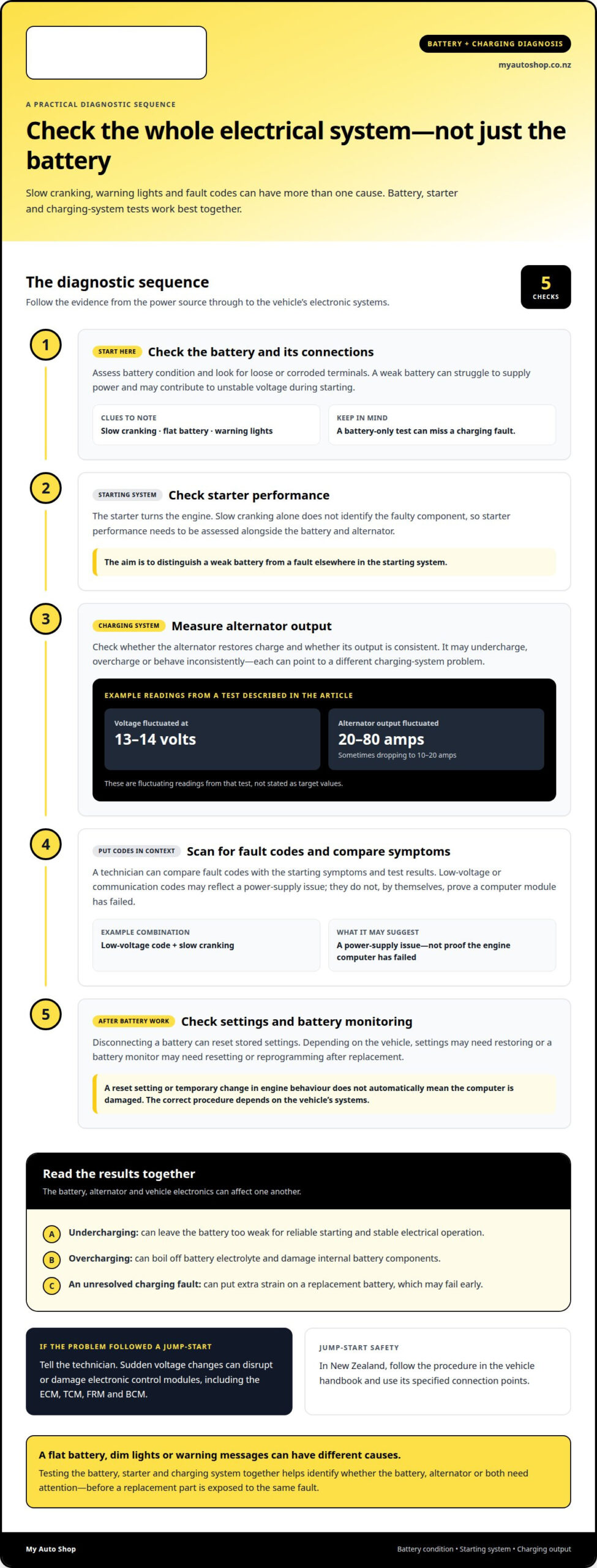
When charging faults go unchecked, one faulty component can put extra strain on another. Testing the battery and alternator together helps show whether the battery, alternator or both need attention, before a replacement part is exposed to the same fault.
Sudden voltage changes during a jump-start can damage electronic control modules. If the battery or charging system may be faulty, have a technician assess both and mention any trouble that began after a jump-start. When a vehicle is completely immobilized or jump-starting risks further electrical damage, using professional roadside transport like Dependable Towing & Recovery Services ensures the car can be moved safely to a workshop for proper diagnosis.
Why should the charging system be tested at the same time as the battery?
Testing the battery, starter and charging system together helps distinguish a weak battery from a fault elsewhere. It also reduces the risk of replacing the battery while an underlying charging problem remains.
Battery and System Diagnostics
System diagnostics assess whether the battery can supply power, the starter can turn the engine, and the alternator can restore charge. These parts affect one another, so slow cranking alone doesn’t identify the faulty component.
For a safe jump-start in New Zealand, follow the procedure in the vehicle handbook and use its specified connection points. A sudden voltage change during a jump-start can disrupt or damage electronic modules.
A useful diagnostic sequence starts with the battery’s condition and connections, then checks starter performance and alternator output. A technician can also scan for fault codes and compare them with the starting symptoms. For example, a low-voltage code alongside slow cranking may indicate a power-supply issue, rather than prove that the engine computer has failed.
ETSI explains that an ageing battery with rising impedance can experience voltage disturbances during inrush currents and large load changes. In everyday terms, a battery that struggles to meet sudden electrical demand may make voltage less stable. Testing the whole system helps show whether the battery, starter or charging system is contributing.
Settings Loss and ECU Relearning
Disconnecting a battery interrupts power, so some stored settings may reset. Whether an ECU needs to relearn varies by vehicle. A reset setting or temporary change in engine behaviour doesn’t automatically mean the computer is damaged.
After replacement, some vehicles may need settings restored or a battery monitor reset. Many modern vehicles need their battery monitor reprogrammed after battery replacement. Without a reset, the vehicle may use a charging programme intended for the worn battery, potentially causing charging issues or warning lights. The correct procedure depends on the vehicle’s systems.
Diagnosis should account for what happened before and after the battery work. A technician can assess whether fault codes relate to low voltage, whether the charging system is working properly, and whether settings or monitoring need attention. This helps distinguish a reset from a failed module, and prevents a charging fault being overlooked because the battery is new.
If the battery warning light appears, understanding the warning light on your dashboard can help put test results in context.
Electrical diagnosis should begin with checking the vehicle battery, then assess whether the charging system is keeping output stable. During the same charging-system test, the truck’s voltage fluctuated at 13-14 volts. In that test, alternator output fluctuated from 20 to 80 amps and sometimes dropped to 10-20 amps.
These readings show why a battery check alone may not explain a starting or charging symptom: the battery and alternator need to be considered together. A system test can identify changing output that a simple check of whether the engine starts may miss. Comparing battery condition with charging performance gives a clearer basis for deciding what needs attention, rather than assuming a weak start means the battery is the only problem.
Corroded or loose battery terminals
A battery terminal connects the battery post to the vehicle’s electrical cables. Corrosion or a loose connection can interrupt the current needed by the starter and vehicle electronics. A car might start inconsistently even though the battery still holds charge. Symptoms can also come and go as vibration changes the contact between a terminal and its cable clamp.
Corrosion often appears as a deposit around the positive or negative battery post. If it spans the terminals, it can create a mild, constant drain while the ignition is off. This is separate from power loss caused by a poor connection during starting. Either issue can leave the battery flat, but the symptoms alone don’t show whether the battery itself has failed.
A loose terminal may cause an intermittent connection. You might notice slow cranking, clicking, or dashboard lights dimming as the starter operates. If the engine starts after the car has been moved or the bonnet opened, mention that during diagnosis. It doesn’t prove the computer is damaged: unstable power at the connection can affect several electrical systems.
Terminal condition is one part of a battery assessment. A mechanic can inspect both posts, the cable clamps and visible cable connections, then assess whether corrosion or looseness is affecting power delivery. The battery and charging system may also need testing, since a poor connection can complicate a weak-starting complaint. Replacing the battery without fixing a damaged or loose connection can leave the original symptom unresolved.
Treat corrosion as a clue, not a complete diagnosis. Clean-looking terminals don’t rule out an internal battery fault, a charging issue or another electrical drain. Visible deposits don’t prove corrosion has damaged an electronic control module either. A technician can compare the connections with the vehicle’s starting behaviour, warning lights and fault codes.
For example, if a car struggles to start and its dashboard resets, check the battery connection as well as the battery condition. If the battery repeatedly loses charge while parked, corrosion bridging the terminals is one possible cause, but another drain may also be present. An assessment can separate these possibilities before parts are replaced. The next step may be restoring a sound connection, replacing a failed battery or investigating another electrical fault.
Deep discharge and battery capacity loss
A deep discharge happens when a car battery loses much of its stored charge. In a lead-acid battery, one deep discharge can permanently reduce capacity by 20% or more. The battery may still start the car afterwards, but it can hold less charge and become more vulnerable to another flat-battery event. That loss of capacity can make starting less reliable, especially when the battery must supply a strong current to the starter.
Low voltage can affect electronics that rely on stable power. A weak battery may trigger voltage or communication fault codes in vehicle modules. These codes may clear after battery replacement, so a code alone doesn’t prove permanent computer damage. The key question is whether the fault clears once battery voltage is restored or remains and needs further diagnosis.
Consider a car left with its lights on until the battery goes flat. After a jump-start, it may run but struggle to start again because deep discharge has reduced the battery’s usable capacity. Recharging can restore charge, but may not reverse permanent capacity loss. If the same battery repeatedly goes flat, the cause of the discharge also needs attention.
A parasitic draw is electrical consumption while the vehicle is switched off. An abnormal draw of over 50 milliamps can flatten a battery overnight or over a few days. That makes the pattern useful: a car that starts after a drive but is flat after parking may have an ongoing drain, a weakened battery, or both. Replacing the battery without finding a continuing drain can leave the problem unresolved.
Diagnosis considers the battery’s ability to hold and supply charge alongside the vehicle’s electrical demand. A technician can assess battery condition and investigate whether there’s an abnormal draw. The car’s modules need time to enter their normal sleep state before a drain is measured, because some electronics remain active briefly after the ignition is switched off. A door switch keeping a module awake is one possible cause of continued power use.
After a deep discharge, note whether the battery goes flat again and how long the vehicle was parked. Share that timeline, along with any warning lights or starting symptoms, during assessment. If a replacement battery is needed, it must suit the vehicle; an unsuitable battery may not solve repeat starting trouble. A separate drain or charging fault can also affect a new battery.
Short-trip driving and chronic undercharging
A car battery supplies a burst of energy to start the engine, then the alternator restores the charge used. An alternator needs 15-20 minutes of driving to replace the charge used to start the engine. Repeated short trips may end before that energy is replenished, especially when the battery is already weak or the journey includes frequent stops.
Over time, short trips can contribute to chronic undercharging, sulfation and premature battery failure. Sulfation is a build-up that can form inside a lead-acid battery when it remains undercharged. As capacity declines, the battery has less reserve for starting and powering the vehicle’s electronics. This can contribute to low-voltage symptoms, but doesn’t by itself prove a computer module is damaged.
Consider a car used mainly for brief trips. Each start uses charge, while a short drive may not give the alternator enough time to replace it. Repeating this pattern can gradually leave the battery with less charge available. The result may be slower cranking or a flat battery, even if the car started normally on earlier trips.
The alternator maintains battery charge, but isn’t designed to recharge a dead or very low battery. If the battery is seriously depleted, ordinary driving alone may not restore it properly. A charging-system test can help distinguish an alternator fault from a battery that has lost capacity. This matters because replacing the battery won’t fix a charging problem that keeps draining or undercharging it.
Driving habits are only part of the picture. A battery that repeatedly goes flat may also have a parasitic draw while the car is parked, a poor connection or a charging fault. A mechanic can assess the battery and charging system, taking the vehicle’s use pattern into account. Mentioning that most journeys are short gives useful context for interpreting the results.
If short trips are unavoidable, watch for changes in starting behaviour and dashboard warnings. Repeated slow cranking, for example, suggests the battery may not be supplying power reliably. Don’t treat a longer drive as a guaranteed fix for a low battery: the alternator is designed to maintain charge, and battery condition affects how well it can accept and retain it.
If starting trouble keeps returning, learn what can cause a battery not to jump-start to help identify what may need attention.
A short in a car’s starter solenoid can cause a constant battery drain, whether the engine is running or not.
My Auto Shop
My Auto Shop helps New Zealand motorists decide what to do when battery symptoms or electrical warnings keep returning. For routine maintenance, choose a Basic Service or Comprehensive Service. If the car needs a repair at home or work, Turners Service & Repairs provides mobile servicing and mechanical repairs in its operating regions.
Share what you’ve noticed, such as slow starting, warning lights or trouble after a battery change. This context helps identify whether servicing or a mechanical assessment is the right next step. If symptoms persist, don’t assume a new battery alone will fix the cause.
Contact My Auto Shop to discuss your vehicle’s symptoms.
Choose a clear next step for your car
If you’re still wondering whether a bad battery can damage a car’s computer, focus on finding the cause before deciding what needs repair. A clear account of when symptoms occur makes an assessment more useful. Note whether they appear after the car has been parked, during starting or following battery work.
My Auto Shop offers a Pre-Purchase Inspection for people assessing a vehicle before buying, as well as Basic Service and Comprehensive Service options for routine maintenance. Choose the next step that fits your situation, rather than assuming every warning light means the computer needs replacing.
For help deciding what your vehicle needs, contact My Auto Shop. A practical assessment can help you move forward with more confidence.
Frequently Asked Questions
Can a weak or failing car battery damage the ECU or other electronics?
A weak battery alone doesn’t confirm ECU damage. The key distinction is whether an electronic fault continues after the vehicle has a stable power supply. A clock or radio preset resetting after battery work, for example, differs from a persistent engine-control fault. A technician can assess the affected function and its wiring before deciding whether a control module needs repair.
What car computer problems can be caused by low battery voltage?
Low voltage can cause inconsistent electronic symptoms rather than one clear, lasting failure. You might find that a setting resets after starting, or that a dashboard warning appears alongside slow cranking. Note which functions change and whether they recover after the next start. This gives a technician more useful context than treating every warning as a separate computer failure.
How can you tell whether a faulty battery or damaged ECU is causing car problems?
Look for patterns across different vehicle functions. A starting problem paired with several unrelated warning messages may point to a shared power-supply issue, while one function failing consistently calls for focused circuit testing. A diagnostic scan can identify affected systems, but the codes need to be interpreted alongside battery condition, wiring and grounds. Replacing an ECU based on a code alone can miss the underlying cause.
What battery maintenance or testing helps prevent damage to car electronics?
Use the vehicle’s specified battery type and installation procedure, and have the battery assessed if its performance changes. After replacement, check whether the vehicle requires its battery monitoring system to be reset. Keep a note of repeated warning messages or settings that reset, including when they occur. These details help distinguish a one-off interruption from a recurring electrical issue during assessment.
Disclaimer
This article provides general information only and should not be relied on as professional mechanical, safety or legal advice. Vehicle requirements and circumstances vary. If you are unsure about your vehicle, have it inspected by a qualified automotive professional.