

A fluid check should explain more than whether a reservoir needs filling. A mechanic that explains things simply checks fluid levels and condition, looks for leaks, then tells you whether a top-up is enough or a closer inspection is needed. Checks may include engine oil, coolant, brake fluid and windscreen washer fluid, using the vehicle’s requirements rather than guesswork. If a fault comes and goes, describe when it happens and what you notice. A video or ride-along can help show a problem that doesn’t appear during testing.
It’s understandable to feel unsure when a repair explanation is full of unfamiliar terms, especially if the fault isn’t happening while the car is being inspected. Clear explanations help you understand what’s been checked and what the mechanic recommends, so you know what happens next.
This article explains what a mechanic checks when inspecting and topping up vehicle fluids, and what details to share about an intermittent fault. You’ll also learn how to ask about test results and recommended repairs so you can make an informed decision.
Key Takeaways
- Ask what the diagnosis found, which repair is recommended and what the work will cover before approving it.
- Compare independent mechanics and dealership service centres by how clearly they explain the work and its costs, not by price alone.
- Notice when a repair recommendation lacks a clear explanation of the fault, evidence or proposed fix.
- Learn plain-English meanings for common workshop terms so you can follow the diagnosis and make informed decisions.
- For mobile servicing, diagnostics or mechanical repairs in selected New Zealand regions, Turners Service & Repairs may be a practical next step.
What questions should I ask a mechanic before approving repairs?
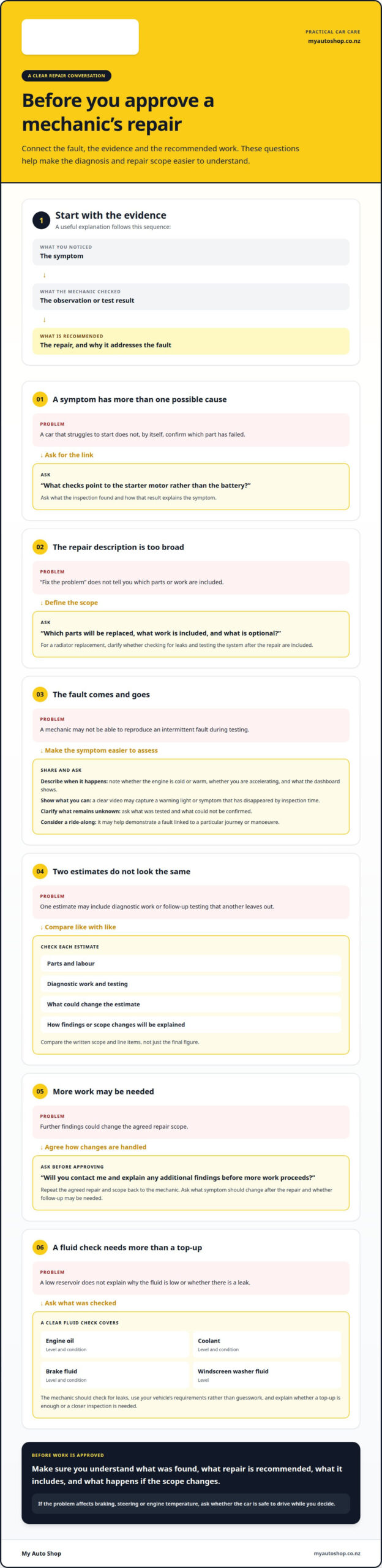
Before approving a repair, ask the mechanic to connect the fault, test result and recommended work. For example, if your car struggles to start, ask what checks point to the starter motor rather than the battery. A clear explanation should describe what was observed, what needs fixing and what may happen if you wait. If the answer relies on unfamiliar terms, ask for the same explanation in plain English.
Ask what the repair includes before agreeing. Replacing a radiator, for instance, may involve more than fitting a part. Clarify whether the diagnosis includes checking for leaks and whether the mechanic will test the system after the repair. Ask which parts will be replaced and whether related work is optional or necessary. This gives you a defined scope to consider, rather than an open-ended instruction to fix the problem.
Use these questions to make the conversation specific:
- What did your inspection find? Ask for the observation or test result behind the diagnosis.
- How does that explain the symptom? For a clicking noise during turns, ask which component could cause it.
- What work do you recommend, and why? Separate the essential repair from preventative or optional work.
- What does the quoted work include? Confirm parts, labour and any further testing in the scope.
- Will you contact me if the scope changes? Agree how additional findings will be explained before more work proceeds.
- What should I expect after the repair? Ask which symptom should change and what follow-up may be needed.
An intermittent fault calls for a slightly different discussion. The mechanic may not reproduce it during testing, so describe exactly when it occurs. Note whether the engine is cold or warm, whether you’re accelerating, and what the dashboard shows. If a warning light appears briefly, a clear video can capture details that may be gone by the time the car is inspected. Ask what the mechanic was able to test and what remains uncertain because the symptom didn’t occur.
Then agree on the next step. If a fault appears during a particular journey or manoeuvre, ask whether a ride-along could help demonstrate it. For example, a steering vibration that only appears at higher speeds may be difficult to assess while stationary. Don’t treat a suspected cause as a confirmed diagnosis. Ask what evidence would distinguish it from other possible causes.
Before authorising work, repeat the agreed repair and scope back to the mechanic. Ask whether the car is safe to drive while you decide, especially if the problem affects braking, steering or engine temperature. If reaching a workshop is difficult, a mobile mechanic service may suit some inspection and repair needs. Clear questions help you understand the recommendation before giving approval.
How do independent mechanics compare with dealership service centres on price and communication
Independent mechanics and dealership service centres can differ in how they price and explain repairs, but the business type alone doesn’t determine value. The vehicle, fault and work required all matter. A routine service on a common model, for example, may involve different checks from diagnosing an electronic fault in a newer vehicle. Compare the written scope and explanation, not just the business name or final figure.
A dealership service centre works with the vehicle makes it services, which can be useful when a fault involves model-specific systems or service information. An independent mechanic may work across different makes and models, which can suit owners seeking general maintenance or repairs. The experience still depends on the mechanic, the diagnosis and the information available for your vehicle. Ask how the proposed work relates to your car’s symptoms.
Compare estimates using the same details. One figure may cover parts and labour, while another includes diagnostic work or follow-up testing. Ask each provider to explain:
- What work is included? For a brake repair, clarify whether the recommendation covers pads, rotors or both.
- What parts are proposed? Ask what type of replacement part the estimate allows for.
- How was the fault diagnosed? A battery warning, for example, can have more than one possible cause.
- What could change the estimate? Ask how the mechanic will handle related damage found during the repair.
- How will progress be explained? Confirm how you’ll hear about findings or changes before additional work proceeds.
Communication matters as much as the estimate. A useful explanation links the symptom to a finding, then to the recommended repair. If your car hesitates during acceleration, the mechanic should clarify which checks support the diagnosis, rather than treating the symptom itself as proof of a failed part. Ask for an everyday explanation and a written scope you can review.
Price comparisons are clearer when the scopes match. Check whether diagnostic time, parts, labour and testing appear in each estimate. If an independent mechanic’s estimate differs from a dealership’s, ask which inclusions account for the difference. A lower total may leave out an item included in the other estimate; a higher total may include extra work. Compare each line rather than guessing from the final amount.
Use the same questions with either provider, then weigh clarity alongside cost. A clear explanation of the repair price should help you understand the work and what it includes. If you’re unsure whether a recommendation is necessary, ask what evidence supports it and what the mechanic expects if the repair is delayed.
Some repair questions are easier to compare when an estimate is tied to a specific symptom or finding. Tyres with tread close to the legal minimum may mean your vehicle does not meet WoF requirements. A slipping clutch can make acceleration and hill driving more difficult, with engine revs rising without a matching increase in speed. Ask whether the recommendation addresses the condition described and what work is being proposed; the wording of each estimate can then be reviewed against the same issue.
An ABS fault may involve a wheel speed sensor, wiring or the ABS module. Ask the mechanic to explain which possibility the checks point to, and whether the estimate includes diagnosis as well as repair. A clogged catalytic converter may be treated with a chemical cleaner or replaced if the damage is more serious. Ask which option is proposed and what finding supports it, so you understand what the estimate covers.
Some faults are intermittent, and the mechanic may not reproduce one during testing. Help by describing when it happens, recording a video or taking a ride-along with the mechanic. Share those details and ask how they relate to the diagnosis and proposed work. This gives you a clearer basis for comparing explanations and estimates.
What warning signs suggest a mechanic is not explaining repairs honestly?
A vague diagnosis is a reason to pause and ask for clearer details, not proof of dishonesty by itself. For example, “the whole system is worn” doesn’t explain which component failed or how the mechanic found it. A useful explanation connects the reported symptom, inspection result and recommended repair. If those points don’t line up, ask the mechanic to explain why before approving the work.
Watch for recommendations that keep changing without a clear reason. If the original estimate covers a radiator leak but later includes unrelated work, ask what new inspection finding prompted the change. A sound recommendation should be explainable in plain language. The mechanic should distinguish work needed to address the fault from optional maintenance, rather than presenting every suggestion as equally urgent.
Other signs deserve a direct question:
- No specific evidence: The mechanic recommends replacing a starter motor but can’t describe the checks supporting that diagnosis.
- Unclear scope: The estimate says “repair suspension” without identifying the component or work involved.
- Pressure to decide immediately: You’re urged to approve an extra repair before its reason and urgency are explained.
- Unexpected additions: New work appears on the invoice without an explanation of what changed or when it was approved.
- Confident claims without testing: A fault that comes and goes is described as definitively diagnosed, although the symptom wasn’t present during inspection.
Ask for a specific observation behind the recommendation. For example, if a mechanic says a CV joint is damaged, ask what they noticed during inspection and how it relates to the noise or vibration. A clear answer should explain the connection without relying on unexplained jargon. A guide to common vehicle symptoms can also help you describe what you’ve noticed accurately.
Pay attention to changes in the agreed work. If a repair’s scope or estimate changes, ask what was discovered, what work is now proposed and whether you approved it. Keep the updated explanation in writing where possible. For example, a message naming a newly identified fault helps distinguish an agreed change from a surprise charge at collection.
Before authorising a repair, summarise the diagnosis and proposed work back to the mechanic. If the explanation still doesn’t make sense, pause and ask for the specific finding, proposed fix and any safety concern in plain English. Clear communication should leave you understanding what the mechanic found, what they recommend and why, even when the issue involves a technical system such as the cooling circuit or charging system.
The same standard applies to an exhaust fault. Damaged pipes, clamps, gaskets or silencers may need repair or replacement, but that possibility alone doesn’t explain which part is damaged or why the proposed work is appropriate. Ask the mechanic to identify the affected part, describe the observation that supports the diagnosis, and connect that finding to the repair. If several parts are included, ask what evidence supports each item and which work addresses the reported problem.
You can also ask the mechanic to separate the explanation into what was inspected, what was found and what action is proposed. If the answer stays broad, ask for a clearer description before agreeing to the work. A written estimate or message can help you check that the explanation matches the authorised scope. If the mechanic can’t explain a recommendation, consider pausing rather than treating confidence or urgency as evidence. The aim isn’t technical certainty about every fault, but a reasoned account that connects the vehicle’s symptoms to the inspection and proposed repair.
Mechanic jargon
Workshop terms can make a straightforward repair sound more complicated than it is. Ask the mechanic to explain what a term means for your car. “The alternator isn’t charging” means the component that supplies electrical power while the engine runs may not be working properly. “The battery is flat” describes a low charge, but doesn’t explain why it happened.
These terms often come up during diagnosis or a repair discussion:
- Diagnostic scan: A tool reads information from the vehicle’s computers. It may show a fault code, but that code points to an area to investigate, not automatic proof that a particular part has failed.
- Misfire: One or more cylinders aren’t burning fuel as expected. You may notice rough running, hesitation or an uneven engine sound.
- Coolant leak: Engine coolant is escaping from the cooling system. The mechanic should explain where the leak was found and what repair is proposed.
- CV joint: A joint transfers drive to the wheels while allowing the suspension and steering to move. A worn joint can make a clicking noise during turns.
- Brake pads and rotors: Pads press against the rotating discs, also called rotors, to slow the car. Ask which part needs attention and what inspection finding supports that advice.
- Labour: The time and work involved in carrying out a repair, separate from the parts used. Ask what tasks the labour covers.
Some phrases describe a check’s result, rather than a confirmed cause. For example, “the scan found a sensor code” doesn’t necessarily mean replacing that sensor will fix the fault. The mechanic may need to inspect wiring or test related components. Ask what the code means, what checks followed, and how those results support the recommended repair.
Parts descriptions can also sound interchangeable when they aren’t. “Genuine”, “original equipment” and “aftermarket” refer to different parts categories, so ask which type the estimate includes. For a brake job, clarify whether the recommendation covers pads, rotors or both. A guide to brake pad types can help explain terms used in that discussion.
Try a simple three-part check when a new term comes up: ask what it means, what the mechanic found and what action they recommend. If the explanation is “play in the steering”, for example, ask which component moves more than it should and what that means for the repair. A mechanic that explains things simply connects technical language to your vehicle’s symptoms and the proposed work.
Turners Service & Repairs: Mobile Mechanics and Repairs
My Auto Shop connects New Zealand motorists with vehicle services through a network of professional mechanics. For mobile servicing, diagnostics or mechanical repairs, Turners Service & Repairs brings the service to the customer in selected regions. A mobile mechanic can attend where your vehicle is parked, which may help when fitting a workshop visit around work or home commitments.
Choose a service that matches your vehicle’s needs. A Basic Service or Comprehensive Service covers routine maintenance, while a mobile mechanic can assess a specific concern or carry out a mechanical repair. If the engine hesitates, a warning light appears or a fluid leak leaves a mark under the car, explain the symptom and when you notice it. Those details give the mechanic useful context for assessing the fault.
To help the appointment focus on the right issue, share practical details such as:
- The vehicle’s make, model and year.
- What you hear, feel or see, including any dashboard warning lights.
- When the issue occurs, such as during a cold start or while turning.
- Any recent change, such as a new noise or a symptom that has become more frequent.
For an intermittent fault, a short video or clear description can capture a symptom that isn’t happening during the mechanic’s visit. Note the conditions, such as whether the vehicle was accelerating or stationary. The mechanic can use those details alongside diagnostic checks, then explain what the results indicate and what repair they recommend. If testing doesn’t reproduce the issue, ask what was checked and what information might help narrow it down.
Be clear about your priority. For routine upkeep, describe the service history and any concerns you want discussed during a Basic Service or Comprehensive Service. If a particular fault is affecting how the vehicle drives, lead with that symptom. This helps distinguish scheduled maintenance from diagnostic work or a repair, so the proposed work addresses your reason for booking.
A mobile appointment can be useful when the vehicle is at home or work and the required work suits a mobile mechanic. It won’t suit every repair: some work needs workshop equipment or conditions. If that’s the case, ask for a plain explanation of the next repair step. The aim is to understand the finding, recommended work and how it relates to your original concern.
For a used-car buying decision, My Auto Shop also offers a Pre-Purchase Inspection. This serves a different purpose from diagnosing a fault in a vehicle you already own. Keep your need clear, then choose the service that matches it.
To discuss mobile servicing, diagnostics or mechanical repairs, contact Turners Service & Repairs.
Frequently Asked Questions
How to find a mechanic who explains car repairs clearly in New Zealand?
Look for a mechanic that explains things simply by how they discuss the work, not by technical claims alone. Before booking, describe your vehicle and concern, then notice whether the response addresses your actual question. My Auto Shop connects motorists with automotive service and repair providers through its marketplace; those providers aren’t necessarily My Auto Shop employees. Choose a provider who communicates in terms you can follow and makes the proposed work understandable.
How can I ask a mechanic to explain a diagnosis in plain language?
Say, “Could you explain that without workshop terms?” Then ask for an everyday comparison or a description of how the fault affects your car. If the mechanic mentions an electrical issue, for example, ask what you might notice when starting or driving. You can also repeat the explanation in your own words and ask whether you’ve understood correctly. This keeps the conversation clear without needing to know mechanical terminology.
Disclaimer
This article provides general information only and should not be relied on as professional mechanical, safety or legal advice. Vehicle requirements and circumstances vary. If you are unsure about your vehicle, have it inspected by a qualified automotive professional.