

Imagine pulling away from a green light in Auckland rush-hour traffic. Your engine revs high, but your car barely crawls forward. It’s a sinking feeling that forces the question: can i drive with a worn clutch for just another week? While your car might technically move, you’re driving a ticking clock that could stop at the most inconvenient intersection.
We understand the stress of potential breakdowns and the dread of hidden mechanical costs. You want to keep your life moving without being sidelined by jargon or surprise bills. This article clears the air. We’ll show you how to test your clutch yourself, explain the safety risks of delay, and provide a transparent look at New Zealand repair costs. We’ll break down why a typical replacement ranges from NZ$1,200 to NZ$2,500 so you can plan your budget with confidence. By the end, you’ll know exactly when to call in the experts to get back on the road safely.
Key Takeaways
- Understand the thin line between a slipping clutch and a total breakdown to avoid being stranded on the motorway.
- Get a definitive answer on exactly how long can i drive with a worn clutch before it causes permanent damage to your engine.
- Learn why delaying a repair can double your service bill by overheating and warping the expensive flywheel.
- Master a simple 5-step DIY handbrake test to accurately check your vehicle’s health from your own driveway.
- Discover how to access transparent, upfront pricing and pick-up convenience for a professional clutch replacement.
Can You Drive with a Worn Clutch? The Short Answer
The short answer is yes, you can usually drive for a short period, but it’s not a good idea. If you’re asking, “can i drive with a worn clutch for another week?” the answer depends on how much friction material is left. You might manage a few local trips, but you’re operating on borrowed time. A worn clutch is essentially a ticking time bomb for your vehicle’s transmission. As the friction material thins, the heat generated during gear changes increases, which can lead to catastrophic failure without warning.
The most common symptom you’ll encounter is “slipping.” This happens when you press the accelerator and the engine revs spike, but the car doesn’t speed up proportionally. It feels like the car is struggling to find its footing. If you continue to drive during this phase, you risk damaging other expensive components like the flywheel. This turns a standard maintenance job into a much larger, more expensive repair project.
The Difference Between Worn and Broken
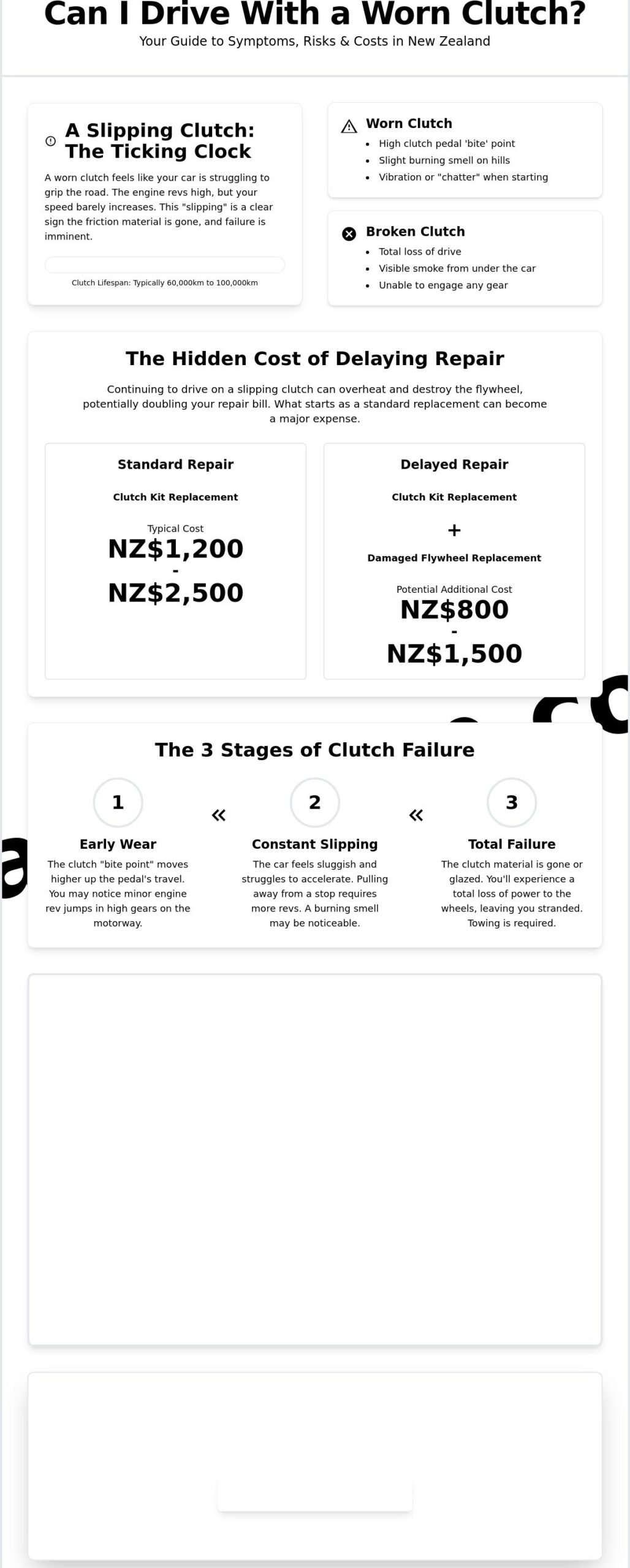
Understanding the distinction between these two states can save you from a massive repair bill. A worn clutch is a natural result of the friction plate thinning over time. Most Kiwi drivers find their clutch lasts between 60,000 and 100,000km. Signs of wear include:
- A “high” clutch pedal where the engagement point is near the top of the pedal’s travel.
- A slight burning smell after driving up steep hills or in heavy traffic.
- Minor vibrations or “chatter” when pulling away from a stop.
A broken clutch is when that wear reaches a tipping point. This usually manifests as a total loss of drive or visible smoke from the bell housing. At this stage, your car is a driveway ornament until a professional clutch replacement is performed. You’ve moved past the point of “limping it home” and into the territory of needing a tow truck.
When is it Absolutely Unsafe to Drive?
Safety should always come first. There are several no-go scenarios where you must stop driving immediately. If you find it difficult to engage any gear while the engine is running, the clutch is no longer doing its job. Forcing the car into gear will eventually destroy your synchros and gearbox internals, leading to even higher costs.
The real danger occurs in high-pressure situations. If your clutch slips while you are overtaking on a rural road or merging onto a busy Auckland motorway, you lose the ability to accelerate out of trouble. Beyond the immediate safety risks, a clutch that shows obvious signs of failure will result in a failed Warrant of Fitness (WOF). Inspectors check for smooth gear engagement and power delivery. If your clutch is slipping, you won’t get that sticker on your windscreen.
How a Clutch Wears Out: The Mechanical Progression
Think of your clutch as a bridge. It uses friction to carry power from the engine to the wheels. The star of the show is the friction disc. It’s essentially a giant brake pad sandwiched between the engine’s flywheel and the transmission’s pressure plate. Every time you shift or pull away from a stop, a tiny layer of this material wears away. This is normal, but it’s exactly why you eventually find yourself wondering, “can i drive with a worn clutch?”
When this friction material gets too thin, you reach the rivets. These are the metal fasteners that hold the disc together. Once they’re exposed, they act like a lathe against your flywheel. They gouge deep grooves into the smooth metal surface. While a standard clutch replacement is a routine job, replacing a destroyed flywheel can add NZ$800 to NZ$1,500 to your total repair bill. Catching the wear early prevents this metal-on-metal disaster.
The Three Stages of Clutch Death
Clutch failure isn’t usually instant. It follows a predictable path of decline. Understanding these stages helps you decide if you can make it through the week or if you need a tow today.
- Stage 1: The bite point moves higher. You might notice the engine revs jump slightly when you’re in 5th gear on the Southern Motorway, but the car feels mostly normal.
- Stage 2: Slipping becomes constant. Pulling away from a stoplight requires more care. The car feels sluggish, especially when you have passengers or groceries in the back.
- Stage 3: Thermal failure. The friction material glazes over from extreme heat or wears away completely. You’ll smell a pungent, acrid scent. Total loss of drive follows quickly.
Common Causes of Premature Wear
Kiwi driving conditions often accelerate this mechanical progression. Auckland’s stop-start traffic is a notorious clutch killer. “Riding the clutch,” which means keeping your foot slightly on the pedal while driving, keeps the disc in partial contact. This generates immense heat that bakes the friction material.
Towing heavy trailers or boats up steep inclines like the Remutaka Hill also puts massive strain on the pressure plate and throw-out bearing. If these components overheat, they lose their tension. Aggressive gear changes or “launching” the car from a standstill can also cause the friction disc to warp or shatter. By driving smoothly and keeping your left foot off the pedal when not shifting, you can significantly extend the life of your transmission.
The Hidden Risks of Delaying a Clutch Replacement
Driving on a slipping clutch is a financial gamble. Every time the engine revs without the car accelerating, you’re generating intense heat. This heat doesn’t just stay in the clutch plate. It transfers directly to the flywheel, which is the heavy metal disc attached to your engine. If you’ve been wondering, “can i drive with a worn clutch for just a bit longer,” consider the risk of warping that flywheel. A warped flywheel causes permanent vibrations and prevents a new clutch from gripping properly. This means you can’t just “pad slap” a new disc in and call it a day.
Then there’s the ‘Riveting’ problem. As the friction material disappears, the metal rivets holding the plate together become exposed. These rivets act like a lathe against your flywheel. They gouge deep, irreparable channels into the smooth metal surface. This is exactly how a standard NZ$1,200 clutch job quickly escalates into a NZ$2,500 nightmare. You’re no longer just paying for a maintenance kit; you’re paying for major engine-side components that should have lasted the life of the car.
Your gearbox also takes a hit. If the worn clutch doesn’t disengage fully, you’ll find yourself “crunching” into gears. This puts immense pressure on your synchros and gear teeth. Over time, this mechanical bullying leads to a gearbox rebuild. That is a far more complex and expensive prospect than a simple clutch replacement. Beyond the costs, there is the simple safety risk of losing drive. Stalling in a busy Auckland intersection or failing to hold gear on a steep Dunedin hill puts you and your passengers in immediate danger.
Financial Escalation: Plate vs. Flywheel
A standard clutch kit includes the friction plate, pressure plate, and release bearing. In many modern Kiwi vehicles, especially diesel utes like the Toyota Hilux or Ford Ranger, the car uses a “dual-mass flywheel” (DMF). These are designed to dampen engine vibrations but are incredibly sensitive to heat. While a standard solid flywheel can sometimes be machined for a few hundred dollars, a ruined DMF almost always requires a full replacement. We always recommend inspecting these parts thoroughly “while we’re in there” to avoid paying for the same 8 hours of labour twice.
Will a Worn Clutch Pass a WOF?
In New Zealand, a slipping clutch is a bit of a grey area for a Warrant of Fitness. Strictly speaking, a clutch that slips isn’t an automatic fail unless it prevents the vehicle from being driven safely or stops you from selecting gears. However, a WOF inspector can reject a vehicle under the “Safety of Operation” clause. If they feel the car cannot safely merge into traffic or maintain speed on an incline, you’ll be walking home. Don’t wait for your next WOF to address the issue. A clutch that fails while you’re navigating a rural highway or a busy motorway is a safety risk that no inspection sticker can fix.
How to Test Your Clutch: A 5-Step DIY Diagnostic
Before you decide if you can keep driving, you need facts. Find a flat, open area away from busy Auckland or Christchurch traffic. Testing a clutch involves putting the transmission under load, so safety is your priority. If you’re still wondering “can i drive with a worn clutch,” these five tests will give you the answer you need to make an informed choice. You don’t need a degree in mechanical engineering to spot the red flags.
Start with the High Gear Acceleration Test. Drive at a steady 40km/h in fourth gear. Press the accelerator firmly. If the engine revs climb rapidly but your speedometer barely moves, your friction material is failing. This proves the clutch can no longer handle the engine’s torque under load. It’s a clear sign that the “worn” stage is rapidly turning into “broken.”
Don’t ignore the Sniff Test either. Burnt clutch has a distinct, acrid smell. Many Kiwi drivers compare it to burnt toast or singed hair. If you catch this scent after a short drive or while reversing into a driveway, your clutch is overheating. This heat is what warps flywheels and doubles your repair bill, as we discussed earlier.
Step-by-Step: The Handbrake Method
The handbrake test is the gold standard for checking clutch bite in a controlled, stationary setting.
- Start the engine and ensure your handbrake is pulled up firmly.
- Depress the clutch pedal and select 4th gear.
- Slowly release the clutch pedal while giving the engine a tiny amount of throttle.
Interpreting the results is simple. If the engine stalls immediately as the clutch engages, your clutch still has life. If the engine continues to run or the car “lingers” without stalling, the clutch is slipping. This means the friction disc can’t fully lock the engine to the transmission.
Identifying Different Clutch Noises
Listen closely to your car. Sound is often the first indicator of mechanical fatigue. A squealing noise that only happens when the pedal is pressed usually points to a worn throw-out bearing. If you hear a light chirping at idle that disappears when you rest your foot lightly on the pedal, the release fork is likely the culprit. Grinding or “crunching” when shifting gears is more serious. This often signals that the clutch isn’t fully disengaging, which forces the gearbox synchros to do extra work.
If these tests confirm your fears, don’t wait for a total breakdown. You can get an instant quote for a clutch replacement and book a fix with one of NZ’s best mechanics today.
Fixing Your Clutch with My Auto Shop
You shouldn’t have to guess if your car is safe or how much a repair will cost. If you’re still stuck wondering, “can i drive with a worn clutch,” it’s time to stop the guessing game and take control. MyAutoShop removes the “mysterious mechanic” anxiety by acting as your transparent partner. We understand that your life is busy, so we’ve built a platform that prioritises your time and your budget. You get the confidence of an expert with the friendliness of a helpful neighbour.
Our network of pre-vetted mechanics spans across New Zealand, ensuring you have access to NZ’s best mechanics whether you’re in Auckland, Wellington, or Christchurch. We don’t just book you in; we ensure the service is seamless from start to finish. One of our signature promises is the “Pick up & drop off” convenience. You don’t have to lose your entire day sitting in a waiting room or arranging lifts. We handle the logistics so you can focus on your day while your clutch replacement is completed professionally.
Transparent Pricing and Professional Service
Getting a quote through MyAutoShop beats calling five different garages and trying to decode their jargon. We provide transparent, upfront pricing so you know exactly what you’re paying before the work begins. This commitment to openness is our hallmark. We only use high-quality parts that meet or exceed OEM standards, ensuring your new clutch lasts for the long haul. If you aren’t sure if the clutch is actually the problem, our mobile mechanics can come to your home or office to provide a professional diagnosis on the spot.
Book Your Clutch Inspection Today
Don’t wait for a tow truck to decide your schedule for you. Be proactive with your car’s health to avoid the financial escalation of a warped flywheel or damaged gearbox. Our booking process is designed for modern efficiency. It takes just three simple steps on our digital platform to move from a problem to a scheduled solution. Take the stress out of car maintenance and get back to driving with total peace of mind.
Book a clutch inspection or replacement with My Auto Shop today.
Protect Your Gearbox and Your Budget Today
You now have the practical tools to identify the difference between a minor slip and a major mechanical failure. While the answer to “can i drive with a worn clutch” is technically yes for a very short period, the financial risks to your flywheel and gearbox make it a dangerous gamble. Catching the wear early saves you from the NZ$2,500 repair bills that occur when metal rivets start gouging your engine’s components. Proactive maintenance is always cheaper than an emergency tow from the side of a busy state highway.
Don’t let mechanical anxiety slow you down or disrupt your schedule. MyAutoShop connects you with a network of 100+ pre-vetted NZ mechanics who offer transparent, upfront pricing with no hidden surprises. We even provide a signature “Pick up & drop off” service to ensure your day remains productive while your vehicle is being repaired. Our goal is to make car care as seamless as possible for every Kiwi driver.
Get an instant quote for a clutch replacement with My Auto Shop. Take the guesswork out of your car’s health and get back on the road with total confidence.
Common Questions About Clutch Repairs
How much does a clutch replacement cost in NZ?
A typical clutch replacement in New Zealand costs between NZ$1,200 and NZ$2,500. For compact economy cars, you might pay closer to NZ$800, while heavy duty utes or luxury European models can reach NZ$3,500. Most of this cost is labour because the transmission must be removed to access the parts. We provide transparent, upfront pricing so you don’t have to worry about hidden fees or mechanical guesswork during the repair.
How many kilometres should a clutch last?
A clutch typically lasts between 50,000 and 240,000 kilometres, with most Kiwi drivers needing a replacement around the 120,000km mark. This lifespan depends heavily on your driving style and environment. Stop-start traffic in cities like Auckland or heavy towing on rural hills will wear the friction material faster. Regular inspections during your basic service can help you track its health and avoid sudden failure on the road.
Can a worn clutch damage my engine?
Yes, a worn clutch can cause significant collateral damage to your engine’s flywheel and the transmission internals. When you ask yourself “can i drive with a worn clutch,” remember that excessive heat from a slipping disc can warp the flywheel. This creates vibrations that strain the crankshaft. Additionally, metal rivets on a failing disc can gouge the flywheel surface, turning a routine NZ$1,200 job into a much more expensive repair.
What does a burnt clutch smell like?
A burnt clutch has a sharp, acrid scent that is often compared to singed hair or burnt toast. You’ll likely notice this pungent smell after driving up a steep hill or reversing a heavy trailer. This scent is a warning that the friction material is overheating and glazing over. If you smell this regularly, your clutch is likely failing and needs a professional inspection to prevent a total loss of drive in traffic.
Is it okay to drive with a high clutch pedal?
A high clutch pedal is a primary warning sign that your friction material is getting thin, but the car is usually still safe for short trips. As the disc wears down, the bite point moves higher in the pedal’s travel. While it’s okay to drive locally for a few days, this is the best time to book a fix. Waiting longer increases the risk of being stranded when the friction material finally disappears completely.
Can I just replace the clutch plate and not the flywheel?
You can technically replace just the plate if the flywheel is in perfect condition, but it’s rarely recommended by NZ’s best mechanics. Most professionals suggest machining a solid flywheel or replacing a dual-mass flywheel (DMF) to ensure the new clutch grips properly. Reusing a heat-damaged flywheel will cause your new clutch to wear out prematurely. Investing in the full kit now prevents you from paying for the same 8 hours of labour twice.
Will a slipping clutch get better on its own?
No, a slipping clutch will never improve on its own because friction material does not grow back. Once the disc begins to slip, the problem will only accelerate as more heat is generated during every gear change. The slipping will become more frequent, especially under load or during acceleration. Ignoring the issue is a financial gamble that usually ends with a tow truck and a much higher repair bill for damaged parts.
How long does it take a mechanic to replace a clutch?
A professional clutch replacement usually takes between 4 and 8 hours to complete. It is a labour-intensive job because the mechanic must disconnect the battery, remove the driveshafts, and drop the entire transmission to access the clutch assembly. Because it’s a full-day job, our “Pick up & drop off” service is a popular choice for busy customers who need to stay productive while their car is in the workshop.
Disclaimer
This article provides general information only and should not be relied on as professional mechanical, safety or legal advice. Vehicle requirements and circumstances vary. If you are unsure about your vehicle, have it inspected by a qualified automotive professional.