
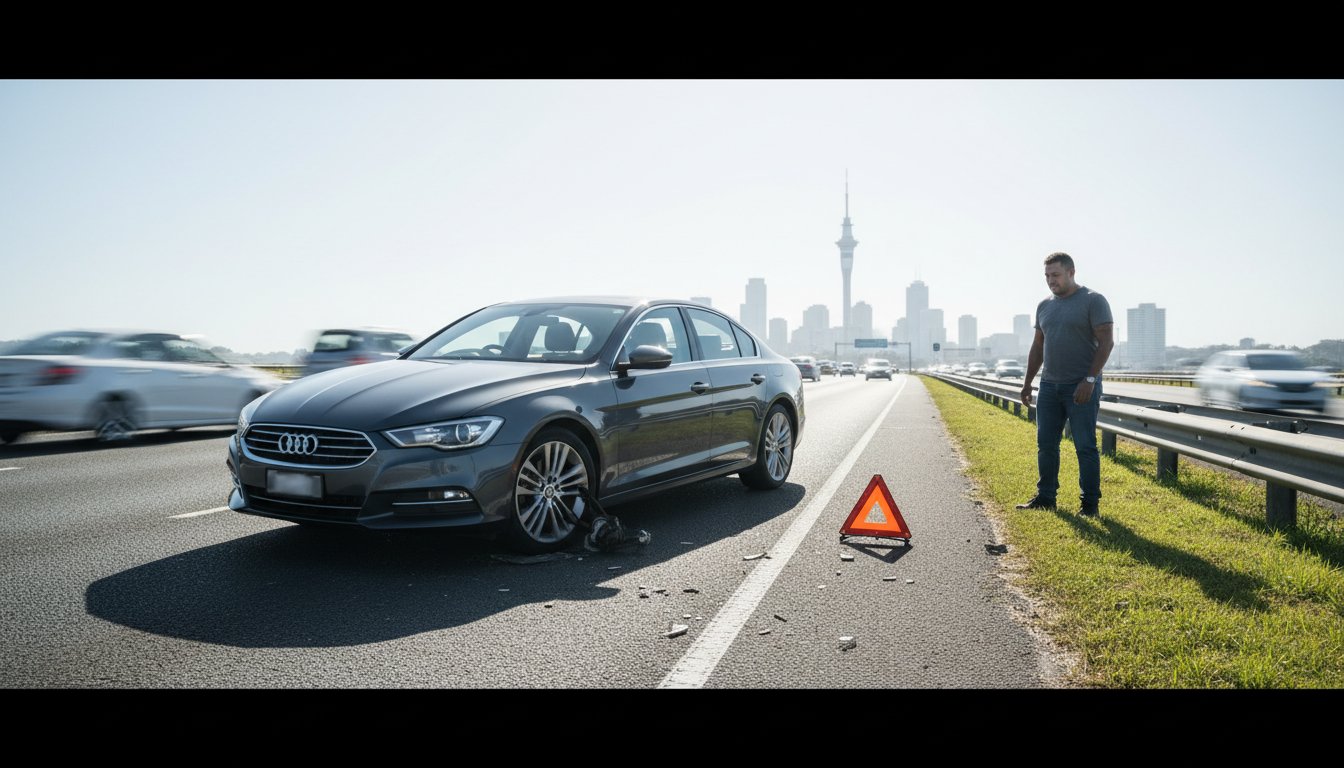
Is that rhythmic clicking sound in your steering wheel just a minor annoyance, or is your front wheel about to lock up on the Southern Motorway? It’s a question many Kiwi drivers face when they hear something new under the bonnet. Most people hope a strange noise is just a quirk that can wait until their next service. It’s stressful to think about mechanical jargon and unexpected bills when you just need to get to work. However, ignoring the risks of driving with a bad CV joint can turn a simple fix into a total loss of control.
Replacement costs in New Zealand typically range from $240 to $1500. With 40% of cars failing their first WOF inspection, staying ahead of repairs is vital for your safety and your budget. This guide breaks down the critical safety dangers and financial consequences of CV joint failure before you find yourself stranded or facing a WOF rejection. You’ll learn how to identify the symptoms of imminent failure and see how our transparent repair solutions keep you on the road without the mechanical guesswork.
Key Takeaways
- Understand how CV joints act as your drivetrain’s “elbows” and why their failure can lead to a sudden loss of steering control.
- Recognize the major risks of driving with a bad CV joint, including losing all engine power while you’re in the middle of traffic.
- Identify the “Click of Death” and other critical symptoms so you can tell the difference between a minor vibration and an imminent mechanical failure.
- Learn why a simple torn boot leads to an automatic WOF failure and how early repairs save you hundreds on total axle replacements.
- Get a clear path to transparent pricing and mobile mechanic solutions that take the guesswork out of your car’s maintenance.
What is a CV Joint and Why is Driving with a Bad One Risky?
Imagine your car’s front wheels trying to steer while receiving power from the engine. It is a complex mechanical job that requires a high degree of flexibility. To handle this, your vehicle uses a Constant-velocity joint, or CV joint. Think of these as the “elbows” of your drivetrain. They allow the axle to bend in different directions while still spinning the wheels at a constant speed. This flexibility is what lets you turn corners while the engine continues to push you forward.
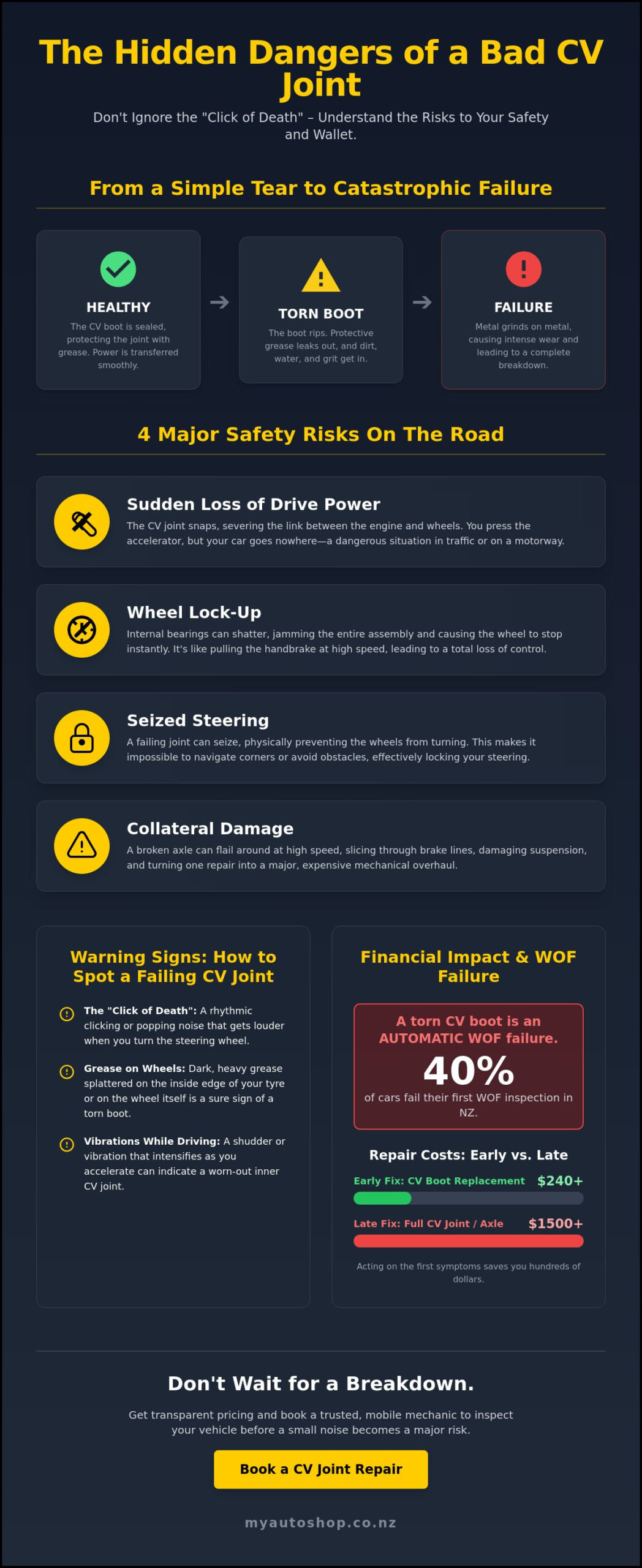
The first line of defense for this precision part is the CV boot. This thick rubber sleeve sits over the joint, packed with high-pressure grease. Its only job is to keep that lubricant inside while blocking out water, salt, and road grime. Usually, a “bad” joint doesn’t fail overnight. It starts with a simple tear in this rubber boot. Once the seal is broken, the clock starts ticking on the risks of driving with a bad CV joint.
The Mechanics of Failure
When the boot rips, the protective grease leaks out. Without lubrication, the internal bearings generate intense heat. Metal-on-metal friction begins to eat away at the joint’s surface. To make matters worse, road grit and moisture enter the tear. This debris acts like liquid sandpaper, grinding down the internal components every time the axle rotates. It only takes a few hundred kilometres of driving with an open boot to cause permanent damage. The CV joint is the critical link between your engine and your wheels. When that link wears down, it loses the ability to handle the torque produced by your engine, especially during acceleration.
Can You Drive with a Clicking CV Joint?
Many Kiwi drivers hear a rhythmic clicking while parking and think they can ignore it because the car still moves. This is a dangerous misconception. While your car might technically drive for a few days with a clicking joint, the structural integrity is already compromised. You aren’t just dealing with a noise; you’re dealing with a component that is physically disintegrating.
The risks of driving with a bad CV joint involve total unpredictability. You might get lucky for a week, or it might snap on your next trip to the supermarket. The joint could seize or disintegrate entirely. It rarely happens while you’re idling in your driveway. Instead, the extra stress of a motorway merge or a sharp emergency turn is often what triggers the final break. Driving on a failing joint means you’re operating a vehicle that could lose drive power or steering control without a second’s notice. It isn’t just about a noisy car; it’s about whether your wheels will respond when you need them most.
The 4 Major Safety Risks of CV Joint Failure on the Road
Driving with a clicking sound isn’t just an annoyance; it’s a countdown to a potential emergency. The physical risks of driving with a bad CV joint escalate quickly once the internal components lose their structural integrity. When the joint reaches its breaking point, the consequences are immediate and often dangerous.
First, you face a sudden loss of drive power. When the joint eventually snaps, the connection between your transmission and your wheels is severed. You’ll press the accelerator, the engine will roar, but the car won’t budge. Second, a failing joint can seize. Since the CV joint must pivot to allow for steering, a seized assembly can physically prevent your wheels from turning. This makes it impossible to navigate a corner safely or avoid an obstacle in your path. If you suspect your car is at risk, booking a CV joint and boot repair through a professional can prevent these dangerous scenarios.
Third, extreme wear can lead to wheel lock-up. If the internal bearings shatter, the metal fragments can jam the entire assembly, stopping the wheel instantly. This is essentially like pulling the handbrake while driving. Finally, there is the risk of collateral structural damage. A broken axle doesn’t always just sit still; it can flail around under the car at high speeds. This spinning metal can slice through brake lines or smash expensive suspension components, turning a single repair into a massive mechanical overhaul.
What Happens at High Speeds?
Failure on New Zealand motorways or open roads is significantly more dangerous than a breakdown in a suburban car park. At 100km/h, the centrifugal force acting on a compromised joint is immense. This force makes an already unstable joint much more likely to disintegrate under load. If your vehicle becomes disabled suddenly on a high-speed road, you aren’t just a danger to yourself; you’re a stationary hazard for every other road user. The risks of driving with a bad CV joint increase exponentially the faster you travel.
The Danger of “Differential Spin”
Most Kiwi cars use an “open differential” system. This means power follows the path of least resistance. If one CV joint breaks, that axle offers zero resistance. Your car’s mechanical system will send all the engine’s power to that broken spinning stub instead of the working wheel. You’ll experience the panic of a revving engine with zero forward momentum. With the New Zealand AA handling around 500,000 calls for assistance annually, being stranded in a busy intersection or a remote rural area because of a preventable mechanical failure is a situation every driver should avoid.
How to Tell if Your CV Joint is Failing: Symptoms and Triage
The first sign of trouble is usually audible. The most infamous warning sign is often called the “Click of Death”. It’s a rhythmic, metallic clicking or popping sound that happens when you turn the steering wheel sharply while moving. You’ll likely hear it while pulling into a driveway or navigating a tight car park. This sound tells you the outer joint is worn and struggling to pivot. If you ignore it, the risks of driving with a bad CV joint move from a minor annoyance to a major safety hazard.
Look at your front wheel rims for splatters of thick, dark grease. This lubricant looks like oily mud and is flung out of the boot by centrifugal force as the axle spins. If the grease looks fresh and shiny, you’ve caught the issue early. If it’s caked in road grime and grit, the joint has likely already suffered internal damage. This grit acts like sandpaper, grinding down the metal components until the joint eventually snaps. With 40% of cars failing their first WOF inspection in New Zealand, identifying these symptoms early is your best defense against an unexpected “failed” sticker.
Another red flag is a distinct clunking sound when you take off from a stop or shift gears. This indicates excessive “play” in the joint where the metal components no longer fit snugly. They slam together when torque is applied, which is a clear sign that the structural integrity is failing. Identifying this early helps you avoid the most severe risks of driving with a bad CV joint, such as a total loss of drive power on the motorway.
Outer vs. Inner CV Joint Symptoms
Outer joints are located near the wheels and are the most common failure point. They provide feedback through the steering wheel, specifically clicking during turns. Inner joints sit closer to the transmission and behave differently. Instead of clicking, they cause a side-to-side shudder or heavy vibration during acceleration. Because this feeling mimics a wheel balance issue, many drivers misdiagnose it. However, if the shaking stops the moment you lift your foot off the accelerator, the inner CV joint is likely failing under load.
The Visual Inspection
You don’t need a workshop hoist to perform a basic check. Turn your wheels all the way to one side and use a torch to look behind the wheel. The CV boot looks like a black rubber accordion. Look for visible cracks, deep perished lines, or fresh grease leaking from the ends. If you spot a tear, the joint is now exposed to New Zealand’s wet road conditions. Booking a professional inspection immediately is the only way to determine if you need a simple boot replacement or a full new axle.
Beyond Safety: The Financial Impact and WOF Implications
The financial risks of driving with a bad CV joint often hit home much faster than the physical ones. In New Zealand, your car’s roadworthiness is tied directly to the health of your drivetrain. If you roll into a testing station with a clicking front end, you’re unlikely to leave with a fresh Warrant of Fitness sticker. NZTA regulations are strict because a failed joint is a high-stakes event on the road. Procrastinating on a small noise today can lead to a massive bill tomorrow when the component finally gives up.
Why a Torn Boot is a WOF Fail
A split CV boot is an automatic WOF failure if it is leaking grease onto the brakes or exhaust. Testing officers also check that steering components operate without roughness or stiffness. A clicking joint is a clear sign of internal roughness, meaning it can be failed even if the boot looks intact. Once New Zealand’s wet weather and road grime enter an open boot, the joint’s internal surfaces are destroyed rapidly. This regulatory hurdle exists to ensure your axle doesn’t snap while you’re navigating a busy intersection or merging onto a motorway.
The Cost of Procrastination
Managing car costs is about timing. A simple CV boot repair is a proactive fix that keeps your original axle in service. If you ignore the symptoms, you face the snowball effect of mounting repair bills. Replacement costs in NZ typically range from $240 to $1500. This price jumps when a vibrating axle damages your transmission seals or puts uneven stress on your wheel bearings. You’re no longer just paying for a joint; you’re paying for a full drivetrain overhaul.
Neglecting these repairs also ruins your car’s resale value. A noisy drivetrain is the first thing flagged during a pre-purchase inspection, often leading buyers to demand a massive discount or walk away entirely. With the AA rescuing a person every minute in New Zealand, being the driver stranded on the side of the road with a snapped axle is an expensive and preventable mistake. Fixing the issue early is the smart Kiwi way to stay safe and keep your maintenance budget under control. It’s about protecting your wallet as much as your passengers.
Getting Your CV Joint Fixed: Transparent Solutions with My Auto Shop
Don’t let the fear of a breakdown or a surprise bill keep you off the road. We know car repairs often feel like a black hole for your time and money. My Auto Shop bridges the gap between traditional mechanical skill and modern digital convenience. We’ve built a nationwide network of NZ’s best mechanics to handle the risks of driving with a bad CV joint before they turn into a motorway emergency. Our platform ensures you’re never left in the dark about what’s happening under your car’s bonnet.
Our “Transparent pricing” promise is the ultimate signature of how we work. You’ll never face hidden costs or mechanical guesswork when you book through us. You get an instant quote upfront. This means you know exactly what the job costs before any tools touch your vehicle. It’s about stripping away the anxiety often associated with the automotive industry. We act as your organized, honest partner, ensuring you feel empowered rather than intimidated by mechanical jargon. We value your time as much as your safety.
For busy Kiwis, our “Pick up & drop off” service is a signature promise of our brand. We can collect your car from your home or office, get it fixed by a vetted professional, and bring it back when the work is finished. You stay productive while we handle the heavy lifting. This seamless experience is designed to respect your busy life while keeping your vehicle in top condition. It is the modern way to manage car maintenance without the usual stress of visiting a workshop.
Mobile Mechanic vs. Workshop Repair
If you’ve spotted fresh grease but haven’t heard the clicking sounds yet, a mobile mechanic might be your best first step. They can perform an on-site inspection at your house or workplace to assess the damage. This is a fast, efficient way to catch a torn boot before the joint itself fails. However, for more complex drivetrain work like a full CV joint and boot repair, a workshop hoist is usually required. These heavier tasks need specific equipment to ensure the axle is seated correctly and meets all safety standards. My Auto Shop helps you navigate this choice effortlessly, guiding you to the right solution for your specific car problem.
Booking Your Repair in Seconds
Our booking process is built for the digital age. Enter your rego, select your service, and pick a time that fits your calendar. You get the peace of mind that comes with professional, guaranteed work from a local Kiwi-owned business. Don’t wait for a WOF failure or a sudden breakdown in the middle of traffic. Address the risks of driving with a bad CV joint now with a solution that values your safety as much as your time. Our system moves at the speed of a mobile app while maintaining the steady pulse of a dependable service business.
Book your CV joint inspection or repair today and experience a better way to look after your car.
Stay Safe and Roadworthy on Kiwi Roads
Your safety on the road shouldn’t be a guessing game. By recognizing the “Click of Death” early and understanding the risks of driving with a bad CV joint, you protect both your passengers and your bank account. Remember that a small tear in a rubber boot can quickly escalate into a total loss of steering or an expensive WOF failure. Staying proactive is the best way to avoid being one of the half a million calls the AA handles annually in New Zealand.
Taking care of your car doesn’t have to be a hassle. We provide a seamless bridge to NZ’s best mechanics without the jargon or hidden fees. With our NZ-wide network of 300+ MTA-assured mechanics, you’re always close to a professional solution. We offer transparent, upfront pricing and a convenient pick-up and drop-off service to fit your busy schedule. This ensures your vehicle stays in top shape while you focus on your day.
Get an instant quote for CV joint repair with My Auto Shop and get back to driving with confidence. You’ve got the knowledge to stay ahead of mechanical issues; now let us handle the hard work for you.
Frequently Asked Questions
How long can I drive with a clicking CV joint?
You shouldn’t drive for more than a few days once the clicking starts. There is no guaranteed mileage or timeframe before a total break occurs. The clicking sound means the internal bearings are already worn and the structural integrity is compromised. Continuing to drive significantly increases the risks of driving with a bad CV joint, potentially leading to a breakdown in heavy traffic or a loss of steering control.
Can a bad CV joint cause my car to shake at high speeds?
Yes, specifically when the inner CV joint begins to fail. While a shaky steering wheel often points to wheel balance, a side-to-side shudder during acceleration is a classic inner joint symptom. This vibration usually gets worse as you increase speed or carry heavier loads. If the shaking stops as soon as you take your foot off the accelerator, it’s a clear sign your drivetrain needs an urgent inspection.
Is a clicking sound always a CV joint problem?
Clicking is the most common sign of CV failure, but it isn’t the only possibility. Loose brake callipers or worn wheel bearings can sometimes produce similar metallic noises. However, if the sound is rhythmic and only happens during sharp turns, the CV joint is almost certainly the culprit. Because the New Zealand AA handles around half a million calls for assistance annually, getting a professional diagnosis early prevents a simple noise from becoming a roadside emergency.
Will my car fail its WOF if the CV boot is torn?
Yes, a torn CV boot is an automatic Warrant of Fitness failure in New Zealand. NZTA safety standards require the boot to be intact to prevent grease from leaking onto your brakes or exhaust. Inspectors also check for any “roughness or stiffness” in the steering. If your joint is clicking or the boot is split, you won’t receive a new WOF sticker until the component is repaired or replaced.
Can I just replace the CV boot instead of the whole axle?
You can only replace the boot if you catch the tear before internal damage starts. If the joint isn’t clicking and the grease inside is still clean, a boot kit is a cost-effective fix. However, if you’ve been driving with a tear for more than a few weeks, road grit has likely already ground down the metal. In that case, a full axle replacement is the only safe way to eliminate the risks of driving with a bad CV joint.
What happens if my CV joint snaps while I am driving?
You will lose all power to the wheels instantly. Even if your engine is running and the car is in gear, the broken axle won’t be able to transfer torque to the road. This is especially dangerous on motorways where you need momentum to reach the shoulder safely. In extreme cases, the broken end of the axle can flail around, slicing through brake lines or damaging your car’s suspension components.
How much does it cost to fix a CV joint in New Zealand?
Repair costs typically range from $240 to $1500 depending on your vehicle’s make and model. A basic CV boot replacement is on the lower end of that scale, while a full heavy-duty axle assembly for a 4WD can reach the higher end. Most Kiwi drivers find that parts cost between $150 and $350, with the remainder of the bill covering the specialized labor required to disassemble the hub and suspension.
Does a bad CV joint affect my car’s transmission?
It can cause secondary damage to your gearbox over time. A failing joint often creates intense vibrations that travel up the axle and into the transmission housing. This constant shaking can wear out the transmission seals, leading to fluid leaks and internal overheating. Addressing a clicking joint early protects your transmission from these unnecessary stresses and prevents a relatively simple repair from turning into a multi-thousand-dollar gearbox overhaul.
Disclaimer
This article provides general information only and should not be relied on as professional mechanical, safety or legal advice. Vehicle requirements and circumstances vary. If you are unsure about your vehicle, have it inspected by a qualified automotive professional.