

Most Kiwi drivers treat a trip to the mechanic like a tax they can’t avoid, fearing that every dollar spent is simply gone. It’s frustrating to feel like your hard-earned money is disappearing into a gearbox or a set of new brake pads. You’ve likely wondered exactly how much do car repairs depreciate value when it’s finally time to list your vehicle on Trade Me. While it’s common to worry that a history of repairs will scare off buyers, industry data shows that a verifiable service history can protect up to 15% of a car’s resale value compared to one with missing records.
You’ll discover how mechanical repairs actually protect your asset and why neglected maintenance is the single biggest driver of depreciation in New Zealand. We will show you the difference between routine maintenance and major repairs, how to document your service history to secure a higher resale price, and clarify IRD rules for business vehicle owners. You don’t have to guess about your car’s worth anymore. This guide provides the clarity you need to stop viewing repairs as a loss and start seeing them as an investment in your car’s future sale price.
Key Takeaways
- Distinguish between inevitable depreciation and avoidable repair costs to better manage your vehicle’s long-term worth in the New Zealand market.
- Understand how much do car repairs depreciate value and why a Full Service History is the ultimate insurance policy for your asking price.
- Learn why buyers often demand a “repair discount” worth twice the actual cost of a fix when you neglect basic maintenance or fail a Pre-purchase Inspection.
- Identify the specific IRD rules that allow Kiwi businesses to deduct repair costs and when a fix must be treated as a capital improvement.
- Discover how maintaining a digital service history keeps your car’s value high while saving you time with our seamless pick-up and drop-off service.
Understanding Car Depreciation vs. Repair Costs
Owning a vehicle in New Zealand involves balancing two distinct financial realities: the money you spend to keep it running and the value it loses just by sitting in your driveway. Many Kiwi car owners struggle to separate these concepts, often wondering how much do car repairs depreciate value when they see a large bill for a new clutch or radiator. Depreciation is the inevitable drop in market price over time. Repairs are the specific costs required to restore a vehicle to its functional state after a mechanical failure.
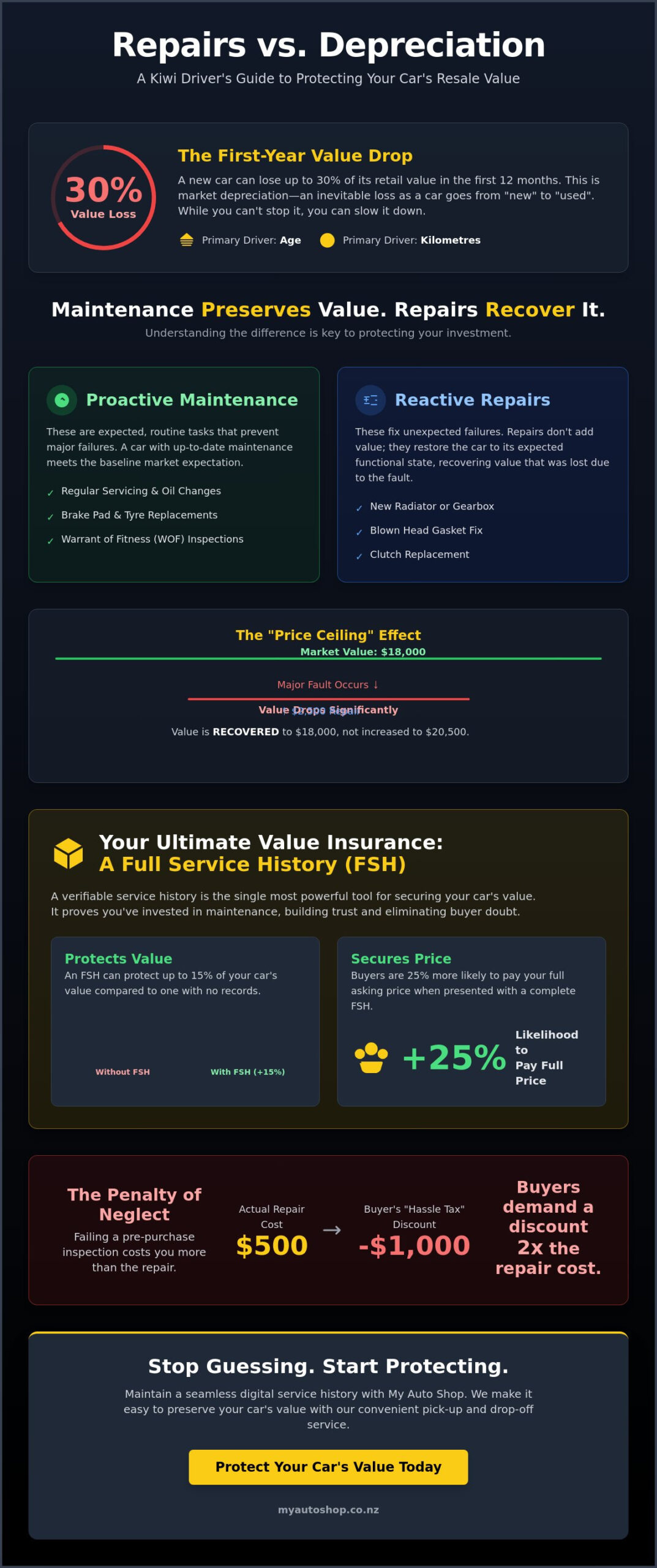
The 30% rule is a harsh reality for new car buyers in Auckland, Wellington, and across the country. Most new vehicles lose 30% of their retail value within the first 12 months of ownership, regardless of how well they are maintained. This loss occurs because the car transitions from “new” to “used” the moment it leaves the dealership. While regular maintenance preserves your car’s worth, neglecting it accelerates this downward slide. Understanding the concept of Understanding Diminished Value helps clarify that while a repair fixes a problem, the history of that repair can still impact the final sale price.
What is Market Depreciation?
Market depreciation is driven primarily by age and kilometres (kms). In the New Zealand used car market, a vehicle with 150,000 kms on the clock will naturally command a lower price than an identical model with only 50,000 kms. Luxury European brands often experience faster depreciation than Japanese models. A high-end sedan might lose 50% of its value in just three years because the cost of specialized parts and labor increases as the vehicle ages.
The prevalence of ‘Grey Imports’ (used vehicles imported from Japan) also shapes local values. These imports create a high supply of affordable, high-spec vehicles, which puts downward pressure on the resale value of cars sold new in New Zealand. Buyers compare your car against thousands of similar imports, making condition and service history the primary ways to stand out.
Repairs vs. Maintenance: A Vital Distinction
It is essential to distinguish between proactive maintenance and reactive repairs. Maintenance includes tasks like regular servicing, oil changes, and Warrant of Fitness (WOF) inspections. Buyers expect these to be up to date. If they aren’t, the buyer will likely deduct the cost of the overdue service from your asking price. Repairs involve fixing broken components like a radiator or a gearbox. While these repairs restore the car to its expected state, they rarely increase the value beyond the current market average.
- Maintenance: Routine tasks that prevent wear (e.g., brake pads, filters).
- Repairs: Fixing unexpected failures (e.g., a blown head gasket).
- WOF: A baseline safety requirement in NZ, not a guarantee of mechanical health.
Maintenance is a proactive value-preservation strategy that ensures your car meets the expected market standard for its age and mileage. By staying on top of these tasks, you prevent the accelerated depreciation that comes with a “fix-it-later” attitude. Knowing how much do car repairs depreciate value starts with realizing that a well-maintained car simply holds its ground, while a neglected one loses value fast.
Does Fixing Your Car Increase Its Resale Value?
Most car owners view repairs as an investment, but the market treats them as a baseline requirement. This is known as the price ceiling. If a 2015 Mazda CX-5 has a market value of NZ$18,000, spending NZ$2,500 on a major engine repair won’t push the price to NZ$20,500. It simply restores the car to its NZ$18,000 potential. Repairs don’t usually add value; they recover it. Understanding how much do car repairs depreciate value starts with realizing that a broken car is worth significantly less than the cost of the fix because buyers factor in the “hassle tax” of managing the repair themselves.
A Full Service History (FSH) functions like an insurance policy for your resale price. It proves you haven’t cut corners. Buyers are 25% more likely to pay the full asking price when they see a consistent paper trail from reputable NZ workshops. This transparency builds peace of mind, which is a powerful psychological tool during a sale. Modern vehicles are complex machines. As highlighted in a GAO report on vehicle repair, evolving technology and data access impact how cars are maintained. This complexity makes documented, professional repairs even more vital for maintaining value in the secondary market.
The ROI of Common Mechanical Repairs
- Brake pads and tyres: These are consumables. You won’t get a higher price for having 80% tread, but you’ll certainly get a lower one if they’re down to the wear indicators. Fresh rubber prevents 15% low-ball offers.
- Cambelt/Timing belt: This is a massive selling point. If your vehicle is at the 100,000km mark and the belt is done, highlight it. It removes a looming NZ$800 to NZ$1,200 expense for the buyer.
- Car battery and fluids: These are minor costs that signal pride of ownership. A clean engine bay with clear fluids suggests the car hasn’t been neglected.
Why ‘Original Condition’ Matters More Than ‘New Parts’
Keeping a car close to factory-spec is almost always better for your wallet. Poorly installed aftermarket parts can actually hurt your car’s value. A 2018 Toyota Hilux with genuine parts will hold its value better than one fitted with cheap, unbranded components that don’t meet OEM standards. Using certified NZ mechanics ensures that any work performed meets the standards buyers expect. When you use quality parts, you avoid the how much do car repairs depreciate value trap caused by “backyard” fixes. Buyers want to know the car was cared for by professionals who understand the local New Zealand conditions, from our salty coastal air to our rugged backroads.
The Depreciation Penalty: How Neglect Tanks Your Price
Neglecting your car doesn’t just make it less reliable; it actively drains your bank account when it’s time to sell. Most buyers apply a “Repair Discount” to your asking price. This isn’t a simple one-to-one deduction. If your car needs a NZ$400 brake pad replacement, a savvy buyer won’t just ask for NZ$400 off. They usually subtract double the cost to account for their time, hassle, and the risk of hidden issues. This psychological barrier is a primary factor in how much do car repairs depreciate value over the life of the vehicle.
Selling a vehicle without a current Warrant of Fitness (WOF) is a major red flag in the New Zealand market. An expired WOF suggests you’ve stopped caring about the car’s safety or, worse, that it will fail an inspection and require thousands in repairs. Minor oil leaks or unusual suspension knocks act as mechanical smoke signals. They tell prospective buyers that the car has suffered from mechanical neglect, leading them to lowball your listing price immediately to protect themselves from future costs.
The Role of the Pre-Purchase Inspection
A Pre-Purchase Inspection (PPI) report serves as a definitive valuation tool for the buyer. When a mechanic finds issues like worn CV joints or a leaking radiator, the buyer uses that report as a shopping list for discounts. Common red flags like engine sludge or transmission hesitation can lead to price drops of NZ$2,000 or more. To protect your sale, get your own inspection done before listing the car. Fixing these issues early prevents them from becoming leverage for a buyer. For more context on how damage history impacts your car’s worth, you can check Kelley Blue Book’s guide to diminished value to see how experts quantify these losses.
Deferred Maintenance: The Hidden Value Killer
Missing service stamps are a silent profit killer. Industry data suggests that each missed annual service can drop a car’s resale value by 5% to 10%. A small coolant leak left unaddressed today often evolves into a blown head gasket nightmare, which can instantly wipe NZ$3,500 off your car’s market worth. New Zealand buyers also place a high premium on the “Kiwi-owned” advantage. A local service history with reputable NZ workshops is far more valuable than unknown import records. It provides a transparent paper trail that proves the car hasn’t been neglected. Understanding how much do car repairs depreciate value means recognizing that a NZ$250 oil change today protects thousands of dollars in resale value tomorrow.
Tax Depreciation vs. Mechanical Repairs for NZ Businesses
Managing a business fleet means looking beyond the odometer. You need to understand how Inland Revenue (IRD) views your workshop visits. While you might wonder how much do car repairs depreciate value, the tax benefits often provide a silver lining for Kiwi business owners. Most routine maintenance is classified as a revenue expense. This means you can deduct the full cost from your taxable income in the same year the work is done. It’s a direct way to lower your tax bill while keeping your assets safe on the road.
For the vehicle itself, you should use the IRD depreciation rate finder to track its “book value” over time. Most motor vehicles for business use carry a diminishing value rate of 30% or a straight-line rate of 21%. Claiming these repairs correctly helps offset the inevitable drop in market value as your fleet ages. By writing off the cost of a brake pad replacement or a new set of tyres, you effectively reduce the financial sting of the car’s natural depreciation.
Is a New Engine a Repair or an Asset?
The IRD draws a clear line at “improvements.” If you’re simply fixing a broken part to return the car to its original state, it’s a repair. However, if you install a high-performance engine that makes a 2019 Toyota Hiace significantly better than it was when new, it might be seen as a capital improvement. This would be added to the asset’s value rather than deducted instantly. Most routine repairs are deductible expenses, not capitalised assets. For mobile service vehicles, keeping the engine running is vital for daily cash flow, making these deductions a key part of your annual budget.
Maximising Your Business Vehicle’s Book Value
Accurate records are your best friend during tax season. Your accountant needs clear, itemised invoices to distinguish between a NZ$250 oil change and a NZ$4,000 transmission overhaul. Keeping a precise logbook ensures you’re claiming the right proportion of business use versus private use, which is essential for FBT (Fringe Benefit Tax) compliance. When it’s time to sell, a full digital service history proves the car has been maintained to a high standard, helping you claw back some of that market value.
- Keep every receipt: Even small repairs add up to significant tax deductions.
- Use transparent pricing: Avoid “estimate” guesswork so your cash flow remains predictable.
- Digital tracking: Move away from paper files that get lost in the glovebox.
My Auto Shop helps businesses manage repair records seamlessly by providing digital invoices and a centralized service history for every vehicle in your fleet. This transparency makes it easier to track how much do car repairs depreciate value versus how much they save you in tax. Our platform connects you with NZ’s best mechanics, ensuring your work vehicles spend less time in the shop and more time on the clock.
How to Protect Your Car’s Value with My Auto Shop
Maintaining a vehicle shouldn’t feel like a second job. At My Auto Shop, we’ve built a platform that turns routine maintenance into a strategic investment. A well-documented service history can increase a car’s resale price by up to 15% compared to a vehicle with missing records. We provide every customer with a digital service history that lives online. This record acts as a “gold standard” for future buyers, proving that you never cut corners on essential care.
Many owners wonder how much do car repairs depreciate value when they face a sudden mechanical issue. While a major repair might feel like a hit to your wallet, neglecting it is the real value killer. We use transparent pricing to remove the guesswork. You’ll receive an upfront quote before any work begins. This clarity ensures you can budget for repairs that keep your car’s market value high without worrying about hidden costs or “mechanic’s math.”
Seamless Car Care for Busy Kiwis
Life in New Zealand moves fast, and car maintenance often falls to the bottom of the to-do list. Our “Pick up & drop off” service is designed to stop that from happening. We collect your car from your home or office, take it to one of our 300+ MTA-approved workshops, and bring it back when the job is done. It’s a simple way to stay on top of your service schedule without losing your afternoon.
- Mobile Mechanics: For many jobs, our mobile experts come directly to your driveway, saving you a trip across town.
- National Coverage: You get access to a trusted network of local experts from Auckland to Invercargill.
- 60-Second Booking: Our digital platform lets you secure a service or WOF in under a minute.
Your Partner in Resale Readiness
When you’re ready to list your car on TradeMe, you need more than just a clean interior. We help you prepare for a sale with comprehensive pre-purchase inspections (PPI). These checks identify potential “value killers” like worn suspension bush or aging cambelts before a buyer’s mechanic finds them. Fixing these small issues early prevents buyers from haggling your price down by thousands of dollars.
A car with a full, transparent history is much easier to sell. You can present your digital records with confidence, showing that every WOF and oil change was handled by professionals. This level of detail justifies a higher asking price and builds immediate trust with potential buyers. Don’t let your investment slide away through neglect or poor record-keeping.
Protect your car’s value—book a service with My Auto Shop today
Protect Your Car’s Resale Value Today
Understanding how much do car repairs depreciate value is the first step to saving money. While every vehicle loses value, a documented service history stops the neglect penalty from stripping thousands off your trade-in price. Industry data suggests that a well-maintained car in New Zealand can retain up to 15% more value than a neglected counterpart. Regular maintenance isn’t just a cost; it’s an investment in your asset’s future.
My Auto Shop makes looking after your car simple. We’ve gathered NZ’s best network of qualified mechanics to ensure you get top-tier service without the jargon. You’ll always receive transparent, upfront pricing, so there are no surprises when the bill arrives. We even offer a convenient pick-up and drop-off service to keep your day moving while we handle the hard work.
Book a comprehensive service to protect your car’s resale value. It’s the easiest way to stay safe on Kiwi roads and keep your vehicle’s value exactly where it should be.
Frequently Asked Questions
Does a brand new engine increase my car’s value?
A new engine rarely increases a car’s value above its standard market price. It usually just restores the value lost from a failed engine. While a receipt for a NZ$5,000 engine replacement shows reliability, buyers expect a working engine as a baseline. You might recoup 10% to 15% of the engine cost in the final sale price compared to a car with an older, high-mileage motor.
Is car repair tax deductible in New Zealand for personal vehicles?
Car repairs for personal vehicles are not tax deductible in New Zealand according to Inland Revenue (IRD) guidelines. You can only claim these costs if you use the vehicle for business purposes or income generation. If you use your car for work, you can claim a portion of repairs using the IRD mileage rate, which is currently 95 cents per kilometer for the first 14,000km of business travel.
How much value does a car lose if it doesn’t have a full service history?
A missing service history can reduce a car’s resale value by 10% to 20% in the New Zealand used car market. Buyers view a gap in records as a risk for hidden mechanical issues. For a vehicle worth NZ$20,000, this lack of documentation could cost you up to NZ$4,000. Keeping every receipt from your WOF and scheduled maintenance ensures you get the best possible price.
Can I claim depreciation on my car repairs if I’m self-employed?
You can’t claim depreciation on the repairs themselves, but you can claim the repair cost as a business expense if you’re self-employed. The IRD allows you to deduct the actual costs of running the vehicle or use the tier-one mileage rate. Understanding how much do car repairs depreciate value is vital here, as the vehicle itself depreciates at a set rate, typically 30% annually using the diminishing value method for tax purposes.
Does a minor accident repair affect my car’s resale value if fixed properly?
Even perfectly executed minor repairs can lower a car’s value by 5% to 10% due to the accident history tag. Modern buyers use services like CarJam to check history, and any recorded damage often leads to lower offers. To minimize this loss, keep detailed photos of the minor damage and the professional repair invoice to prove the structural integrity remains intact.
Should I fix my car before selling it or just lower the price?
Fix major mechanical issues and safety items like brake pads or tires before selling to avoid drastic price drops. A car needing a NZ$500 repair often sees buyers asking for a NZ$1,000 discount. However, don’t spend NZ$2,000 on minor paint chips, as you likely won’t see that investment returned. Focus on passing a fresh WOF to give the buyer immediate confidence.
What is the difference between diminishing value and straight-line depreciation for cars?
Diminishing value calculates depreciation as a constant percentage of the car’s current value each year, leading to higher deductions early on. Straight-line depreciation spreads the cost evenly over the car’s expected life, such as 15% of the original purchase price every year. Most Kiwi small business owners prefer the diminishing value method because it reflects the rapid 20% drop in value that occurs when a new car leaves the lot.
How do I prove my car has been well-maintained to a buyer?
Provide a chronological folder of all service invoices and a stamped maintenance logbook to prove your car’s history. Digital records from a platform like MyAutoShop provide transparent proof of every oil change and repair. Showing a consistent history of 10,000km service intervals can help you justify a higher asking price and explain how much do car repairs depreciate value by preventing neglect-related losses.
Disclaimer
This article provides general information only and should not be relied on as professional mechanical, safety or legal advice. Vehicle requirements and circumstances vary. If you are unsure about your vehicle, have it inspected by a qualified automotive professional.