
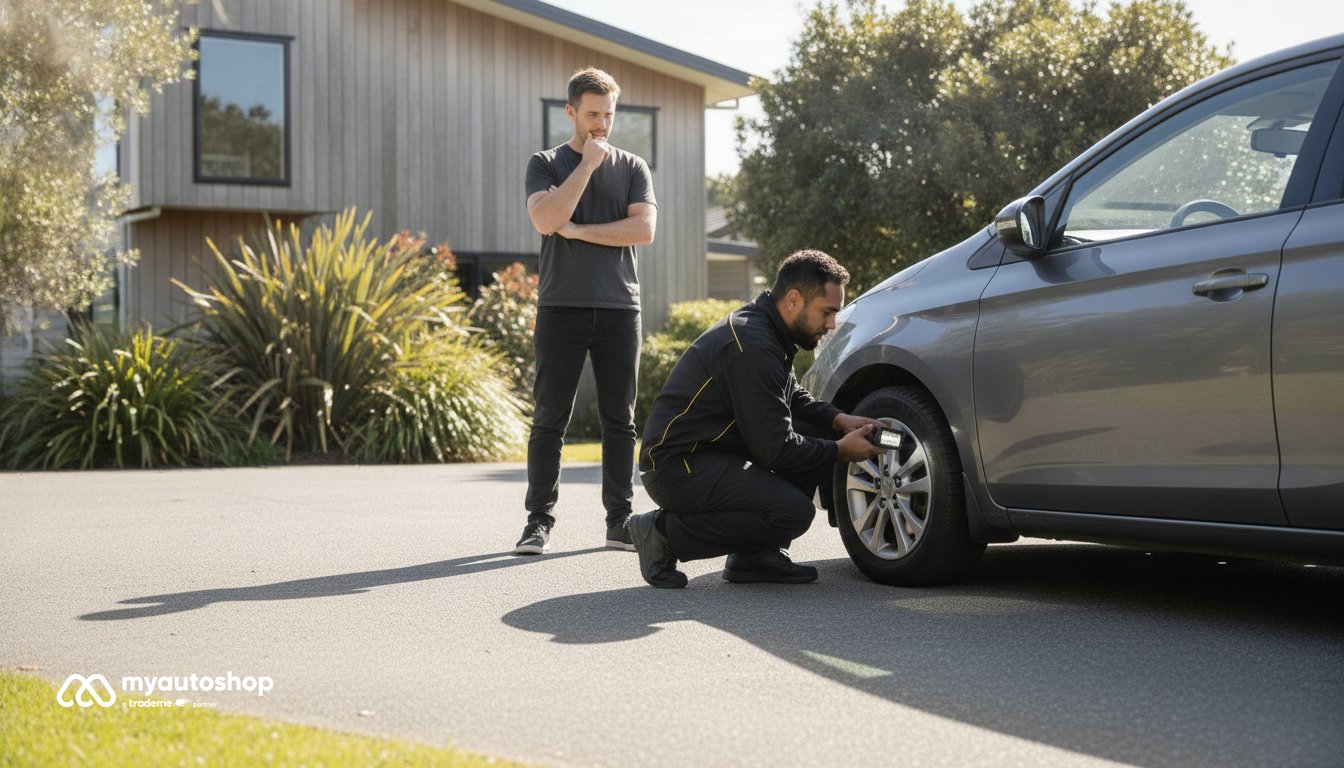
What if that “mint condition” Japanese import is actually hiding a $4,000 gearbox failure behind a fresh coat of wax? Buying a used car in New Zealand often feels like a gamble. With the 2026 WoF changes moving many vehicles to a two-yearly inspection cycle, you’re right to feel nervous about what’s happening under the bonnet between official checks. Using a comprehensive pre purchase inspection checklist is the only way to separate a genuine bargain from a looming financial disaster.
We’ve designed this guide to give you total control over the buying process. You’ll learn how to spot critical red flags, from worn tyres to subtle engine smoke, before you hand over any cash. We’ll walk through a step-by-step DIY inspection and explain when it’s time to bring in a professional expert for the final mechanical sign-off. You’ll gain the confidence to negotiate a fair price and the peace of mind that your new ride is safe for the open road.
Key Takeaways
- Verify the current WoF and registration status via NZTA, and ensure any outstanding Road User Charges (RUC) are settled before you buy.
- Inspect the bodywork for inconsistent panel gaps and rust under door seals, which are common indicators of past accidents or poor maintenance.
- Follow a mechanical pre purchase inspection checklist to check fluid levels, as “milky” oil residue is a classic sign of a failing head gasket.
- Perform a thorough test drive on multiple road types to listen for unusual noises and feel for brake shuddering.
- Recognise that while DIY checks are a great first filter, a professional inspection is essential for detecting deep-seated electronic or structural faults.
The Essential NZ Used Car Buying Checklist for 2026
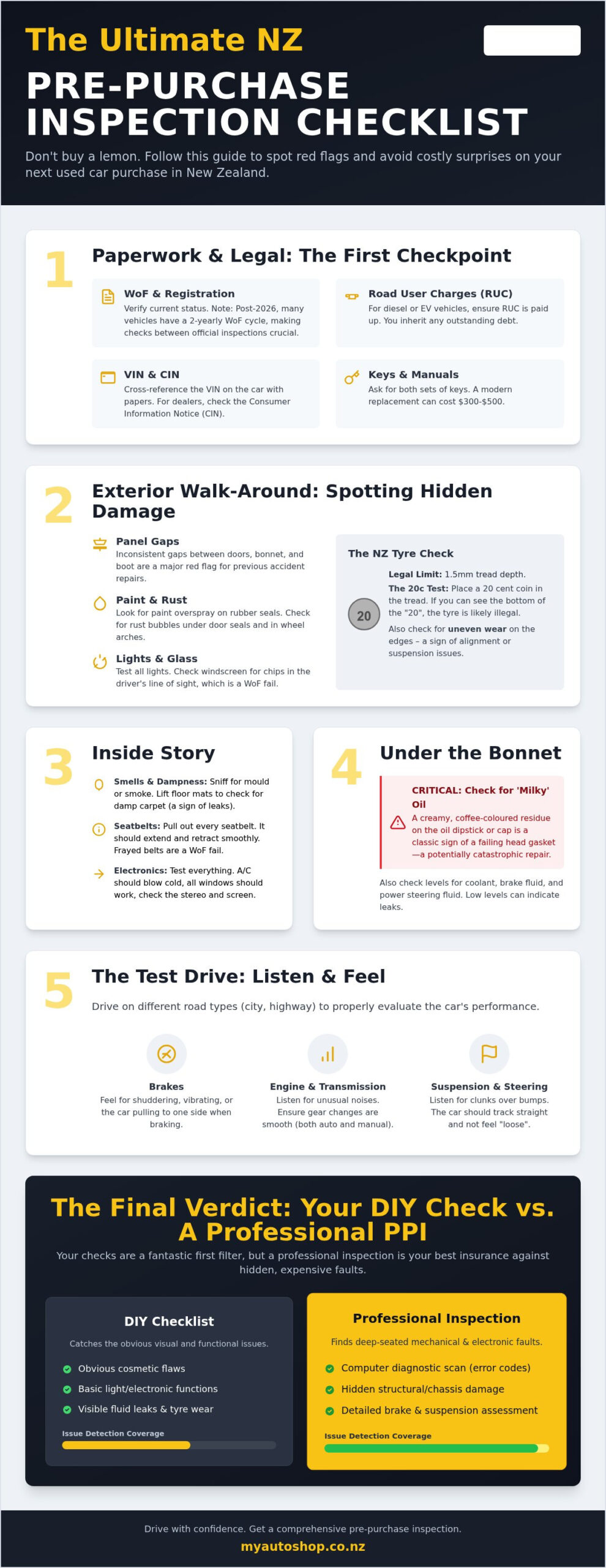
Before you even pop the bonnet, you need to verify the car’s legal status. In 2026, NZTA regulations have shifted significantly. New vehicles now require their first WoF at four years, and vehicles between 4 and 14 years old have moved to a two-yearly cycle. This makes checking the expiry date more critical than ever. Don’t assume a car is “fresh” just because it has a year left. A professional pre-purchase inspection helps confirm these details are legitimate and that the vehicle hasn’t been neglected during these longer gaps between official checks.
Check the Road User Charges (RUC) status if you’re looking at a diesel or electric passenger vehicle. The 2026 registration fee for these is $248.83 for 12 months, but the RUC balance is separate. If the RUC is in arrears, that’s a debt you’ll inherit. Next, look at the tyres. The legal limit in New Zealand is 1.5mm of tread depth. Use a 20 cent coin to check; if the “20” is visible, the tyre is likely illegal. Look for uneven wear on the edges. This often points to wheel alignment issues or worn suspension components that could cost hundreds to fix.
Paperwork and NZ Compliance
If you’re buying from a registered motor vehicle trader, they must display a Consumer Information Notice (CIN). This document is your best friend. It lists the odometer reading, any money owing, and the dealer’s registration number. Cross-reference the VIN on the CIN with the physical plate on the car’s firewall and the registration papers. For Japanese imports, check if the car has a local service history or if it’s a “fresh” arrival. Local history is always preferred. It proves the car has handled Kiwi roads and our damp climate rather than sitting in a yard for months. Always ask for both sets of keys and the original owner’s manual. Replacing a modern transponder key can easily cost $300 to $500 in NZ.
The “First Glance” Safety Check
Start your physical pre purchase inspection checklist by looking at the windscreen. A current service sticker on the top right tells you if the previous owner stayed on top of maintenance. Walk around and check the tyre brands. Ideally, you want matching brands on each axle. Mismatched tyres can affect handling and braking performance, especially in the wet. Finally, have the seller cycle through the lights while you stand outside. Check the indicators, brake lights, and high beams. It’s a simple test that prevents an immediate failed WoF and ensures you’re driving home safely.
Exterior and Interior: Spotting Hidden Damage and Neglect
You’ve checked the paperwork. Now it’s time to get hands-on. A car’s exterior often tells a story that the seller might not mention. Start by looking closely at the panel gaps where the doors, bonnet, and boot meet the frame. These gaps should be perfectly uniform. If one side is tighter than the other, it’s a major red flag for previous accident repairs. This is a vital step in any pre purchase inspection checklist because structural alignment issues can affect both safety and tyre wear; seeing the standards of a professional facility like NW Houston Auto Repair and Collision illustrates how precise these repairs must be to maintain vehicle integrity.
Check the paint under bright sunlight. Look for “overspray” on rubber window seals or plastic trim. This suggests a cheap respray to hide damage. New Zealand’s high UV levels often cause sun-faded clear coats on the roof and bonnet, which can be expensive to fix. Don’t forget to check the glass for chips. Even a small stone chip in the driver’s line of sight will result in a failed WoF. For more detailed guidance on what to look for, you can refer to the Consumer Protection pre-purchase checks.
Grab a torch and look into the wheel arches. You’re searching for rust or “bubbling” paint. Pull back the rubber door seals and check the metal underneath. In New Zealand’s coastal environments, salt air can accelerate corrosion in these hidden spots. If you find significant rust here, it’s often a sign the vehicle has lived near the beach or hasn’t been washed regularly. These repairs are notoriously difficult and expensive to rectify once they take hold.
Cabin Comfort and Red Flags
Open the doors and take a deep breath. A smell of stale cigarette smoke or heavy perfume often hides mould. Lift the floor mats and feel the carpet for dampness. This usually points to a leaking windscreen or, worse, previous flood damage. Ensure every seatbelt pulls out smoothly and retracts without hesitation. Frayed belts are an immediate safety failure and must be replaced to pass a WoF.
Finally, test every electronic button. Cycle the air conditioning to ensure it blows cold within 30 seconds. Check every electric window and the infotainment system for glitches. Head to the boot and confirm the spare tyre is inflated and the jack and tool kit are present. If these basics are missing, it’s a sign of a neglected history. If you’re unsure about what you’re seeing, booking a professional pre-purchase inspection through a trusted marketplace can save you from a “lemon” with hidden costs.
Mechanical and Under-the-Bonnet Inspection
Once you’re satisfied with the bodywork, it’s time to check the heart of the vehicle. Start with the oil dipstick. Pull it out, wipe it clean, and dip it again to check the level and colour. Clean oil is typically amber or light brown. If you notice a milky, “mayonnaise-like” residue on the dipstick or under the oil filler cap, it’s a major warning sign. This usually indicates coolant is leaking into the oil due to a failed head gasket, which is one of the most expensive repairs a car can face. Next, inspect the coolant reservoir. The fluid should be a clear pink, green, or blue. A rusty brown colour or an oily film on the surface suggests the cooling system has been neglected or contaminated.
Shine a torch around the engine block to look for active oil leaks or heavy, wet grease buildup. While a small amount of “sweating” is common on older Kiwi cars, fresh puddles are a sign of failing seals or gaskets. Check the battery terminals for white, crusty corrosion that can prevent the car from starting. Many modern batteries have a health “eye”; green is usually good, while black or white suggests it needs replacing. Including these steps in your pre purchase inspection checklist ensures you aren’t buying a car that will leave you stranded. If the battery terminals look corroded or the car struggled to start, it’s also worth checking whether the charging system is healthy — a failing alternator is a common culprit, and understanding the alternator replacement cost NZ 2026 can help you factor this into your negotiation. Finally, always insist on a cold startup. Listen for a metallic rattle or “clacking” sound that disappears after a few seconds. This often points to a stretched timing chain or worn valve lifters that are struggling with oil pressure — and if you suspect the chain is the culprit, reviewing the timing chain replacement cost NZ motorists are facing in 2026 will help you factor this into your offer. If the engine is slow to turn over or you hear a single hollow click when the key is turned, these are classic signs the starter motor is going bad — a fault that’s easy to miss but can leave you stranded shortly after purchase.
Critical Engine Components
Ask the seller for proof of the last cambelt replacement. Most vehicles in New Zealand require this every 100,000km or every 6 to 8 years. If there’s no sticker or receipt, you should assume it needs doing immediately. Inspect the serpentine belt for visible cracks or fraying on the edges. While the oil cap is off, look inside for “sludge”—a thick, black jelly-like substance. Sludge is the result of skipped oil changes and can lead to total engine failure if left unchecked. For a broader view of what to ask the seller, you can refer to the government’s comprehensive pre-purchase checklist.
Hybrid and Modern Tech Checks
With hybrids making up a significant portion of the NZ fleet in 2026, you need to check the dashboard for specific hybrid system warning lights. Ensure the 12V auxiliary battery is in good condition, as a weak one often causes “ghost” errors in the car’s computer. Modern vehicles also rely on Advanced Driver Assistance Systems (ADAS). Check that features like lane-keep assist and radar cruise control initialise correctly without error messages. These high-tech components are difficult to assess with a DIY check. If the “Check Engine” light is on or the car feels sluggish, booking a professional pre-purchase inspection is the only way to get a clear digital health report.
The Test Drive: Evaluating Performance on NZ Roads
A test drive is the most revealing part of your pre purchase inspection checklist. Don’t settle for a quick lap around the block at 40km/h. You need to take the car onto a motorway to reach 100km/h. This reveals vibrations or wheel balancing issues that are invisible at low speeds. Conversely, find a bumpy side street or a gravel road to put the suspension to work. While you’re driving, keep a close eye on the temperature gauge. It should sit steadily in the middle. If it creeps towards the red, the cooling system is likely failing. A car that runs hot only when stationary or in slow-moving traffic but seems fine at speed could be experiencing car overheating in traffic but fine on motorway conditions — a specific cooling system fault worth investigating before you commit to buying.
Pay attention to the steering feel. Find an empty car park and turn the wheel to full lock in both directions while moving slowly. If you hear a rhythmic “clacking” or “clunking” sound, the CV joints are probably worn. This is a common issue on front-wheel-drive cars navigating New Zealand’s hilly terrain. The steering should feel precise and return to the centre naturally after a turn without any sticking or heavy spots.
Transmission and Handling
Gear changes should be smooth and predictable. In an automatic, a “thumping” sensation when shifting indicates a tired transmission or old fluid. If it’s a manual, test the clutch by putting the car into fourth gear at about 40km/h and accelerating hard. If the engine revs climb but the car doesn’t speed up, the clutch is slipping and will need a clutch replacement soon. Listen for a low-pitched “hum” that gets louder as you speed up. This is usually a worn wheel bearing. On NZ’s coarse-chip roads, it can be hard to tell road noise from mechanical noise, so try driving on a smoother asphalt section to confirm the sound.
Braking and Suspension
Find a safe, straight stretch of road and apply the brakes firmly. The car should stop in a straight line without pulling to one side. If the steering wheel shudders under your hands, the brake rotors are likely warped. A “spongy” pedal that sinks too far suggests air in the brake lines or a failing master cylinder. This is a critical safety check for any pre purchase inspection checklist.
Listen for squeaks or groans when going over speed bumps. This typically means the suspension bushes or shock absorbers are worn out. Finally, park on a safe slope and ensure the handbrake holds the car firmly. If it clicks more than five or six times before it bites, it likely needs adjustment or new shoes. If these DIY checks leave you feeling uncertain, the best move is to book a professional pre-purchase inspection to get an expert’s opinion before you commit your hard-earned cash.
Why a Professional Pre-Purchase Inspection is Your Best Insurance
You’ve worked through your pre purchase inspection checklist and the car seems like a winner. However, even the most thorough DIY check has its blind spots. Some of the most expensive mechanical failures happen deep inside the gearbox or within the engine’s electronic brain. These are areas you simply can’t assess in a driveway. While your initial walkaround filters out the obvious lemons, a professional assessment is what protects your bank account from hidden disasters.
Professional inspectors use workshop hoists to get a clear view of the vehicle’s underside. They look for structural rust in the chassis and fine cracks in CV boots that are almost impossible to see while the car is on the ground. They also perform full computer diagnostic scans. This is crucial because some sellers clear fault codes just before a viewing to hide intermittent engine or transmission issues. A professional scan pulls the full history, revealing the truth about the car’s health and any “cleared” warnings that could reappear the moment you drive away.
The Limits of a DIY Checklist
It’s a common mistake to think a fresh Warrant of Fitness (WoF) means a car is mechanically sound. A WoF only proves the car was safe to be on the road at the time of the test. It doesn’t check the health of the clutch, the condition of the turbo, or the internal wear of the engine. Some sellers use “band-aid” fixes, like adding heavy-duty oil additives to quieten a knocking engine, which might fool a casual buyer. A professional Pre-Purchase Inspection is designed to see through these temporary masks. It provides an independent, unbiased report that serves as your ultimate insurance policy, giving you the leverage to negotiate a lower price or walk away from a bad deal.
Booking Your My Auto Shop Inspection
My Auto Shop makes this final step effortless. Our marketplace connects you with top-rated mechanics across New Zealand who specialise in independent assessments. You don’t need to spend hours calling around different garages; simply book through the platform and the inspector will handle the rest. You’ll receive a detailed digital report directly to your phone, complete with photos and a clear breakdown of any issues found. This transparency takes the guesswork out of the process, ensuring you buy a car that’s actually as good as it looks. Don’t leave your next big purchase to chance. Book your Pre-Purchase Assessment here and buy with total confidence.
Drive Away with Absolute Certainty
Buying a used car in 2026 doesn’t have to be a gamble. By following a structured pre purchase inspection checklist, you’ve already done more than most buyers to protect yourself from a “lemon.” You now know how to spot inconsistent panel gaps, identify signs of head gasket failure, and feel for transmission issues during a test drive. These DIY steps are your first line of defence against unexpected repair bills and safety risks.
While your own checks filter out the obvious red flags, the final sign-off belongs to the experts. My Auto Shop connects you with qualified NZ mechanics who provide independent, detailed reports. With our easy online booking and fast turnaround, you’ll get a comprehensive mechanical and safety assessment that reveals what’s happening under the surface. It’s the most reliable way to ensure your new vehicle is roadworthy and fair-priced.
Ready to make your move? Book a Comprehensive Pre-Purchase Inspection with My Auto Shop today. You’ve done the hard work; now let us provide the peace of mind you deserve. Enjoy the open road in your new ride.
Frequently Asked Questions
Is a Pre-Purchase Inspection worth it for a car with a brand new WoF?
A brand new Warrant of Fitness only confirms that the vehicle met minimum safety standards on the day of the test. It doesn’t assess the engine’s internal health, the clutch’s lifespan, or the gearbox’s condition. With 2026 regulations moving many vehicles to a two-yearly WoF cycle, a professional inspection is even more critical. It ensures you aren’t buying a car that is technically legal but mechanically failing.
How much does a pre-purchase inspection typically cost in New Zealand?
Prices for a pre purchase inspection checklist vary across New Zealand depending on the level of detail required and the vehicle type. While we don’t provide specific quotes here, costs typically reflect the time a qualified mechanic spends performing a hoist check and a road test. You should check the My Auto Shop marketplace for transparent, up-to-date pricing from local providers to ensure you’re getting a fair deal for your specific car.
What happens if the mechanic finds faults during the inspection?
If a mechanic identifies faults, you’ll receive a detailed report outlining the severity of each issue. Some problems might be minor maintenance tasks, while others could be critical safety failures. You can use this information to ask the seller to fix the issues before purchase or walk away from the deal entirely. Having an independent, professional assessment gives you the facts needed to make a rational choice without the emotional pressure.
Can I negotiate the car price based on the inspection report?
Negotiating the price is one of the primary reasons to get a professional report. If the inspection reveals upcoming costs, such as a cambelt replacement or new tyres, you can ask the seller to reduce the price by the estimated repair cost. To help gauge the value of quality replacements, you can discover Partner Tires. Most sellers are reasonable when presented with a professional, unbiased document from a qualified mechanic. It transforms a vague “gut feeling” into a clear, evidence-based conversation about the car’s true value.
A standard mechanical inspection focuses on the physical and electronic health of the vehicle rather than its legal or financial history. You should perform a separate PPSR check via the official government website to ensure there is no money owing on the car. Combining a physical pre purchase inspection checklist with a financial background check is the only way to ensure you’re fully protected from both mechanical and legal surprises.
How long does a professional pre-purchase inspection take?
Most professional inspections take between one and two hours to complete. This timeframe allows the mechanic to perform a thorough under-the-bonnet check, lift the car on a hoist for a structural assessment, and conduct a comprehensive road test. Once the physical check is finished, the inspector needs a small amount of additional time to compile the digital report and upload photos so you can review the findings on your phone or computer.
Should I get an inspection for a car bought from a registered dealer?
Even though the Consumer Guarantees Act (CGA) provides some protection when buying from a registered dealer, an independent inspection is still highly recommended. It’s much easier to identify a fault before you pay than it is to fight for a refund or repair after the deal is done. A professional report ensures the dealer’s Consumer Information Notice (CIN) is accurate and that the car meets the high standards you expect.
What is the difference between a basic car service and a pre-purchase inspection?
A basic car service focuses on maintenance, such as changing the oil and filters to keep a car running well. In contrast, a pre-purchase inspection is a deep-dive diagnostic tool designed to find faults. It includes a structural rust check, a computer fault code scan, and a detailed evaluation of the vehicle’s overall longevity. While a service looks after the car’s present, an inspection looks into its future to protect the buyer.
Disclaimer
This article provides general information only and should not be relied on as professional mechanical, safety or legal advice. Vehicle requirements and circumstances vary. If you are unsure about your vehicle, have it inspected by a qualified automotive professional.