
For what to look for when buying a used Mazda CX-5, start with clear service records, a careful check of the engine and tyres, and a drive that tests the car’s features. The 2017-21 CX-5 has 442 litres of boot space with all seats occupied, and the KF generation received a five-star ANCAP safety rating.
A tidy interior and low odometer reading can look reassuring, but they don’t tell you how consistently a car has been maintained. The CX-5 can suit family life, yet its generation, engine and service history all affect what you’re buying and what ownership may cost.
This guide explains how the CX-5’s generations and petrol and diesel engines differ, what to inspect before you commit, and how to weigh mileage against condition. You’ll also get a practical picture of New Zealand used prices and why a well-documented service history can matter more than a tempting asking price.
Key Takeaways
- Check service records, engine condition, tyres and controls, not just the odometer or the car’s appearance.
- Compare KE and KF models by their model-year changes, equipment and condition, rather than assuming newer always means better value.
- Choose between petrol and diesel based on how you drive and the maintenance history of the specific vehicle.
- For family use, weigh the CX-5’s 442 litres of boot space against ride comfort, which can differ between 17-inch and 19-inch wheels.
- Use the asking price and mileage alongside service records to judge likely ownership costs, then consider a pre-purchase inspection before you commit.
Is the Mazda CX-5 (2017-21) a good choice for families?
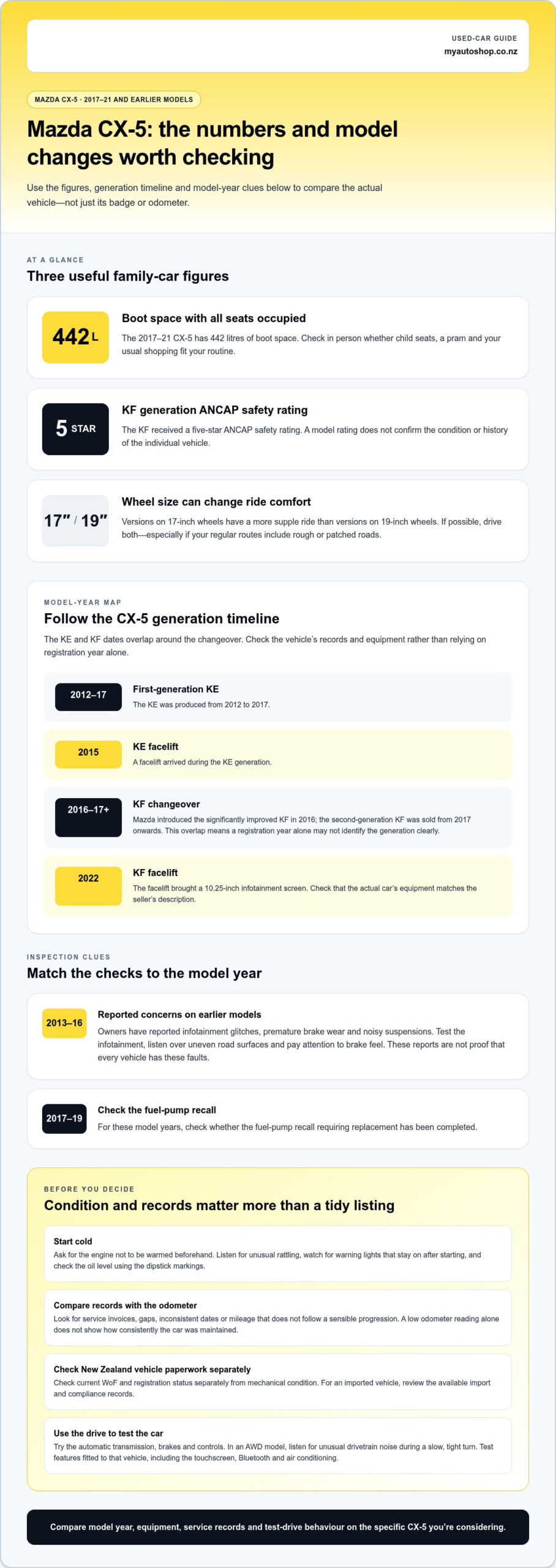
Yes, the 2017-21 Mazda CX-5 can suit family use, with 442 litres of boot space when all seats are occupied. Its KF generation received a five-star ANCAP safety rating. Check whether child seats, prams and weekly shopping fit your routine, rather than judging boot space by appearance alone.
Wheel size also affects comfort. CX-5 versions with 17-inch wheels have a more supple ride than versions with 19-inch wheels, often found on higher trim levels. If your regular route includes rough or patched New Zealand roads, drive both sizes if possible. A comfortable ride matters more on family trips than an attractive wheel design.
Compared with the Toyota RAV4 and Honda CR-V, the CX-5 is another medium SUV option; the right choice depends on the specific vehicle and your family’s needs. Compare rear-seat access, boot usefulness, driving comfort and service records across the actual cars you’re considering.
Start the inspection with a cold engine. Ask for the CX-5 not to be warmed beforehand, then listen for unusual rattling and watch for warning lights that remain on after starting. Check the engine oil on the dipstick before driving, following the markings on the dipstick. Redbook Inspect identifies low oil levels from high consumption and infrequent owner checks as a common 2017-21 CX-5 fault. If dashboard lights appear, note which ones and when they illuminate; the dashboard warning-light symptoms guide can help explain what they may indicate.
Check carefully for signs of previous accident damage. Compare paint colour across panels, look for even panel gaps, and inspect visible structural areas. Uneven tyre wear may point to alignment issues, including those caused by a past collision. A tidy exterior alone can’t confirm the vehicle’s history.
Match the odometer reading against service invoices and other available vehicle-history records. Look for gaps, inconsistent dates or mileage that doesn’t follow a sensible progression. For a New Zealand vehicle, check the current WoF and registration status separately from its mechanical condition. If it was imported, review the available import and compliance records as part of the vehicle’s history.
On the test drive, try the automatic transmission from a stop and through ordinary acceleration. Note delayed engagement, harsh shifts or unexpected noises. In an AWD model, drive slowly through a tight turn and listen for unusual drivetrain noise. Test the brakes at a safe speed; pulling to one side, vibration or squealing deserves attention. Also try the touchscreen, Bluetooth, air conditioning, windows, liftgate and any power-seat adjustments. Confirm premium features such as adaptive cruise control or a Bose sound system work. For 2017-19 models, check whether the fuel-pump recall requiring replacement has been completed.
KE and KF generations and their model-year changes
The CX-5’s generation helps explain its equipment and reported issues. Use the model year and generation together when comparing New Zealand listings.
The first-generation KE was produced from 2012 to 2017, with a facelift in 2015. Mazda introduced a significantly improved KF version in 2016, and the second-generation KF was sold from 2017 onwards. This overlap means a registration year alone may not clearly describe a vehicle’s generation. Check the listing details and vehicle records, then compare the specific car’s features and condition.
The KF received a facelift in 2022, bringing a 10.25-inch infotainment screen. That change can help distinguish facelifted models from earlier KF examples, but it doesn’t tell you how well a used vehicle has been maintained. Compare the centre screen and other visible equipment in the actual car with the seller’s description. A model-year label is a starting point, not a substitute for checking the vehicle itself.
Earlier model issues
Reported issues are faults owners have described in particular CX-5 model years, rather than proof that every vehicle has them. Owners of 2013-2016 models have reported infotainment glitches, premature brake wear and noisy suspensions. For a KE from those years, test the infotainment system, listen for suspension noises over uneven road surfaces, and pay attention to brake feel during a drive. These checks help you focus on areas linked to that model-year range.
Use the generation timeline to make a shortlist, then inspect the exact year. A 2015 KE, for example, is facelifted, while a 2016 vehicle may sit near the transition to the improved KF version. Ask the seller to identify the generation and compare that information with the car’s documentation. This avoids relying on broad descriptions such as “new shape” or “updated model” when comparing listings.
Model strengths and weaknesses
The main strength of comparing generations is knowing what changes to expect; the weakness is treating a newer badge as a guarantee of better condition. A facelift can bring visible equipment changes, such as the KF’s 10.25-inch screen from 2022, while earlier 2013-2016 models have specific reported concerns. That context helps you match features and inspection priorities to the vehicle you’re viewing.
For everyday driving, choose based on the features you’ll use and the condition you can verify. An earlier KE may suit a buyer prioritising a simpler, older model, while a KF offers a later-generation cabin and, after its 2022 facelift, a larger infotainment screen. Neither generation removes the need to assess the particular vehicle. Compare model year, equipment, maintenance records and test-drive behaviour before deciding which CX-5 best fits your needs.
Petrol and diesel engine options
No single CX-5 year or engine is automatically the most reliable choice; compare the exact engine’s condition and service record. For a diesel, check the oil level carefully, as a rising level can point to oil dilution.
Engine reliability and diesel checks
Engine reliability depends on the individual vehicle’s care, so model year alone can’t identify a guaranteed best pick. The 2017-onward range includes 2.2-litre diesels, with different power outputs across years. Before buying one, check its service records and dipstick level. A rising oil level is a concern to investigate because diesel oil dilution is a documented issue. Ask about oil changes and any engine warnings.
Petrol choices include the 2.0-litre engine and larger 2.5-litre versions. The 2017-21 2.0-litre petrol produces 115 kW; the non-turbo 2.5-litre produces 140 kW. Turbo-petrol availability can vary by model year, so check the vehicle details before buying. The 2.5-litre petrol introduced in 2021 produces 194 bhp. Match the engine listed in the vehicle details to the car itself, since badges and trim names don’t explain its condition.
Fuel consumption by engine
Fuel consumption varies by engine and specification, so compare like with like. For 2017-21 models, the stated average is 5.7 L/100 km for the 2.2-litre turbo-diesel and 7.5 L/100 km for the non-turbo 2.5-litre petrol. Your actual use also depends on driving conditions and how the vehicle is driven.
Recommended engine and trim
Choose the engine that suits your regular trips, rather than chasing one universal recommendation. A petrol model is a straightforward option to compare for mixed everyday use, while a diesel’s fuel-use figure needs weighing against its condition and maintenance history. The 2.5-litre turbo adds power but uses more fuel on the stated average. Compare trim equipment with your needs; higher trims can have 19-inch wheels.
Used prices in New Zealand depend on the CX-5’s year, engine, trim, mileage, condition and service history. Compare listings with the same key details, not just similar registration years. A higher trim or different engine can affect asking prices, while incomplete maintenance records may change how attractive a particular car looks. Check what equipment is fitted and whether it works before judging the price difference.
Mileage and used-car pricing
Read the odometer as one clue, not a verdict on a Mazda CX-5. A lower-kilometre example may have missed regular maintenance, while a higher-kilometre vehicle may have detailed records. Compare the displayed distance with service invoices, inspection records and the vehicle’s overall condition. The pattern matters: consistent evidence tells a clearer story than one attractive number.
Check that the mileage progresses logically across dated documents. Compare an earlier service invoice with the current odometer reading and any later records, noting gaps or entries that don’t line up. Ask how the vehicle was used: long trips and frequent short journeys can affect wear differently, so consider the use alongside the mileage.
Price comparisons are useful only when the vehicles are genuinely similar. Match CX-5 listings by generation, model year, engine, transmission, drivetrain and trim. Then account for kilometres, service history, condition and equipment. Comparing a front-wheel-drive petrol model with a higher-trim AWD version can create a misleading price gap, even if both listings show the same year.
In New Zealand, judge the asking price against comparable local listings, rather than importing overseas prices. A vehicle’s value reflects more than its original specification: condition, maintenance, mileage and demand all influence what buyers will pay. Use several closely matched listings to establish a realistic comparison, then adjust your view for differences such as worn tyres, missing service records or faulty equipment.
Higher mileage isn’t automatically a reason to reject a CX-5, but it makes the maintenance trail especially important. Check whether service entries are regular and whether invoices identify the work completed. An odometer reading without supporting records leaves more uncertainty about how the vehicle was cared for. Likewise, a low reading doesn’t cancel out warning signs in the cabin, engine bay or test drive.
Before deciding, write down the asking price, kilometres, model year, engine, trim and documented maintenance for each candidate. Compare those details side by side. If one CX-5 costs more, identify what justifies the difference, such as stronger records, better condition or equipment you’ll use. If the reason isn’t clear, treat the listing cautiously and weigh its condition against another comparable example.
Service history and maintenance costs
For a used CX-5, consistent maintenance records help reveal how carefully previous owners managed routine servicing. Review the paperwork alongside the vehicle’s age, mileage and condition.
Service history
A service history is a dated record of maintenance and repairs, useful for spotting gaps before purchase. Check invoices for the work completed, not just stamps or handwritten notes. Mazda recommends oil changes for the CX-5 every 5,000 to 7,500 miles. Compare the records with that schedule, the odometer and the engine fitted.
Look for records of servicing and any belt inspection or replacement. Check that entries are dated and include mileage, then compare them with the current odometer reading. Missing paperwork doesn’t prove neglect, but it gives you less evidence of the vehicle’s upkeep. Ask the seller to explain any gaps and provide supporting records.
A CX-5 with over 100,000 miles may need more frequent servicing. At that mileage, review the maintenance timeline closely and identify upcoming work. A recent service doesn’t necessarily mean every maintenance item is up to date, so check what the invoice covered. Use the vehicle’s specific records rather than assuming all CX-5s follow an identical repair schedule.
Maintenance costs
Maintenance costs are the combined expense of routine servicing and repairs over ownership. They depend on the engine, service needs, condition and any overdue work, so a clean record can help you anticipate what comes next. Build your assessment around the actual CX-5’s documented maintenance, rather than relying on a generic estimate.
Separate routine work from repairs when reviewing past invoices. A record showing regular oil changes tells you something different from an invoice addressing a fault. Note repeated repairs, deferred work and items due soon, then consider how each affects your ownership budget. For example, an older CX-5 with incomplete records may need a fuller catch-up service than one with recent, clearly documented maintenance.
Before committing, make a short list of confirmed work, unclear gaps and likely upcoming maintenance. Compare that list across the CX-5s you’re considering. This gives you a better basis for judging two similar asking prices: the car with stronger records may have fewer immediate unknowns, while a lower-priced example could require more attention. For help planning routine care, use this guide to vehicle service options.
My Auto Shop: Pre-purchase Inspection
My Auto Shop’s Pre-purchase Inspection can help assess a CX-5 before you decide to buy. It’s useful when service records have gaps, the dipstick reading raises questions, or a test drive reveals unusual noises or handling. An inspection adds a mechanical assessment to your own checks of the vehicle’s history, features and condition.
Use the findings to understand which issues need attention and factor them into your decision. If you already own the CX-5, a Basic Service or Comprehensive Service can help with ongoing maintenance. For a concern such as a damaged CV joint or a radiator fault, the relevant repair service may be the next step.
Visit My Auto Shop’s pre-purchase inspection page to arrange an inspection for a CX-5 you’re considering.
Make your next CX-5 decision with confidence
Before viewing another CX-5, decide what would make you proceed, what needs follow-up, and what would make you walk away. That simple framework helps keep a polished interior or persuasive sales pitch from shifting your priorities. Write down your must-haves, acceptable compromises, and questions about the specific vehicle. After each viewing, record what you noticed while the details are fresh. This gives you a clear basis for comparing options and considering any concerns before committing.
A practical plan for what to look for when buying a used Mazda CX-5 turns a complicated decision into a series of manageable checks. If you’d like support with your next step, contact My Auto Shop. Take your time, trust the evidence in front of you, and choose the CX-5 that fits your needs.
Frequently Asked Questions
What’s the used Mazda CX-5 like?
The CX-5 is a medium SUV, and how it feels depends on whether its driving position suits you. Adjust the seat and steering wheel before setting off, then check mirror visibility and how easily you can judge the vehicle’s edges. Try a familiar type of road, including a tight car park if possible. This helps you judge everyday comfort and manoeuvrability, not just the car’s appearance.
What are common problems with used Mazda CX-5s in New Zealand?
Assess issues on a vehicle-by-vehicle basis rather than treating one repair as proof of a widespread fault. Check invoices for repeated visits about the same symptom, and note whether the recorded work resolved it. A recurring issue may matter more to your buying decision than an isolated repair. Ask the seller about repeat work and compare their explanation with the paperwork.
What should I check when inspecting a used Mazda CX-5?
A practical way to approach what to look for when buying a used Mazda CX-5 is to compare the car with how you’ll actually use it. Take the usual driver’s seat and check that the controls are easy to reach without changing your posture. Bring any regular luggage or equipment to see how it fits. Notice wind noise and seat comfort on a longer test drive, not only during a quick lap.
What service history and maintenance records should a used CX-5 have?
Ask for invoices that describe the work and parts used, rather than relying only on service-book stamps. Separate routine maintenance from repairs to see what was preventive and what addressed a fault. Compare dates and descriptions across the records. If an invoice mentions an item without explaining the work, ask the seller for details before assessing the maintenance history.
How can I check a used Mazda CX-5’s NZ ownership, finance, and accident history?
Treat ownership, finance and accident history as separate questions: evidence about one doesn’t answer the others. Ask who is authorised to sell the vehicle, whether finance remains, and what damage or repairs the seller knows about. Request relevant paperwork and compare its dates and vehicle details. Keep the seller’s answers with your notes so you can assess any gaps before deciding.
Which Mazda CX-5 trims and features are worth choosing in New Zealand?
Choose a trim by checking the actual vehicle’s equipment, rather than assuming a badge means the same specification across every listing. Make a short list of features you’ll use regularly, then confirm each is fitted and working. If two CX-5s have different trim names, compare their equipment directly. A feature you won’t use adds little practical value, so let your needs and the car’s condition guide the choice.
What are the running costs and fuel economy of a used Mazda CX-5?
Your fuel use depends on how and where you drive, so a single official figure won’t predict every New Zealand commute. Traffic, trip length, passengers and luggage can all affect consumption. To understand a particular CX-5, record fuel bought and distance travelled across your normal driving, then compare results over several refills. Consider fuel alongside servicing and repairs when setting your ownership budget.
Which used Mazda CX-5 model years and engines are most reliable?
No model year or engine is guaranteed to be the most reliable; compare the specific vehicle’s condition and service history. For 2013-2016 models, check for reported infotainment glitches, premature brake wear and noisy suspension. For diesels, check for a rising oil level, which can indicate oil dilution.
Disclaimer
This article provides general information only and should not be relied on as professional mechanical, safety or legal advice. Vehicle requirements and circumstances vary. If you are unsure about your vehicle, have it inspected by a qualified automotive professional.