

Start by putting your complaint to the garage in writing, explaining what went wrong and what you want it to do. Under the Consumer Guarantees Act 1993, you can ask for faulty repair work to be fixed and faulty parts replaced at no extra charge when the service hasn’t been carried out with reasonable skill and care. Knowing how to complain about a mechanic in New Zealand also means keeping a clear record of the repair and the garage’s response.
It’s frustrating to pay for a repair and still have a problem with your vehicle. A calm, well-documented complaint gives the garage a clear opportunity to put things right and helps you decide what to do if it doesn’t.
This guide explains how to raise the issue, check a mechanic’s registration and trade association options, and consider whether the Fair Trading Act may support a claim. You’ll also learn which dispute pathways may apply and what information to gather before taking your complaint further.
Key Takeaways
- Put your complaint to the garage in writing and keep records of the work, messages and any costs linked to the problem.
- Check whether the business is a registered motor vehicle trader, and whether a trade association offers a complaints process.
- Consider whether the Fair Trading Act or Consumer Guarantees Act applies to your situation and what outcome you want.
- Choose a dispute-resolution pathway that fits the type of complaint, the vehicle and the parties involved.
- If you’re considering a used vehicle, a pre-purchase inspection can help identify mechanical issues before you buy.
Checking trade association membership and dispute resolution options
Start by checking the garage’s membership status, then match your complaint to the right resolution route. A trade association process and the Motor Vehicle Disputes Tribunal serve different purposes.
Complaint Deadlines
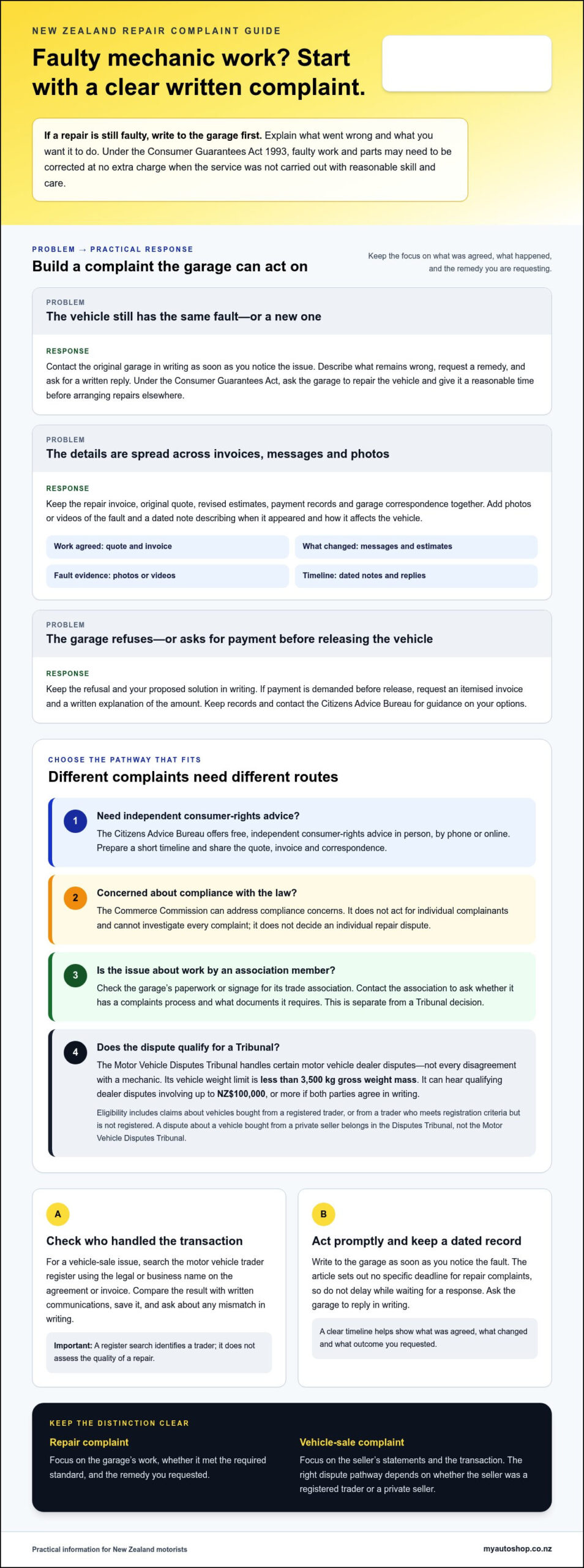
A complaint deadline is the time limit for raising an issue or starting a formal process. For a repair dispute, act promptly: write to the garage as soon as you notice the fault, and keep a dated record of each step. There is no specific deadline for repair complaints set out here, so don’t delay while waiting for a response. Ask the garage to reply in writing.
Collect the repair invoice, original quote, any revised estimate, payment records, and messages with the garage. Add photos or videos showing the fault, along with a dated note about when it appeared and how it affects the vehicle. Keep copies together. This evidence helps show what work was agreed, what changed, and what outcome you requested.
Agencies Handling Repair Complaints
An agency’s role is the kind of help it can provide with a consumer complaint. The Citizens Advice Bureau offers free, independent consumer-rights advice in person, by phone, or online. The Commerce Commission can address compliance concerns, but it doesn’t act for individual complainants and cannot investigate every complaint. Neither agency makes a decision on your individual repair dispute.
For practical help, prepare a short timeline and share the invoice, quote, and garage correspondence with an adviser. Ask which process fits your repair complaint rather than assuming the Motor Vehicle Disputes Tribunal handles every disagreement with a mechanic. The Tribunal’s role concerns qualifying motor vehicle dealer disputes. If your issue is about a private vehicle sale, use the Disputes Tribunal, not the Motor Vehicle Disputes Tribunal.
Faulty Work and Vehicle Release Disputes
A faulty-work dispute concerns whether a repair service met the required standard or should be corrected. Tell the garage in writing what remains wrong and request a remedy. Under the Consumer Guarantees Act, ask the original garage to repair the vehicle and give it a reasonable time before arranging repairs elsewhere.
If the mechanic refuses, keep the refusal and your proposed solution in writing. If the garage demands payment before releasing the vehicle, request an itemised invoice and a written explanation of the amount. Don’t rely on a verbal exchange alone. Contact the Citizens Advice Bureau for guidance on your options, and retain all records while the dispute continues.
Trade Association and Tribunal Options
A trade association is an industry membership body that may offer a complaints process for work by its members. Check the garage’s paperwork or signage for its membership name, then contact the association directly to ask about its process and required documents. Membership and a complaint pathway are separate from a Tribunal decision.
The Motor Vehicle Disputes Tribunal is a formal route for certain vehicle-related disputes. According to the New Zealand Ministry of Justice, it can only consider claims about vehicles with a gross weight mass of less than 3,500 kg. According to the New Zealand Ministry of Justice, it can deal with motor vehicle dealer disputes involving amounts up to NZ$100,000, or more if both parties agree in writing.
Eligibility matters. The Tribunal handles claims about vehicles bought from a registered trader, or from a trader who meets registration criteria but isn’t registered. It can hear certain vehicle-sale claims under the Consumer Guarantees Act 1993, the Fair Trading Act 1986, or specified parts of the Contract and Commercial Law Act 2017. A private-seller vehicle-sale dispute belongs in the Disputes Tribunal instead. If you need repair help while the vehicle is at home or work, see the mobile mechanic service information.
Checking whether a trader is registered
A registered motor vehicle trader is a person or business recorded as a trader in New Zealand. When you’re working out how to complain about a mechanic in New Zealand, start by identifying the exact business named on your paperwork, especially if the issue involves a vehicle sale.
Search the motor vehicle trader register using the full legal or business name shown on your agreement or invoice. If you only have a trading name, compare it with the name used in the business’s written communications. A garage may use one name publicly and another on its paperwork, so compare the details before assuming they refer to separate businesses.
Keep a copy of the result and note the name you searched. If you find a possible match, compare its business details with your documents. If the names differ, ask the business in writing which legal entity handled the transaction. Save its answer alongside the agreement, invoice, and any messages identifying the trader.
This check helps clarify who you’re dealing with, but it doesn’t assess the quality of a repair. For example, a register search won’t show whether a particular brake repair was completed with reasonable skill and care. Keep a repair complaint focused on the garage’s work, and a vehicle-sale complaint focused on the seller’s statements and the transaction.
Use this practical sequence to check the business identity:
- Search the name printed on the sales agreement or invoice.
- Compare the result with the business details in its written communications.
- Save the result and record the name used for the search.
- Ask the business to explain any mismatch in writing.
If a garage arranged work through another business, keep the paperwork showing who booked the work and issued the invoice. For example, note whether the invoice names the garage or a separate trading entity. This helps you direct your complaint to the business connected with your transaction, rather than relying on a workshop sign or informal name.
Keep the records together: the register result, agreement, invoice, payment record, and relevant messages. Add a brief note explaining which business name appears on each document. If the same name appears consistently, your records will make it easier to identify the trader in later correspondence.
Registration is one piece of information, not a finding about what happened in your case. Use it to identify the business and keep your complaint evidence tied to that entity. A clear record of names and documents can prevent confusion as you continue the complaint process.
Fair Trading Act claims
A Fair Trading Act claim says a trader breached the Fair Trading Act 1986 in a vehicle transaction. Build your account around specific statements or conduct, then show the documents that support your version. Avoid relying on a broad label such as “misleading” without explaining what was said and what happened.
Start by identifying the trader and transaction. Record the date, where you saw the statement, who made it, and how you relied on it. A quote, advertisement, text message, or invoice may show the exact wording. Keep the original file or message where possible, rather than relying only on a rewritten summary.
Next, compare the statement with the outcome. For example, if a written quote describes a particular repair, set out what the document says and what the completed invoice records. Explain the difference plainly. Separate what you observed yourself from information supplied by someone else, and label each document clearly.
A concise complaint can follow this structure:
- Identify the trader: Use the business name shown on your paperwork.
- Quote the representation: Include the relevant wording and its source.
- Describe what happened: Explain the difference between the statement and the transaction.
- Explain your request: State the practical outcome you want the trader to consider.
Keep concerns about workmanship separate from concerns about what was represented. A repair that still has a fault raises questions about the service performed; a statement about what the repair included raises a different issue. If both apply, describe them separately and connect each to its own evidence. This helps clarify which part of the transaction you’re challenging.
Write to the trader first with a focused account. Attach only documents that support the points you raise, and keep the originals for your records. Ask for a written response. If the trader disputes your account, compare its explanation with the dated quote, invoice, and messages rather than adding unrelated complaints.
The Motor Vehicle Disputes Tribunal’s role in Fair Trading Act claims was covered earlier. To prepare, make your account easy to follow: put events in date order, use short headings in your letter, and explain how each attachment supports a particular point. A clear, evidence-based account gives your concern a practical foundation without overstating what the documents prove.
Which New Zealand agencies handle complaints about mechanics and motor vehicle repairs?
Prepare a focused account for each organisation you approach. The Citizens Advice Bureau, Commerce Commission, Motor Vehicle Disputes Tribunal, and Disputes Tribunal have distinct functions, so tailor your information to the question you need addressed.
Citizens Advice Bureau
Before approaching the Citizens Advice Bureau, write a short summary that separates confirmed details from unanswered questions. Include the garage’s name, the work involved, and the response you received. Then identify what you need help understanding, such as which complaint pathway fits your circumstances or how to phrase a request for a remedy.
Bring or organise the relevant records so you can refer to exact wording. A clear question, such as “How should I describe the difference between this quote and invoice?”, makes the discussion more useful than a general account of frustration. Note any guidance you receive and the next action you plan to take.
Commerce Commission
If you provide information to the Commerce Commission, make the conduct easy to assess. Describe what the business said or did, when it happened, and where the statement appeared. Attach the relevant advertisement or message, not unrelated correspondence. Keep your account factual and distinguish what you witnessed from what someone else told you.
Keep your personal request for a remedy separate from that report. Continue communicating directly with the garage about the outcome you seek, and save its replies. Reporting conduct does not replace resolving your own repair disagreement.
Motor Vehicle Disputes Tribunal
For a Tribunal matter, organise your account so someone unfamiliar with the background can follow the sequence. Create a dated timeline, label each attachment, and connect each document to a point in your claim. For example, identify which record shows the agreed work and which records the later disagreement.
State the outcome you seek in practical terms, and keep your explanation consistent across your application and supporting documents. If a record seems to contradict your account, explain the difference rather than leaving it unresolved. This makes your case clearer and keeps the focus on the issue in dispute.
Disputes Tribunal
For a private vehicle-sale dispute, organise evidence around the sale. Keep the agreement, the seller’s written statements, payment records, and documents describing the problem. Put each item in date order and note what it helps establish. Avoid mixing unrelated repair concerns into the sale account unless they directly explain the dispute.
Before submitting information, check that names and dates match across your documents. A simple contents list can help you find the agreement, messages, and inspection records quickly. Keep a complete copy of everything you provide, along with notes of any follow-up actions.
Whichever organisation you contact, use one consistent timeline and record each communication. Separate your evidence, the issue you want addressed, and the outcome you’re seeking. This structure makes it easier to explain the matter clearly without sending every organisation an unfocused bundle of documents.
What rights do consumers have under New Zealand’s Consumer Guarantees Act for faulty vehicle repairs?
The Consumer Guarantees Act 1993 may protect New Zealand consumers when a purchased service fails to meet reasonable expectations. For vehicle repairs, a key guarantee is that the service must be carried out with reasonable skill and care.
Reasonable skill and care means the garage should carry out the agreed repair competently. If the work is faulty, you can ask the garage to fix it and replace faulty parts at no extra charge. Describe the fault clearly, explain how it relates to the original repair, and state the remedy you want.
Write to the garage before arranging another repair. Include the invoice, the work agreed, and what has gone wrong. Ask it to correct the problem, then give it a reasonable time to respond and complete the work. Keep its reply and any further inspection notes with your repair records.
Giving the garage an opportunity to repair the fault matters if you later seek repair costs. Under the Consumer Guarantees Act, ask the trader to repair the vehicle and give it a reasonable time before having the failure repaired elsewhere. If the garage refuses or doesn’t fix the fault, keep evidence of its response and records explaining the later repair.
The garage remains responsible for outsourced work it arranged. For example, if it sends a vehicle component to a specialist and that work is faulty, raise the issue with the garage that arranged the service. Keep the specialist’s paperwork if you have it, but direct your remedy request to the garage you engaged.
Keep a repair failure separate from a vehicle-sale problem. The Act may also protect consumers who buy a vehicle that fails to meet reasonable expectations, but the remedy and process depend on the issue. A complaint about an unsuccessful repair should identify the service, the promised work, and the remaining fault.
Use this sequence to make your request practical:
- Match the fault to the repair listed on your invoice.
- Ask the original garage in writing to correct the work and replace faulty parts.
- Give the garage a reasonable opportunity to respond and carry out the repair.
- Keep the response and records if you need to explain why the work remains unresolved.
If the garage’s response doesn’t resolve the problem, your records can support a further complaint or claim. Keep the issue specific: for example, explain that a repaired radiator still leaks or that a replaced CV joint continues making the same noise. Don’t present a new, unrelated fault as proof that the original service failed.
My Auto Shop: Pre-purchase Inspection
My Auto Shop offers a Pre-purchase Inspection to help you assess a used vehicle before buying. It’s useful when you want an independent view of the vehicle’s condition before committing, rather than after a fault becomes a dispute.
An inspection can help identify mechanical issues that may affect your decision, such as concerns with the engine, brakes, or tyres. It doesn’t replace a complaint process or determine whether a previous mechanic breached the Consumer Guarantees Act. For an existing repair issue, continue seeking a remedy through the garage or appropriate dispute pathway.
If you’re considering a used vehicle, explore the pre-purchase inspection option. To discuss your next step, contact My Auto Shop.
Take your next step with confidence
Once you’ve decided what outcome you want, make your next move specific. Keep your communication calm and focused on the result you’re seeking, whether that’s a repair, a response to a concern, or advice before buying another vehicle. Knowing how to complain about a mechanic in New Zealand can help you make that request clearly and keep the process moving.
For routine vehicle care, My Auto Shop offers Basic Service and Comprehensive Service. If you’re considering a used vehicle, it also offers a Pre-purchase Inspection. These services cover maintenance and pre-purchase checks, rather than deciding or resolving an existing complaint.
Choose the option that fits what you need now, and keep your records organised as you go. For information about My Auto Shop’s services, contact My Auto Shop. A clear next step can make a difficult situation feel more manageable.
Frequently Asked Questions
How do I complain to the Motor Trade Association or another mechanic industry body in New Zealand?
First, check whether the garage belongs to the Motor Trade Association or another industry body. Look for its name on the invoice, website, or workshop signage, then contact the organisation about its member-complaint process. Identify the garage, describe the repair issue, and state the outcome you want. Include relevant documents and keep copies of your submission and any response.
How does the Fair Trading Act apply to mechanic workmanship, quotes, and representations in New Zealand?
The Fair Trading Act 1986 may apply if a mechanic or dealer makes a misleading representation about a repair, quote, or vehicle. For example, compare an advertisement promising a specified repair with the work actually invoiced. Explain the difference and how it affected your decision. A workmanship problem may also raise rights under the Consumer Guarantees Act, so describe each concern separately rather than relying on a legal label alone.
What steps should I take before making a formal complaint about a mechanic in New Zealand?
Prepare a timeline showing when you booked the work, what the garage agreed to do, when you noticed the problem, and how it responded. Gather the booking confirmation, quote, invoice, payment record, and messages. Add dated photos or a short video if they clearly show the fault. Then write to the garage with a specific remedy request, such as correcting an incomplete repair, and save its reply.
How can I resolve a dispute with a mechanic through the Disputes Tribunal, and what is the claim limit and fee?
First identify whether the dispute concerns repair work or a vehicle sale, and name the person or business you’re claiming against. Set out what happened, the remedy sought, and the documents supporting your position. The applicable claim limit and filing fee depend on the Tribunal’s current rules; check its application information before filing so you use the correct figures. A private vehicle-sale dispute belongs in the Disputes Tribunal, not the Motor Vehicle Disputes Tribunal.
Can I get an independent vehicle inspection or report to support a complaint in New Zealand, and what does it cost?
An independent inspection or written report can document a vehicle’s condition and help explain a technical disagreement. Ask the inspector to record the symptoms, relevant findings, and how they relate to the disputed repair. The cost depends on the inspection scope, vehicle access, and reporting required. My Auto Shop’s Pre-purchase Inspection assesses a vehicle before purchase, rather than deciding an existing complaint.
Disclaimer
This article provides general information only and should not be relied on as professional mechanical, safety or legal advice. Vehicle requirements and circumstances vary. If you are unsure about your vehicle, have it inspected by a qualified automotive professional.