
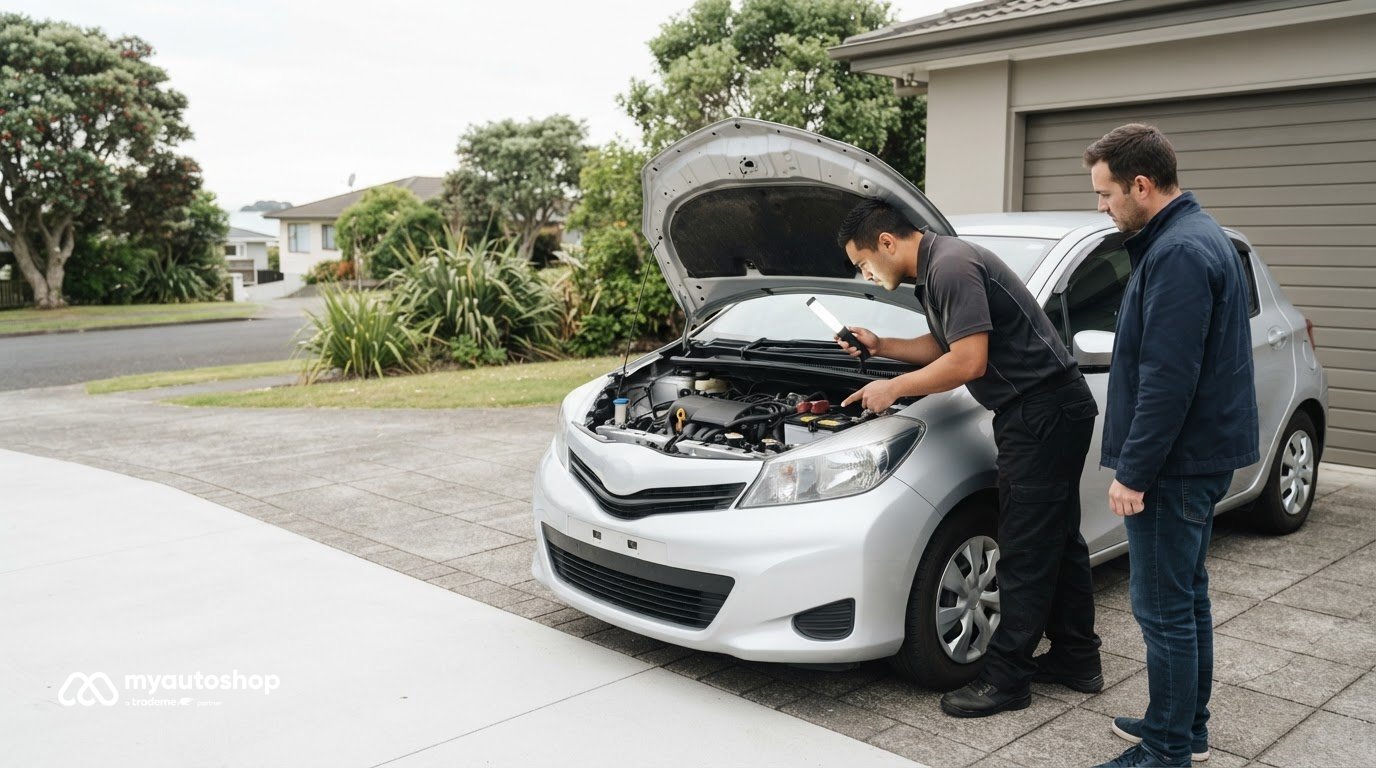
A used Corolla can hide faults in its electrical system, suspension or cooling system, so a tidy exterior isn’t enough to judge its condition. Treat common faults in a used Toyota Corolla in NZ as inspection points, not proof that every car has a problem. Check how it starts, listen and feel for suspension issues, and look for signs of coolant or oil leaks.
It’s sensible to expect a Corolla to have a strong reliability reputation, but any used car’s condition depends on its history and how it’s been maintained. This guide explains what electrical glitches, worn suspension parts and overheating signs can look like, and what reliability survey results say about Corollas. You’ll also get a practical walk-around and test-drive checklist, including the bodywork, tyres, windscreen, electrical equipment and transmission fluid, so you can make a more informed decision before buying.
Key Takeaways
- Test the battery, lights and infotainment system, and watch for warning signs that electrical equipment isn’t working properly.
- Listen for suspension knocks and notice how the Corolla handles over uneven roads; these clues can point to wear that needs closer inspection.
- Reliability survey results offer useful context, but a car’s maintenance history and current condition matter when assessing a specific used Corolla.
- Check coolant and engine oil levels, and look for signs of leaks or overheating before you buy.
- Use a structured walk-around and test drive to spot bodywork damage, wheel issues, windscreen chips and faults that may not show up at first glance.
1. Electrical system problems
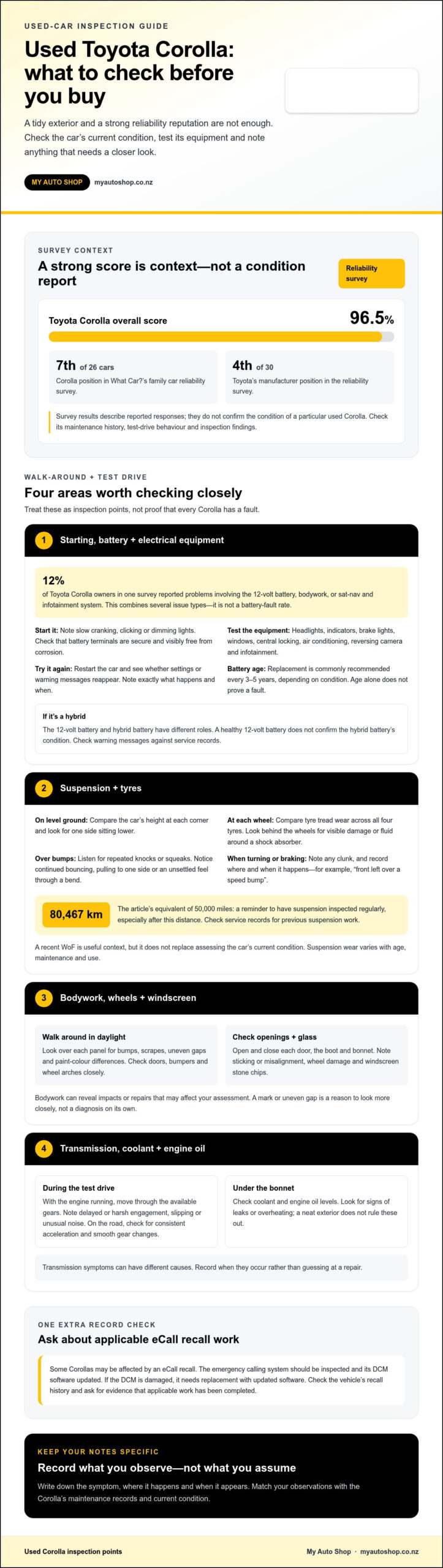
Electrical faults can affect starting, dashboard warnings, cabin equipment and the way a Corolla drives. In one survey, 12% of Toyota Corolla owners reported problems involving the 12-volt battery, bodywork or sat-nav and infotainment system. That figure combines several issue types, so it doesn’t mean 12% had battery faults alone. Test each feature rather than relying on a tidy dashboard or a seller’s description.
This video features a 1976 Toyota Corolla Liftback and offers a look at an older model’s maintenance and inspection points.
Start with the 12-volt battery. Turn the key or press the start button and note whether the engine starts promptly. Slow cranking, a clicking sound or dimming lights can point to a weak battery or a charging issue. Check that the battery terminals are secure and free from visible corrosion. Battery replacement is commonly recommended every 3-5 years, depending on condition, but age alone doesn’t prove a fault. The battery and electrical symptoms guide can help you identify warning signs.
Test the headlights, indicators, brake lights, electric windows, central locking, air conditioning, reversing camera and infotainment screen. Try the radio and sat-nav, then restart the car to see whether settings or warnings reappear. An intermittent fault may point to a loose connection, an ageing battery or another electrical component. Note the exact symptom and when it occurs, such as a screen going blank after starting.
Some Corollas may also be affected by an eCall recall. The emergency calling system should be inspected and its DCM software updated. If the DCM is damaged, it needs replacement with updated software. Check the vehicle’s recall history and ask for evidence that any applicable work has been completed. A warning light alone may not tell the whole story.
Include the transmission in your test drive. With the engine running, move through the available gears and note any delay, harsh engagement, slipping or unusual noise. On the road, check whether acceleration feels consistent and gear changes are smooth. These symptoms can have different causes, so record when they occur rather than guessing at a repair.
For a hybrid Corolla, watch for hybrid-system warnings and changes in starting or running behaviour. The 12-volt battery and hybrid battery serve different roles, so a healthy 12-volt battery doesn’t confirm the hybrid battery’s condition. Match any warning message to the vehicle’s service records and have unexplained electrical or transmission symptoms assessed before purchase.
2. Suspension issues
A Corolla’s suspension helps its tyres stay in contact with the road and keeps the car stable over bumps. Worn or damaged components can cause knocking, uneven tyre wear, excessive bouncing or vague steering. On New Zealand roads, pay attention to how the car behaves over patched surfaces, speed bumps and uneven sections. A quiet, smooth drive is useful evidence, but it doesn’t replace a close inspection.
Start with a walk-around on level ground. Compare the Corolla’s height at each corner and check whether one side sits lower. Inspect the tyres for uneven tread wear: wear on one edge can indicate an alignment issue or a suspension problem. Look behind each wheel for visibly damaged parts or fluid around a shock absorber. These clues won’t identify the exact fault, but they can show where closer assessment is needed.
During the test drive, use a familiar route with both smooth and rough surfaces. Drive slowly over a speed bump, then listen for repeated knocks or squeaks from the front and rear. Notice whether the Corolla keeps bouncing after the bump, pulls to one side or feels unsettled through a bend. A clunk when turning or braking is also worth investigating. Record where and when each noise occurs, such as “front left over a speed bump”.
Suspension wear depends on the car’s age, maintenance and use. A Corolla driven regularly over rough roads may show different wear from one used mainly on smoother urban routes. Have the suspension inspected regularly, especially after 50,000 miles, equivalent to about 80,467 kilometres. Check service records for previous suspension work, and compare any listed repairs with what you feel during the drive. A recent WoF is useful context, but it isn’t a substitute for assessing the car’s current condition.
Bodywork can reveal impacts or repairs that may affect your assessment. In daylight, walk around the Corolla and check each panel for bumps, scrapes, uneven gaps and differences in paint colour. Look closely around the doors, bumpers and wheel arches, where marks can be easy to miss. Inspect the wheels for damage and the windscreen for stone chips. Open and close each door, the boot and the bonnet, noting any sticking or misalignment.
- Compare tyre wear across all four wheels, not just the front pair.
- Listen for knocks and squeaks over bumps, then note where they seem to come from.
- Check body panels, wheels and glass in good light before deciding.
When a suspension noise, uneven stance or damaged panel gives you pause, include that specific observation in a used-car inspection before buying.
3. Corolla reliability survey results
What Car?’s family car reliability survey placed the Toyota Corolla seventh out of 26 cars, with a 96.5% overall score. Toyota ranked fourth out of 30 manufacturers in the reliability survey. These results suggest a strong overall showing, but they describe survey responses, not the condition of every used Corolla in New Zealand.
Which Corolla model years and generations have the most reported problems? The survey results give a model-wide score rather than ranking Corolla generations or years separately. Use that score as background, then assess the specific car through its maintenance records, test-drive behaviour and inspection findings.
Survey figures also show how reported faults affected owners. Just over half of the affected Toyota Corollas were repaired in a day or less. This gives a sense of repair duration among affected cars, but it doesn’t tell you whether a particular fault will be quick or straightforward to fix. The cause, required parts and vehicle variant all matter.
How does a used Toyota Corolla compare with other reliable used cars in New Zealand? In What Car?’s family car survey, the Corolla ranked seventh among 26 cars, placing it in the upper part of that comparison. Treat this as useful context, not a direct ranking of New Zealand’s used-car fleet, because the result doesn’t compare every model, year and vehicle condition available here.
How reliable are used Corolla hybrids, and what battery problems occur? The survey figures above don’t separate hybrid Corollas from petrol versions, so they don’t provide a hybrid-specific reliability score. Check for hybrid-system warnings and distinguish the 12-volt battery from the hybrid battery. A weak 12-volt battery can affect starting and electrical functions; hybrid battery condition needs its own assessment.
Are there Toyota recalls or safety notices for Corolla models sold in New Zealand? An eCall recall issue calls for an inspection of the emergency calling system and a DCM software update. A damaged DCM needs replacement with updated software. Ask for the vehicle’s recall work history and evidence of completion, especially for eCall repairs. Recall applicability can depend on the exact vehicle, so identify the Corolla using its registration or vehicle identification details.
Put the survey score in perspective before making a decision. A high model-level result can’t reveal missed servicing, a poorly repaired impact or a fault developing in a particular car. Check that service records make sense for the vehicle’s age and odometer, then compare them with warning lights, unusual noises and how the Corolla behaves on a drive. For a hybrid, include battery condition in your assessment rather than assuming the general Corolla score covers it.
4. Engine overheating
Check the coolant level before starting the Corolla, while the engine is completely cool. The level should sit between the marks on the coolant reservoir. A low level can reduce the cooling system’s ability to carry heat away from the engine. Top up only with coolant suitable for the vehicle, following the owner’s manual. Repeatedly needing to add coolant is a reason to investigate, not a normal maintenance routine.
Look around the reservoir, radiator and hoses, and beneath the front of the car, for wet patches, coloured residue or crusty deposits. These can indicate coolant escaping from a connection or component. Check the service records for cooling-system work and note any mention of coolant loss. A recent top-up by the seller doesn’t explain why the level was low, so look for the underlying cause.
During a test drive, watch the temperature gauge and dashboard warnings in different driving conditions. Note whether the gauge rises unusually, fluctuates or moves towards the hot end while idling or climbing a hill. A heater that suddenly blows cold air as engine temperature rises can also be a warning sign. Stop driving if the temperature warning appears, and don’t dismiss it as a minor dashboard glitch.
Overheating can have several causes, including coolant loss, a radiator problem, a faulty thermostat or an issue with the cooling fan. The symptoms alone won’t identify which part has failed. For example, a Corolla that warms up in traffic but cools while moving may need its fan operation checked. Overheating in varied conditions may have a different cause. Record when the symptom occurs and whether the gauge changes during the drive.
Ask the seller directly about past overheating, coolant top-ups and cooling-system repairs. Compare the answers with service invoices, the reservoir’s condition and any visible leakage. Repeated coolant loss deserves more attention than a single documented repair with a clear explanation. Don’t rely on a short drive alone, because a developing fault may not appear immediately.
Keep the inspection practical:
- Check the coolant reservoir when the engine is cool, and compare its level with the marked range.
- Look for residue around hoses, the radiator and the reservoir, plus damp patches under the front.
- Watch the temperature gauge during the test drive, including traffic and uphill driving.
- Match any cooling-system repairs in the service records with the seller’s explanation.
Checking the coolant level regularly and topping it up as needed can help you notice changes early. If the level drops again after topping up, or the temperature warning appears during your drive, pause the purchase decision until the fault is understood. A sound coolant level today doesn’t erase a history of overheating, so consider both the current inspection and the Corolla’s repair records.
5. Used Corolla inspection checks
Check the paperwork before deciding on a used Corolla. Compare the vehicle identification number (VIN) on the car with the number on its documents. Make sure the make, model and registration details match the vehicle in front of you. If the seller’s account of the car’s history differs from its records, note the mismatch and ask for a clear explanation.
Read service invoices in date order. Look for regular entries, note what work was completed, and check whether an invoice describes a recurring issue or a repair that was followed up. A stamped service book provides useful context, but invoices often give more detail about the work. Keep the odometer reading in view as you review the records, and note any gaps or sudden changes in the recorded history.
What common suspension, steering, brake, and electrical faults should buyers check? Treat knocking, pulling, braking noise, warning lights or unreliable electrical features as reasons to investigate further. For this final pass, record the exact symptom, when it appears and what the seller says about it. A clear note, such as “brake noise during a slow stop”, is more useful for follow-up than a general comment like “the car feels off”.
Check the cabin for clues about how the Corolla has been used. Look beneath the mats and around the boot floor for dampness, unusual smells or stains. Try each seat adjustment and check that seatbelts extend and retract smoothly. Make sure the boot opens and closes, and look for the owner’s manual, service book and any spare keys the seller says are included.
Ask what’s included in the sale and compare the answer with what’s present. For example, check that removable accessories shown in the listing are still with the vehicle. Note any dashboard message or feature you can’t operate, then ask the seller to demonstrate it. Keep these observations separate from assumptions about the cause. This gives you a focused list to discuss before deciding.
- Match the VIN and registration details across the vehicle and its paperwork.
- Read invoices in order and note unexplained gaps or repeat repairs.
- Check the cabin, boot, seatbelts, manuals and keys.
- Record unanswered questions and features the seller needs to demonstrate.
If the records or your checks leave important questions, a used-car inspection before buying can help you assess the Corolla with more information.
My Auto Shop: Pre-purchase Inspection
My Auto Shop offers a Pre-purchase Inspection to help you assess a Corolla before buying. Consider one if your checks raise questions about suspension wear, electrical faults, coolant loss, braking or service history. An inspection can help identify issues that may need attention, giving you clearer information to weigh against the seller’s records and your test drive. It is especially useful when a warning light, unusual noise or uneven tyre wear needs closer examination. It won’t make the decision for you, but it can add a practical assessment before you commit. To arrange an inspection, visit My Auto Shop’s pre-purchase inspection page.
Make your next step with confidence
Understanding common faults in a used Toyota Corolla in NZ is most useful when it helps you make a clear buying decision. If an inspection raises concerns, use the findings to decide whether to proceed, discuss the issues with the seller or keep looking. Once you’ve bought the car, a Basic Service or Comprehensive Service can help you plan maintenance around its condition and history.
My Auto Shop offers a Pre-purchase Inspection for buyers who want an assessment before committing. You can also explore servicing options or get in touch through the website. Take the time to make an informed choice, then enjoy your next drive with greater confidence.
Frequently Asked Questions
What should I look for in a used Toyota Corolla?
Check that the car suits your needs and confirm its exact model and drivetrain. Ask the seller about previous use, modifications and any known unresolved issues. Confirm what’s included in the sale, such as keys, manuals and accessories shown in the listing. If the seller’s explanation changes or important details remain unclear, pause and resolve those questions before committing.
What are the most common faults in used Toyota Corollas in New Zealand?
Areas worth attention include 12-volt electrical equipment, suspension, cooling systems and transmission behaviour. These are inspection priorities, not proof that every Corolla has a defect. Separate a minor equipment fault from symptoms that affect braking, steering or engine temperature. Ask what caused any reported problem, what work was completed and whether the seller can show supporting service records.
Are there known engine, transmission, or CVT issues in used Toyota Corollas?
Assess the specific engine and gearbox fitted to the Corolla rather than assuming every model has the same issues. On a test drive, notice whether the drivetrain behaves consistently from a cold start and after warming up. For an automatic or CVT, watch for hesitation, shuddering or warning messages; for a manual, note how the clutch engages. Record symptoms for a mechanic to assess.
What do NZ vehicle inspection reports and owner reviews say about Corolla reliability?
These sources provide different kinds of evidence. An inspection report describes the condition of the particular vehicle assessed, while an owner review reflects one person’s experience. What Car?’s reliability survey offers a broader comparison, but it doesn’t establish the condition of a Corolla in New Zealand. Read reviews for context, then give more weight to evidence about the exact car you’re considering.
What should buyers check on a used Corolla before purchase, including a pre-purchase inspection?
Prepare the car’s details and your questions before arranging an inspection, especially any points the seller’s account hasn’t resolved. My Auto Shop offers a Pre-purchase Inspection to help buyers make better-informed used-car decisions. Weigh the findings alongside the vehicle’s history and your intended use. If an issue remains unclear, use that information to decide whether to proceed, discuss it with the seller or keep looking.
Disclaimer
This article provides general information only and should not be relied on as professional mechanical, safety or legal advice. Vehicle requirements and circumstances vary. If you are unsure about your vehicle, have it inspected by a qualified automotive professional.