

If you’re unsure what to do when a mechanic can’t diagnose an issue, give them a clear timeline of the symptoms, explain when they occur, and share what’s already been tried. Agree on how long they’ll investigate and what work they can do before spending more. A scan can point to an area of trouble, but further testing may be needed to find the faulty part.
It’s frustrating to leave the garage without an answer, especially when the problem keeps interrupting your day. A careful diagnosis can help avoid replacing the wrong part, and you’re entitled to expect agreed work to be completed with reasonable care and skill under New Zealand’s Consumer Guarantees Act.
This guide explains how to describe the fault, when a test drive can help, what scan results mean, and how to set expectations for diagnostic time and costs. You’ll also learn what steps to take if you’re unhappy with the explanation or the repair.
Key Takeaways
- Give the mechanic a clear timeline of the fault, the conditions that bring it on, and what has already been tried.
- A test drive can help the mechanic experience intermittent symptoms and narrow down possible causes.
- Treat a scan code as a clue, not a diagnosis; further testing may be needed to identify the faulty component.
- Agree on investigation time, charges and approval for any extra work before diagnosis continues.
- If a repair doesn’t resolve the problem, raise it with the mechanic and understand the consumer protections and dispute options available in New Zealand.
Giving the mechanic useful information about the fault
If you’re deciding what to do when a mechanic can’t diagnose an issue, start by keeping a clear record of the symptoms. Note when the problem began, whether it happens every time, and what makes it better or worse. “The engine hesitates after a cold start” gives a mechanic more to investigate than “it runs badly”. Include changes in sound, smell or vibration, and any dashboard warning lights.
Describe the conditions each time the problem occurs. For example, note whether a noise appears while braking, turning, accelerating or driving over rough roads. Record whether the engine is cold or warm, and whether the fault occurs in wet weather or after the car has been parked. These details can help distinguish an intermittent fault from one that happens consistently.
Keep a simple log on your phone. Add the date, approximate location, driving conditions and what you noticed. An audio or video recording can help capture a noise or warning light, but record only when safely parked. Share it with the mechanic and explain anything that may not be clear from the recording.
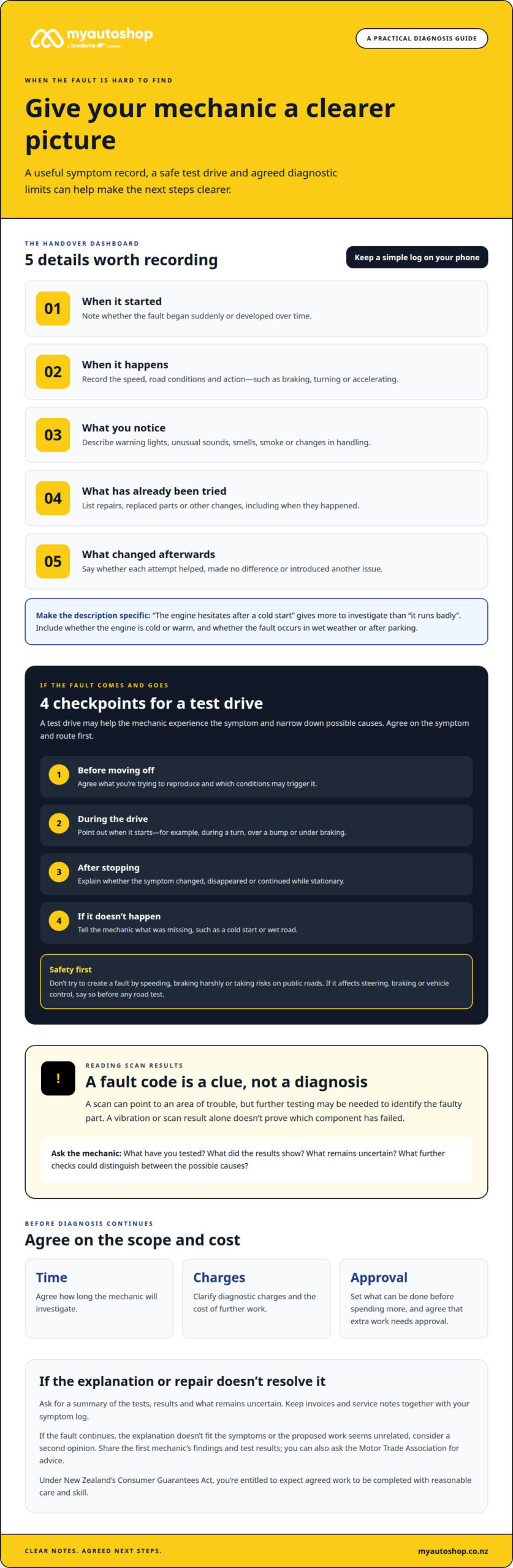
- When it started: Note whether the fault began suddenly or developed over time.
- When it occurs: Record the speed, road conditions and driving action, such as braking or turning.
- What you noticed: Describe warning lights, unusual sounds, smells, smoke or changes in handling.
- What you’ve tried: List repairs, replaced parts or other changes, including when they happened.
- What changed: Say whether each attempt improved the symptoms, made no difference or introduced another issue.
Be specific about previous work. If a battery was replaced or a warning code cleared, tell the mechanic. A fault that returns after a repair may need a different investigation from one that hasn’t been checked before. Keep invoices or service notes together so you can easily explain when work was done and what it involved.
Ask the mechanic to summarise what they have tested, what the results showed, and what remains uncertain. That creates a useful record if you need to revisit the problem or seek another opinion. A guide to common car symptoms can also help you describe what you’re experiencing in plain language.
Get a second opinion if the explanation doesn’t account for the symptoms, the proposed work seems unrelated, or the fault continues after a repair. Share the first mechanic’s findings and test results so the next assessment can build on them. In New Zealand, you can also ask the Motor Trade Association for advice.
To find a specialist mechanic or automotive electrician in New Zealand, ask for your diagnostic notes and a referral to someone who works on the system involved, such as the vehicle’s wiring or starting circuit. Give the specialist your symptom log and details of previous tests, rather than relying only on a fault-code description.
Test-driving the vehicle to experience symptoms
An intermittent fault can disappear in the workshop, leaving the mechanic without the conditions needed to reproduce it. A test drive lets the mechanic experience the vehicle’s behaviour and may help narrow down likely causes. For example, a steering vibration that occurs only while braking may point the investigation towards a different system from a vibration felt during acceleration.
Explain which driving action brings on the symptom, then agree on a suitable route with the mechanic. A short drive through local streets may reveal hesitation at low speed, while a route with a safe place to stop could help reproduce a noise during braking. The mechanic can choose conditions appropriate for the vehicle and the issue.
If you accompany the mechanic, describe what you feel as it happens. Say whether a judder comes through the steering wheel, brake pedal or seat. For a noise, identify whether it sounds like a squeal, knock, hum or scrape, and whether it changes when the vehicle turns or slows. These distinctions give the mechanic useful observations to compare with their own.
- Before moving off: Agree on the symptom you’re trying to reproduce and the route or conditions that may trigger it.
- During the drive: Point out when the fault starts, such as during a turn, over a bump or under braking.
- After stopping: Explain whether the symptom changed, disappeared or continued once the vehicle was stationary.
- If it doesn’t occur: Tell the mechanic which conditions were missing, such as a cold start or wet road.
A test drive may not reproduce the problem. If the fault depends on a cold engine, for example, it may not appear after the vehicle has been running. Explain that condition before the drive and ask how the mechanic will account for it during further diagnosis.
Don’t try to create a fault by speeding, braking harshly or taking risks on public roads. Describe the conditions that usually bring it on, then let the mechanic decide how to assess it safely. If the symptom affects steering, braking or vehicle control, explain that clearly before any road test.
After the drive, ask the mechanic what they experienced and how it affects the next diagnostic step. A vibration felt through the steering wheel is useful information, for example, but doesn’t identify a specific faulty part by itself. Ask what further checks could distinguish between possible causes, and agree on any additional work before it begins.
What computer diagnostic scans can and cannot identify
A diagnostic scan gives a mechanic information, not an automatic answer. For cars made after 1996, a mechanic can connect the vehicle’s computer to diagnostic equipment. The vehicle’s on-board diagnostics system monitors operations and records fault codes when it detects a problem. A scan tool connected to the OBD2 port can access that data.
A fault code usually points to an area or system that needs investigation, rather than identifying the exact failed component. For example, an engine code may indicate a problem with a sensor circuit. The sensor itself could be faulty, but wiring, a connection or another issue affecting its signal could also be involved. Testing helps distinguish between those possibilities.
Modern vehicles can have up to 150 electronic control units, or ECUs. These computers manage different vehicle functions, so a scan’s usefulness depends on which systems the tool can access and what data it retrieves. A warning light may relate to one system, while a separate mechanical fault may not produce a useful code at all.
- Ask what the code identifies: Find out which system or circuit the result relates to, in plain language.
- Ask what was tested next: A code should guide checks, such as inspecting a connection or testing a sensor.
- Keep the results: Record the code and the mechanic’s explanation, especially if the fault returns.
- Clarify what remains unknown: Ask which possible causes still need to be ruled out.
Clearing a code doesn’t necessarily fix the cause. If the same warning returns after a repair, the first result may have identified a symptom rather than the underlying fault. Ask what changed after the repair and what evidence supports the next proposed step. This helps prevent a scan result being treated as proof that a particular part needs replacing.
Is it safe to keep driving when a car fault can’t be diagnosed? It depends on the symptoms: a warning light alone doesn’t explain the vehicle’s condition. Stop driving and arrange help if you notice problems with braking or steering, overheating, smoke or a sudden loss of power.
Some faults need more than a scan. A mechanic may need to reproduce the symptom, inspect components or test electrical signals before reaching a conclusion. Even a complicated result can have an ordinary explanation: an ABS diagnostic manual once identified the wrong wheel location for a fault code, requiring further investigation. Ask what the scan did and didn’t establish, then agree on the next diagnostic step before authorising additional repair work.
Agreeing on a diagnosis time and hourly rate
A difficult fault can take even a skilled mechanic several hours to diagnose. Before the investigation begins, agree on the hourly rate, how diagnostic time is charged, and when the mechanic must pause for your approval. This gives you a clear decision point if the first round of testing doesn’t identify the cause.
Ask for a time limit that suits your budget. For example, you could authorise an initial period of investigation, then ask the mechanic to report their findings before continuing. A time limit doesn’t promise the fault will be solved within that period. It sets a boundary on the work they can carry out without further approval.
Clarify what the rate covers. Diagnostic work may involve inspecting a component, tracing wiring, using a scan tool or reproducing an intermittent symptom. Ask whether the quoted rate applies to labour only and how the garage records time. Get the agreed rate and time limit in writing, for example in an email or job card.
- Set the scope: Describe which fault the mechanic will investigate, such as an intermittent starting problem.
- Agree the limit: State how long they can investigate before contacting you again.
- Confirm the charge basis: Ask whether diagnosis is billed by time, a fixed fee, or another agreed method.
- Set an update point: Agree when you’ll receive findings and discuss the next step.
- Require approval: Make clear that extra diagnostic time or repairs need your agreement first.
Keep diagnosis separate from repair authorisation. Finding a likely cause doesn’t automatically give permission to replace a part. Ask the mechanic to explain the test results, proposed repair and any additional labour before you approve the work. If testing finds another fault, treat it as new work and agree on its scope and cost separately.
If a fault appears only in certain conditions, investigating it may take longer than a simple visual check. Agree on how the mechanic will handle that uncertainty: they can complete the authorised checks, update you and explain what further testing would involve. This helps prevent an unclear diagnosis from turning into open-ended work.
Keep a copy of the written agreement and any later approvals. Under New Zealand’s Contract and Commercial Law Act, a mechanic could breach a contract by missing an agreed completion date or charging more than an agreed fixed price. Record the expected completion date, agreed amount or rate, and any changes so both parties can refer to the same terms.
Consumer rights when hiring a mechanic
New Zealand’s Consumer Guarantees Act requires a mechanic to complete agreed work with reasonable care and skill. That standard applies to the work you authorised, even if the fault proves difficult to identify. Keep the job card, messages, invoice and diagnostic notes together so you can compare the agreed work with what happened.
Can a New Zealand mechanic charge for diagnostic work if they don’t find the problem? Yes. They can charge for diagnostic work you agreed to pay for, even if testing doesn’t reveal the cause. Check the agreed rate, time limit and scope: a charge for authorised investigation is different from an unapproved repair.
Additional repairs should go ahead only after you agree to them. If testing reveals another issue, ask for an explanation and the proposed work before authorising it. Permission to investigate one fault isn’t automatic approval to replace parts or carry out unrelated repairs.
- Keep the agreement: Save written approval for diagnostic time, repair work and any changes.
- Ask for the findings: Request the tests completed, results and reason for the proposed next step.
- Raise problems promptly: Explain in writing if the repair hasn’t resolved the fault or has caused a new problem.
- Allow a chance to respond: Give the mechanic a reasonable opportunity to address your complaint.
If a repair doesn’t work or creates a new problem, ask the mechanic to put it right at no extra cost. Explain what has happened and refer to the original job and agreed repair. If the mechanic refuses or takes an unreasonable time, you may arrange for another person to fix it and claim the cost from the first mechanic.
If discussion doesn’t resolve the issue, start with a formal written complaint. The Motor Trade Association offers free mediation for disputes involving member mechanics when both sides are willing. If mediation doesn’t resolve the complaint, or you choose not to try it, you can take the unresolved dispute to the Disputes Tribunal after making a formal complaint in writing.
The Contract and Commercial Law Act may apply where the Consumer Guarantees Act doesn’t, such as when a private individual carries out the repair or the customer is a business. The agreed terms also matter: missing an agreed completion date or charging more than an agreed fixed price could breach the contract. Keep records of dates, estimates, approvals and payments to support your account.
My Auto Shop: Mobile Mechanic
If the fault still needs investigation, Turners Service & Repairs provides mobile vehicle diagnostics and mechanical repairs in selected New Zealand regions. My Auto Shop connects motorists with automotive service providers; marketplace mechanics are not necessarily Turners technicians.
A mobile mechanic may suit you if getting the vehicle to a workshop is difficult. Share the previous findings when arranging the next assessment. For routine maintenance, My Auto Shop also offers Basic Service and Comprehensive Service options.
Contact My Auto Shop to discuss the next step.
Make your next diagnostic step a clear one
A difficult fault doesn’t have to leave you guessing about what to do next. Treat the next assessment as a fresh decision: share the vehicle’s history, explain what outcome you need, and agree on the work before it starts. If you’re still deciding what to do when a mechanic can’t diagnose an issue, focus on getting a clear plan for the next checks rather than authorising parts without an explanation.
My Auto Shop can also help with other vehicle needs. Choose a Pre-purchase Inspection when assessing a car before buying, or a Basic Service or Comprehensive Service for routine maintenance. Matching the service to the task helps keep your next step relevant.
Bring your notes and previous diagnostic findings together, then contact My Auto Shop for help choosing a suitable next step. A clear record puts you in a stronger position to make an informed decision and get back to driving with confidence.
Frequently Asked Questions
Why Can’t My Mechanic Diagnose My Car’s Issue?
A mechanic may not identify a fault immediately because its symptoms can have several possible causes. For example, a battery warning could relate to the battery, charging system or an electrical connection. A fault may also depend on conditions the mechanic hasn’t yet reproduced. Ask which possibilities have been ruled out and what evidence would distinguish the remaining causes.
What information should I give a mechanic about an intermittent car problem?
Share details that help recreate the specific situation, including whether the vehicle was starting, idling or already moving when the problem appeared. Mention recent changes, such as a new accessory, a flat battery or work on the vehicle. If the fault happens after a particular routine, describe that sequence. These clues can help the mechanic choose relevant checks instead of relying on a general description.
What diagnostic tests can a mechanic do when they can’t identify a vehicle fault?
A mechanic can use tests suited to the suspected system rather than relying on one scan result. For an electrical concern, they might check voltage at a circuit and inspect its connections. For an engine performance issue, they may compare live readings while the engine runs. A pressure test or a controlled attempt to reproduce the symptom can help assess other faults. Ask what each test is intended to confirm.
What are my rights if a mechanic cannot diagnose or repair my car in New Zealand?
If you hire a mechanic as a consumer, the Consumer Guarantees Act requires agreed work to be done with reasonable care and skill. You can ask for an explanation of the work completed and raise concerns if the repair hasn’t fixed the agreed problem. Additional repairs need your approval. If the customer is a business or the repairer is a private individual, the Contract and Commercial Law Act may apply instead.
How can I document an intermittent vehicle fault for a mechanic?
Make a brief entry each time the fault occurs, using the same details: date, trip stage, weather, warning lights and what the vehicle did. Note when it doesn’t happen too, such as after a restart. If safe, photograph a dashboard message while parked. Keep each entry factual, such as “engine turned over but didn’t start”, rather than guessing at the cause.
What should I do if I disagree with a mechanic’s diagnosis or bill in New Zealand?
Ask the mechanic to explain the diagnosis or charge in relation to the work you authorised, then put your concern in writing and keep their reply. If the repair dispute remains unresolved, the Motor Trade Association offers free mediation for disputes involving member mechanics when both parties are willing. After making a formal written complaint, you can take an unresolved dispute to the Disputes Tribunal if mediation doesn’t work or you choose not to try it.
Disclaimer
This article provides general information only and should not be relied on as professional mechanical, safety or legal advice. Vehicle requirements and circumstances vary. If you are unsure about your vehicle, have it inspected by a qualified automotive professional.