
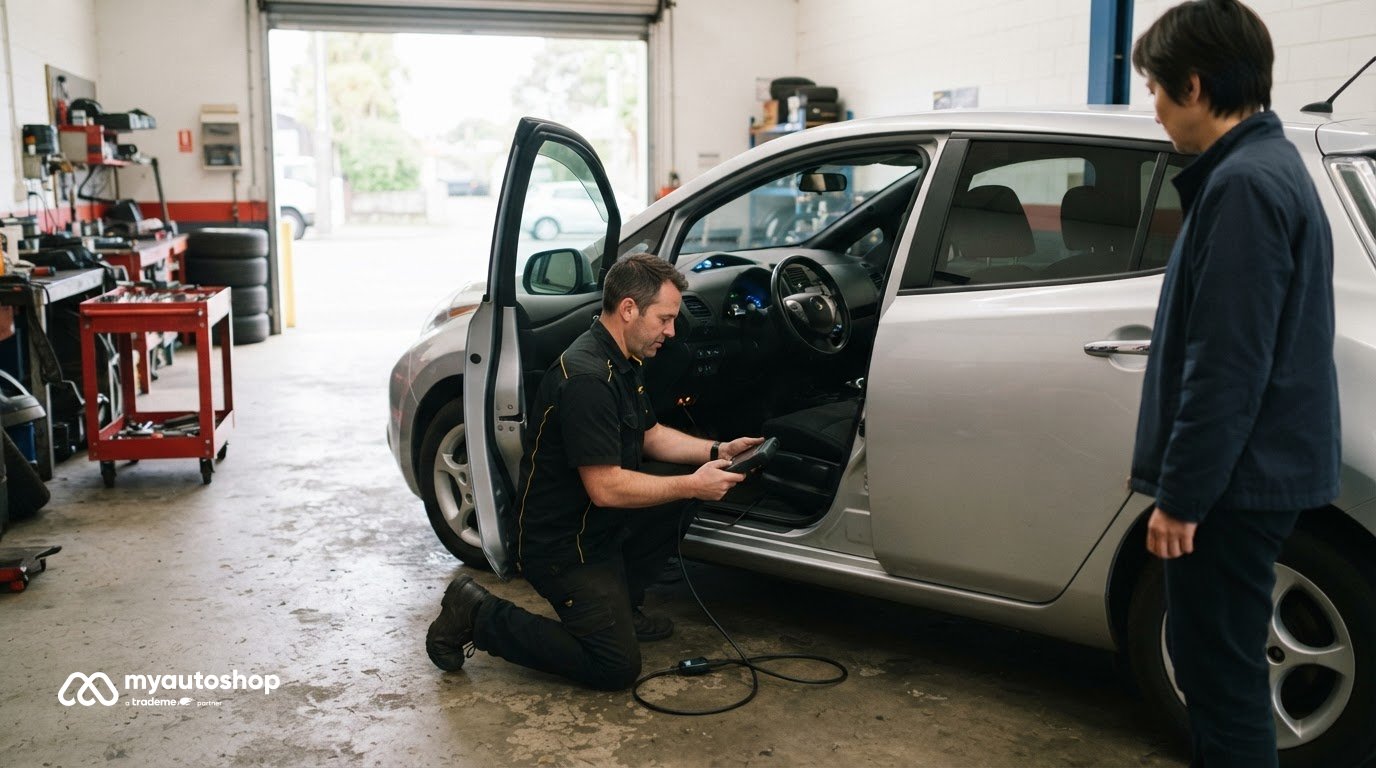
EV battery testing in New Zealand can check your battery’s state of health (SoH) by reading data from its battery management system (BMS). An OBDII reader can access information such as SoH, battery temperature and voltage. Most original equipment manufacturers guarantee that EV batteries retain at least 70% of their original capacity for 8 years or 160,000 km, whichever comes first.
It’s understandable to question a battery’s condition when your driving range changes or you’re considering a used EV. Range alone doesn’t tell the whole story: driving style, temperature and terrain all affect how far a vehicle travels on a charge.
This guide explains what a battery health check measures, how mobile and OBD-based tests work, and which factors can influence degradation. You’ll also learn what SoH results can tell you, how to interpret them alongside real-world range, and when a diagnostic check can help you make a more informed decision.
Key Takeaways
- For a used EV, pair a battery health report with the vehicle’s history and condition to build a clearer picture before buying.
- Battery ageing can be influenced by charging habits, deep discharges, driving behaviour and factory variation.
- Mobile testing uses an OBD dongle connected to the vehicle, with a mobile app used to start the test.
- OBD-based checks can reveal battery-management data, but readings make more sense when you know what each measure represents.
- Compare estimated range with the conditions you actually drive in, rather than treating one range figure as the whole story.
How can I check the health of my EV battery in New Zealand?
Check the battery management system’s state-of-health reading, then consider it alongside capacity, warranty details and expected range. For a used electric vehicle, treat the report as one part of the vehicle’s overall condition.
Battery Checks for Buyers and Sellers
A battery health check gives buyers and sellers evidence about the traction battery’s condition at sale. Buyers can use the report alongside the vehicle’s service history, odometer reading and observed range. Sellers can share a current report to explain the battery’s condition with useful data, rather than relying on dashboard range alone.
Keep traction-battery health separate from the 12-volt battery. Guidance on choosing a car battery relates to the 12-volt battery, not a report on the EV’s main battery pack.
Scanners, State of Health, and Certificates
State of health (SoH) estimates remaining battery capacity against its original condition. A battery test reads SoH from the vehicle’s battery management system (BMS); the reported value is the same as with an official manufacturer diagnostic tool. An AVILOO battery scanner is one option for checking battery health and producing a report.
A full certificate can include vehicle details, SoH, nominal and usable capacity, warranty details, and estimated real-world range under different conditions. Use each field for context: nominal capacity is the stated battery capacity, while usable capacity reflects what’s available to drive. Estimated range varies with driving style, temperature and terrain.
Test Results and Testing Limitations
Results from different providers are easiest to compare when the reports show the same measures and test conditions. Check the vehicle identification, SoH, capacity figures and report date together, rather than comparing a single percentage without context. Testing methodology can be aligned with Car Remarketing Association Europe guidelines; TÜV SÜD tests electric vehicle batteries against SAND 2005-3123.
Battery testing can reveal degradation indicators and BMS data, including battery temperature, voltage and SoH. It can’t make estimated range identical across routes or weather conditions. A report also doesn’t replace a broader inspection: a capacity result alone doesn’t describe every mechanical condition or rule out every fault or safety risk.
Rules, Warranties, and Testing Costs
New Zealand battery testing and manufacturer warranties are separate matters. The warranty terms belong to the vehicle maker; most original equipment manufacturers guarantee at least 70% of original capacity for 8 years or 160,000 km, whichever comes first. These are manufacturer warranty terms, not a universal New Zealand testing rule. In practice, replacement is considered necessary when capacity drops below 70%.
Testing costs in New Zealand depend on the vehicle, method and report scope; the price is given after a quote request. A warranty claim depends on the applicable maker’s terms and the battery’s recorded condition. For perspective, an example test adds 33 kWh to a 66 kWh Chevrolet Bolt battery, which should raise its state of charge by 50%.
Factors affecting battery degradation
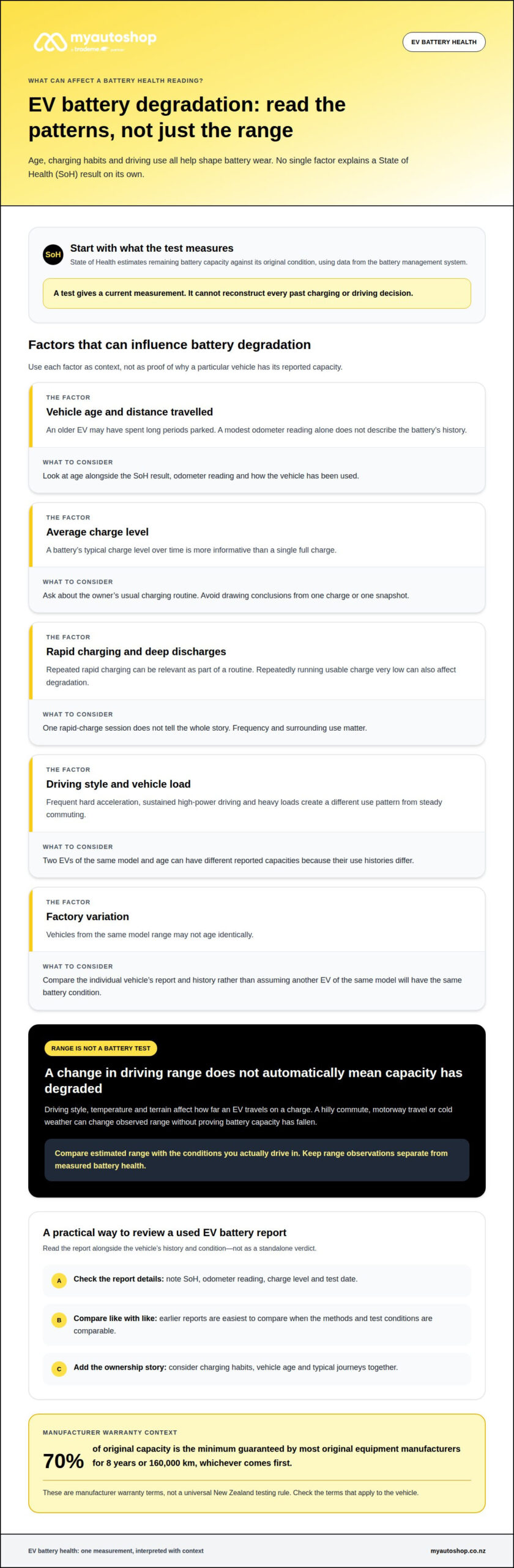
Battery wear reflects interacting factors, not one dashboard reading. Age, average state of charge, rapid charging, driver behaviour, factory variation and deep discharges can all affect capacity. Consider them as a pattern, then interpret battery health alongside how the vehicle has been used.
Age matters even when the odometer reading seems modest. An older EV may have spent long periods parked, so distance travelled alone doesn’t describe its battery history. Average state of charge matters too. A battery’s typical charge level over time is more informative than a single full charge. Look at the owner’s usual routine rather than drawing conclusions from one charge.
Rapid charging is another factor, particularly when it’s part of a repeated routine. One rapid-charge session doesn’t describe the pack’s full history; frequency and surrounding use matter. Driver behaviour also changes how the battery is used. Frequent hard acceleration, sustained high-power driving and heavy loads create a different pattern from steady commuting. These differences help explain why two EVs of the same model and age can have different reported capacities.
Factory variation means vehicles from the same model range may not age identically. Deep discharges, where usable charge is repeatedly run very low, can also affect degradation. Consider these factors alongside age and charging habits. No single factor proves why a vehicle has a particular state-of-health result. A test gives a current measurement, but can’t reconstruct every past charging or driving decision.
To assess a used EV, note the state of health, odometer reading, charge level and test date on its report. Compare earlier reports only when their methods are comparable. Ask about the usual charging pattern and whether the vehicle often sat fully charged or nearly empty. Then account for driving conditions. A hilly commute, motorway travel or cold weather can change observed range without proving capacity has degraded. In New Zealand, the same EV may travel different distances on steep regional roads and flatter urban routes. Separate a change in range from a measured change in battery health.
Keep the conclusion practical: consider the report, charging history, vehicle age and typical journeys together. For a hybrid, a hybrid battery test can help assess the battery’s condition.
How mobile EV battery testing works
A mobile test uses an OBD dongle and an app to access vehicle battery data. The process connects the car’s battery management system (BMS) readings to a health report.
What EV Battery Testing Measures
Battery testing assesses the BMS’s estimate of state of health (SoH), alongside available battery data. This helps owners understand capacity readings in context, rather than relying only on the range displayed on the dashboard.
An OBDII reader can access SoH, battery temperature and voltage. A full health check can also report vehicle details, usable and nominal capacity, warranty details, and estimated real-world range under different conditions. These fields help explain what the result describes. For example, usable capacity and nominal capacity are separate report values, not interchangeable labels.
The mobile process starts by connecting an OBD dongle to the vehicle’s onboard diagnostics port. The test is then started through a mobile application. The app initiates the check; the dongle provides access to data from the vehicle’s systems. This connects the test to the car’s own BMS rather than relying on a range estimate alone.
The Mobile Testing Process
Mobile testing means initiating the battery check with a connected dongle and app, rather than relying solely on dashboard information. The BMS can provide readings that help owners assess battery health and capacity.
After the app starts the test, the result draws on BMS information. Its SoH value is the same as the value from an official manufacturer diagnostic tool. This makes the report useful for understanding the vehicle’s recorded battery condition. It doesn’t mean one percentage describes every possible battery issue.
Read the report as a set of related measures. Consider SoH alongside usable capacity, nominal capacity and estimated range. Range estimates vary with driving style, temperature and terrain. A vehicle’s displayed distance can therefore differ from an estimate without showing that the battery’s measured condition has changed.
Battery temperature and voltage add context to the BMS reading. A report can help a buyer or owner see what the system records at testing time, but it can’t recreate every past charge or driving condition. Keep the test date with the result, especially when comparing reports taken at different times.
For a used electric vehicle, the process is straightforward: connect the dongle, start the app-based test, then review the report. Use its battery measures alongside the vehicle’s actual use. A steep route, cooler weather or a different driving style can affect range, so distinguish those influences from the reported battery health.
OBD-based battery testing process
An OBD-based battery check connects a dongle to the vehicle’s onboard diagnostics port, then starts the test through a mobile application. The connection provides access to battery management system (BMS) data, including state of health, temperature and voltage.
The process begins at the car. Connect the OBD dongle to its diagnostics port, then use the mobile app to start the test. The app initiates the battery check, while the dongle connects to the vehicle’s systems. This differs from judging battery condition solely by the range shown on the dashboard.
Once the test accesses BMS data, the result can include a state-of-health reading. This value comes from the vehicle’s battery management system and is the same as the value from an official manufacturer diagnostic tool. It represents the system’s SoH figure, not a complete account of every part of the vehicle.
An OBDII reader can access several useful battery measures:
- State of health: the BMS-reported indication of battery condition.
- Battery temperature: a reading that adds context to the battery data.
- Battery voltage: another recorded measure from the battery management system.
A fuller report can also show vehicle details, nominal and usable capacity, warranty details, and estimated real-world range under different conditions. Read these fields together. Nominal and usable capacity are different figures, while estimated range isn’t a direct substitute for either capacity measure.
Use the report as a snapshot of the data available during the test. Keep its date and vehicle details with the result, especially if you later compare another report. If readings differ, first make sure you’re comparing the same vehicle and measures. Don’t confuse a state-of-health figure with a temperature or voltage reading.
Range estimates need real-world context. Driving style, temperature and terrain can change how far an electric vehicle travels. A route across hilly roads, for example, won’t necessarily produce the same range as flatter driving. These conditions affect range comparisons, even when the report focuses on BMS data.
OBD-based testing gives owners a structured way to access battery information without treating dashboard range as the whole picture. It can show SoH, temperature and voltage, alongside report details such as capacity and estimated range. Use those measures to understand the recorded battery condition, then consider them in light of the vehicle’s use and driving conditions.
What is EV battery testing and what does it measure?
EV battery testing examines battery data and condition using diagnostic methods. Depending on the method, it can assess state of health, capacity, electrical behaviour or temperature patterns.
A battery health report can combine vehicle details with state of health, nominal and usable capacity, warranty details, and estimated real-world range. These measures answer different questions. State of health describes the battery management system’s estimate of condition, while capacity figures describe battery energy values. Estimated range is affected by driving style, temperature and terrain, so it isn’t a direct capacity measurement.
Electrical behaviour and impedance
Electrochemical impedance spectroscopy measures a battery’s impedance at multiple frequencies. Impedance describes how the battery responds to electrical current, while frequency-based readings help analyse behaviour at the electrode-electrolyte interface.
Processes inside a battery cell affect its electrical response at the electrode-electrolyte interface. Looking across multiple frequencies gives a more detailed picture than a single reading. This differs from reading battery management system data through an OBDII connection. Each method provides information about a different aspect of the battery.
Temperature patterns and hotspots
Thermal monitoring uses sensors and thermal imaging cameras to measure temperature distribution across the battery. The resulting pattern can identify hotspots, or areas warmer than surrounding parts of the pack.
A temperature map adds information that a single SoH percentage can’t show. For example, different areas of a battery may have different measured temperatures. Thermal monitoring reveals that distribution, while a BMS reading reports system data. Neither describes every possible battery condition.
Method matters when interpreting a result. An OBD-based check reads data available from the vehicle’s battery management system, including SoH, temperature and voltage. Impedance spectroscopy analyses electrical response at multiple frequencies, while thermal imaging focuses on temperature distribution. These methods aren’t interchangeable, so identify what each test measured before comparing results.
For owners, the useful question is what the report actually contains. Check whether it gives a BMS-reported SoH, capacity values, temperature readings or a thermal image. A range estimate has a different role: it describes expected driving distance under stated conditions, not the battery’s internal temperature pattern or impedance response.
Use the measures together, not as competing verdicts. A capacity report, for instance, describes available energy, while a thermal scan highlights temperature differences. A mobile diagnostic can provide BMS information, but its value depends on the question being asked. Matching the test type to the concern makes the result easier to interpret.
My Auto Shop: Pre-purchase Inspection
My Auto Shop offers a Pre-purchase Inspection for buyers assessing a used EV before making a decision. A battery health report focuses on the battery; an inspection adds a broader view of the vehicle’s condition. Consider both when weighing reported state of health against the car’s overall condition, service history and intended use.
If you’re considering a used EV, arrange a Pre-purchase Inspection to help assess the vehicle beyond its battery report.
Contact My Auto Shop or visit myautoshop.co.nz to take the next step.
Make your next vehicle decision with confidence
Use your battery report to guide the questions you ask about the car’s ongoing care. Your next step can focus on the vehicle’s maintenance needs and the way you plan to drive it.
For routine upkeep, explore Basic Service and Comprehensive Service options through My Auto Shop, and choose the one that best fits your vehicle’s needs.
Take the next step at a pace that works for you. A clear maintenance plan can help you feel ready for the road ahead.
Frequently Asked Questions
Why is EV battery testing important?
Battery information helps you make decisions without relying on a single dashboard estimate. If you’re planning regular longer trips, for example, a report can help you judge whether the vehicle’s battery condition suits that use. Treat the result as one factor alongside your budget, route needs and the car’s overall condition, not as an automatic buy-or-avoid verdict.
How does this help when buying or selling an EV?
It gives buyers and sellers shared evidence to discuss during a sale. A buyer can use it to focus questions on the car’s recorded condition, while a seller can present it with the vehicle’s records. If the report and observed performance seem inconsistent, pause to consider what additional information could explain the difference before deciding.
What does State-of-Health mean?
State of health (SoH) estimates a battery’s condition relative to its original condition. It differs from the charge level shown on the dashboard: charge describes energy available now, while SoH describes battery condition. For a useful comparison, read SoH alongside the vehicle’s capacity figures and intended use, rather than interpreting it as a direct range reading.
What factors affect the SoH of a battery?
Battery age, average state of charge, rapid charging, driver behaviour, factory variation and deep discharges can all influence degradation. For a particular used EV, consider these factors as part of its history rather than guessing from its model or appearance. If you know how the car was typically charged and driven, use that context to interpret its test result.
How is an electric vehicle battery health test performed?
Some tests use a dongle connected to the vehicle’s onboard diagnostics port and a mobile app to initiate a data check. Other methods analyse electrical response or battery temperature patterns. Each method examines different information. Before relying on a result, identify which test was performed and what it assessed, so you don’t mistake one reading for a complete diagnosis.
What does an EV battery health report include?
Depending on the test, a report may include vehicle details, capacity measures, warranty information and estimated range. Read the vehicle identification and test date first, then check which measures are included. A report’s range estimate doesn’t promise the distance you’ll achieve on every trip; your route, driving style and conditions affect real-world travel.
Where can I get an EV battery tested in New Zealand?
Look for an EV-specific battery assessment that explains its method and readings. If you’re purchasing a used EV, My Auto Shop’s Pre-purchase Inspection can assess the vehicle’s broader condition, separate from a dedicated battery report. Keep those purposes distinct when deciding what information you need before buying.
What is a good state of health for a used EV battery?
There isn’t one figure that suits every used EV purchase. Consider the result in relation to the vehicle’s age, capacity, warranty terms and the range you need for regular journeys. Someone whose driving is mostly local may assess suitability differently from someone relying on longer trips. Base the decision on the vehicle’s condition and your own use, not one percentage alone.
Disclaimer
This article provides general information only and should not be relied on as professional mechanical, safety or legal advice. Vehicle requirements and circumstances vary. If you are unsure about your vehicle, have it inspected by a qualified automotive professional.