
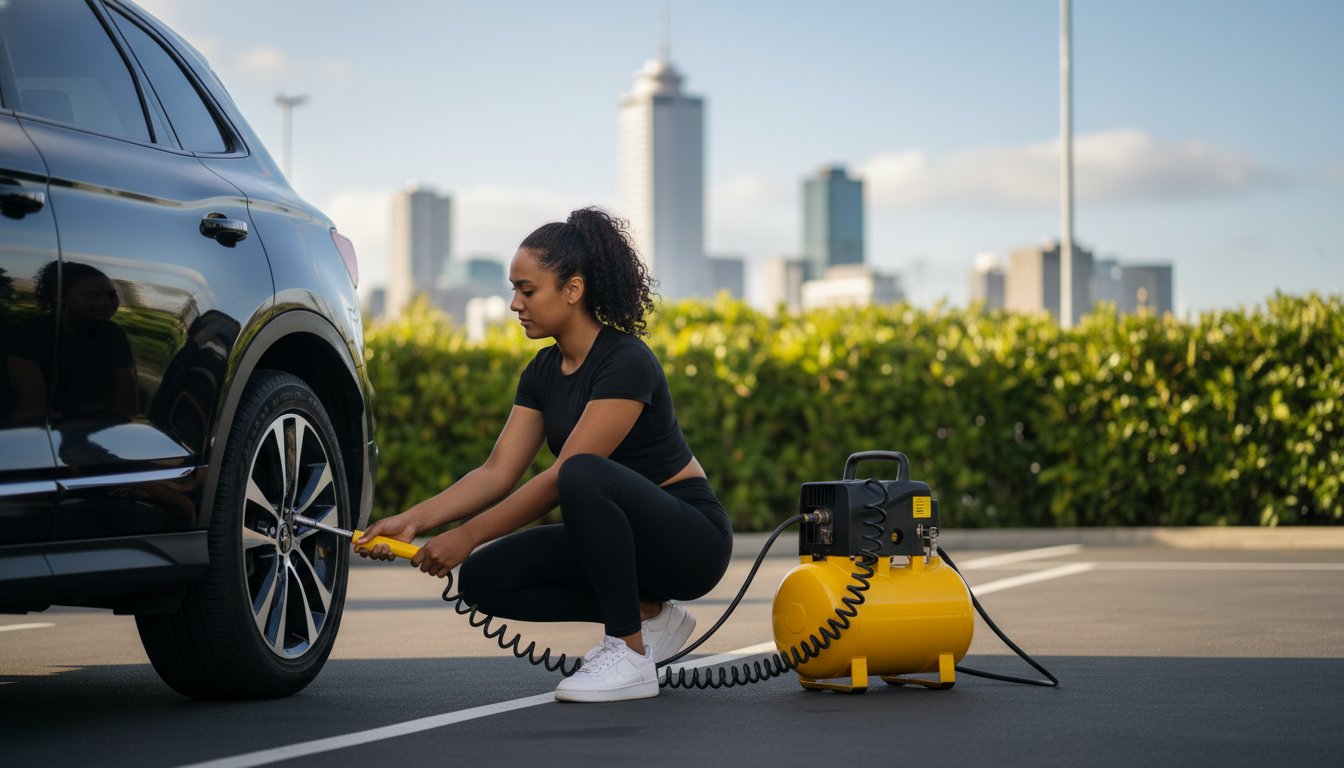
According to data from Gen Less NZ, driving on tyres that are just 5 PSI under-inflated can increase your fuel consumption by 4%. For the average Kiwi driver, that is essentially throwing away a full tank of petrol every single year. Most of us know we should do it, but learning how to check tyre pressure often takes a backseat to the fear of looking confused at a busy Z or BP station. It’s easy to feel intimidated by loud compressors and the pressure of a queue forming behind you.
We understand that the technical jargon around PSI and Bar can make a simple task feel like a science experiment. However, neglecting your tyres is a fast track to a failed WOF and dangerous handling on wet New Zealand roads. This guide simplifies everything. You’ll learn how to find your car’s correct settings, how to use the pump like an expert, and how to keep your family safe while saving money at the pump. We’re stripping away the mystery so you can drive with total confidence.
Key Takeaways
- Learn how maintaining the right pressure improves braking on wet NZ highways and helps you breeze through your next WOF.
- Discover the ‘cold tyre’ rule and exactly how to check tyre pressure like a pro using simple tools at your local petrol station.
- Find out where your car hides its tyre information placard so you always use the manufacturer-recommended PSI for your specific model.
- Identify common issues like slow leaks and TPMS warnings before they turn into expensive roadside emergencies.
- Understand the link between tyre pressure, fuel economy, and wheel alignment to keep your Kiwi road trips smooth and cost-effective.
Why Correct Tyre Pressure is Critical for New Zealand Roads
Tyre pressure is the measure of compressed air inside your tyre, typically calculated in Pounds per Square Inch (PSI) or Bar. It is the only thing connecting your vehicle to the tarmac, making it the most vital safety setting on your car. To get an accurate reading, you need to understand what cold inflation pressure means before you start. This involves checking your tyres after the car has been stationary for at least two hours, ensuring the air inside hasn’t expanded due to driving heat.
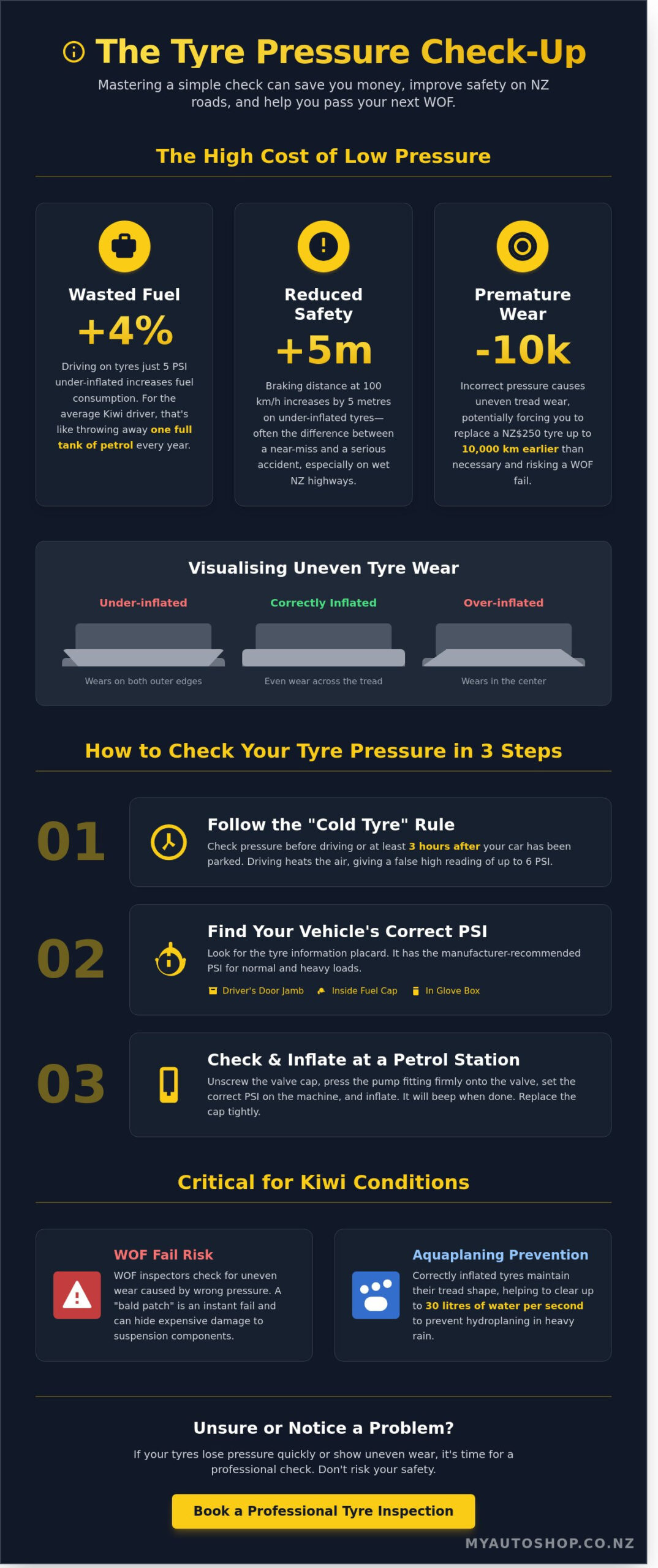
Safety is the primary reason to stay on top of your levels. Under-inflated tyres significantly increase braking distances, especially on wet New Zealand highways. At 100km/h, a car with soft tyres can take an extra 5 metres to stop compared to a properly inflated one. That distance is often the difference between a close call and a serious nose-to-tail accident. When tyres lack air, the sidewalls flex excessively, generating heat that can lead to a sudden blowout at high speeds.
Your weekly petrol spend is also directly linked to your tyres. Low pressure increases rolling resistance, which means your engine has to work harder to move the car forward. This inefficiency can hike your fuel consumption by 3%. If you spend NZ$100 on fuel every week, you could be wasting over NZ$150 a year just by ignoring your valves. Learning how to check tyre pressure also protects your investment in rubber. Correct inflation prevents uneven tread wear, stopping you from having to replace a NZ$250 tyre 10,000 kilometres earlier than necessary.
Passing Your Warrant of Fitness (WOF)
A Warrant of Fitness inspection is strict about tyre health because it’s a core safety component. Incorrect pressure causes the tread to wear down unevenly, either on the edges or in the centre, which creates a ‘bald’ patch that fails WOF standards. Beyond the rubber itself, running on soft tyres puts unnecessary strain on your suspension bushies and shocks, leading to mechanical wear that is expensive to fix. WOF inspectors look for ‘evidence of under-inflation’ as a safety red flag.
Handling the Kiwi Landscape
New Zealand roads are famous for their ‘chip seal’ surface, which is coarser and more abrasive than the smooth asphalt found overseas. This texture demands an optimal contact patch to maintain grip. If your tyres are over-inflated, the contact area shrinks, making the car feel bouncy and nervous on winding rural drives like the Desert Road or the Crown Range. Understanding how to check tyre pressure ensures your vehicle remains stable when navigating these tight bends. Properly inflated tyres also help the tread grooves stay wide enough to clear up to 30 litres of water per second. This prevents aquaplaning during our frequent heavy downpours, keeping you in control when the weather turns.
Finding the Correct Pressure for Your Vehicle
Before you learn how to check tyre pressure, you need to know what your target number is. Every vehicle has a specific pressure range designed for safety and fuel efficiency. You’ll find this on the tyre information placard. Manufacturers usually stick this silver or white sticker on the driver-side door jamb, but sometimes it hides inside the fuel filler cap or the glove box. If the sticker is missing or unreadable, your owner’s manual is the final authority. It provides the exact specifications for your specific model and wheel size.
Timing is everything when getting an accurate reading. Always follow the “Cold Tyre” rule. This means checking your tyres before you start a long drive or at least 3 hours after the car has been parked. Driving generates heat through friction, which causes the air inside to expand. Checking “hot” tyres can lead to a reading that is 4 to 6 PSI higher than the actual baseline. Most New Zealand petrol station gauges allow you to toggle between PSI and Bar. If your placard uses Bar, multiply it by 14.5 to get the PSI equivalent. For example, 2.2 Bar is roughly 32 PSI.
Maintaining these levels is a core part of vehicle maintenance. According to NHTSA tyre safety information, proper inflation is the most important factor in preventing tyre failure. If you notice your tyres are wearing unevenly or losing air faster than 1 PSI per month, it might be time to have a professional take a look. You can easily book a tyre inspection through our platform to stay safe on the road.
Understanding Load Factors
Your ideal pressure changes based on what you’re carrying. Most placards list two different settings: “Normal” and “Maximum” load. If you’re heading off on a Kiwi road trip with a full car and a boot packed with gear, or if you’re towing a trailer, you must increase your pressure to the maximum load setting. This extra air supports the additional weight and prevents the sidewalls from flexing too much. However, don’t leave them at max pressure once the car is empty. Over-inflating a lightly loaded vehicle reduces the contact patch with the road, which hurts your braking performance and makes the ride uncomfortably bouncy.
Decoding the Tyre Sidewall
A common mistake is reading the numbers printed directly on the tyre. You will see a “Max Press” figure on the sidewall, often around 44 or 50 PSI. Never use this number for daily driving. This is the maximum pressure the tyre can physically hold before it risks failing, not the recommended setting for your car. Instead, use the sidewall to identify your tyre size, such as 205/55R16. Match this size to the corresponding row on your door placard to find the correct PSI. Keep in mind that older tyres lose pressure faster as the rubber becomes more porous. If your tyres are more than 6 years old, check them every fortnight to ensure they’re still holding steady.
Step-by-Step: How to Check Tyre Pressure Like a Pro
Checking your tyres doesn’t require a degree in mechanical engineering. You just need the right tools and five minutes of your time. Start by choosing a gauge. Digital gauges are the most reliable and provide a clear readout. Traditional analogue “pencil” gauges are compact but can be harder to read accurately. If you’re at a local Z or BP, their digital inflators are usually well-calibrated and easy to use.
Before you start, unscrew the valve caps from all four tyres. These small plastic caps disappear easily on dark tarmac, so pop them into your pocket or the centre console of your car. Once the valve is exposed, press your gauge firmly onto the valve stem. You want a tight, hiss-free seal. If you hear air escaping, adjust the angle until the sound stops. For a detailed breakdown of this technique, you can learn more about how to check tyre pressure from industry experts. If the reading is too high, use the small pin on the back of your gauge to release air in short bursts.
Using the Petrol Station Air Pump
Most NZ petrol stations feature digital towers. Use the (+) and (-) buttons to set your target PSI before you connect the hose. Once you attach the nozzle, the machine automatically adds or releases air. Wait for the loud, repetitive beep. This signal confirms the tyre reached the set pressure. Always double-check the screen after the beep to ensure the final reading matches your goal. Forecourts are busy places, so stay alert for moving vehicles. Use a paper towel from the dispenser to handle the hose if it’s covered in road grime.
Checking Your Spare Tyre
Your spare tyre is often tucked away under the boot floor and forgotten. Check it every three months to avoid a nasty surprise. A flat spare tyre is a common reason for roadside rescue calls in NZ, accounting for thousands of call-outs annually. Space saver tyres typically require much higher pressure than standard tyres, often up to 60 PSI. Check the sidewall of the spare for the specific rating. Full-size spares usually follow the same PSI as your main tyres, but they still lose air over time through natural permeation. Keeping this tyre ready ensures you aren’t stranded when you’re far from home.
Common Issues and Troubleshooting Your Tyres
Knowing how to check tyre pressure is only half the battle; you also need to know what to do when the numbers don’t add up. A healthy tyre naturally loses about 1 to 2 PSI every month through normal use. If you find a single tyre is down by 5 PSI or more while the others remain steady, you’ve likely got a slow leak. This is usually caused by a stray nail or a leaking valve stem. Regularly practicing how to check tyre pressure allows you to spot these issues before they become expensive roadside emergencies.
Always perform a quick visual inspection while you have the dust caps off. Look for “bulges” that look like small bubbles or eggs on the sidewall. These indicate internal structural damage and make the tyre prone to a sudden blowout. Check for sidewall cracking too. If the rubber looks like a dried-out riverbed, it’s perishing and needs replacement, regardless of how much tread is left. These visual cues are your first line of defence against tyre failure on the motorway.
Dealing with TPMS Errors
The yellow horseshoe symbol on your dashboard represents the Tyre Pressure Monitoring System (TPMS). If this light stays on after you’ve topped up your air, you likely need to reset the system. Most Kiwi vehicles require a reset via the steering wheel menu or a physical button located in the glovebox or near the ignition. If the light blinks for 60 seconds before staying solid, a sensor has probably failed. These sensors have internal batteries that typically last 5 to 7 years. Replacing them during your next tyre change is the most efficient way to avoid paying for double labour later.
Seasonal Pressure Changes
Temperature plays a massive role in your readings because air expands when hot and contracts when cold. For every 5°C drop in ambient temperature, your tyre pressure decreases by roughly 1 PSI. This is why your warning light might trigger on a freezing July morning in Christchurch but disappear once the day warms up. Conversely, long summer hauls on hot tarmac can cause pressure to spike significantly. Stick to the gold standard of Kiwi maintenance by checking your tyres once every 30 days. This habit ensures your car handles correctly and keeps your fuel bills down.
Beyond the Gauge: Professional Tyre Care and Maintenance
Mastering how to check tyre pressure is the first step toward road safety, but a handheld gauge cannot tell the whole story. Sometimes your car sends signals that require a professional eye. If you feel a persistent vibration through the steering wheel at 100km/h, your wheels are likely out of balance. If the car drifts toward the kerb on a flat stretch of State Highway 1, your wheel alignment needs urgent attention. Misaligned wheels can reduce tyre life by 25% or more, costing you hundreds of dollars in premature replacements.
Correct pressure works in tandem with mechanical health. Even if you know how to check tyre pressure perfectly, worn suspension components or warped brake rotors can mimic the feel of a flat tyre. Professional maintenance ensures your car remains WOF-compliant and handles predictably during emergency braking. Regular inspections prevent small issues from turning into expensive roadside breakdowns.
The My Auto Shop Advantage
We believe car maintenance should be as simple as ordering a coffee. Our digital platform connects you with NZ’s best mechanics, providing a seamless experience from start to finish. You get transparent pricing for every repair, whether you need new brake pads or a full suspension overhaul. We remove the guesswork and the jargon, giving you total clarity on what your car needs and what it costs.
- Transparent pricing: See the cost upfront for all mechanical repairs and servicing.
- Pick up & drop off: We collect your car from home or work, get the job done, and return it to you.
- Expert network: Access a curated selection of top-rated New Zealand garages through one easy interface.
Your Maintenance Schedule
Consistency is the secret to vehicle longevity. Integrate a quick tyre and fluid check into your Sunday morning routine. This five-minute habit helps you spot uneven wear patterns or embedded nails before they cause a blowout. For those looking at a second-hand vehicle, a professional pre-purchase inspection is non-negotiable. Our inspectors verify tread depth and structural integrity, ensuring you aren’t buying someone else’s maintenance debt.
Keeping your car road-ready doesn’t have to be a chore. Modern drivers deserve a service that respects their time and their budget. Book your next service with My Auto Shop to keep your tyres in top condition and enjoy the peace of mind that comes with a professionally maintained vehicle.
Stay Safe and Save Fuel on Kiwi Roads
Knowing how to check tyre pressure is one of the simplest ways to protect your wallet and your passengers. Data from the Energy Efficiency and Conservation Authority (EECA) shows that properly inflated tyres can improve fuel efficiency by up to 4%. This small habit also extends tyre life by 25%, which means you’ll spend less on premature replacements. Kiwi roads are famously unpredictable, so maintaining the right grip is essential for safe braking and handling in all weather conditions.
If you want a professional to handle the technical details, MyAutoShop offers a modern solution for busy drivers. We’re a Kiwi owned and operated business focused on making car maintenance easy and accessible. You’ll get transparent, instant pricing upfront, so there’s no guesswork involved. We even offer a pick up and drop off convenience that fits your schedule perfectly.
Book a Comprehensive Service with My Auto Shop Today and enjoy the peace of mind that comes with a road-ready vehicle. Keep your car running smoothly and stay safe out there.
Frequently Asked Questions
How often should I check my tyre pressure?
You should check your tyre pressure at least once every 30 days and before any long road trip. Tyres naturally lose about 1 to 2 PSI of air each month through the rubber and valve. Learning how to check tyre pressure regularly ensures you catch slow leaks early and keeps your fuel efficiency high.
Should I check tyre pressure when tyres are hot or cold?
Always check your tyre pressure when the tyres are cold for the most accurate reading. Friction from driving heats up the air inside, which can increase the pressure reading by 3 to 5 PSI and give you a false result. For the best data, wait at least 3 hours after driving or ensure you have travelled less than 3km to the petrol station air pump.
What happens if I over-inflate my tyres?
Over-inflating your tyres causes the centre of the tread to wear down faster, which can reduce the lifespan of the tyre by up to 25%. It also shrinks the contact patch with the road, leading to poor traction and a much harsher ride for you and your passengers. You are also at a higher risk of a blowout if you hit a pothole with over-pressurised tyres.
Why does my tyre pressure light stay on after I put air in?
Your tyre pressure monitoring system (TPMS) light often stays on because the car’s computer needs a few minutes to recalibrate. Most modern vehicles require you to drive for 10 to 15 minutes at speeds over 30km/h to reset the sensor after you’ve followed the steps for how to check tyre pressure. If it stays on after a short drive, you might have a faulty sensor or a slow puncture that needs a professional look.
Is the PSI on the tyre sidewall what I should use?
No, the PSI printed on the tyre sidewall is the maximum pressure the tyre can safely hold, not the recommended setting for your specific car. You should always follow the figures found on the tyre placard inside the driver’s door frame or in your owner’s manual. Using the maximum PSI listed on the sidewall can lead to dangerous handling and accelerated wear on New Zealand roads.
Can I drive with low tyre pressure to the nearest petrol station?
You can usually drive a short distance to a petrol station if the pressure is only slightly low. Keep your speed under 40km/h and avoid sudden braking or sharp turns to keep the tyre securely on the rim. If the tyre looks visibly flat or is below 20 PSI, don’t drive on it, as this can cause permanent internal damage to the tyre structure within seconds.
Do different tyres on the same car need different pressures?
Yes, many vehicles require different pressures for the front and rear axles. Front tyres often need more air because they support the weight of the engine and handle the majority of the steering forces. Check your car’s placard carefully, as it will often list different PSI requirements for the front and rear based on whether you are carrying a full load of passengers.
How much does it cost to have a mechanic check my tyres?
Most Kiwi mechanics will check your tyre pressure for free as part of a standard WOF or basic service. If you book a standalone safety inspection, you can expect to pay between NZ$20 and NZ$40 for a comprehensive check of tread depth, condition, and pressure. It’s a small investment that ensures your car stays safe and efficient for your daily commute.
Disclaimer
This article provides general information only and should not be relied on as professional mechanical, safety or legal advice. Vehicle requirements and circumstances vary. If you are unsure about your vehicle, have it inspected by a qualified automotive professional.