

A bad feeling is a reason to pause, not to guess. Knowing what to do when you have a bad feeling about a mechanic starts with asking what repairs are proposed, how long they’ll take and what they’ll cost, then agreeing that no extra work goes ahead without your approval. Get the estimate in writing, with each repair and its costs set out.
It’s reasonable to want a clear explanation before you authorise work, especially when the fault or estimate doesn’t make sense. An estimate indicates likely costs, but the final bill may differ. Ask what could happen if you delay a repair, which work is urgent and whether the recommended work can be staged.
This guide covers practical questions to ask, ways to assess a mechanic’s qualifications and reputation, and what to look for in a written estimate. It also explains what to do if the bill includes work you didn’t approve, helping you make a calmer, better-informed decision about your car.
Key Takeaways
- Agree on the repair work, investigation time and approval process before the mechanic starts.
- Ask whether recommended repairs are safety-critical, performance-related or preventative, and what delaying them could mean.
- Check a mechanic’s qualifications, trade-association membership and reputation through recommendations and online reviews.
- Look for a written estimate that itemises each repair and its costs, then compare it with the final bill.
- If you need a mechanic to assess or repair your vehicle, My Auto Shop offers a Mobile Mechanic service.
1. Asking about proposed repairs, timing and cost
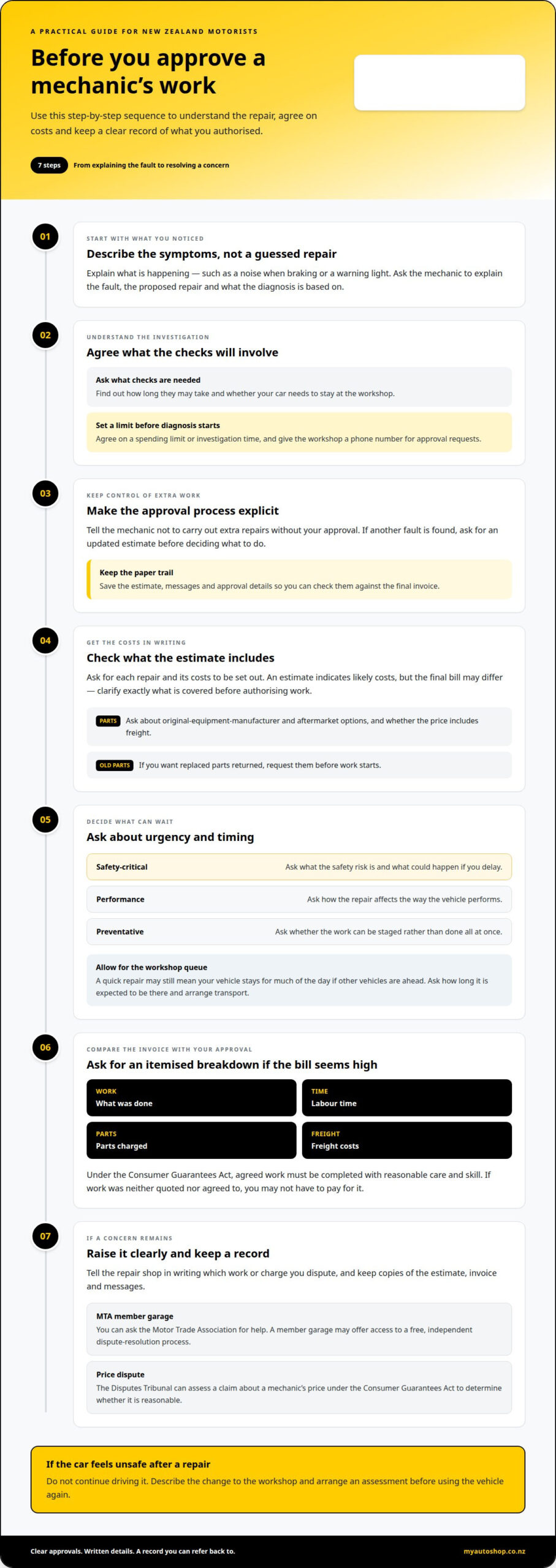
Before approving work, ask the mechanic to explain the fault, the proposed repair and the basis for the diagnosis. Describe what you’ve noticed, such as a noise when braking or a warning light, rather than guessing which part has failed. Ask what checks are needed, how long they may take and whether your car needs to stay at the workshop while other vehicles are serviced.
In New Zealand, you can tell a mechanic not to carry out extra repairs without your approval. Agree on a spending limit or investigation time before diagnosis begins, and provide a phone number for approval requests. An estimate indicates likely costs but may not match the final bill exactly. Ask for an updated estimate if the mechanic finds another fault.
Under the Consumer Guarantees Act, a mechanic must complete agreed work with reasonable care and skill. If work was neither quoted nor agreed to, you may not have to pay for it. Keep the estimate, messages and approval details so you can compare the authorised work with the final invoice.
Ask whether the proposed work is critical for safety, recommended for performance or preventative maintenance. Find out what could happen if you delay it and whether the repairs can be staged. For replacement parts, ask about original-equipment-manufacturer and aftermarket options, and whether the price includes freight. If you want the replaced parts returned, request them before work starts and explain that you’d like to see what was removed.
Diagnostic checks and second opinions don’t have one standard cost. The price depends on the case and is provided after a quote request; factors include the checks required, investigation time, parts and freight. Before authorising diagnosis or repairs, ask exactly what the estimate covers.
If a bill seems high, ask for an itemised breakdown of the work, labour time, parts and freight. Raise the issue with the repair shop in writing and keep copies. If the garage is an MTA member, you can ask the Motor Trade Association for help. The Disputes Tribunal can assess a claim about a mechanic’s price under the Consumer Guarantees Act to determine whether it’s reasonable.
If your car feels unsafe after a repair, don’t continue driving it. Describe the change to the workshop and arrange an assessment before using the vehicle again. If you need an assessment where your car is parked, a mobile mechanic service may suit the situation.
Timing can depend on the queue as well as the repair itself: a vehicle may need to remain at the shop for most of the day even when the repair is quick, because other vehicles may be ahead in the service bay. Ask how long it is expected to be there and arrange transport to and from the facility. If a mechanic recommends replacing brake pads at 3mm, for example, ask how that recommendation relates to avoiding rotor damage. Be prepared to pay the going rate for vehicle parts and labour. If disputing a garage bill in New Zealand, ask the mechanic to itemise work, time, parts and freight costs.
2. Checking a mechanic’s qualifications and trade-association membership
Ask who will work on your vehicle and about their training or experience with its make, model and fault. A mechanic who regularly works on your type of vehicle may recognise model-specific symptoms more quickly. Ask them to explain the checks they’ll use and how those checks relate to the recommended repair. Clear answers help you judge whether the explanation fits the problem you described.
Qualifications and experience provide useful context, but they don’t replace clear communication. Ask what the mechanic’s qualification covers and whether they’ve handled a similar repair. For example, if the recommendation involves a cambelt, ask what condition or service information supports the work. You don’t need to diagnose the vehicle yourself, but you do need enough detail to understand why the work is proposed.
Trade-association membership can provide another point of reference. An MTA member garage in New Zealand may offer access to a free, independent dispute-resolution process. If you’re considering a garage, ask whether it is an MTA member and what help is available if a disagreement arises. Membership is a practical safeguard to understand, not proof that every repair decision is right for your vehicle.
Warning signs include a mechanic refusing to explain a diagnosis in plain language, changing the proposed work without a clear reason, or failing to describe what an estimate covers. Be cautious if you feel pressured to approve work immediately, especially if the mechanic hasn’t explained the safety risk or consequences of waiting. One unclear answer may be a misunderstanding, but repeated evasiveness makes informed approval difficult.
Can you dispute a mechanic’s invoice or refuse to pay for unsatisfactory work in New Zealand? Under the Consumer Guarantees Act, agreed work must be completed with reasonable care and skill. If a bill includes work you didn’t agree to, you may not have to pay for it. Raise the issue with the garage and explain what you dispute.
Keep the estimate, invoice, messages and notes about conversations together. State which work or charge you’re challenging, and ask the garage to respond in writing. If the dispute concerns the price, the Disputes Tribunal can assess whether it’s reasonable under the Consumer Guarantees Act. If the garage belongs to the Motor Trade Association, you can ask the association for help through its dispute-resolution process.
Before choosing a mechanic, notice whether they answer questions directly, explain the basis for their recommendations and respect your decisions. These behaviours make it easier to understand what you’re authorising and raise concerns early, before uncertainty turns into a dispute.
3. Finding a reputable mechanic through recommendations and reviews
Start with people who know how you use your car. Ask friends, whānau or coworkers about repair shops they’ve used and what happened. A recommendation is more useful when it includes a specific example, such as a garage explaining a recurring warning light or keeping someone updated during a repair. Ask whether they’d return for similar work, not simply whether they liked the staff.
Look for recommendations that match your vehicle and repair. A positive experience with a routine service may say little about a complex engine fault. Ask what make and model they took in, what work the garage completed and whether it resolved the original issue. If the recommendation concerns a different repair, treat it as a clue about communication, not proof of expertise.
Online reviews can add context. Read several accounts rather than relying on one glowing or angry post. Look for repeated details: do customers describe clear explanations, updates about delays or work that matched their expectations? A pattern across separate reviews is more informative than a single broad claim. Check when the review was posted and what repair it describes.
Car sites and message boards can help you understand how other owners describe a similar problem. Search using your vehicle’s make, model and symptom, such as a vibration while braking. Treat forum comments as personal experiences, not a diagnosis. The same symptom can have different causes, so an online discussion can’t establish which repair your car needs.
Knowing what to do when you have a bad feeling about a mechanic may mean getting another garage’s view. If you’re unsure whether a part genuinely needs replacing, ask another garage to assess the vehicle. Share the first recommendation and describe the symptoms, then ask for its findings and reasoning.
Keep your comparison focused. Write down the proposed repair, the reason given and the questions each mechanic answers. If one recommends replacing a component and another suggests further checks, ask what evidence supports each view. For example, compare their explanations of a brake noise, not just the parts they mention.
Before booking, consider which garage gave you the clearest, most relevant information about your vehicle and repair. Note unanswered questions and raise them directly with the garage. A specific conversation about your car can help you decide whether you’re comfortable proceeding.
When asking for recommendations, invite people to describe the repair shop they’d choose and the work they had done there. Ask how they discussed the repair with the shop and whether they’d return for similar work. Ask friends, family and coworkers for recommendations, then weigh those suggestions alongside your own questions. If someone offers only a general endorsement, ask what experience it’s based on rather than assuming it applies to your car or repair. Note the shops mentioned and the reasons people gave. This makes it easier to distinguish recommendations based on relevant work from those based mainly on a pleasant interaction.
4. Getting a written estimate with a cost breakdown
Ask for a written estimate before approving repairs. It should break down the cost of each proposed repair rather than show only an unexplained total. Check that it identifies the work, parts, labour time and any freight charges. This gives you a clear record of what the mechanic expects to do and charge.
An estimate indicates likely costs, not necessarily the exact final amount. A mechanic may find another fault after opening a component or completing diagnostic checks. Ask what could change the estimate and how the workshop will contact you before doing extra work. Make sure the estimate states that additional repairs need your approval.
Read each line item and ask for a plain-language explanation. If the estimate says “replace radiator”, ask whether it includes removing the old unit, fitting the replacement and checking the cooling system afterwards. An item described as “investigation” should identify what the mechanic plans to inspect. Clear wording helps you distinguish diagnosis from repair.
Check that the estimate separates the main costs. A repair may involve a part, the time needed to fit it and freight to obtain it. If labour time is listed without explanation, ask what tasks it covers. If a part has alternatives, ask which option the estimate includes and whether choosing another changes the total.
- Scope: Confirm the fault being addressed and the repair proposed.
- Parts: Check what component is included and whether freight appears separately.
- Labour: Ask what work and time the labour charge covers.
- Approval: Agree how the mechanic will seek permission if costs change.
Keep the estimate with messages, approval records and the final invoice. When the car is ready, compare each invoice item with the written scope. Look for work you didn’t authorise, parts that weren’t included or freight that needs explaining. If a line is unclear, ask the garage to explain and itemise the work, time, parts and freight.
A written estimate also helps you compare recommendations without relying on memory. If another garage assesses the same fault, compare the proposed work and reasoning, not just the totals. One estimate may include further checks, while another may cover only a specific repair. Ask what each document includes before treating the figures as equivalent.
Save the final version you approved, especially if the workshop updates its estimate. A dated message confirming the revised scope can help show which work you accepted. If the invoice differs, point to the relevant line and ask for a written explanation. This keeps the discussion focused on the agreed repair and its documented costs.
5. Using recommendations and reviews to choose a garage
Turn your shortlist into a practical comparison before booking. Check each garage’s location against your usual routes, work commute or regular parking spot. A nearby workshop may make it easier to drop off and collect your car, while a longer trip may affect your day. Choose a location that fits how you’ll manage the vehicle, not just the first name you recognise.
Check that the reviews refer to the same garage you’re considering. Businesses can have similar names, and a review for another branch may not describe the team or premises you’re considering. Compare the business name and location shown across its public profiles. If details differ, contact the garage using the information on its own listing before making plans.
Read the garage’s replies to reviews as well as the customer comments. A response that addresses the issue directly can show how the business handles feedback. Notice whether it explains its process, acknowledges the customer’s concern or offers a way to continue the conversation. A reply alone doesn’t settle what happened, but it can help you decide what to ask.
Pay attention to how specifically a review describes the customer’s experience. A useful account may explain how the garage communicated, handled a delay or managed a follow-up visit. Separate those details from broad claims about honesty or competence, which are harder to assess from a post. This gives you clearer questions for your first conversation.
Use your notes to compare how each garage fits your needs. You might record its location, communication details mentioned in reviews and anything you want clarified before booking. Keep the notes factual. For example, write “review mentions an update about a delay” rather than concluding that every customer receives updates.
Recommendations from people you know can also help you understand the practical side of choosing a garage. Ask how they arranged drop-off and collection, whether the workshop explained the next steps and how it handled follow-up questions. These details help you picture the process without assuming someone else’s experience will be identical to yours.
Once you’ve chosen a garage to approach, use your research to start a direct, focused conversation. Mention what you found and ask about anything that matters to your decision, such as how the workshop communicates during a repair. The garage’s response gives you current information about its process and helps you decide whether to proceed.
My Auto Shop: Mobile Mechanic
My Auto Shop connects New Zealand motorists with professional mechanics through its service network. If you’d prefer an assessment at home or work, a Mobile Mechanic may suit your situation. For a car you’re considering buying, choose a Pre-purchase Inspection; for ongoing maintenance, consider a Basic Service or Comprehensive Service.
Describe the symptoms you’ve noticed or the type of assessment you need. Clear details help the provider understand what you’re looking for. Mechanics in the marketplace are not necessarily My Auto Shop employees.
Tell My Auto Shop whether you need a mobile assessment, a pre-purchase check or routine servicing when you get in touch about your vehicle.
Take the next step with confidence
If you’re deciding what to do when you have a bad feeling about a mechanic, give yourself room to make a clear choice. You don’t have to resolve every concern in one conversation. Write down what you still need to understand, then use those points to guide your next discussion or decision.
A calm, informed approach puts you back in control. Focus on what you need to feel ready to proceed, whether that means arranging an assessment or planning routine care for your car. Clear information makes it easier to choose a next step that suits your needs.
For support with your vehicle’s next step, contact My Auto Shop for help. Take it one decision at a time, and move forward with confidence.
Disclaimer
This article provides general information only and should not be relied on as professional mechanical, safety or legal advice. Vehicle requirements and circumstances vary. If you are unsure about your vehicle, have it inspected by a qualified automotive professional.